
TL;DR:
- Compressors are the main consumer of energy in industry and the right choice will increase savings. Regular maintenance and optimisation of the distribution reduce consumption by up to a quarter. Monitoring of operation and regulation of pressure are key for efficient operation and long-term savings.
In industrial and construction plants compressors are among the biggest consumers of electric energy, often making up 20 to 30 % of the total consumption of the whole plant. Every percent of saving is therefore reflected directly in the operating costs. A correctly chosen compressor, regular maintenance and an optimised the compressed air distribution can together reduce energy consumption by tens of percent. In this guide you will find specific, expert-verified procedures which can be applied immediately, without the need for extensive investments or a shutdown of production.
Contents
- How to choose an energy-efficient compressor
- Correct maintenance and its influence on energy consumption
- Optimisation of the operation of a compressor in production
- Energy saving thanks to the right air technology and distribution
- An expert perspective: what really works in practice
- Combine energy saving with quality equipment
- Most frequent questions about energy savings with a compressor
Key findings
| Point | Details |
|---|---|
| The right choice of compressor | The type and parameters of the compressor fundamentally influence energy consumption and operating costs. |
| Regular maintenance | Checking tightness and filters and maintaining the systems will reduce the risk of losses and increase efficiency. |
| Optimisation of the air technology | A quality air distribution and modern technologies bring significant energy savings. |
| Automation and monitoring | An investment in regulation and monitoring systems offers a long-term reduction of consumption. |
How to choose an energy-efficient compressor
The choice of the right type of compressor is the basic step towards achieving a low energy consumption. Two main types dominate the market: piston and screw compressors. Every type has different characteristics of power input, output and efficiency, which directly influence the operating costs.
| Parameter | Piston compressor | Screw compressor |
|---|---|---|
| Suitable operation | Intermittent | Continuous |
| Efficiency | Lower | Higher |
| Noise level | Higher | Lower |
| Purchase costs | Lower | Higher |
| Service life | Medium | High |
| Speed regulation | Limited | Electronic (frequency converter) |
Piston compressors are suitable for operation with breaks, where the compressor is not loaded continuously. As soon as operation requires a constant supply of compressed air, however, their efficiency drops considerably. Screw compressors for continuous operation are in such a case clearly the better choice. Modern screw compressors achieve up to 30% higher efficiency than piston ones, which with year-round continuous work represents a fundamental saving on the electricity bill.
When choosing, follow these key parameters:
- Power input (kW): Compare the power input at the nominal output, not just the maximum values from the catalogue.
- Specific air delivery (l/min/kW): The higher the value, the more efficient the compressor.
- Frequency converter (VFD): It makes regulation of the motor revolutions according to the current need possible and eliminates unnecessary idling.
- Size of the air receiver: A larger receiver evens out fluctuations of consumption and reduces the number of starts of the motor.
- Energy efficiency class of the motor: Prefer motors of class IE3 or IE4.
- Automatic control: A compressor with an intelligent control system adapts its output itself to the current consumption.
It is important to compare not only the catalogue values, but also real data from operation. Manufacturers state parameters under ideal conditions, the actual consumption can differ depending on the temperature, humidity and the state of the filtration.
Professional tip: Prefer screw compressors with electronic speed regulation (a frequency converter). A compressor with a VFD consumes only as much energy as you currently need, and eliminates losses during idling, which with piston compressors can make up as much as 35 % of the total consumption.
When purchasing a new compressor always carry out an analysis of the actual consumption of air in your plant. An oversized compressor runs unnecessarily idle, an undersized one conversely works at the limit of its capacity and wears out faster. Both situations increase energy consumption.
Correct maintenance and its influence on energy consumption
Even the best compressor loses efficiency if it is not maintained regularly. Neglected maintenance is one of the most frequent causes of an unnecessarily high energy consumption in industrial plants. A badly sealing system can increase energy consumption by up to 15 %, while air leaks are as a rule invisible and without regular checking operators overlook them for a long time.
The recommended procedure of regular maintenance:
- Checking the tightness of piping and joints: Carry it out at least once a month using an ultrasonic detector or a soap solution. Even a small leak at a joint causes permanent energy losses.
- Cleaning or replacement of the air filters: A clogged filter increases the intake resistance and thereby the power input of the compressor. The interval of replacement depends on the dustiness of the environment, as a rule every 500 to 1000 operating hours.
- Draining the condensate: Condensate in the system increases corrosion and reduces the flow. Automatic draining of the condensate is more reliable than manual and reduces the risk of omission.
- Checking the oil and lubrication: With oil compressors follow the level and quality of the oil. Contaminated or insufficient oil increases friction and energy consumption.
- Checking belts and couplings: A worn belt transfers the power with higher losses. Replacement is cheap, but neglect makes operation more expensive.
- Checking the cooling system: An overheated compressor works with a lower efficiency. Clean the coolers and ensure sufficient ventilation of the machine room.
Regular, documented maintenance is not just a question of the service life of the equipment. It is a direct tool for reducing operating costs. Every hour invested in preventive maintenance comes back in the form of a lower energy consumption and fewer unplanned shutdowns.
Pay attention also to the most frequent mistakes in using compressors, which directly influence consumption. They include operation at an unnecessarily high pressure, ignoring warning signals or postponing the replacement of worn parts.

Professional tip: Invest in monitoring systems for preventive maintenance. Modern sensors follow temperature, pressure, flow and vibrations in real time. They alert you to deviations before a fault or a significant rise in consumption occurs. The return on such an investment tends to be shorter than one year. An overview of the savings of a screw compressor shows how markedly regular care of the equipment is reflected in the real figures on the electricity bill.
Optimisation of the operation of a compressor in production
Correct maintenance is the basis, but the operation of the compressor itself offers further great room for savings. Regular monitoring of air consumption brings a saving of up to 20 %, while most often it is about the elimination of unnecessary operation and the reduction of the working pressure to the really necessary value.
The most significant optimisation steps in everyday operation:
- Setting the working pressure according to the actual need: Every extra bar increases energy consumption by approximately 6 to 8 %. Map the actual pressure requirements of all consumers and set the compressor to the lowest functional pressure.
- Automatic switching off during inactivity: A compressor which runs idle during breaks in production consumes energy unnecessarily. Automatic control with time profiles eliminates this loss.
- Use of air receivers for evening out peaks of consumption: A sufficiently large receiver dampens short-term fluctuations of consumption and prevents unnecessary starts of the compressor. Every start is more demanding energetically than steady running.
- Operation of several compressors in cascade: If you have several compressors, control them with a cascade system so that only the necessary number of machines is always working at an optimal load.
- Use of waste heat: Compressors produce a large amount of heat. The recovery of this heat for heating the plant or heating water can significantly reduce the overall energy costs.
| Measure | Average energy saving |
|---|---|
| Reduction of the pressure by 1 bar | 6 to 8 % |
| Elimination of idling | 10 to 35 % |
| Repair of air leaks | 5 to 15 % |
| Monitoring and regulation of consumption | up to 20 % |
| Recovery of waste heat | 10 to 15 % |
For plants with variable consumption two-stage compressors are suitable, which achieve a higher efficiency at various levels of load. Understanding the function of the decompressor in a pneumatic system then helps to dimension the whole distribution correctly and eliminate unnecessary pressure losses at the outlet.
Analyse the operating data at least quarterly. Follow the average consumption per unit of production, not just absolute figures. Such an approach reveals trends and makes it possible to react in time to a worsening of efficiency.
Energy saving thanks to the right air technology and distribution
The compressor may be ever so efficient, but if the distribution of compressed air is badly designed or neglected, a large part of the energy is lost before the air even reaches the consumer. An efficient air distribution can reduce losses by up to 25 %, which is a figure comparable with replacing the whole compressor.
Principles of the correct design and maintenance of distribution lines:
- Choice of the right material of the piping: Aluminium or stainless steel piping offers a lower resistance to flow and minimal corrosion compared with older steel or galvanised systems. Less corrosion means fewer impurities in the air and lower pressure losses.
- Minimisation of the length and the number of bends: Every metre of piping and every elbow or T-piece increases the pressure resistance. Design the distribution as straight as possible and dimension the diameters of the piping with a reserve.
- A ring distribution instead of a branched one: A ring (loop) connection of the distribution ensures an even pressure at all points of consumption and eliminates drops of pressure at peak consumption.
- Regular audit of the system: Once a year carry out a complete audit of the distribution. Check the tightness of all joints, the state of the filters and condensate separators and the pressure losses on the key sections.
- Correct dimensioning of the air receivers: The receiver functions as a pressure store and evens out fluctuations of consumption. A correctly dimensioned receiver reduces the number of starts of the compressor and extends its service life.
- Local distribution at the consumers: Where it is possible, place a small local receiver directly at a consumer with a high consumption. You will thereby reduce the pressure losses in the main distribution.
Professional tip: Invest in modern aluminium distribution with quick couplings. The purchase costs are higher than with steel piping, but the installation is faster, the system is tighter and the pressure losses are considerably lower. The total life cycle costs are lower and the efficiency of the pneumatic systems demonstrably increases.
Do not underestimate the filtration and treatment of the air either. Correctly chosen filters, water separators and air dryers protect the distribution as well as the consumers, reduce pressure losses and extend the service life of the whole system.
An expert perspective: what really works in practice
In theory all the recommendations sound logical. In practice, however, we see that most plants lose the greatest part of their energy not because of a bad compressor, but because of the absence of systematic control of consumption. Firms invest in new machines, but neglect an audit of the existing distribution. The result is predictable: a new compressor drives an old, leaky system.
The most effective approach, which really works, is a combination of data and discipline. Install flow meters and pressure gauges at the key places of the system. Follow the consumption daily, not only at the annual inspection. The data reveal leaks, inefficient operation and opportunities for reducing pressure which would otherwise remain hidden.
The conventional advice about choosing the right compressor is correct, but without consistent control of consumption it remains only theory. Choosing a compressor according to real operating data, not just catalogue values, is the difference between a real saving and an optimisation only on paper. An overview of the most frequent mistakes in practice confirms that it is precisely the neglect of monitoring that is the most expensive mistake plants make.
Combine energy saving with quality equipment
The optimisation of energy consumption begins with the right choice of equipment and continues with regular maintenance and monitoring. At Kompresory-vzduchotechnika.cz you will find a complete offer for every step of this process.
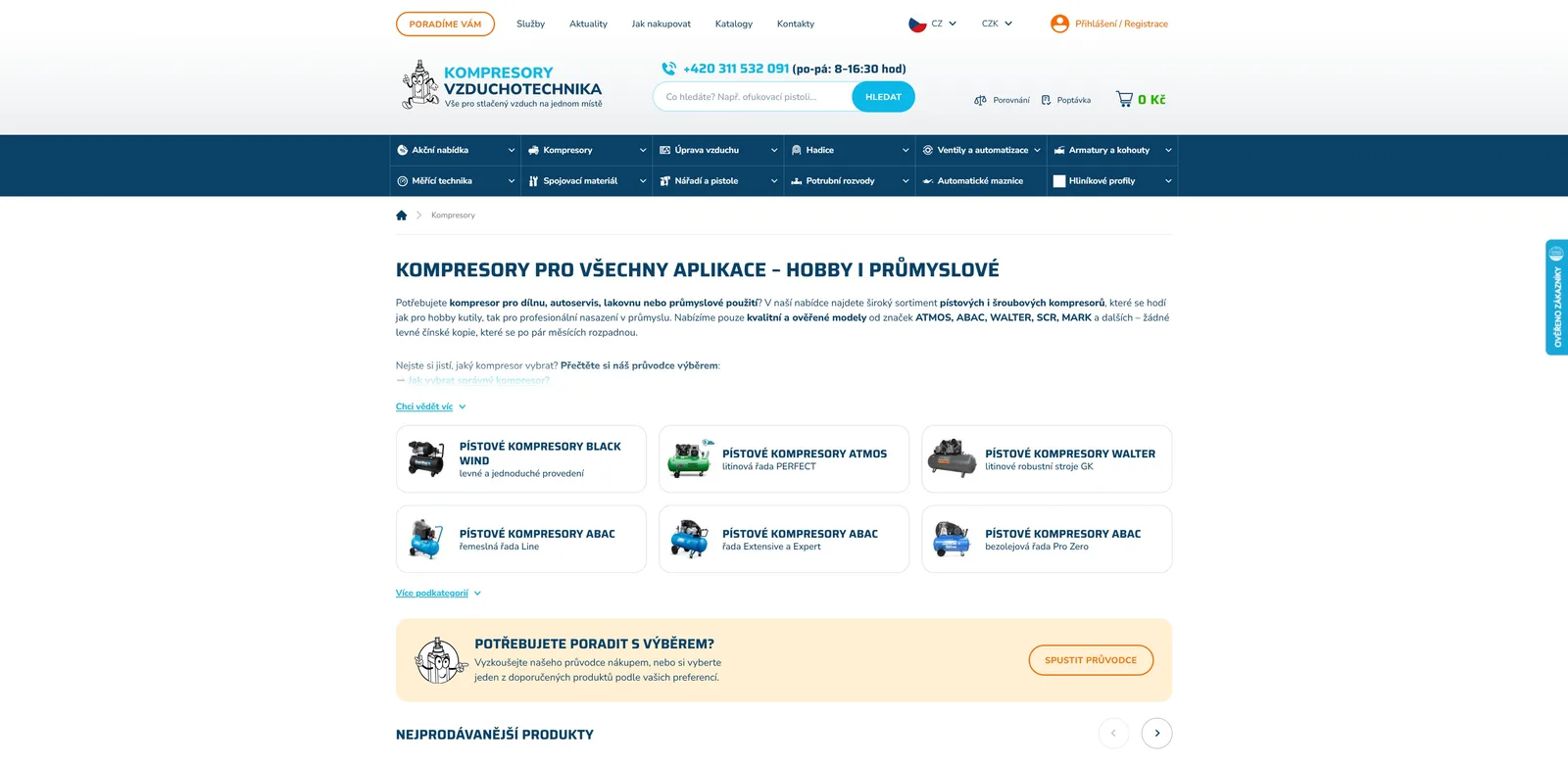
The offer includes premium MARK compressors for demanding industrial plants as well as energy-saving SCR screw compressors with a frequency converter. For the optimisation of distribution, quality pipes for distribution with minimal pressure losses are available. Do you need advice on the choice or dimensioning of the system? Our technical team will provide expert consultation and help design a solution exactly according to your operating requirements.
Most frequent questions about energy savings with a compressor
How often is it necessary to check the compressor because of energy savings?
The compressor should be checked at least once a month, with intensive operation every week. Regular maintenance significantly reduces energy consumption and prevents costly faults.
Which modifications of the compressor bring an energy saving fastest?
The greatest savings are brought by automatic speed regulation and regular repairs of air leaks. Monitoring of air consumption brings a saving of up to 20 % without the need to replace the equipment.
Is it better to invest in a new compressor or to optimise the existing one?
The ideal is to start with the optimisation of the existing system, and if the compressor is older than ten years, then replacement will bring considerably higher savings. Modern screw compressors achieve up to 30% higher efficiency than older piston types.
Can the right air technology really reduce consumption by tens of percent?
Yes, optimised distribution and quality air receivers reduce losses by up to 25 %. An efficient air distribution is therefore just as important as the choice of the compressor itself.