
For most industrial operations in the Czech Republic, a condensation (refrigerated) dryer is the standard and most economical choice. Choose an adsorption dryer when the application requires a pressure dew point below 0 °C. Membrane dryers cover specific cases with low flow and a requirement for zero electrical energy consumption.
A brief overview of the three main technologies:
- Condensation dryer: cools the air, separates and discharges the condensate; achieves a pressure dew point of approximately +3 °C; low acquisition and operating costs.
- Adsorption dryer: air passes through an adsorbent (silica gel, activated alumina or molecular sieves); achieves a PDP of up to −40 °C or −70 °C; higher energy consumption.
- Membrane dryer: moisture passes through a membrane; does not require electrical power supply; the typical achievable PDP is between +3 °C and −40 °C depending on the specific design and operating conditions; limited to lower flow rates.
Basic rule for selection: first determine the required pressure dew point, then select the technology. Size the dryer's flow rate with a reserve of 10–20% above the compressor's nominal output, while always recalculating the nominal output using correction factors for pressure and temperature.
Contents
- What types of air dryers for compressors exist?
- What is pressure dew point and which values should you choose?
- How to size a dryer: procedure with correction factors
- Energy efficiency and life cycle costs of dryers
- How to properly maintain a dryer and integrate it into the air distribution system
- What to watch out for when choosing a dryer and how to prepare an inquiry
- How we choose solutions at Kompresory-vzduchotechnika
- Key takeaways
- Dryers and accessories for your compressor from Kompresory-vzduchotechnika
- Useful resources and technical data sheets
- Frequently asked questions
What types of air dryers for compressors are there?
Refrigerant (chilled) dryers
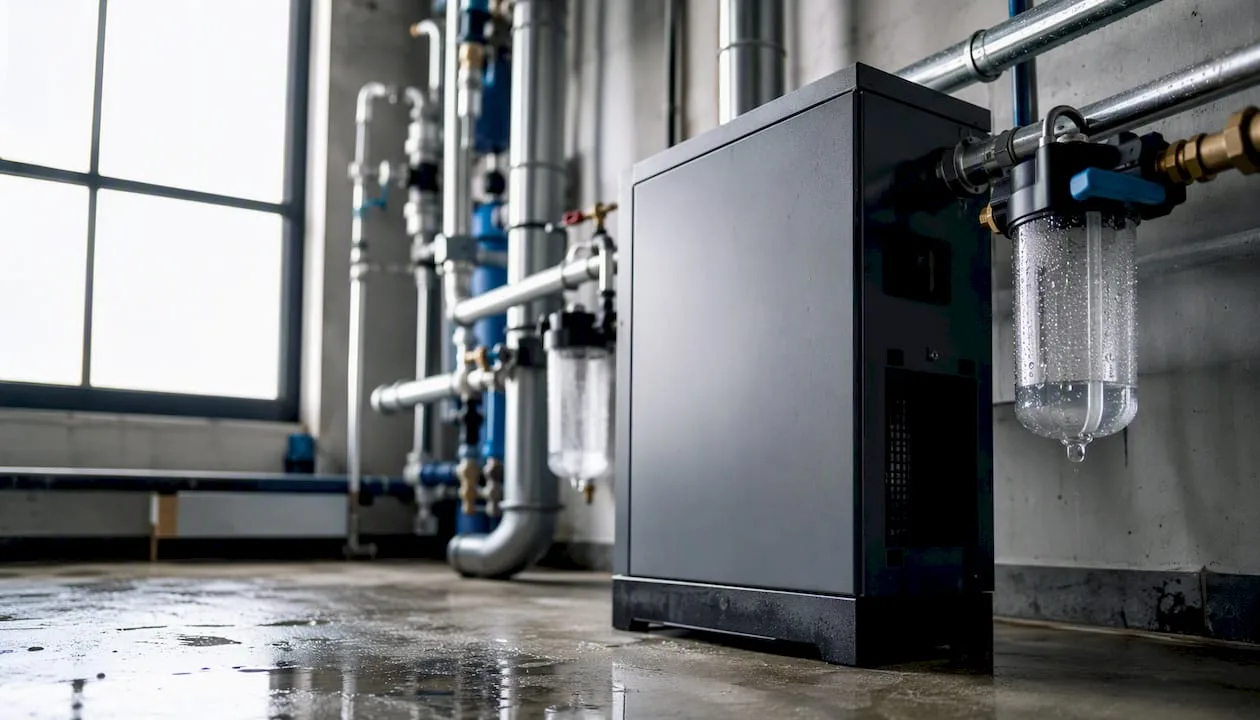
A refrigerant dryer cools the compressed air below the dew point temperature, forcing moisture to condense. The condensate collects in a separator and is automatically drained. A typical achievable pressure dew point is approximately +3 °C, which is sufficient for the vast majority of industrial applications.
Advantages: low purchase cost, simple operation, low energy consumption, minimal maintenance requirements.
Disadvantages: PDP cannot be reduced below 0 °C (risk of condensate freezing inside the dryer), unsuitable for applications with extreme air dryness requirements.
Refrigerant dryers are divided into non-cycling (the refrigeration circuit compressor runs continuously) and cycling types (the compressor switches on as needed). Cycling variants save energy under partial load.
Typical use: workshops, auto repair shops, production lines, pneumatic tools, general industrial production.
Membrane dryers
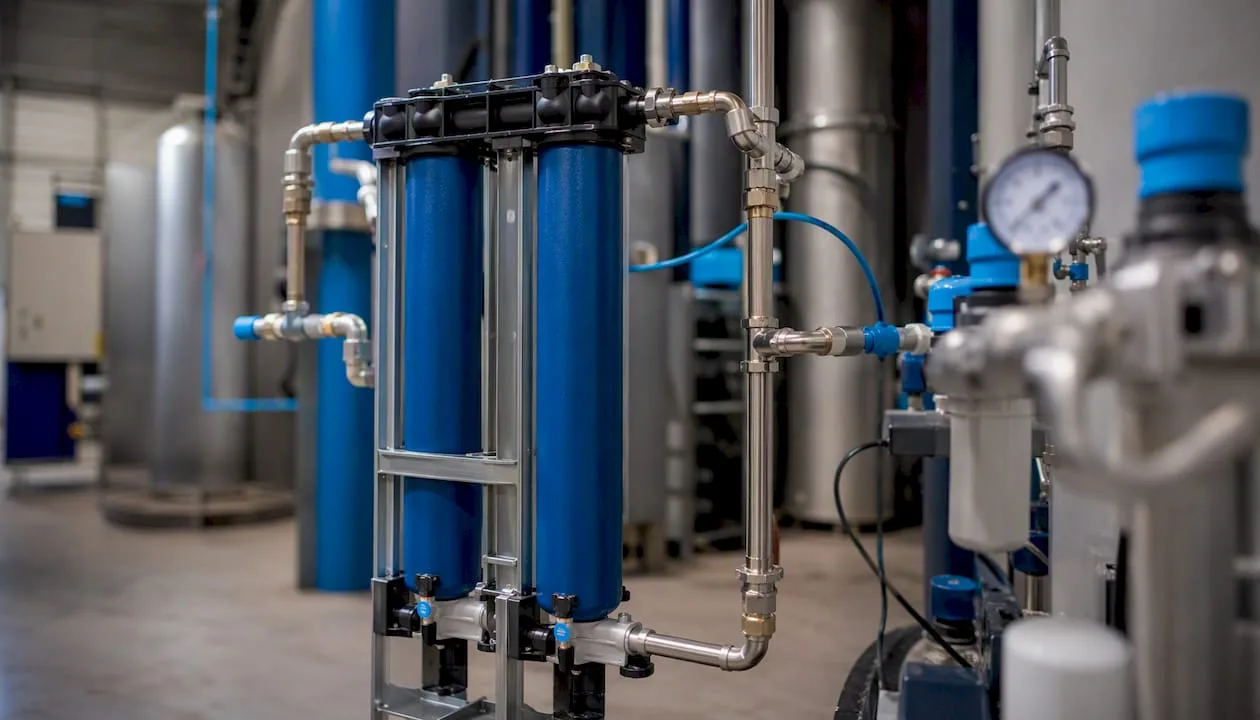
A membrane dryer uses a selectively permeable membrane: water molecules pass through the membrane wall outward, while dry air continues onward. It requires no electrical power or moving parts.
Advantages: no electricity consumption, compact dimensions, zero maintenance of moving parts, suitable for explosive environments.
Disadvantages: limited flow capacity, typically achieves PDP between condensation and adsorption values (usually in the range of +3 °C to −40 °C), the achievable PDP depends on flow and pressure, higher price per unit of flow.
Typical use: analytical instruments, small industrial applications, mobile equipment, environments with explosion risk.
Combined systems
Combining a refrigerant dryer and an adsorption dryer makes sense when the required PDP is very low but the operation generates large flow rates. The refrigerant stage removes most of the moisture and reduces the load on the adsorption stage, thereby extending the adsorbent's service life and reducing overall energy consumption.
Professional tip: When selecting an adsorption dryer, always verify whether the manufacturer states the PDP at rated flow and reference conditions. A PDP of −40 °C achieved at 50% flow does not mean the dryer will meet this parameter at full load.
What is the pressure dew point and which values should you choose?
Pressure dew point (PDP) is the temperature at which air begins to condense at a given operating pressure. If the PDP is +3 °C and the air in the piping cools to +2 °C, condensate will form. In unheated spaces or outdoor distribution systems, there is a risk of freezing when the PDP is above 0 °C.
The relationship to the ISO 8573-1 standard is direct: this standard defines compressed air quality classes based on the content of solid particles, water, and oil. Class 4 corresponds to a PDP of +3 °C (refrigerant dryer), class 2 corresponds to a PDP of −40 °C (adsorption dryer). When specifying a system, always state the required ISO 8573-1 class, not just a verbal description.
| Application | Recommended PDP | ISO 8573-1 Class (water) | Suitable dryer type |
|---|---|---|---|
| General workshop, pneumatic tools | +3 °C | Class 4 | Refrigerant |
| Car service, assembly line | +3 °C | Class 4 | Refrigerant |
| Paint shop (standard) | 0 to −10 °C | Class 3 | Refrigerant or adsorption |
| Paint shop (high requirements) | −20 °C | Class 2–3 | Adsorption |
| Food industry, beverage industry | −20 °C | Class 2 | Adsorption |
| Pharmaceuticals, laboratory equipment | −40 °C | Class 1–2 | Adsorption |
| Electronics manufacturing, clean rooms | −40 to −70 °C | Class 1 | Adsorption |
How to size a dryer: procedure with correction factors
Manufacturers state the nominal capacity of a dryer for reference conditions, usually 25 °C ambient temperature, 35 °C inlet air temperature and 7 bar operating pressure. Under different operating conditions, the nominal capacity must be recalculated, otherwise there is a risk of undersizing and failing to achieve the required PDP.
Correction factors: reference tables
Correction according to operating pressure:
| Operating pressure (bar) | Pressure correction factor |
|---|---|
| 8 bar | 1,08 |
Correction according to inlet air temperature:
| Inlet air temperature | Temperature correction factor |
|---|---|
| 40 °C | 0,84 |
Calculation example
The compressor delivers 80 m³/h at an operating pressure of 8 bar. The inlet air to the dryer has a temperature of 40 °C (typical summer in an unventilated compressor room). The correction factor for 8 bar is 1.08; the correction factor for 40 °C is 0.84.
The actual required dryer capacity = 80 ÷ (1.08 × 0.84) = 80 ÷ 0.907 = approximately 88 m³/h.
With a 15% reserve, the minimum nominal capacity of the dryer is 101 m³/h. The Remeza RFD81 model with a nominal capacity of 81 m³/h would not be sufficient in this case; a higher model needs to be selected. Detailed factors for selecting an industrial compressor are described in the guide on the Kompresory-vzduchotechnika website.
Energy efficiency and life cycle costs of dryers
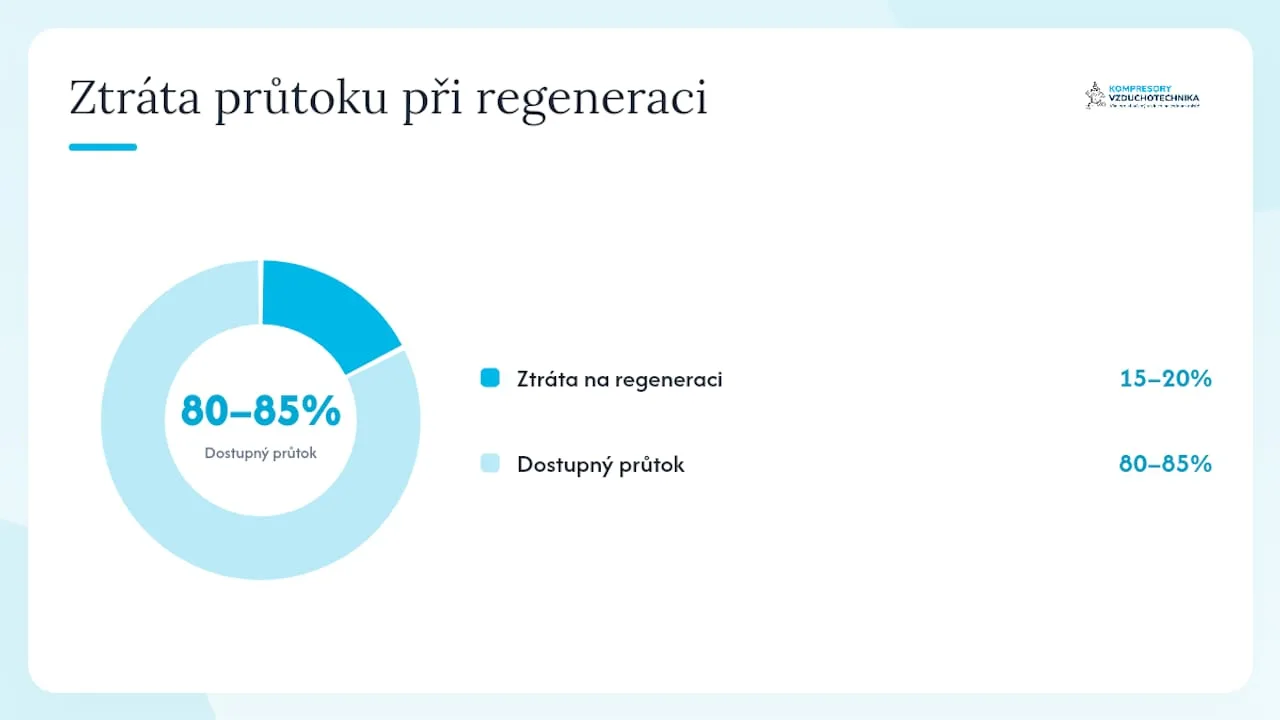
The purchase price of a dryer is only part of the total costs. For refrigerant dryers, the electricity consumption of the refrigeration compressor typically forms the largest operating cost item. For adsorption dryers with heatless regeneration, it is the loss of compressed air for regeneration, which can reach 15–20% of the total flow.
Key factors affecting the total cost of ownership (TCO):
- Availability of spare parts: — Atlas Copco and Kaeser maintain service networks in the Czech Republic with availability of original parts; when selecting a less known brand, verify the availability of service.
Practical estimate: a refrigerant dryer with a power input of 1 kW operating continuously (8,760 hours/year) will consume approximately 8,760 kWh per year. At the average price of industrial electricity in the Czech Republic, this represents a significant item that, over a 10-year service life, can exceed the purchase price of the dryer several times over. An adsorption dryer with heatless regeneration and a flow rate of 100 m³/h will lose 15–20 m³/h of compressed air for regeneration, which the compressor must supply additionally.
TCO summary: Always compare the total costs over 5–10 years, not just the purchase price. For adsorption dryers with high flow rates, the version with heating or heat recovery typically pays for itself within 2–3 years.
How to properly maintain a dryer and integrate it into the air distribution system
Recommended order of components in the air treatment station
Correct connection of the dryer into the distribution system is just as important as its selection. Recommended order: compressor, air tank (accumulation and pre-cooling), oil and condensate separator, dryer, fine filtration, consumers. An air tank placed before the dryer reduces temperature peaks and flow pulsations, thereby protecting the dryer from overload. Detailed requirements for the layout of the compressor room are described in the guide to basic compressor room requirements.
Service requirements by dryer type
Refrigerant dryers:
- Cleaning or replacing the inlet filter (typically every 3–6 months).
- Checking and cleaning the condenser (air-cooled or water-cooled).
- Checking the function of the automatic condensate drain.
Adsorption dryers:
- Replacing the adsorbent as recommended by the manufacturer (typically every 2–4 years, depending on inlet air quality).
- Replacing pre-filters and after-filters (every 3–12 months).
- Checking the tower switching valves.
Membrane dryers:
- Replacing the pre-filter (condensate reaching the membrane will damage it).
- Visual inspection of the membrane.
Condensate drainage
Automatic float or electronic condensate drains are more reliable than manual ones. Electronic timer drains are inexpensive, but they also discharge some compressed air. Float drains discharge condensate continuously without air loss, but require regular checks of patency.
Professional tip: When starting operation after a longer shutdown or in the morning in winter, water hammer can occur if condensate has accumulated in the piping. Before starting the appliances, let the compressor run for 5–10 minutes with the manual drain open at the lowest point of the distribution system.
What to watch out for when selecting a dryer and how to prepare an inquiry
Mapping applications to dryer type
Different industries have different requirements for PDP and flow. A workshop or car service can manage with a refrigerant dryer and a PDP of +3 °C. A paint shop with high demands on surface quality needs a PDP of −20 °C or lower. The food and pharmaceutical industries require an adsorption solution with a PDP of −40 °C and compliance with ISO 8573-1 class 1 or 2. Electronics manufacturing and clean rooms typically work with a PDP of −40 to −70 °C. The overview of examples of compressor use for workshops and production offers further mapping of technologies by field.
Checklist of parameters for an inquiry
Before sending an inquiry to a supplier, have the following values ready:
- Nominal compressor flow (m³/h or l/min) and actual operating pressure (bar).
- Inlet air temperature into the dryer (°C) and ambient temperature at the installation site.
- Required pressure dew point (PDP) and the corresponding ISO 8573-1 class.
- Available electrical power input (kW, phases) and space for installation (dimensions, orientation).
- Condensate drainage method (sewerage, collection tank, disposal regulations).
- Requirements for a service contract and availability of spare parts.
- Whether PDP measurement is required after installation.
Questions for the supplier
When selecting a supplier, ask specifically:
- Does it provide correction tables for pressure and temperature for the given model?
- What are the service intervals and prices of spare parts (adsorbent, filters)?
- Does it offer measurement of the actual PDP after installation?
- What is the availability of service intervention in the Czech Republic (response time, distance to service)?
How to submit an inquiry step by step
- Fill in the parameter checklist above.
- Recalculate the flow rate using correction factors (see the sizing section).
- Add a 10–20% margin to the resulting capacity.
- Specify the required ISO 8573-1 class (not just a verbal description).
- Attach a wiring diagram or a description of the compressor room.
- Request a technical data sheet with reference conditions and correction factors.
The practical compressor accessories checklist will help you check whether you have forgotten the air tank, filters, or oil separator.
How we choose solutions at Kompresory-vzduchotechnika
Kompresory-vzduchotechnika offers technical consultations, custom sizing, and service for the entire compressed air treatment system. The approach to selecting a dryer is based on the customer's specific operating data, not on catalog values.
The standard procedure for designing a solution includes:
- Determining the actual flow rate and pressure in operation (measurement or calculation from the compressor parameters).
- Verifying the inlet air temperature and ambient conditions in the compressor room.
- Calculating the actual required dryer capacity using correction factors.
- Recommendation of a specific model with a technical data sheet and reference conditions.
- Offer of installation, condensate drain connection, and verification PDP measurement after startup.
For applications requiring PDP below 0 °C, Kompresory-vzduchotechnika recommends an adsorption solution and will also assess whether a combination of a refrigeration dryer and an adsorption dryer could result in a lower TCO. Spare parts support and service are available to customers throughout the Czech Republic.
The internal guide compressed air drying and condensate removal contains practical recommendations, an overview of product ranges, and links to technical data sheets for the most commonly supplied models.
A technical consultation or inquiry can be submitted directly via the Kompresory-vzduchotechnika website.
Key takeaways
The correct selection of an air dryer depends on three parameters: the required pressure dew point, the actual flow rate converted using correction factors, and the total life cycle costs.
| Point | Details |
|---|---|
| Refrigeration dryer for standard operation | Achieves a PDP of approximately +3 °C; suitable for workshops, car repair shops, and general production. |
| Adsorption dryer for critical applications | Achieves PDP down to very low sub-zero values; necessary for paint shops with high demands, pharmaceuticals and electronics. |
| Correction factors are mandatory | The nominal output of the dryer applies to reference conditions (7 bar, 35°C inlet); recalculate for different conditions. |
| Reserve of 10–20% on capacity | Always size the dryer with a reserve above the recalculated compressor flow rate. |
| Kompresory-vzduchotechnika | Offers custom sizing, installation and PDP measurement after installation for facilities throughout the Czech Republic. |
Personal note on dryer selection
The most common mistake I see when selecting a dryer is not choosing the wrong technology. It's ignoring the correction factors. The customer selects a dryer based on the compressor's nominal flow rate, but forgets that in an unventilated compressor room in summer, the inlet air temperature can reach 45°C. At 45°C, the actual capacity of a refrigerant dryer drops to approximately 68% of the nominal value. The dryer then can't keep up, PDP rises, and condensate ends up in the distribution system exactly where you don't want it.
The second thing that's underestimated: the TCO of adsorption dryers with heatless regeneration. A loss of 15–20% of compressed air for regeneration means the compressor has to work permanently at a higher output. For larger flow rates, the heated or heat-recovery version pays for itself quickly. The figures from the technical data sheet are available; you just need to compare them.
Dryers and accessories for your compressor from Kompresory-vzduchotechnika
Kompresory-vzduchotechnika supplies refrigerant and adsorption air dryers, treatment units and condensate drainage accessories. The offering covers facilities from small workshops to industrial lines with high flow rates.
The product range includes compressed air treatment units for standard applications up to 10 bar, as well as metal treatment units up to 18 bar for more demanding operations. The range also includes pneumatic components and accessories for complete assembly of a treatment station.
Technical consultation is available for every order: capacity recalculation of the dryer according to correction factors, recommendation of a specific model, and support during installation. Please send your technical inquiry or sizing question via the contact form on the Kompresory-vzduchotechnika website.
Useful resources and technical data sheets
To verify specifications and prepare an inquiry, we recommend working directly with the manufacturers' technical data sheets. Look for the following information in the datasheet:
- Pressure dew point (PDP): under which reference conditions it is stated.
- Nominal flow rate (m³/h or l/min): and the corresponding reference pressure and temperatures.
- Correction tables: for inlet air pressure and temperature.
- Service intervals: replacement of filters, adsorbent, cooling medium.
- ISO 8573-1 class: which the model meets under rated conditions.
Relevant resources and internal guides:
- Compressed air drying and condensate removal — practical recommendations and a product overview from Kompresory-vzduchotechnika.
- Factors for selecting an industrial compressor: 2026 guide — sizing and correction factors for the entire system.
- Technical datasheets from Atlas Copco and Kaeser are available on their official websites; always verify that the datasheet corresponds to the specific model and series.
- Standard ČSN EN ISO 8573-1 defines compressed air quality classes; available through the Czech Agency for Standardization (ČAS).
Frequently Asked Questions
What type of dryer is suitable for a typical workshop or auto repair shop?
For a workshop or auto repair shop, a refrigerant dryer with a pressure dew point of approximately +3 °C is sufficient. Size it with a margin above the compressor's flow rate and recalculate the capacity using correction factors for operating pressure and temperature.
What is the difference between a refrigeration and a desiccant dryer?
A refrigerant dryer cools the air and separates condensate; it achieves a PDP of approximately +3 °C and has low energy consumption. An adsorption dryer passes air through an adsorbent and achieves very low sub-zero PDP values; it is more energy-intensive but necessary for applications with critical dryness requirements.
What should you watch out for when selecting a dryer for a compressor?
The most important thing is to recalculate the dryer's nominal capacity using correction factors for the actual operating pressure and inlet air temperature. Nominal values apply to reference conditions; at different temperatures or pressures, the actual capacity differs.
What is compressor intake capacity and how does it affect dryer selection?
Compressor intake capacity (flow rate) indicates the amount of air the compressor draws in and compresses per unit of time, usually in m³/h or l/min. The dryer must have a capacity equal to or greater than this flow rate after recalculation using correction factors; an undersized dryer will not achieve the required PDP.
How often does air dryer maintenance need to be performed?
For refrigerant dryers, the inlet filter is cleaned or replaced every 3–6 months, and the function of the automatic condensate drain is checked regularly. For adsorption dryers, the adsorbent is typically replaced every 2–4 years depending on the quality of the inlet air, and pre-filters every 3–12 months.
Recommended
- Checklist of accessories for compressors: a guide for technicians - Kompresory-Vzduchotechnika.cz
- List of the best compressors 2026: a buying guide - Kompresory-Vzduchotechnika.cz
- Comparison of screw and piston compressors: a selection guide - Kompresory-Vzduchotechnika.cz
- Factors for selecting an industrial compressor: a 2026 guide - Kompresory-Vzduchotechnika.cz