

TL;DR:
- Choosing the right industrial compressor is key to reducing operating costs and increasing plant efficiency. Measuring actual air consumption for at least a week allows capacity to be sized at 130% of peak demand, ensuring stable pressure and room for system expansion. It is recommended to adapt the choice of technology to the operating profile, with VSD compressors saving energy under fluctuating load, while fixed-speed units are more suitable for constant demand. Efficient distribution and properly sized air tanks minimize pressure losses and extend equipment service life. Air quality and capacity planning for growth are essential for safe and efficient operation of industrial compressed air systems.
An industrial compressor is defined as a machine converting mechanical energy into the pressure energy of compressed air, and the correct selection of this equipment directly determines the operating costs, production reliability, and energy efficiency of the entire plant. Factors for selecting an industrial compressor include precise capacity sizing, choice of technology (piston, screw, VSD/VFD), quality of the supplied air, and integration of the distribution system. A poorly chosen compressor causes overloading, excessive cycling, or unnecessary energy losses. This guide examines each decisive factor with specific data and recommendations for industrial operations in 2026.
1. Factors for selecting an industrial compressor: capacity sizing
Correct sizing is a fundamental factor in selecting an industrial compressor and the most common source of operating problems. Undersized capacity causes pressure drops during demand peaks, while oversized capacity leads to inefficient cycling and unnecessary energy consumption.
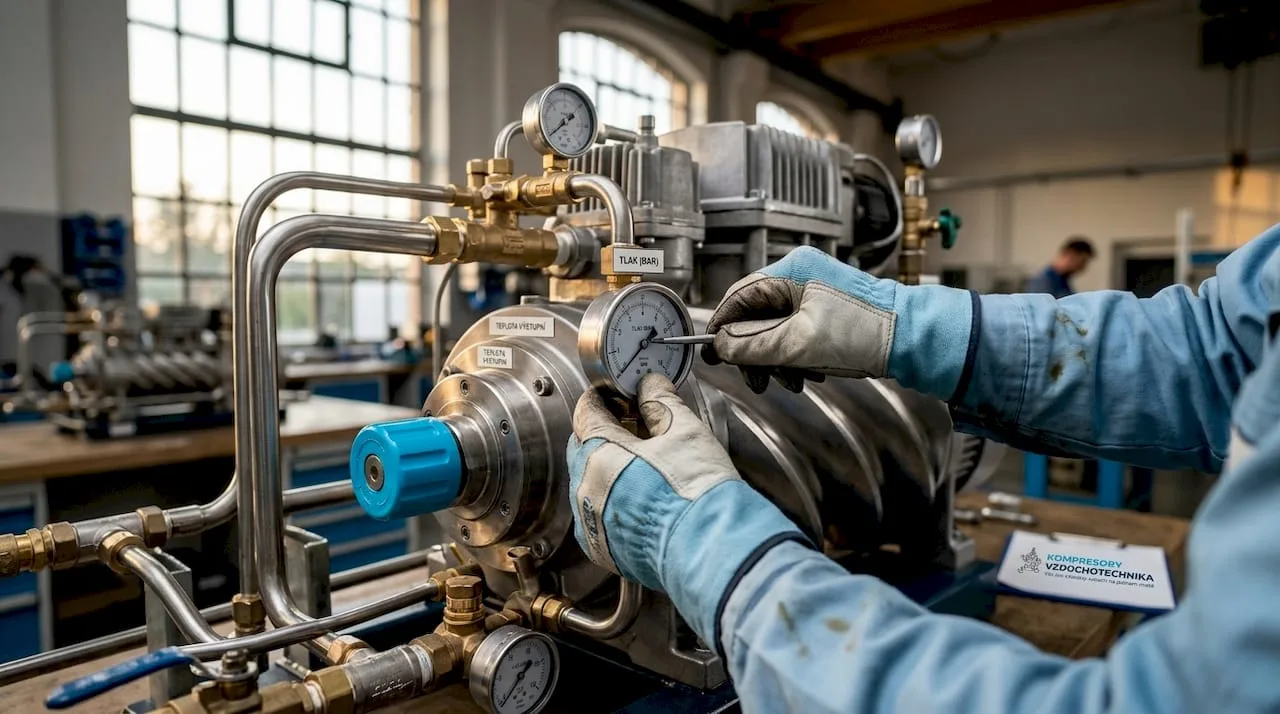
The recommended sizing procedure is based on data measurement of consumption over a period of at least one week. This step reveals the actual demand peaks, average load, and time profiles that cannot be estimated from machine datasheets. Without this data, there is a risk of choosing the wrong output.
The resulting compressor capacity should cover 130% of peak air consumption. This reserve ensures stable pressure during surge demand and provides room for future production expansion without the need for immediate equipment replacement.
- Measure actual air consumption, not the sum of the nominal outputs of the tools
- Take into account the diversity factor of operation (not all tools run simultaneously)
- Include distribution losses, estimated at 10 to 20% of total output
- Plan capacity with a 5-year operating outlook
Professional tip: The most common mistake is sizing according to the sum of the power inputs of all connected tools. Actual simultaneous consumption tends to be 30 to 50% lower. Data logging for a period of one week is an investment that pays off with every compressor purchase.
2. Selecting the compressor type according to the operating profile
Types of industrial compressors are divided into piston, screw, oil-free and VSD/VFD variants, with each type corresponding to a different operating profile and air quality requirements.
Piston compressors are suitable for intermittent operation with lower flow demands. They operate in on/off cycles, withstand overload, and have a lower purchase price. Their disadvantage is higher noise levels and limited suitability for continuous operation above 60% load.
Screw compressors are the standard for continuous industrial operation. They operate quietly, with low vibration and stable pressure. Two-stage screw compressors achieve higher energy efficiency for industry compared to single-stage models at the same output.
Oil-free compressors are essential in the food, pharmaceutical, electronics and other industries, where oil contamination damages the product or process. Their operating costs are higher, but they eliminate the risk of complaints and regulatory penalties.
VSD/VFD compressors (Variable Speed Drive) regulate motor speed according to current consumption. Energy savings of 20 to 35% compared to fixed speeds are achievable with fluctuating consumption exceeding 20%. This technology is particularly worthwhile when the average load falls below 70% of maximum.
| Compressor type | Efficiency | Noise level | Purchase costs | Suitable use |
|---|---|---|---|---|
| Piston | Medium | High | Low | Intermittent operation, workshops |
| Screw (fixed speed) | High | Low | Medium | Continuous production |
| Screw VSD/VFD | Very high | Low | Higher | Fluctuating consumption |
| Oil-free | Medium to high | Medium | High | Food and pharmaceutical industry |
Professional tip: A VSD compressor does not pay off under constant load above 85% of maximum. In that case, a fixed-speed screw compressor with direct drive provides a better price-to-performance ratio. Always base your decision on the measured load profile, not on general recommendations.
3. Operation optimization and wear reduction
Proper compressor operation management extends equipment lifespan and reduces operating costs. Modern compressors with advanced control and monitoring can significantly reduce operating costs and extend the equipment's service life.
Key areas of operation optimization:
-
Tight pressure control. Set the operating pressure to the lowest value that meets the application requirements. Every extra 1 bar increases energy consumption by approximately 7%. Overpressure is a direct energy loss with no operational benefit.
-
Regular condition diagnostics. Measuring vibration, pressure, and temperature enables predictive maintenance and prevents unplanned downtime. Monitoring systems detect anomalies weeks before failure.
-
Scheduled maintenance intervals. Replacing oil filters, air filters, and oil separators based on operating hours (rather than calendar date) extends reliability. Typical intervals for screw compressors are 2,000 to 4,000 operating hours.
-
Minimizing cycling. Frequent switching between loaded and unloaded states (load/unload) shortens the lifespan of the motor and valves. VSD technology eliminates this cycling through smooth speed control.
-
Checking the tightness of distribution lines. Air leaks in distribution lines account for 20 to 30% of total consumption in an average industrial plant. Regular leak detection using an ultrasonic detector is the fastest way to reduce operating costs.
-
Ambient temperature control. A compressor placed in a space with a temperature above 40°C operates with lower efficiency and higher wear. Every additional 10°C above the optimal operating temperature shortens the lifespan of oil and seals by approximately half.
Professional tip: Install a flow meter on the compressor outlet and monitor air consumption in real time. An unexpected increase in flow at the same production output signals a leak in the distribution lines or tool wear. This simple monitoring saves thousands of crowns annually.
4. Compressed air distribution and pressure vessels
Compressed air distribution and air receiver sizing are factors that directly affect compressor selection and overall system efficiency. A poorly designed distribution system negates the benefits of even the best compressor.
Ring main is the standard for industrial facilities. Air flows in both directions to the point of use, reducing pressure losses by 50% compared to a linear (dead-end) distribution system. This configuration also allows the network to be sectioned off for repairs without interrupting the entire operation.
Sizing of the main distribution line must take future expansion into account. Designing the distribution system for 130% of the current peak demand with spare connections eliminates the need to rebuild the network when production is expanded. Underestimating the pipe diameter is a mistake with long-term consequences.
Recommendations for distribution systems and air receivers:
- Size the main distribution line for a maximum air flow velocity of 6 m/s to minimize pressure losses
- Size branch lines to tools for a maximum of 15 m/s
- Place the primary air receiver as close to the compressor as possible to dampen pulsations
- Install secondary air receivers at points of use with high peak consumption
| Parameter | Recommended value | Reason |
|---|---|---|
| Air receiver size (load/unload) | 3 to 5 liters per 1 l/s of capacity | Reduction of compressor cycling |
| Minimum air receiver size | 1 liter per 1 l/s of capacity | Basic pulsation damping |
| Velocity in the main distribution line | Max. 6 m/s | Minimization of pressure losses |
| Distribution capacity reserve | 130% of peak demand | Space for future expansion |
Air receivers serve a dual function: they stabilize pressure in the network and reduce the frequency of compressor starts. A correctly sized air tank with load/unload control extends the intervals between cycles, thereby protecting the motor and valves.
5. Air quality and application requirements
Compressed air quality is defined by the ISO 8573-1 standard and determines the requirements for oil, moisture, and solid particle content. The choice of air purity class directly affects both the choice of compressor technology and air treatment.
The food industry, pharmaceuticals, and electronics manufacturing require air of ISO 8573-1 class 1 or 2, i.e. oil-free air with minimal moisture content. The automotive industry and general manufacturing typically work with class 3 to 4, where an oil-lubricated screw compressor with a coalescing filter is sufficient.
An incorrect choice of air purity class has direct financial consequences. Oil contamination on a food production line results in product recalls, regulatory penalties, and reputational damage. Conversely, installing an oil-free compressor where an oil-lubricated one would suffice unnecessarily increases both acquisition and operating costs.
An overview of compressor application examples by industry shows that air requirements differ not only in purity class, but also in pressure and flow. Automotive painting requires stable pressure and zero oil content. Pneumatic tools in metalworking tolerate class 4 air with oil.
6. Planning capacity for future production growth
Selecting an industrial compressor must take into account not only current needs but also the planned growth of production and the technological development of the plant. A compressor sized precisely for today's consumption will become a bottleneck at the first expansion of production.
Modular systems with multiple lower-output compressors offer greater flexibility than a single large machine. A configuration of two or three screw compressors with a control system allows only the required number of units to be started according to current consumption. The result is lower average load on each machine and a longer service life for the entire system.
- Automotive and heavy industry: high flow, stable pressure of 7 to 10 bar, screw compressor with VSD
- Food and pharmaceutical industry: oil-free compressor, ISO class 1 or 2, redundant configuration for continuous operation
- Metalworking and engineering: fixed-speed or VSD screw compressor depending on the load profile, pressure of 6 to 8 bar
- Electronics and precision manufacturing: oil-free compressor, low noise level, stable pressure with minimal pulsations
- Construction and mobile applications: piston or screw compressor on a chassis, resistance to dusty environments
Hybrid systems combining a screw compressor for base load and a piston compressor for peaks are economically advantageous in operations with significant daily or seasonal consumption fluctuations. The control system automatically switches between sources according to current demand.
Professional tip: When planning capacity for growth, consult with the supplier not only about compressor output, but also about the capacity of the piping and air receivers. Expanding the compressor without a corresponding expansion of the piping will not bring the expected results.
Key findings
Correct selection of an industrial compressor requires a combination of precise capacity sizing, choice of technology matching the operating profile, and design of the distribution system with reserve for future growth.
| Point | Details |
|---|---|
| Capacity sizing | Measure actual consumption for at least 1 week and size for 130% of peak demand. |
| Technology selection | A VSD compressor saves 20 to 35% of energy with consumption fluctuations above 20%. |
| Piping and air receivers | A ring piping system reduces pressure losses by 50% compared to a linear piping system. |
| Air quality | Choose the purity class according to ISO 8573-1 appropriate to the specific application. |
| Growth planning | Size the piping for 130% of current consumption, with reserve connections for expansion. |
Practical experience: what really determines compressor selection
I have worked with industrial compressors for years, and I repeatedly see the same mistake: managers decide on compressor selection based on catalogue values and estimates, not measured data. The result is either an undersized machine that cannot handle peaks, or an oversized compressor cycling every two minutes and wearing out prematurely.
The second thing that still surprises me is the underestimation of piping. An investment in a quality compressor is wasted if the piping diameter is one size smaller than it should be, or if air leaks account for a quarter of total consumption. Leak detection with an ultrasonic device once a year is cheaper than any other saving measure.
VSD technology is a genuine improvement in efficiency, but it is not a universal solution. I have seen installations where a VSD compressor ran continuously at 90% output under constant consumption. In such a case, a fixed-speed screw compressor would be cheaper and more reliable. The load profile must decide, not marketing materials.
I recommend working with a supplier who performs an audit of the existing system before offering new equipment. Kompresory-vzduchotechnika provides technical consultations that start with an analysis of the operation, not a selection from a catalogue. This approach is the difference between a correct and an incorrect decision.
— Zdeněk
Industrial compressors and pressure vessels from Kompresory-vzduchotechnika
Kompresory-vzduchotechnika offers a complete range of industrial compressors and accessories for production facilities of all sizes.
The SCR screw compressors category includes models with fixed and variable speed (VSD) for industrial applications requiring continuous operation and low noise levels. To stabilize pressure in the network, 725 l pressure vessels and other volumes suitable for primary and secondary air receivers are available. The Kompresory-vzduchotechnika team provides technical consultations for selection, sizing, and integration of the entire compressed air system. Contact us for an individual offer tailored to your production requirements.
FAQ
What is the most important factor when selecting an industrial compressor?
The most important factor is accurate capacity sizing based on measured air consumption. Without data from at least a week of measurement, there is a risk of incorrect capacity selection with a direct impact on operating costs.
When is a VSD compressor worth it compared to a fixed-speed one?
A VSD compressor is worthwhile when the average load is below 70% of maximum and consumption fluctuation exceeds 20%. In such operation, it achieves energy savings of 20 to 35% compared to a fixed-speed compressor.
What type of compressor is suitable for the food industry?
For the food industry, an oil-free compressor meeting the ISO 8573-1 class 1 or 2 air purity class is required. Oil contamination on a food production line represents a regulatory and safety risk.
What size air receiver do I need for an industrial compressor?
With load/unload control, an air receiver volume of 3 to 5 liters per liter per second of compressor output is recommended. A larger air receiver reduces cycling frequency and extends the machine's service life.
How to reduce pressure losses in compressed air distribution systems?
A ring main distribution system reduces pressure losses by 50% compared to a linear distribution system. Correctly sizing the pipe diameter for a flow velocity of up to 6 m/s in the main distribution line further minimizes losses.