

Pressure vessels and air receivers from 100 to 720 l
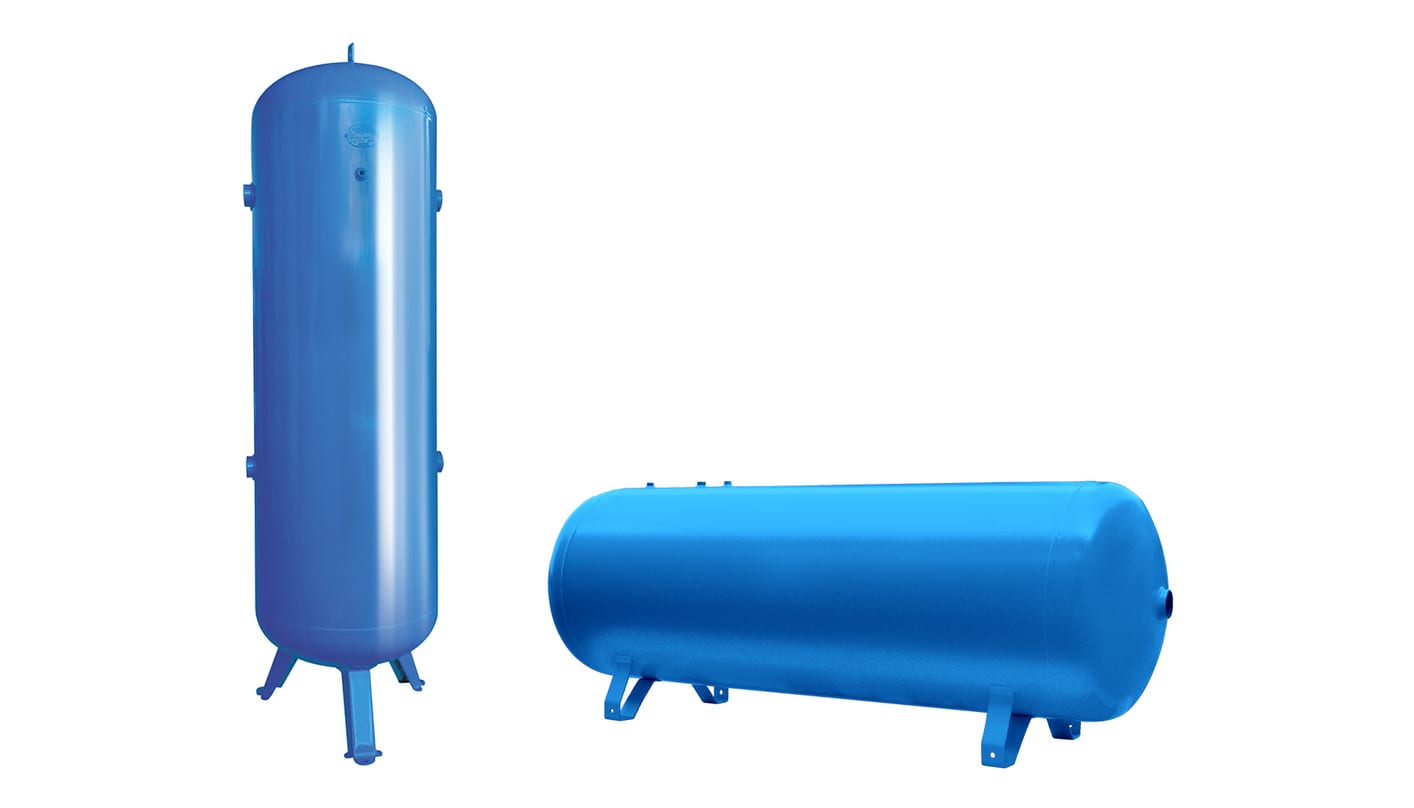
Air receivers from 100 to 720 litres for the main compressed air reserve downstream of the compressor, for balancing fluctuating air demand in a workshop or plant, and for storing nitrogen.
Choose from vertical and horizontal vessels rated for 11 or 16 bar, painted in blue RAL 5015, galvanised or with an internal coating for the food industry. All are made of carbon steel and manufactured to Directive 2014/29/EU on simple pressure vessels.
Vertical or horizontal
Both series cover similar volumes and pressures. The choice comes down mainly to where the vessel will stand.
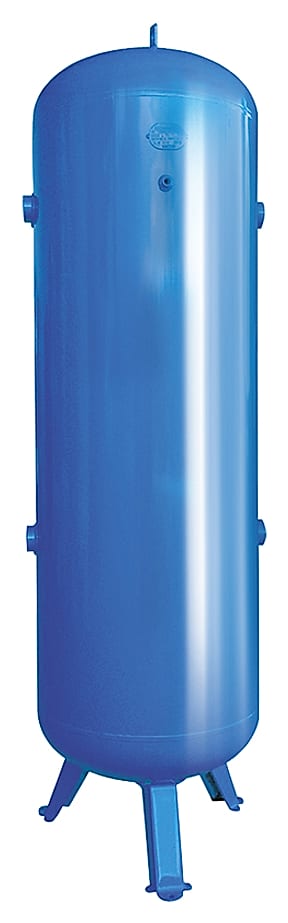
Vertical VVP2
It needs the least floor space, but it is tall: the 500-litre version is over two metres high. It rests on three legs and has connections in both ends and on the sides at two heights, so the air can be fed in at the bottom and drawn off at the top.
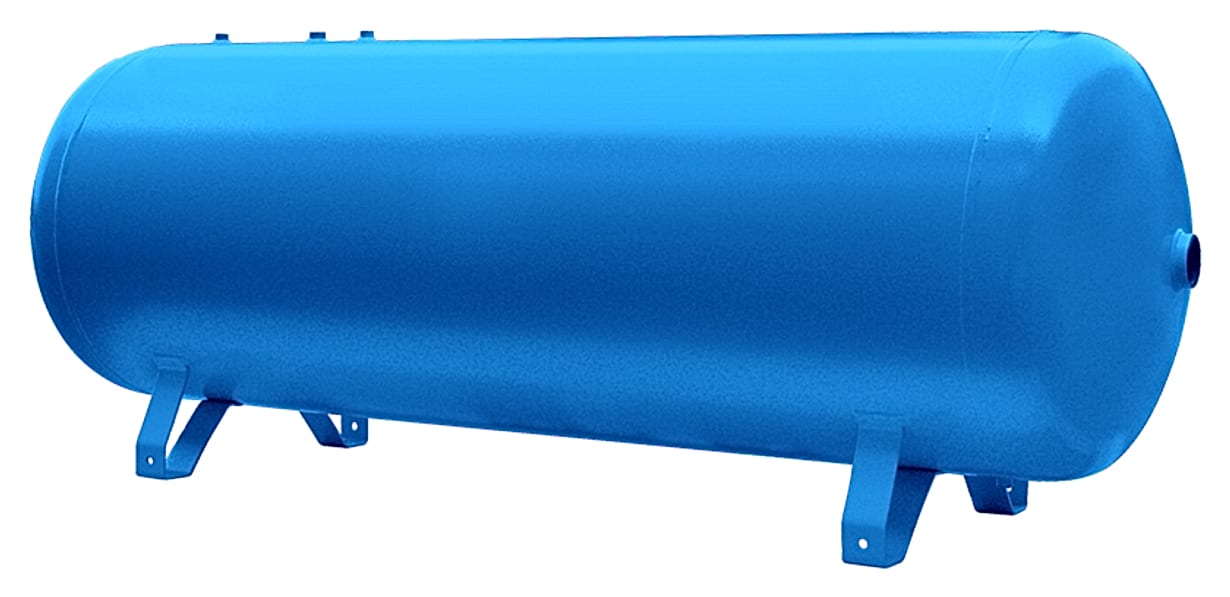
Horizontal VHP
A low vessel on two feet, which should stand on vibration dampers. It fits into a room with a low ceiling or under a platform. It has connections in both ends, three on top and one on the underside for draining condensate.
Painted, galvanised and internally coated
Most sizes are made in three versions. You can tell them apart by the third letter of the order code: P is painted, G galvanised and A has the ALM internal coating.
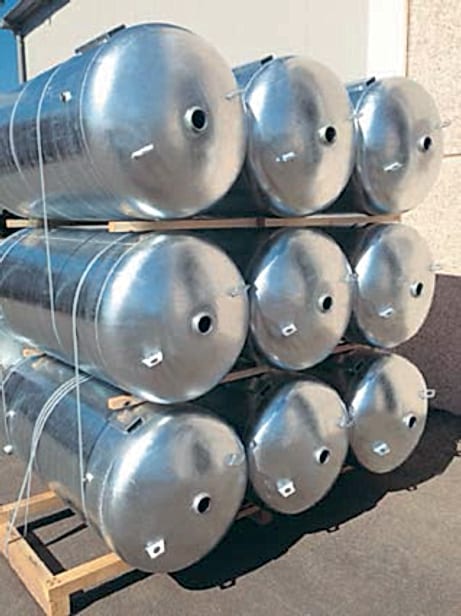
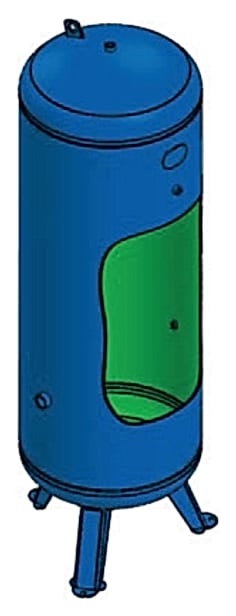
Painted (P)
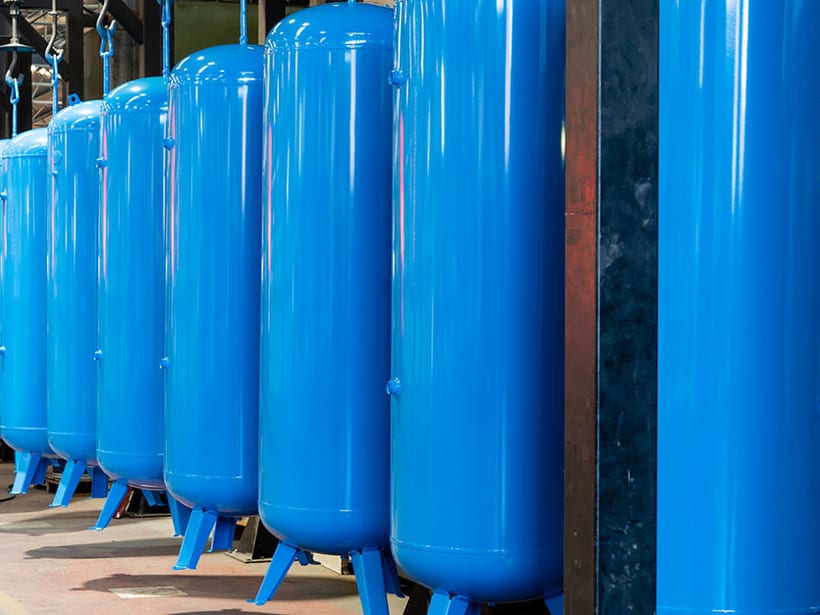
Blue RAL 5015 powder coating on the outside, bare steel inside. The standard version for dry, heated rooms; you will find all painted vessels on the page for painted pressure vessels.
Galvanised (G)
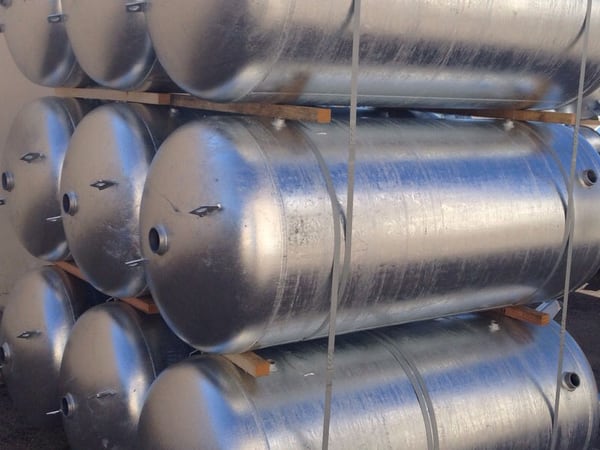
Hot-dip galvanised inside and out, so condensate cannot corrode the steel from the inside either. Suitable for damp rooms and for operations that produce a lot of condensate. For an overview, see the page for galvanised pressure vessels.
ALM internal coating (A)
Inside, an ALM epoxy coating approved for contact with food; outside, blue RAL 5015 paint. For food and beverage production and anywhere the air comes into contact with the product, see our vessels with ALM coating.
Galvanised and ALM-coated vertical vessels always have a 2" connection 1 in each end. The galvanised ones also tend to be a few kilograms heavier. You will find the differences for each size on its product page.
All sizes
You will also find the vessels of each volume, across both series, on separate pages for 100 l, 150 l, 200 l, 270 l, 500 l and 720 l.
| Vertical VVP2 vessels — 100 to 720 l | ||||||||||||||
|---|---|---|---|---|---|---|---|---|---|---|---|---|---|---|
| Order code | Volume | Pressure | Ø × height | Ground clearance A | Side connection heights B / C | Weight | 1 | 2 | 3 | 4 | 5 | 6 | 7 | Versions |
| VVP2-100-11 | 100 l | 11 bar | Ø 370 × 1213 mm | 180 mm | 355 / 1055 mm | 31 kg | 1/2" | 3/4" | – | 3/8" | 3/8" | – | 3/4" | P, G |
| VVP2-200-11 | 200 l | 11 bar | Ø 446 × 1557 mm | 175 mm | 400 / 1225 mm | 55 kg | 1/2" | 1" | – | 3/8" | 3/8" | – | 1" | P, G |
| VVP2-270-11 | 270 l | 11 bar | Ø 500 × 1648 mm | 175 mm | 599 / 1304 mm | 67 kg | 1/2" | 1" | 1" | – | 3/8" | 1" | – | P, G, A |
| VVP2-500-11 | 500 l | 11 bar | Ø 600 × 2050 mm | 155 mm | 785 / 1665 mm | 115 kg | 1/2" | 1" | 1" | – | 3/8" | 1" | 1" | P, G, A |
| VVP2-720-11 | 720 l | 11 bar | Ø 800 × 1745 mm | 145 mm | 580 / 1310 mm | 155 kg | 2" | 2" | 2" | 3/8" | 3/8" | 2" | 2" | P, G, A |
| VVP2-270-16 | 270 l | 16 bar | Ø 500 × 1648 mm | 175 mm | 599 / 1304 mm | 101 kg | 1/2" | 1" | 1" | – | 3/8" | 1" | – | P, G, A |
| VVP2-500-16 | 500 l | 16 bar | Ø 600 × 2050 mm | 155 mm | 785 / 1665 mm | 145 kg | 2" | 2" | 2" | – | 3/8" | 2" | 2" | P, G, A |
| Horizontal VHP vessels — 100 to 720 l | ||||||||||||
|---|---|---|---|---|---|---|---|---|---|---|---|---|
| Order code | Volume | Pressure | Ø × length | Axis height H | Foot spacing B | Weight | x | y | k | j | z | Versions |
| VHP100-11 | 100 l | 11 bar | Ø 370 × 1016 mm | 258 mm | 550 mm | 29 kg | 2" | 3/8" | 1/2" | 3/8" | 3/8" | P |
| VHP150-11 | 150 l | 11 bar | Ø 396 × 1240 mm | 271 mm | 650 mm | 44 kg | 2" | 3/8" | 1/2" | 3/8" | 3/8" | P |
| VHP200-11 | 200 l | 11 bar | Ø 446 × 1364 mm | 288 mm | 750 mm | 55 kg | 2" | 3/8" | 1/2" | 1/2" | 3/8" | P |
| VHP270-11 | 270 l | 11 bar | Ø 500 × 1458 mm | 315 mm | 800 mm | 67 kg | 2" | 3/8" | 1" | 1/2" | 3/8" | P, G, A |
| VHP500-11 | 500 l | 11 bar | Ø 600 × 1858 mm | 396 mm | 1204 mm | 130 kg | 2" | 3/8" | 1" | 1/2" | 3/8" | P, G, A |
| VHP720-11 | 720 l | 11 bar | Ø 800 × 1560 mm | 500 mm | 700 mm | 180 kg | 2" | 3/8" | 1" | 1/2" | 3/8" | P, G, A |
| VHP270-16 | 270 l | 16 bar | Ø 500 × 1484 mm | 315 mm | 800 mm | 104 kg | 2" | 3/8" | 1" | 1/2" | 3/8" | P |
| VHP500-16 | 500 l | 16 bar | Ø 600 × 1858 mm | 396 mm | 1204 mm | 163 kg | 2" | 3/8" | 1" | 1/2" | 3/8" | P |
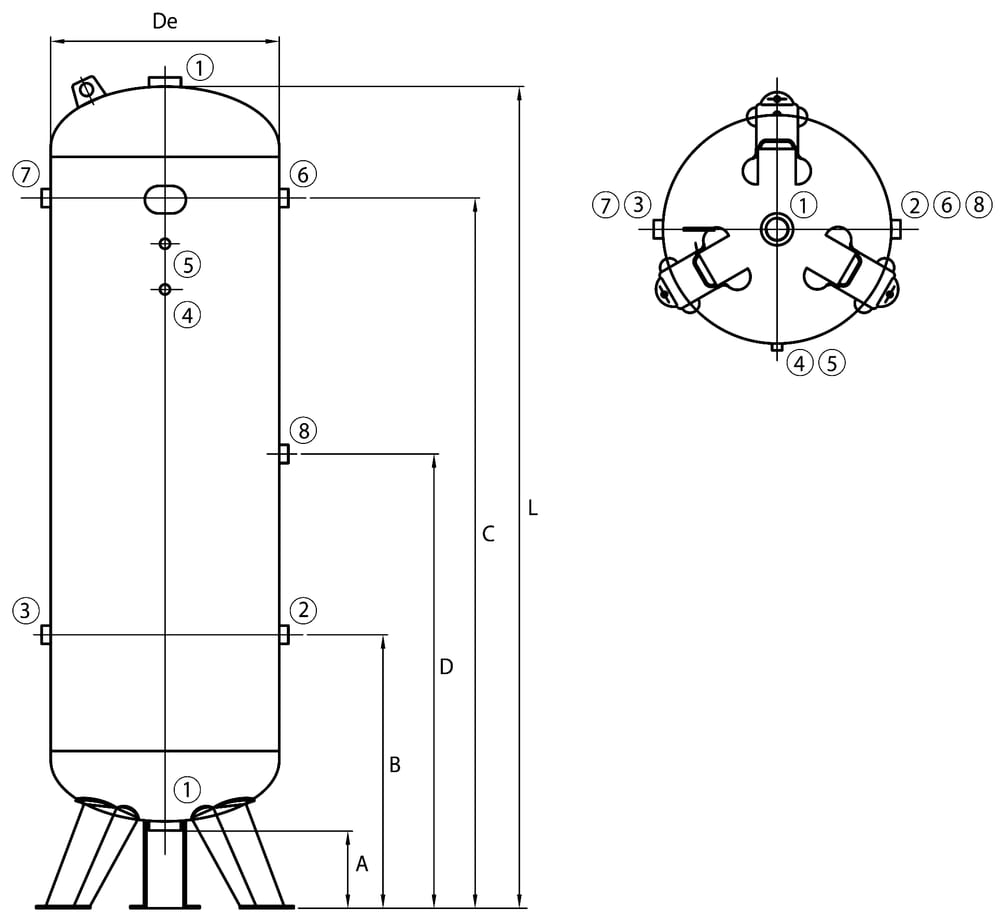
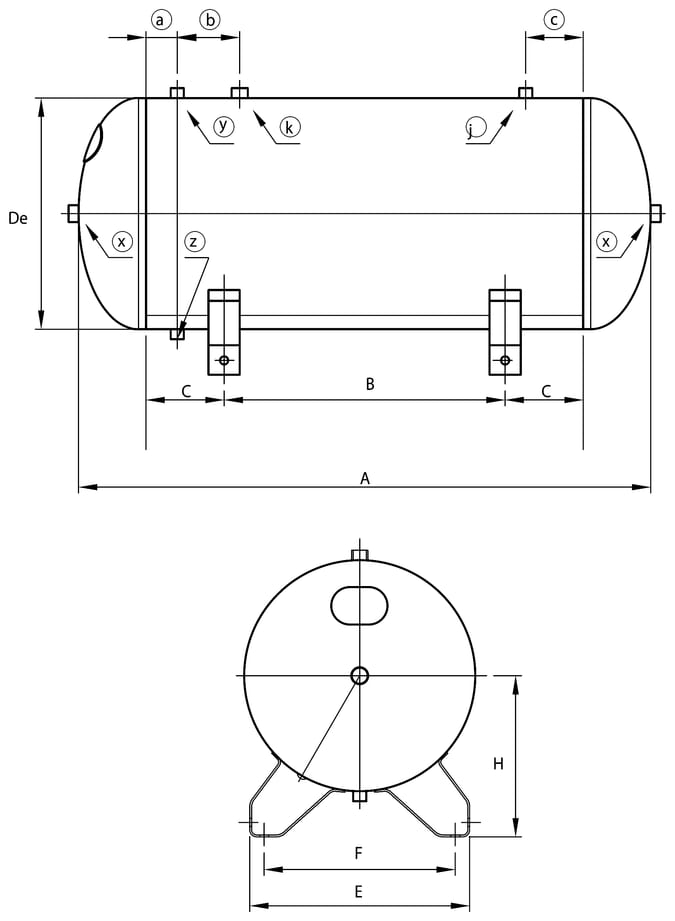
Connection numbers and letters correspond to the drawings; a dash means that a vessel of that size does not have the connection. The dimensions and connections in the table apply to the painted version. Ground clearance A of a vertical vessel is measured from the floor to the bottom connection, B and C are the heights of the side connections above the floor, H is the axis height of a horizontal vessel and B is the spacing of its feet.
#showmore#
Typical uses
- Main air receiver downstream of the compressor. It balances the difference between compressor output and air demand, so the compressor starts less often and the pressure in the air network is steadier.
- Condensate separation. In the vessel, the air slows down and cools, and some of its moisture condenses. That is why the vessel belongs upstream of the dryer, with a condensate drain valve at the bottom.
- Buffer for peak demand. At a machine or workstation that draws air in bursts, it covers the peak before the pressure in the air network drops.
- Nitrogen and food processing. The vessels are designed for both compressed air and nitrogen, and the ALM-coated version is suitable wherever the air comes into contact with food.
The compressor’s maximum pressure must not exceed the vessel’s pressure rating. A compressor that cuts out at 13 or 15 bar needs a 16-bar vessel. An 11-bar vessel is suitable for compressors up to 10 bar.
What to buy with the vessel
The vessels are supplied without fittings. For operation, they need at least a safety valve, a pressure gauge, a shut-off valve and a condensate drain.
Fittings kit
For the 11-bar vertical vessels, there is a ready-made kit with a safety valve, a pressure gauge, two ball valves and a condensate drain cock. You will find it among our fittings kits for pressure vessels.
Safety valve
It must be set no higher than the vessel’s pressure rating. For 11-bar vessels, use our safety valves for compressors; for 16-bar vessels, choose a valve with a higher set pressure from our range of HEROSE safety valves.
Pressure gauge
It shows the pressure in the vessel, and its range should extend above the working pressure. Choose one to match the thread of a free connection, for example from our pressure gauges for compressed air.
Condensate drain
A large vessel collects a lot of condensate, and it should be drained every day. You can drain it by hand with a condensate drain valve; for unattended draining, fit an automatic condensate drain.
Shut-off valve
It isolates the vessel from the air network and from the compressor when something needs replacing or an inspection is due. A good choice is a ball valve for compressed air.
Documents and inspections
Each vessel comes with a declaration of conformity stating its data-plate details, with the instructions for use and maintenance on the back. Keep it safe: you will need it when the vessel is put into service and for inspections.
Manufacture follows the European directive, and the declaration of conformity is valid throughout the EU. In-service inspections, however, are set by each country. In the Czech Republic, vessels of this size count as designated pressure equipment, and the operator must have them inspected regularly: an operational inspection once a year, an internal inspection every five years and a pressure test roughly every nine to ten years. Elsewhere, local regulations apply. You will find the Czech details in our article on operator obligations under Czech law.
How the vessels are made
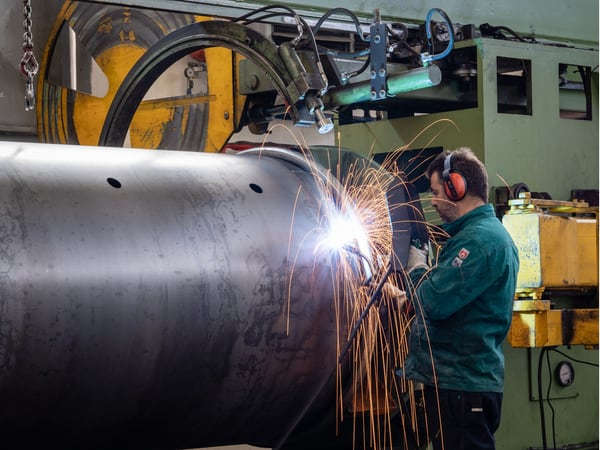
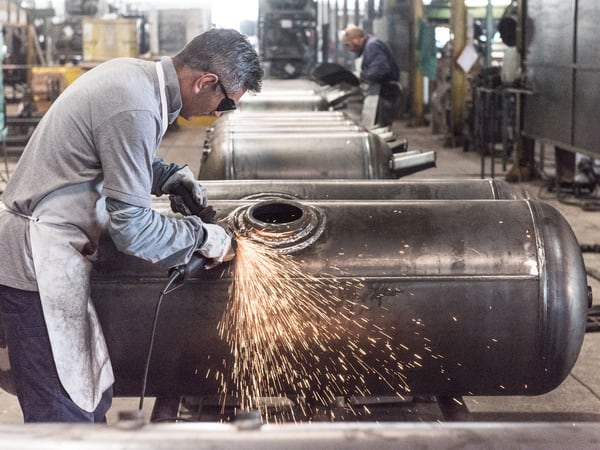
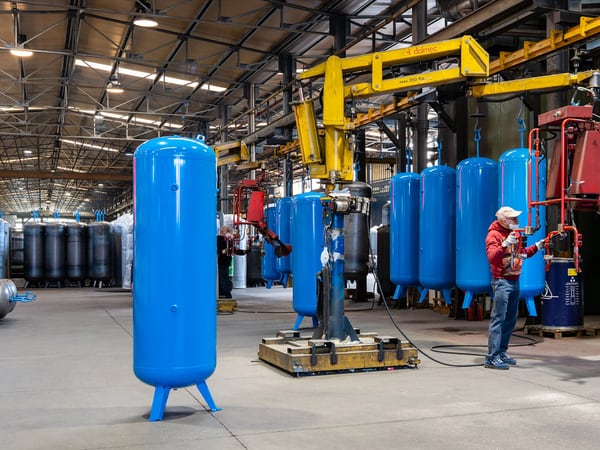
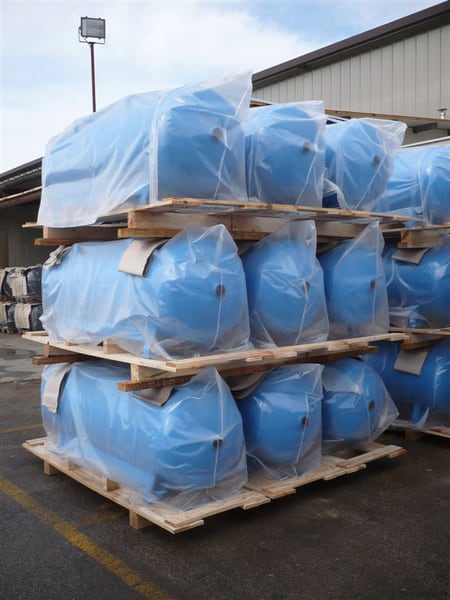
The vessels are made by the Italian Baglioni group. The shell is rolled from sheet steel, the longitudinal and circumferential seams are made by automatic submerged-arc welding, and the legs, feet and sockets are welded on separately. Each vessel then undergoes a hydrostatic pressure test at one and a half times the pressure on its data plate. Painted vessels receive a powder coating 80 to 120 µm thick, while galvanised vessels are dipped whole in molten zinc, so the zinc covers the wall inside and out. The finished vessels leave the factory wrapped in film and accompanied by a declaration of conformity.
For smaller volumes, see our small vessels up to 50 l; from 1000 l upwards, the range continues with the large Baglioni vessels, and for vessels with the fittings already mounted, see our fully equipped pressure vessels.
Ventilek’s tip
Air in at the bottom, out at the top. If you feed the air from the compressor into the lower part of the vessel and draw it off at the top, the condensate stays at the bottom and drier air goes into the network. The bottom is then the place for a condensate drain valve.
- What size of air receiver do I need?
- It depends on the output of the compressor and on how much the air demand fluctuates. The more the demand varies and the more often the compressor starts, the more a larger vessel pays off. Our advice centre explains how to work it out; the link is in Ventilek’s tip.
- Vertical or horizontal?
- Both series come in similar volumes and pressure ratings, except that the 150 l size is only made horizontal. A vertical vessel needs less floor space but is tall; a horizontal one is low and longer. It comes down to where the vessel will stand.
- When do I need a 16-bar vessel?
- When the compressor cuts out above 10 bar, typically at 13 or 15 bar. The vessel’s pressure rating must always be at least as high as the maximum pressure the compressor can deliver into it.
- What else should I order with the vessel?
- A safety valve, a pressure gauge, a shut-off valve and a condensate drain valve or an automatic condensate drain. For the 11-bar vertical vessels, there is a ready-made fittings kit.
- Should the vessel be bolted to the floor?
- Not rigidly. Vibration dampers belong under the legs or feet, so that vibration from the compressor and the pipework is not transmitted to the vessel’s welds.
- What documents come with the vessel?
- A declaration of conformity with the vessel’s data-plate details, together with the instructions for use and maintenance. The vessel bears the CE marking under Directive 2014/29/EU.
- Does the vessel need regular inspections?
- Yes, but the intervals are set by each country; the European directive covers only manufacture and the declaration of conformity. In the Czech Republic, vessels of 100 litres and more count as designated pressure equipment: an operational inspection once a year, an internal inspection every five years and a pressure test roughly every nine to ten years. Elsewhere, local regulations apply.
- Which finish should I choose?
- Painted for dry, heated rooms; galvanised for damp conditions and operations with a lot of condensate; and with the ALM internal coating for the food industry.
- How do I find a replacement for an old vessel?
- The data plate of the old vessel shows its volume and maximum pressure. Choose the same or a higher pressure and compare the diameter, the height or length and the connection positions in the table.
Manufactured to Directive 2014/29/EU on simple pressure vessels (SPVD). Medium: compressed air and nitrogen. Working temperature −10 to +120 °C.


