
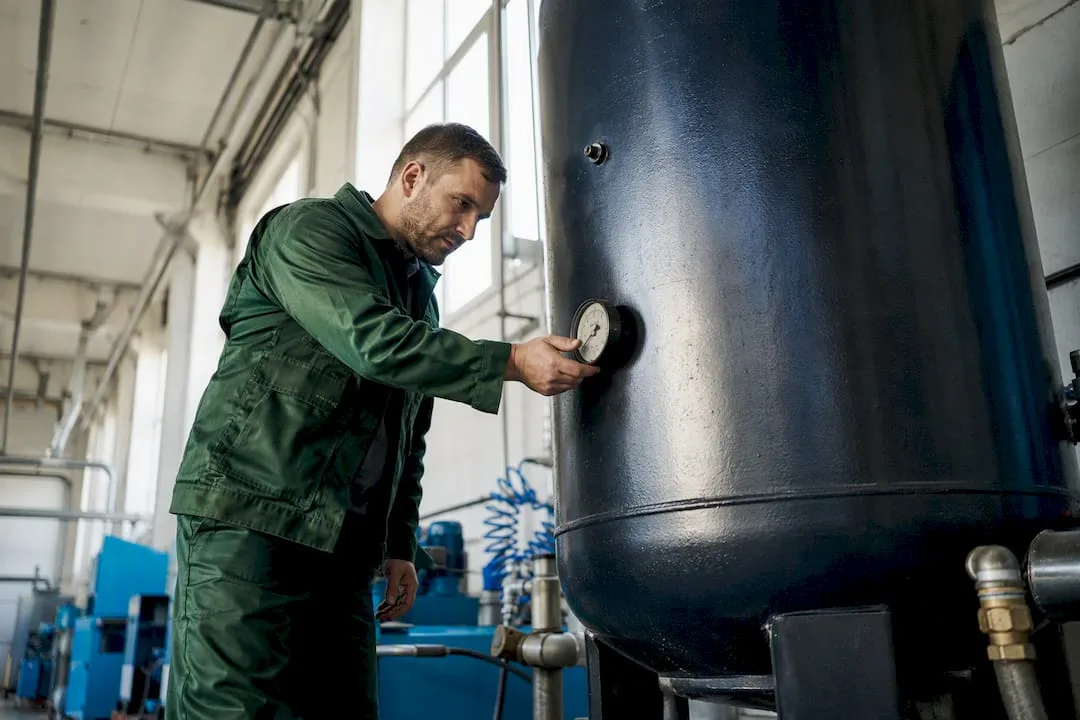
In the Czech Republic a pressure vessel becomes a reserved pressure device the moment the maximum working pressure (PS) exceeds 0.5 bar. This limit is set by Czech Government Regulation No. 192/2022 Sb., and as soon as the vessel exceeds it, a whole range of duties falls on the operator.
They must have a local operating procedure drawn up, keep an inspection plan and ensure that the equipment is operated by professionally competent persons. Czech Act No. 250/2021 Sb. clearly transfers responsibility for operating safety to the operator, not to the manufacturer or the inspection engineer.
The specific intervals can be found in Annex No. 4 to Government Regulation No. 192/2022 Sb. and in the technical standard ČSN 69 0012:
- Initial inspection before commissioning, first operational check within 14 days.
- Operational inspections are normally carried out annually, with longer inspection intervals for LPG and refrigeration equipment.
- Internal inspections are carried out according to the applicable rules at longer intervals.
- The pressure test is usually carried out at longer time intervals set by the relevant standards and decrees.
As regards placing simple pressure vessels on the market, the product PS·V is decisive. If it exceeds 50 bar.L, the vessel must undergo conformity assessment under Government Regulation No. 119/2016 Sb., including EU type-examination in the so-called module B.
Key findings
The operator of a pressure vessel with PS above 0.5 bar bears full responsibility for operating safety and must manage inspections according to the actual operating conditions, not merely according to the statutory maximum.
| Point | Details |
|---|---|
| Classification of the equipment | A vessel with PS > 0.5 bar is a reserved pressure device under Czech GR 192/2022 Sb. |
| Key documents | Ensure a local operating procedure and an inspection plan before commissioning. |
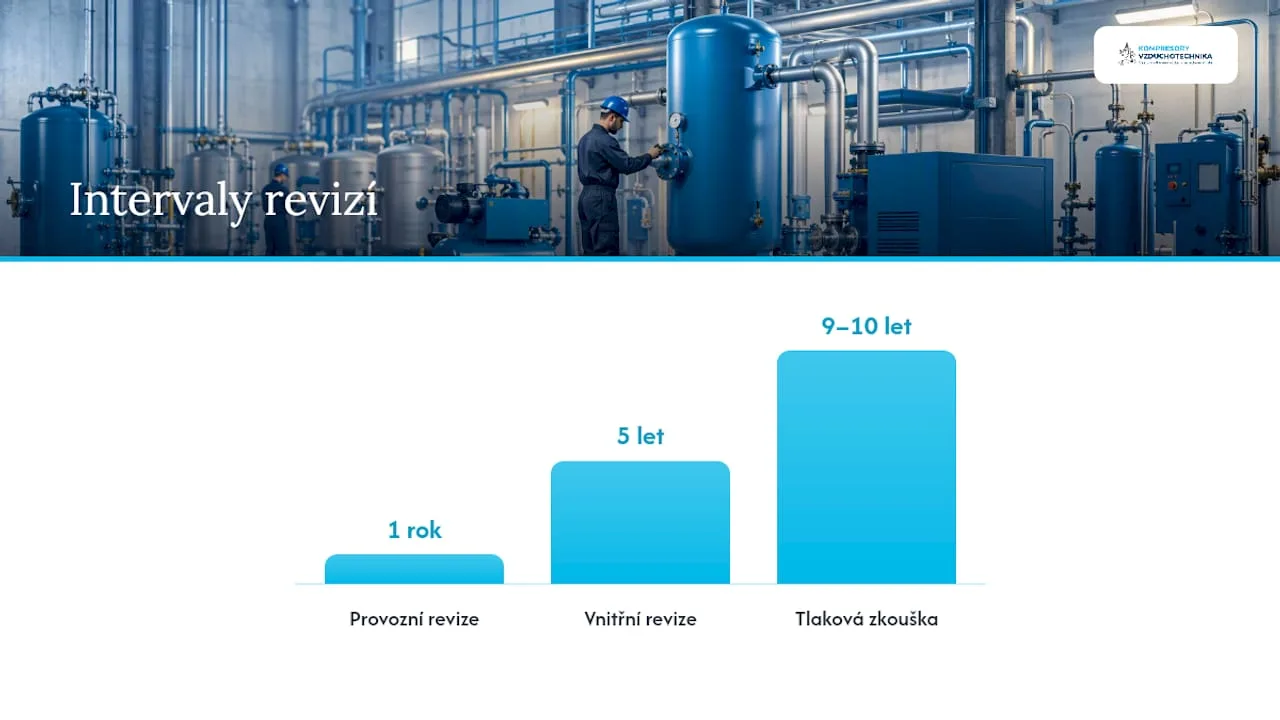
| Inspection intervals | Operational inspection annually, internal inspection after 5 years, pressure test after 9 to 10 years. |
| Conformity assessment | Vessels with a product PS·V above 50 bar.L require conformity assessment under Czech GR 119/2016 Sb. |
| Certified supply | Kompresory-vzduchotechnika supplies air receivers according to ČSN EN 286-1 including installation and service. |
Contents
- Why the inspection engineer's stamp is not enough
- How Kompresory-vzduchotechnika helps you with pressure vessels
- Where to check the regulations and technical standards
- Frequently asked questions
Why the inspection engineer's stamp is not enough
The legislation has shifted responsibility for safety unequivocally onto the operator. In practice this means that the inspection plan must not merely copy the statutory maximum intervals, but has to be based on the manufacturer's documentation and on the actual operating conditions of the particular vessel.
A vessel working with an aggressive medium or in a dusty operation needs more frequent checks than the statutory maximum permits. This includes demonstrable training of the operating staff and ongoing communication with the inspection engineer, not just a one-off contact once a year.
How Kompresory-vzduchotechnika helps you with pressure vessels
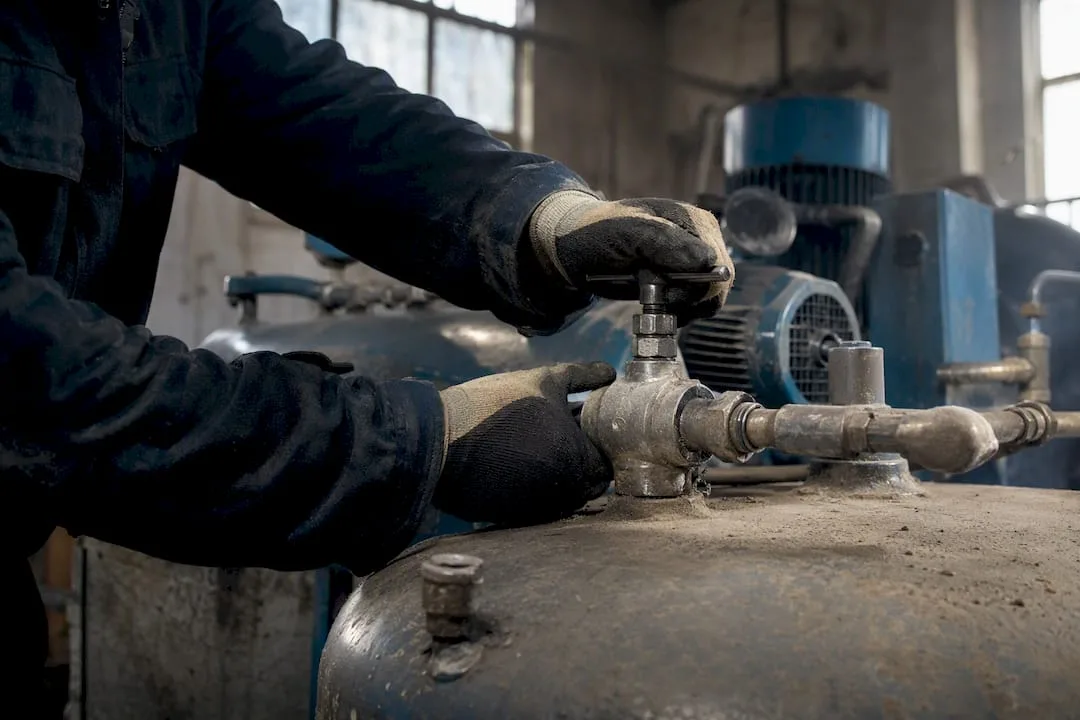
Supplying a certified vessel is only the first step. Kompresory-vzduchotechnika offers pressure vessels and air receivers with a volume of 725 litres manufactured in compliance with ČSN EN 286-1, complemented by installation, drawing up the local operating procedure and follow-up service.
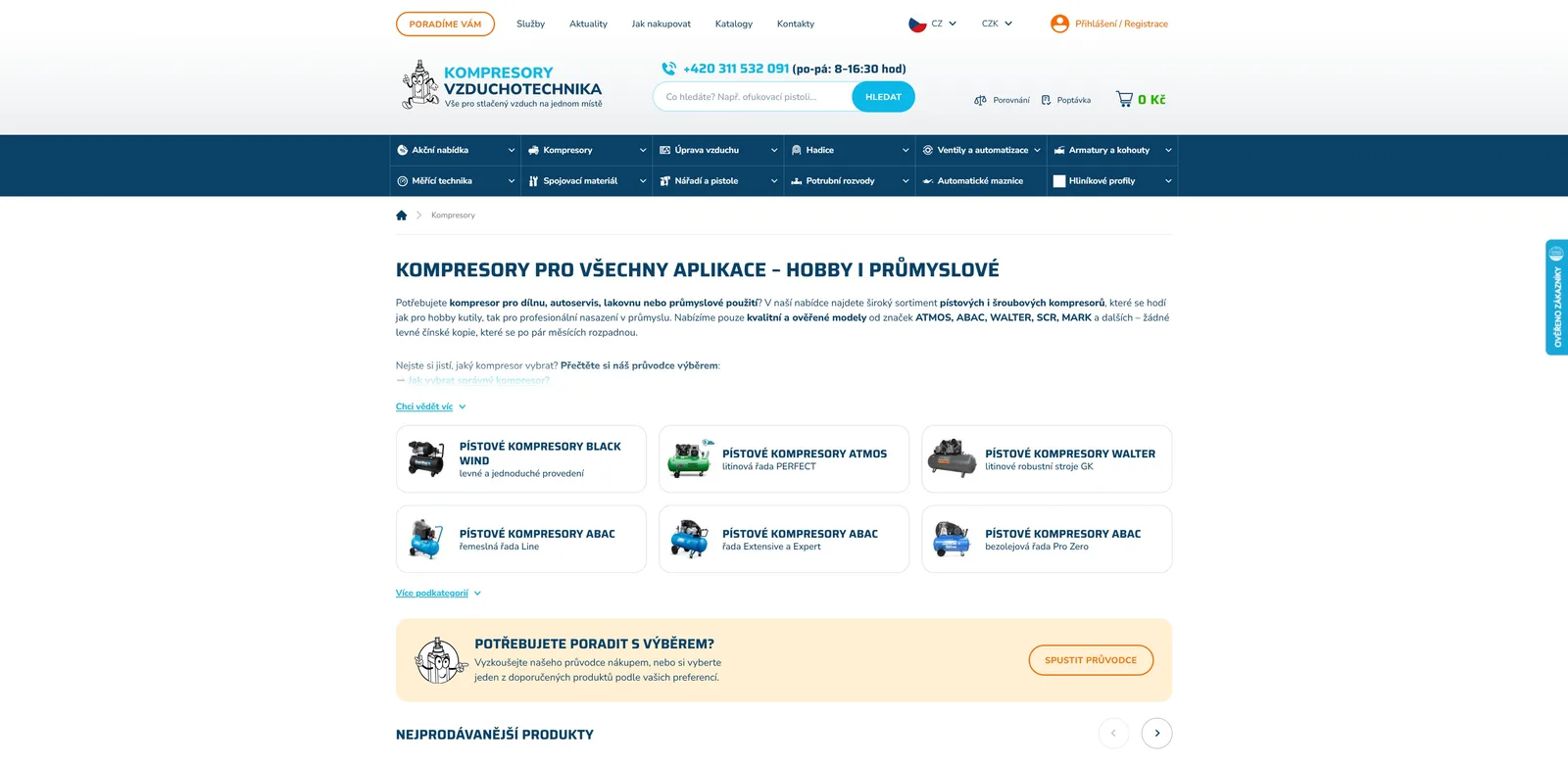
That is the difference from buying a “bare” vessel without support. Our technicians help set up the inspection plan according to the real load of the operation, not just according to table intervals, and they also arrange the connection via pipes for compressed air distribution if you are building a compressor room from scratch. If you are dealing with the purchase of a new vessel or the inspection of an existing air receiver, contact our technical department and arrange a consultation directly on site.
Where to check the regulations and technical standards
The full wording of the main Czech regulations can be found on the portals ZákonyProLidi.cz or ČeskéZákony.cz. We recommend starting with Annex No. 4 to Government Regulation No. 192/2022 Sb., because it contains the specific inspection intervals.
For the classification of the equipment and the operator's duties, Government Regulation No. 192/2022 Sb. is the key one; for placing simple pressure vessels on the market it is Government Regulation No. 119/2016 Sb., and for responsibility for occupational safety it is Act No. 250/2021 Sb. Conformity assessment in general is governed by Act No. 90/2016 Sb. All the regulations named here are Czech law. Technical practice is complemented by the standards ČSN 69 0012 and ČSN EN 286-1.
Practical steps for maintenance and documentation can be found in the guide to caring for a compressor vessel and in the checklist of safety rules for compressor operation.
Frequently asked questions
When is a pressure vessel a reserved device?
As soon as the maximum working pressure (PS) exceeds 0.5 bar, under Czech Government Regulation No. 192/2022 Sb. it is a reserved pressure device with a full inspection obligation.
How often must a pressure vessel be inspected?
The operational inspection is done once a year, the internal inspection once in five years and the pressure test approximately once in 9 to 10 years according to Annex No. 4 to GR 192/2022 Sb.
Who is responsible for the operating safety of the vessel?
Responsibility lies with the operator, who must ensure the local operating procedure, the inspection plan and professionally competent operating staff under Czech Act No. 250/2021 Sb.
When must a simple pressure vessel undergo conformity assessment?
If the product PS·V exceeds 50 bar.L, the vessel requires conformity assessment under Czech Government Regulation No. 119/2016 Sb., including EU type-examination.
Where to buy a pressure vessel that complies with the standards?
Kompresory-vzduchotechnika supplies air receivers in compliance with ČSN EN 286-1 including installation, operating documentation and service.