

In brief:
- A compressor tank is a pressure storage vessel that balances pressure peaks and protects the system from overloading. Proper maintenance and regular inspections with documentation ensure safety and extend its service life. Neglect leads to unnecessary costs, corrosion, and the risk of a pressure vessel failure.
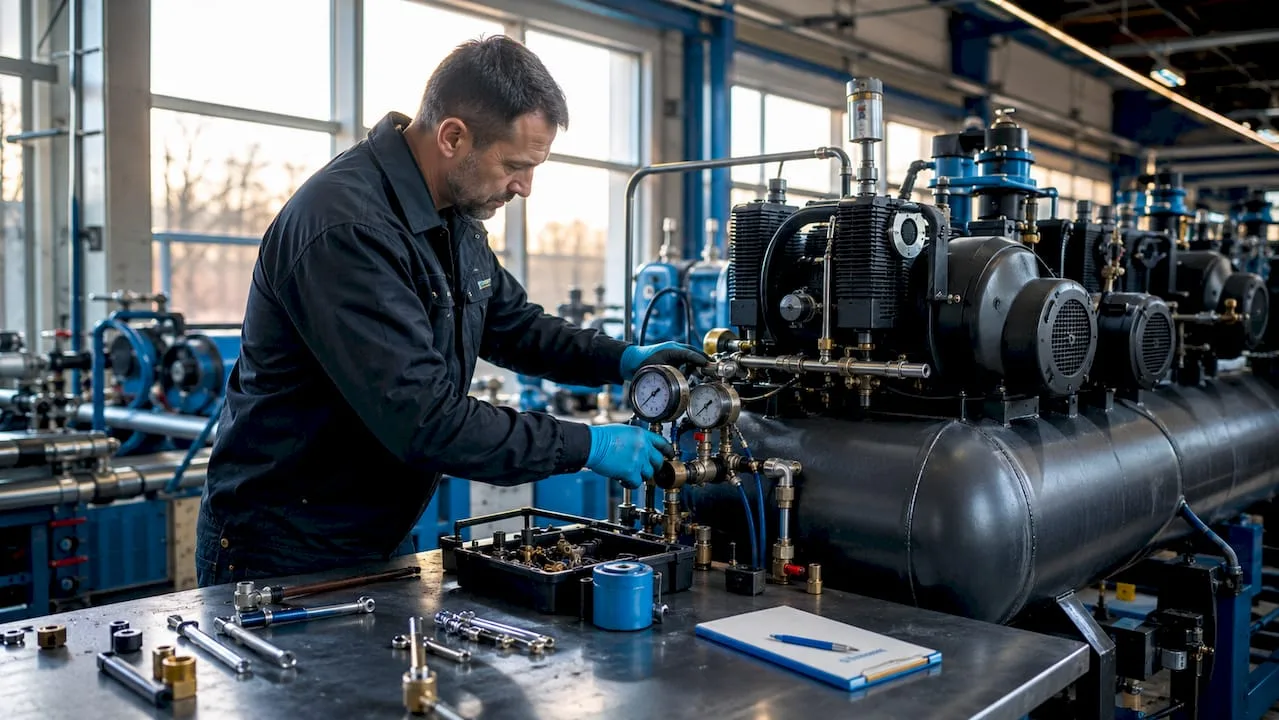
A compressor tank, professionally referred to as an air receiver or air tank, is a compressed air storage vessel that balances pressure peaks and protects the compressor from an excessive number of starts. A proper guide to compressor tank maintenance is a fundamental prerequisite for safe operation and extending the service life of the entire compressor system. Neglected air receiver maintenance leads to energy losses, corrosion damage, and, in the worst case, to a pressure vessel failure. Current standards for pressure vessels impose mandatory inspections and regular checks on technicians, the neglect of which has a direct impact on operational safety and insurance conditions. This guide covers everything from tool preparation, through a step-by-step inspection procedure, to planning long-term preventive maintenance.
What is necessary for compressor tank maintenance?
Proper preparation before the actual air receiver maintenance determines the accuracy and safety of the entire operation. Proper preparation significantly increases the safety and accuracy of the inspections performed. Without complete equipment and documentation, a technician risks overlooking a defect or violating legal requirements.
Necessary tools and measuring instruments
The basic equipment for air receiver maintenance includes the following items:
- Calibrated pressure gauge for measuring operating pressure and pressure drop during a leak test
- Ultrasonic leak detector for locating leaks in welds, flanges, and valves
- Torque wrench for tightening flange joints to the specified torque
- Endoscope or inspection camera for visual inspection of the internal surface of the tank
- Multimeter for checking the electrical wiring of pressure switches and safety devices
- Personal protective equipment: safety goggles, pressure-resistant work gloves, safety helmet when working overhead
Mandatory documentation
Every pressure vessel must have complete documentation available. Without it, the statutory inspection cannot be carried out, nor can compliance with standards be demonstrated.

| Document | Purpose |
|---|---|
| Declaration of Conformity (CE) | Confirms compliance with the requirements of Directive PED 2014/68/EU |
| Inspection report from the previous check | Basis for assessing the current condition of the vessel |
| Manufacturer's operating manual | Defines the maximum allowable working pressure (MAWP) and service intervals |
| Pressure test certificate | Documents the results of the hydraulic or pneumatic test |
| Service log | Chronological record of all performed tasks and repairs |
Professional tip: Keep all documentation in digital form in a CMMS system. Physical printouts get lost or damaged; digital records are immediately available during an unannounced inspection.
How to properly maintain and inspect a compressor air receiver?
The air receiver maintenance procedure consists of several consecutive steps. Skipping any of them increases the risk of overlooking a defect. Air receivers are subject to mandatory periodic inspections as part of statutory obligations and technical standards.
Step 1: Safe disconnection and depressurization
- Switch off the compressor and disconnect it from the electrical supply (lockout/tagout procedure).
- Slowly open the drain valve and depressurize the air receiver to zero overpressure.
- Verify with a pressure gauge that the pressure in the air receiver is actually zero.
- Shut off the compressed air supply from the network to prevent backfilling.
- Drain the condensate from the bottom drain cock into a prepared container.
Step 2: Visual and physical inspection
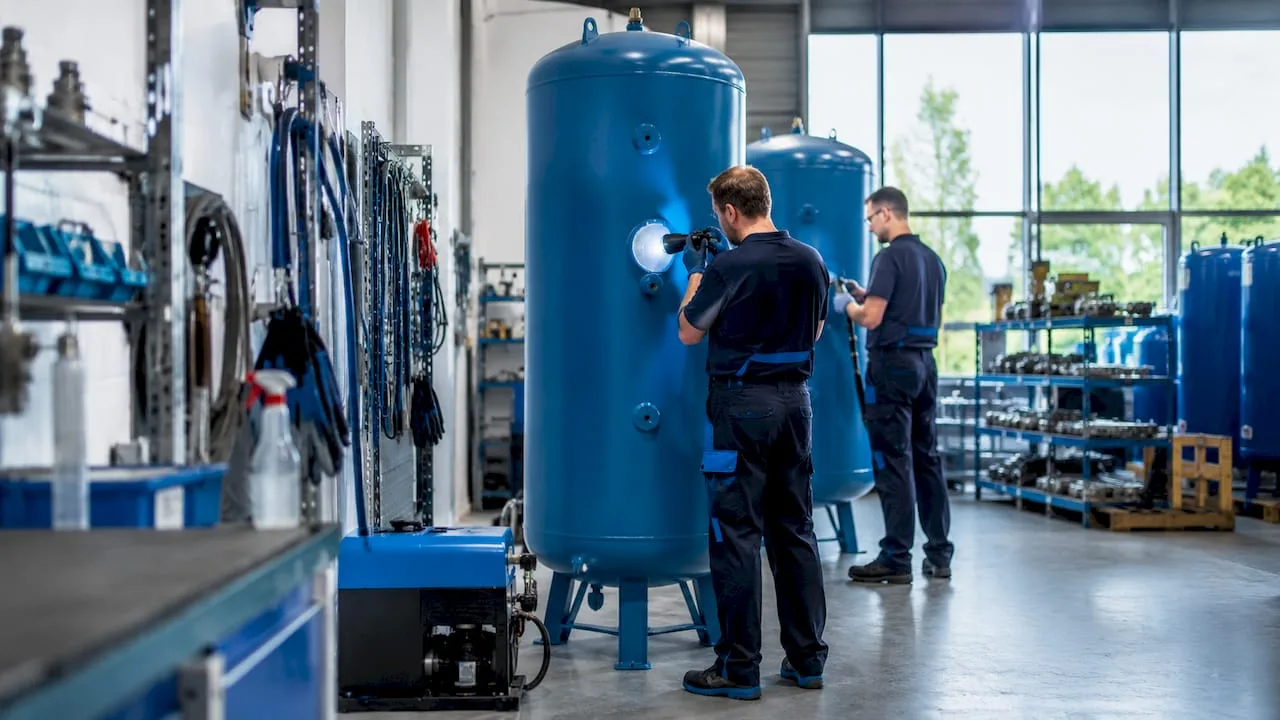
Check the outer surface of the tank for corrosion, mechanical damage and deformation. Pay special attention to weld joints, tank legs and areas where moisture accumulates. Check the condition of the coating; damaged coating accelerates corrosion and indicates areas of higher risk. If the tank is fitted with a manhole, carry out an endoscopic inspection of the internal surface.
Step 3: Leak test
The standardized procedure involves pressurizing the tank to operating pressure, disconnecting all appliances and measuring the pressure drop over a defined period. The pressure drop must not exceed 20% of operating pressure over the specified interval. Apply an ultrasonic leak detector to all flanges, valves and welds; the device detects leaks even where a soap solution is not sufficient. Record every leak found in the service log with its exact location.
Step 4: Valve inspection and maintenance
The safety valve is the most important safety component of the air receiver. The safety valve must be set to at least 110% of MAWP and tested at least once a year. Manually test the safety valve by briefly turning the test ring at operating pressure. If the valve fails to release air or leaks after release, replace it immediately. Check the check valve for flow and correct function; a damaged check valve causes the compressor to run backwards and leads to its premature wear.
Step 5: Filter replacement and cleaning
Replace the air filter at the compressor inlet according to the manufacturer's recommendations or when visibly contaminated. The overview of compressor filters shows that the correct choice of filter directly affects the cleanliness of the air in the tank and the service life of the seals. Clean the condensate separator and check the function of the automatic drain. A neglected separator causes water to accumulate in the tank, which accelerates corrosion from the inside.
Professional tip: The most common mistake made by technicians is skipping the safety valve test with the justification "it worked last time." Safety valves corrode and seize even without visible damage. Test them at every regular inspection without exception.
How to resolve common air receiver faults?
Diagnosing air receiver faults is based on monitoring operating indicators. Monitoring the number of compressor starts and the extent of leaks helps detect faults before they cause serious problems. An increased number of compressor starts per hour is the first signal that the tank or distribution system is leaking.
Overview of the most common faults
| Fault | Cause | Recommended solution |
|---|---|---|
| Increased number of compressor starts | Leak in the air tank or piping | Leak test, leak localization using ultrasound |
| Drop in operating pressure | Damaged check valve, clogged filter | Replacement of the valve or filter |
| Corrosion on the outer surface | Damaged coating, humid environment | Grinding, anti-corrosion coating, drainage inspection |
| Safety valve blows at normal pressure | Overpressure in the network or faulty valve | Check the pressure switch, replace the valve |
| Water in the air outlet | Non-functioning condensate separator | Cleaning or replacement of the separator |
Regular inspections and immediate repair of minor leaks prevent more extensive failures and reduced performance. A small leak that a technician postpones "for next time" will, after three months of operation, grow into a crack requiring replacement of the entire air tank.
How to respond to a safety valve warning
If the safety valve blows at normal operating pressure, shut down the compressor immediately. The cause is either overpressure caused by a faulty pressure switch, or the valve itself being faulty. First check the pressure switch setting and compare it with the MAWP value stated on the air tank nameplate. If the setting is correct, replace the safety valve with a certified replacement part with the same pressure setting.
Professional tip: A CMMS system allows you to set an automatic alert when the threshold number of compressor starts per hour is exceeded. This feature replaces manual monitoring and catches the problem before a technician notices it during a round.
How to plan inspections and long-term care of the air receiver?
Preventive maintenance of the air receiver follows a fixed schedule, not the feeling that "it looks fine." Implementation of a CMMS system enables the transition from reactive to predictive maintenance of compressor equipment. The reactive approach, where you wait for a failure, increases operating costs and jeopardizes operational safety.
The recommended preventive maintenance schedule includes the following intervals:
- Daily: visual pressure check, condensate leak inspection, listening for unusual noises
- Weekly: manual condensate drainage (if automatic drainage is not installed), filter condition check
- Monthly: safety valve test, leak check with soap solution on flanges
- Annually: complete maintenance according to this guide, statutory air receiver inspection, filter and seal replacement
The environment in which the air receiver operates directly affects the inspection frequency. Air receivers in dusty or humid environments require shorter intervals than air receivers in clean air-conditioned spaces. Basic requirements for a compressor room define the environmental conditions that extend the service life of air receivers and reduce the frequency of necessary interventions.
Archiving of service documentation must be systematic. Each entry in the service log contains the date, the technician's name, a description of the task performed, and the measurement result. Digital CMMS tools centralize this data and automate leak checks and part replacements. In the event of an unannounced inspection or insurance claim, a complete digital history is invaluable evidence of proper care.
Neglected air tank maintenance increases operating costs by 6–8% due to higher energy consumption caused by leaks and pressure drops. This figure does not include the costs of unplanned downtime or replacement of a damaged air receiver. Systematic preventive maintenance therefore pays off in energy savings and extended equipment service life.
Key insights
Proper air receiver maintenance requires a combination of regular leak checks, functional testing of safety valves, and digital maintenance planning in a CMMS system.
| Item | Details |
|---|---|
| Preparation and documentation | Before every inspection, have the CE declaration, inspection report, and operating manual available. |
| Leak tightness test | The pressure drop must not exceed 20% of MAWP over the specified measurement interval. |
| Safety valve | Test at least once a year and set to a minimum of 110% of MAWP. |
| Digital planning | A CMMS system automates alerts and reduces the risk of an overlooked fault. |
| Preventive schedule | Daily, weekly, monthly, and annual inspection intervals protect the tank from corrosion and leaks. |
A predictive approach as the basis for safe maintenance
Over years of working with compressor systems, I have reached one clear conclusion: the biggest damage is not caused by major accidents, but by small neglected details. A technician who skips a safety valve test because "it takes five extra minutes" creates a risk whose elimination then takes days and costs ten times as much.
The shift from reactive to predictive maintenance is not a question of technology, but of discipline. A CMMS system is just a tool. If a technician does not enter the correct data into it, the system cannot help. I have seen plants with the most modern software where records were filled in retroactively "by eye". That is not predictive maintenance, that is digitalized negligence.
I recommend that every technician go through the entire air receiver treatment procedure from start to finish once a year, even if the tank "looks fine". Compressor diagnostics reveal problems that are not visible during a routine inspection. A visual check will catch surface corrosion, but an ultrasonic detector will reveal a leak that would otherwise remain invisible for months.
The safety of a compressor air receiver is not a matter of a single annual service. It is the result of small, everyday decisions: draining condensate, recording a reading, testing a valve. A technician who makes these decisions systematically will never experience an unplanned shutdown due to air tank failure.
— Zdeněk
Equipment and accessories for air receiver care
Kompresory-vzduchotechnika offers a complete range of products for the proper care of compressor air receivers and compressed air distribution systems.
For safe and tight compressed air distribution, push-in system pipes are available in diameters of 15–28 mm, suitable for both industrial and workshop installations. A quality distribution system directly reduces the number of points where pressure leaks can occur. To ensure the cleanliness and correct pressure of the air entering the tank, air treatment units up to 18 bar are available, which remove moisture and impurities before entry into the air tank. Kompresory-vzduchotechnika technical support is available for consultation on choosing the right accessories as well as for resolving specific operational situations.
Frequently Asked Questions
What is an air tank and why does it require regular maintenance?
An air tank is a pressure vessel that stores compressed air and evens out pressure fluctuations in the system. Regular maintenance prevents corrosion, pressure leaks, and failure of safety components.
How often is the statutory inspection of a compressor air receiver performed?
Statutory inspections of pressure vessels are carried out at regular intervals specified by applicable standards, generally once a year or after any major repair.
How do I know if my air receiver is leaking?
The main signal is an increased number of compressor starts per hour with unchanged air consumption. Precise leak localization is performed using an ultrasonic detector.
To what value is the safety valve of the air receiver set?
The safety valve is set to a minimum of 110% of the maximum allowable working pressure (MAWP) of the tank and is tested at least once a year.
What is CMMS and how does it help with air receiver maintenance?
CMMS is a maintenance management software system that centralizes service records, automates reminders for scheduled inspections, and enables a transition from reactive to predictive maintenance.
Recommended
- A list of safety rules for working with a compressor in automotive 2026 - Kompresory-Vzduchotechnika.cz
- Basic requirements for a compressor room: guide 2026 - Kompresory-Vzduchotechnika.cz
- Tips for Quiet Compressor Systems: A 2026 Guide - Kompresory-Vzduchotechnika.cz
- How to repair an air leak on a compressor: a 2026 guide - Kompresory-Vzduchotechnika.cz