
In brief:
- Compressor filters remove contaminants from compressed air and protect equipment and production processes. The most common types are coalescing filters, pre-filters, after-filters, activated carbon filters, and sterile filters, with the selection depending on the type of contamination and operating conditions. Proper filtration according to ISO 8573-1 requires a multi-stage system with differential pressure monitoring for efficient operation and energy savings.
A compressor filter is a device designed to remove contaminants from compressed air, with each type addressing a different kind of contamination. Proper filtration protects pneumatic tools, production lines, and final products from oil, moisture, dust, and gases. The ISO 8573-1 standard defines compressed air purity classes and sets measurable limits for solid particles, water, and oil. An overview of compressor filters is therefore not just a catalogue list, but a practical basis for selecting the right solution for a specific operation.
1. Overview of compressor filters: main types and their function
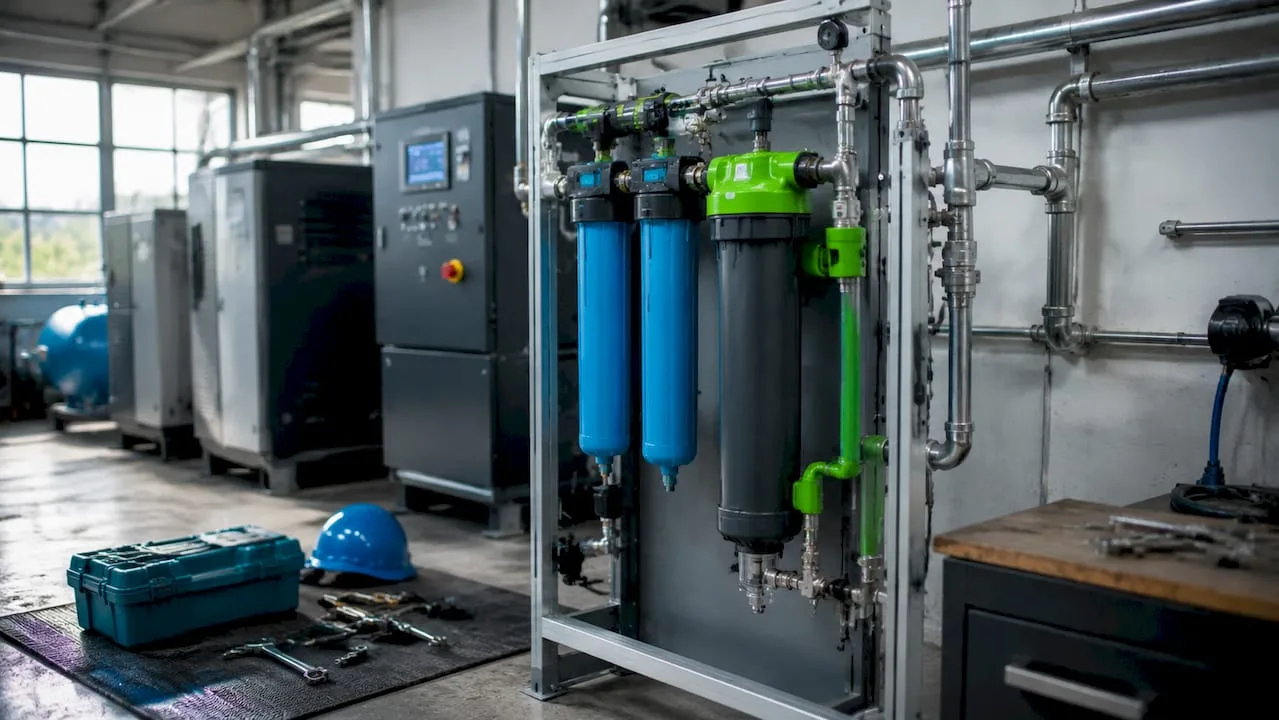
Filtration systems for compressors are divided into several basic categories according to the cleaning mechanism and their position in the system.
Mechanical (particulate) filters are the most widespread and widely available technology. Air passes through a fibrous or membrane medium that captures solid particles above a certain size. They are divided into coarse pre-filters (capturing particles above 5–40 microns) and fine filters (from 1 micron, in some designs down to 0.01 micron). However, they do not address oil mist, oil vapors, or moisture. The compressor's intake filter is the first line of defense for the entire system, and its replacement is the cheapest preventive measure in the whole compressor station, since a clogged intake filter directly increases the compressor's power consumption.
Coalescing filters are the most common type of fine filtration in industrial practice. They work on the principle of coalescence of tiny oil or water droplets: small droplets are captured on a fibrous medium, merge into larger drops, and flow down by gravity into a collection container. Filtration efficiency is 0.01–1 micron, which is essential for protecting pneumatic tools and sensitive production processes. They meet the ISO 8573-1 requirements for class 1 or 2 for oil.
Pre-filters are installed before the refrigerated dryer. They protect the dryer by removing moisture, oil, and larger contaminants before the air enters the more sensitive parts of the system. Without a pre-filter, the dryer becomes clogged faster and its service life decreases.
After-filters operate downstream of the dryer. They capture fine contaminants released by the dryer or that pass through the previous stage. The efficiency of after-filters reaches the same range of 0.01–1 micron as coalescing filters, but their role is supplementary.
Activated carbon filters remove gaseous pollutants, oil vapors, and odors. They work on the principle of adsorption, where contaminant molecules bind to the surface of the activated carbon. They are used where coalescing filters are not sufficient, for example in the food industry, pharmaceuticals, or painting. Their efficiency depends on the temperature and humidity of the environment. A saturated carbon cartridge stops filtering without any visible warning, so replacement intervals must be observed regardless of the filter's visual condition.
Special sterile filters are used in applications with the highest requirements for air purity, such as pharmaceutical or food production. They capture bacteria and microorganisms and meet strict hygiene standards.
2. Filter efficiency and technical parameters
Filtration efficiency is expressed in microns and indicates the smallest particle size that the filter will capture. Coalescing filters cover a range of 0.01–1 micron, pre-filters cover the coarser fraction above 1 micron, and sterile filters capture particles below 0.01 micron.
Operating temperature significantly affects the performance of activated carbon filters. At temperatures above 35–40 °C, their efficiency drops sharply, causing oil vapor to penetrate the system. Activated carbon filters therefore require placement in a cool, ventilated area.
Pressure drop is the most reliable indicator of filter condition. Monitoring the pressure drop allows the filter element to be replaced at the right time, before it becomes fully clogged. A clogged filter increases the compressor's energy consumption and reduces air flow.
Professional tip: Install a pressure gauge before and after each filter. A pressure difference above 0.5 bar indicates that the element needs to be replaced. Do not wait for visible contamination or a fixed time interval.
| Filter type | Efficiency (microns) | Typical application | Temperature sensitivity |
|---|---|---|---|
| Pre-filter | 1–40 | Dryer protection, coarse contaminants | Low |
| Coalescing | 0,01–1 | Oil, moisture, fine aerosols | Medium |
| Post-filter | 0,01–1 | Final purification after the dryer | Low |
| Activated carbon | Gaseous substances | Odours, oil vapours | High (above 35–40 °C) |
| Sterile | Below 0.01 | Pharmaceuticals, food industry | Medium |
3. Comparison of key filter characteristics
The choice of the correct filter depends on a combination of four parameters: filtration efficiency, resistance to operating conditions, maintenance costs, and recommended use.
| Characteristics | Pre-filter | Coalescing | Activated carbon | Sterile |
|---|---|---|---|---|
| Filtration efficiency | Coarse (above 1 µm) | Fine (0.01–1 µm) | Gaseous substances | Very fine (below 0.01 µm) |
| Moisture resistance | High | High | Low | Medium |
| Temperature resistance | High | Medium | Low (above 35–40 °C) | Medium |
| Cartridge replacement costs | Low | Medium | Medium to high | High |
| Replacement frequency | According to pressure drop | According to pressure drop | According to temperature and load | According to application |
| Recommended use | All operations | Industry, painting, pneumatics | Food industry, pharmaceuticals | Pharmaceuticals, medicine |
The following overview shows which contaminants individual filter types actually capture and which oil purity classes according to ISO 8573-1 can be achieved as a result:
| Filter type | Solid particles | Oil/aerosols | Odors | ISO 8573 Class (oil) |
|---|---|---|---|---|
| Mechanical (coarse) | Yes | No | No | 4–5 |
| Mechanical (fine) | Yes | Partially | No | 3–4 |
| Coalescing | Yes | Yes | No | 1–2 |
| Activated carbon | No | Yes (vapors) | Yes | 1 |
Pressure drop and filter clogging significantly affect the operating efficiency and energy consumption of the compressor. A clogged filter does not act as a safeguard, but as a brake on the entire system.
An effective filtration system reduces the rejection rate and increases production reliability. This applies especially in industries where air contamination directly affects the quality of the final product.
4. How to Choose the Right Filter for Industrial or Construction Use
Filter selection begins with an analysis of contamination in the specific operation. A paint shop requires a different approach than a concrete plant, and a pharmaceutical facility requires yet another.
Basic selection criteria:
- Type of contamination: Oil and moisture require a coalescing filter. Dust and coarse impurities are handled by a pre-filter. Odors and gaseous substances are removed by an activated carbon filter.
- Operating temperature: Activated carbon filters cannot be used in spaces with temperatures above 35–40 °C without additional cooling.
- Required purity class: The ISO 8573-1 standard defines classes 0–6 for solid particles, water, and oil. Class 1 for oil means a content below 0.01 mg/m³, while class 4 means below 5 mg/m³.
- Air flow (l/min or m³/h): The filter must match the rated flow of the compressor. An undersized filter increases pressure drop and reduces the performance of the entire system.
- Placement in the line: The pre-filter belongs before the dryer, the post-filter after the dryer, and the activated carbon filter at the end of the line.
- Availability of replacement elements and service support: A cheap filter with an expensive or hard-to-find element may, over a 3–5 year horizon, be more costly than a premium solution with readily available parts.
Multi-stage filtration combines a pre-filter, a main coalescing filter, and optionally an activated carbon filter. This approach meets the strict ISO 8573-1 standards and minimizes the risk of contaminants entering sensitive applications.
Recommendations by type of operation:
- Engineering and automotive (general): pre-filter + fine mechanical filter, sufficient for protecting pneumatic tools and valves.
- Paint shops and surface treatment: pre-filter + coalescing filter + activated carbon, meets class 1 requirements according to ISO 8573.
- Food and pharmaceutical industry: multi-stage filtration with coalescing and carbon stages, possibly a sterile filter.
- Welding and foundries: robust pre-filters with high solid particle retention capacity.
Professional tip: When designing a filtration system, allow for a flow reserve of at least 20%. Operating conditions change, and an undersized filter will cause a pressure drop that increases the operating cost of the entire line. In case of high dust content, choose filter media made of polyester fabric or pleated cartridges, which can be repeatedly cleaned with compressed air or water.
The most common mistakes when selecting a filter:
- Using a single filter where multi-stage filtration is required.
- Underestimating the effect of temperature on activated carbon filters.
- Selecting a filter without regard to flow rate and pressure losses.
- Neglecting regular checks of the pressure drop.
Investment in quality multi-stage filtration typically pays off within 12–24 months thanks to savings on maintenance and reduced downtime. This is a measurable economic argument, not just a technical recommendation.
When selecting a compressor for demanding industrial operations, it is also advisable to consider the criteria for choosing an industrial compressor, where filtration plays a key role in the overall system design.
5. Maintenance of compressor filters and failure prevention
Regular filter maintenance directly determines the service life of the entire pneumatic system. A neglected filter not only causes poorer air quality but also damages valves, cylinders, and tools downstream.
Maintaining filtration systems based on the actual pressure drop significantly prevents costly repairs. Fixed time intervals for element replacement are less accurate than monitoring the actual condition of the filter.
Recommended maintenance procedure:
- Daily visual inspection of the condensate and oil collection bowl.
- Weekly pressure drop reading from the pressure gauges before and after the filter. An increase above 0.2 bar indicates the onset of clogging, a difference above 0.5 bar requires element replacement.
- Regular condensate draining from the collection bowls, ideally using an automatic condensate drain.
- Filter element replacement when the recommended pressure drop is exceeded or at the latest once a year; typically every 6 to 12 months, shorter in dusty environments.
- Service records: replacement date, element type, measured pressure drop values.
- Use original spare parts. Non-original elements may not meet the declared filtration class and may cause complaints or malfunctions.
Activated carbon filters require special attention. With prolonged exposure to temperatures above 35–40 °C, they lose efficiency without this being visible. Regular element replacement according to the manufacturer's recommended interval is therefore mandatory, not optional.
Professional tip: When planning maintenance, take seasonal fluctuations into account. In winter, more moisture condenses in the piping and filters clog faster, so adjust inspection intervals to the season, especially for intake filters and condensate drains.
An overview of the most common mistakes in filter maintenance can also be found in the article on the most common mistakes when using compressors, which describes the specific effects of neglected filtration on operation.
Key Takeaways
Proper compressed air filtration according to ISO 8573-1 requires a multi-stage system with a prefilter, coalescing filter, and optionally an active carbon filter, with pressure drop being the main indicator of the condition of each stage.
| Point | Details |
|---|---|
| Multi-stage filtration | The combination of a prefilter, coalescing filter, and active carbon filter meets ISO 8573-1. |
| Pressure drop as an indicator | A pressure difference above 0.5 bar indicates the need to replace the filter element. |
| Temperature limit of active carbon | Active carbon filters lose effectiveness at temperatures above 35–40 °C. |
| Flow rate reserve | When designing, allow for a flow rate reserve of at least 20%. |
| Return on investment | Quality multi-stage filtration pays for itself within 12–24 months through savings on maintenance. |
| Selection by application | The filter type must correspond to the type of contamination, flow rate and required cleanliness class ISO 8573-1. |
Practical experience: what filtration actually determines
I have worked with compressor systems for many years and repeatedly see the same pattern. The operation invests in a quality screw compressor, but treats filters as a secondary item. The result is predictable: damaged valves, contaminated products and unplanned downtime. Problems with production quality or complaints are traced back precisely to a neglected filtration system.
The biggest mistake I see is relying on a fixed time interval for element replacement. A filter in a dusty paint shop clogs three times faster than a filter in a machine room with clean air. The pressure drop tells the truth, the schedule does not.
Activated carbon filters are an underrated category. In the food or pharmaceutical industry they are irreplaceable, but during summer months in an unventilated compressor room they stop working without anyone noticing. Placing the filter in a cool location is not a detail, it is a condition for proper function.
I recommend that every operation keep a simple record of pressure drops with the date of reading. A table on paper or in Excel is enough. After six months you will have data that shows the actual service life of the elements under your conditions. This is more accurate than any general guideline.
— Zdeněk
Filters and accessories for compressed air treatment from Kompresory-vzduchotechnika
Kompresory-vzduchotechnika offers a complete range of filters and devices for compressed air treatment, from simple pre-filters to multi-stage filtration assemblies for demanding industrial operations.
For standard industrial applications, the air treatment units are suitable, combining filtration, pressure regulation and lubrication in one compact unit. For operations requiring compliance with the ISO 8573 standard, Kompresory-vzduchotechnika offers a filtration program according to ISO 8573 with certified components. The technical team is available for consultation on selecting the right filtration solution according to specific operating conditions.
Recommended
- Factors for selecting an industrial compressor: a 2026 guide - Kompresory-Vzduchotechnika.cz
- Basic requirements for a compressor room: guide 2026 - Kompresory-Vzduchotechnika.cz
- List of advantages of screw compressors for industry - Kompresory-Vzduchotechnika.cz
- Checklist of accessories for compressors: a guide for technicians - Kompresory-Vzduchotechnika.cz