
In brief:
- A pneumatic seal creates an impermeable barrier in the system through elastic deformation and contact pressure. A properly designed seal prevents leakage of compressed air and maintains pressure throughout the service life of the equipment. The key parameter is the compression ratio, which must correspond to the type of seal and the operating load.
A pneumatic seal is an elastomeric element that creates an impermeable barrier in a pneumatic system through controlled deformation and contact pressure. A properly designed seal prevents leakage of compressed air and maintains pressure at the operating level throughout the service life of the equipment. The key parameter is the compression ratio: for static connections, the range of 15–30% applies, for dynamic reciprocating seals 10–15%, and for rotary applications 3–8%. These values are not a recommendation but a technical requirement. Deviation from them leads to premature wear or leakage. Kompresory-vzduchotechnika offers expert advice on selecting seals for specific operating conditions.
What is a pneumatic seal and what is the principle of its function?
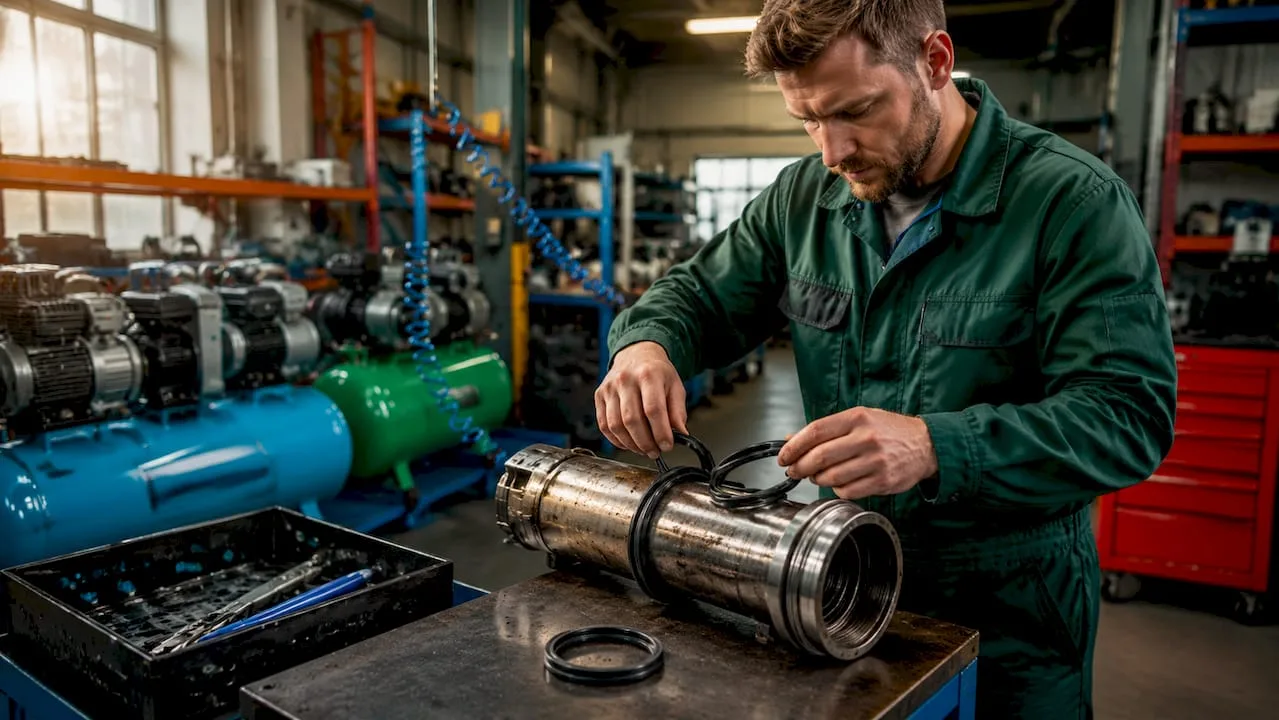
A pneumatic seal works on the principle of elastic deformation of the material under pressure. During installation, the seal is compressed by a defined proportion of its cross-section. This deformation creates contact pressure on the adjacent surfaces, which prevents the passage of compressed air. The seal is not a passive element. It actively responds to changes in system pressure and design clearance, so its behavior is dynamic.
The difference between static and dynamic sealing lies in the movement of the contact surfaces. Static seals operate between fixed parts, for example in pipe joints or cylinder heads. Dynamic seals seal moving components, such as piston rods or rotating shafts. Each type requires a different compression ratio and a different material. Confusing these categories is one of the most common causes of premature failure.
The Poisson's ratio of the elastomer directly affects how the seal behaves under compression. For NBR material, it reaches a value of approximately 0.47, which means 4.7% radial expansion at 10% axial compression. This radial expansion provides the sealing force within the cylinder or groove. Knowledge of this parameter is essential when designing a seal.
How do materials affect the properties of pneumatic seals?
The choice of elastomer determines the temperature resistance, chemical compatibility, and service life of the seal. The wrong material means rapid failure and higher maintenance costs. Below is an overview of the most commonly used materials and their key properties.
| Material | Temperature range | Main advantage | Typical application |
|---|---|---|---|
| NBR (nitrile rubber) | –30 to +100 °C | Resistance to oils and fuels | Hydraulics, pneumatics, automotive |
| PU (polyurethane) | 0 to +60 °C | High resistance to wear | Piston rods, linear actuators |
| HNBR (hydrogenated NBR) | –30 to +150 °C | Resistance to temperature and chemicals | Industrial machinery, compressor technology |
| FKM (Viton) | –20 to +200 °C | Resistance to aggressive media | Chemical industry, high-temperature applications |
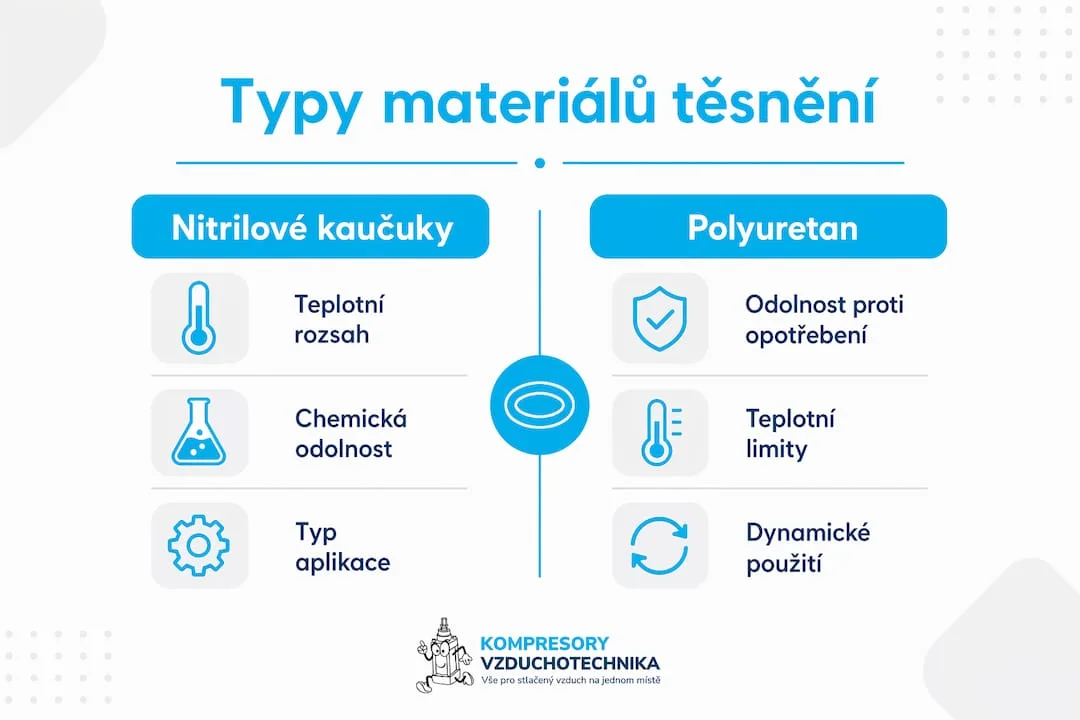
NBR is the most widely used material for standard pneumatic applications. Polyurethane is suitable for temperatures in the range of 0–60 °C and excels in wear resistance, which is why it is used in linear actuators with high stroke frequency. HNBR replaces NBR where temperatures exceed 80 °C or where more aggressive substances are present. FKM is the choice for chemically demanding environments and temperatures exceeding 150 °C.
The geometry of the seal affects sealing force and friction to the same extent as the material. The O-ring is the simplest shape, but for high pressures or abrasive environments, X-rings, U-cups, or special profile seals are used. Asymmetric profiles reduce friction while maintaining sealing force. Integrated wipers remove contaminants from the piston rod and extend the service life of the entire system.
Professional tip: When selecting a material, always base your decision on the highest operating temperature and the most aggressive medium in the system. The seal must handle the worst-case conditions, not the average ones.
What are the main causes of pneumatic seal failure?
In most cases, seal failure has a specific technical cause, not a random character. The most common damage mechanism is the extrusion of material into the design clearance, known in English as nibbling. This phenomenon is caused by a combination of system pressure and the gap between the piston and the cylinder.
A seal designed for a pressure of 100 PSI and a clearance of 0.005" fails quickly when the pressure is increased to 150 PSI or the clearance is widened to 0.010". The seal material is repeatedly pressed into the gap and mechanically abraded. The result is leakage, elastomer fragments in the system, and reduced service life.
Main causes of pneumatic seal failure:
- Nibbling (extrusion into clearance): a combination of high pressure and excessive design clearance; the most common cause of failure in dynamic applications
- Excessive compression: exceeding the recommended compression ratio leads to overheating and degradation of the elastomer
- Wrong material: using NBR in environments with temperatures above 100 °C or in contact with aggressive chemicals
- Insufficient lubrication: dry friction on the piston rod accelerates seal wear even when the correct material is used
- Damage during installation: cutting or twisting the seal during installation causes immediate or early failure
- Contamination: solid particles in the system cause abrasive wear of the sealing surfaces
Dynamic pressure surges are more dangerous than static overpressure. Repeated pressure pulses cause the seal to vibrate in the groove and accelerate nibbling. The effect of variable pressure on the seal must therefore be taken into account already at the system design stage, not only after the first failure.
Professional tip: When analyzing damaged seals, always measure the actual clearance between the piston and the cylinder. Wear on sliding surfaces gradually increases the clearance, so a seal designed for a new machine may no longer be suitable after two years of operation.
How to correctly install and maintain pneumatic seals?
Correct installation and regular maintenance extend seal life significantly more than the choice of a more expensive material alone. Precise adherence to compression ratios is more important than the material itself in dynamic applications. Excessive compression leads to overheating and degradation of the elastomer, while insufficient compression leads to leakage.
Correct installation and maintenance procedure:
- Measure the groove and the seal cross-section before installation. Verify that the compression ratio matches the type of application: 15–30% for static seals, 10–15% for dynamic reciprocating seals.
- Apply a suitable lubricant to the seal and to the contact surfaces. For pneumatic applications, silicone or mineral lubricants compatible with the elastomer are used. Lubrication during assembly reduces friction and prevents damage during initial start-up.
- Install the seal without twisting it. For O-rings, check that the seal is not folded or twisted in the groove. A twist of 5° reduces the sealing force and causes uneven wear.
- Check the clearance between moving parts. The clearance must match the design value. Worn sliding surfaces must be repaired or replaced before installing a new seal.
- Set the operating pressure to the design value. Operation above the rated pressure accelerates nibbling and shortens seal life.
- Establish inspection intervals. For standard applications, inspect the seal at every scheduled shutdown. For critical assemblies, set shorter intervals or use condition monitoring.
Lubrication has specific requirements in pneumatics. Too much lubricant contaminates the system and can damage valves or sensors. Too little lubricant causes dry friction. A detailed overview of lubrication procedures for pneumatic systems is provided by the lubrication guide for technicians. Proper service procedure also includes cleaning the grooves of old seal residue and inspecting the piston rod surface for scratches or corrosion.
Where are pneumatic seals used in industry?
Pneumatic seals in industry are present in practically every sector that works with compressed air. The automotive industry is one of the largest users: pneumatic cylinders operate clamps, fixtures, and assembly lines, where seals must withstand millions of cycles. The food industry requires food-contact approved materials, typically silicone or EPDM elastomers. Mechanical engineering and automation use seals in linear actuators, rotary actuators, and pneumatic valves.
Modernized pneumatic seals in demanding conditions increase machine reliability by 40–70% and extend service intervals from the original 3–6 months to 2–3 years. This extended lifespan directly reduces maintenance costs and unplanned downtime. Advanced seals with asymmetric profiles and integrated wipers handle pressures up to 16 bar without damaging the backup structures.
| Industry | Typical application | Recommended material | Benefit of modernization |
|---|---|---|---|
| Automotive | Assembly lines, clamps | NBR, PU | Extended intervals to 2 years |
| Food industry | Filling and packaging machines | Silicone, EPDM | Compliance with hygiene standards |
| Chemical industry | Valves, pumps | FKM (Viton) | Resistance to aggressive media |
| Mechanical engineering | Linear actuators, cylinders | PU, HNBR | Reduction of friction and wear |
| Energy sector | Pneumatic valve actuators | HNBR, FKM | Reliability at high temperatures |
Future development is moving toward the integration of seals with condition monitoring. Pressure and vibration sensors detect incipient leakage before it causes a failure. This approach shifts maintenance from reactive to predictive and further extends service intervals. Effective servicing of pneumatic systems, including proper seal care, is described in the service guide on the Kompresory-vzduchotechnika website.
Key findings
Pneumatic sealing works reliably only when the material, compression ratio, and design clearance correspond to the specific operating conditions.
| Point | Details |
|---|---|
| Compression ratio | Static seals require 15–30%, dynamic reciprocating seals 10–15%, rotary seals 3–8%. |
| Material selection | PU for 0–60 °C, HNBR for temperatures above 80 °C, FKM for aggressive chemical environments. |
| Nibbling as the main risk | A combination of pressure above the design value and increased clearance causes mechanical extrusion and seal failure. |
| Benefit of modernization | Advanced seals increase machine reliability by 40–70% and extend service intervals to 2–3 years. |
| Lubrication and assembly | Proper lubrication during assembly and clearance inspection are just as important as material selection. |
Practical experience: what technical documentation doesn't tell you
I have worked with pneumatic systems for many years and repeatedly run into the same problem. Technicians pay great attention to selecting the seal material, but underestimate the compression ratio and design clearance. Yet these two parameters are exactly what determines whether a seal lasts one year or three months.
The most common mistake I see in practice is using the seal from a new machine as a replacement part after two years of operation. The sliding surfaces wear, the clearance increases, and a seal that was originally correctly designed starts to nibble. The result is a mysterious leak with no obvious cause. The solution is simple: every time you replace a seal, measure the actual clearance and compare it with the design value.
The second thing that surprises me is underestimating lubrication. Silicone lubricant costs nothing during assembly compared to the cost of unplanned downtime. Yet technicians skip it because "it worked before without it." It worked, but for a shorter time.
Upgrading seals to advanced types with asymmetric profiles or integrated scrapers is always worthwhile when the machine is part of a critical production line. The investment in a better seal pays off with the first downtime avoided. I see the future in predictive monitoring, but the foundation remains proper selection and installation. Without that, no sensor will help.
— Zdeněk
Pneumatic accessories and tubes from Kompresory-vzduchotechnika
A correctly selected seal needs a high-quality compressed air distribution system. A leaking or unsuitable pipeline negates even the best seal in the cylinder.
Kompresory-vzduchotechnika offers a complete range of compressed air tubes in diameters of 15–28 mm, suitable for industrial distribution as well as smaller workshops. The offer also includes air treatment units for pressures up to 10 bar, which maintain air quality and protect seals from contamination. The expert team at Kompresory-vzduchotechnika provides technical advice when selecting accessories for a specific application. Contact us for a consultation on your pneumatic system.
Frequently Asked Questions
What is pneumatic sealing and what is it used for?
A pneumatic seal is an elastomeric element that creates an impermeable barrier in a pneumatic system through controlled deformation and contact pressure. It prevents the leakage of compressed air and maintains operating pressure in pneumatic cylinders, valves, and actuators.
What compression ratio is correct for dynamic seals?
For dynamic reciprocating seals, a compression ratio of 10–15% applies, while for rotary applications it is 3–8%. Exceeding these values leads to overheating and premature wear of the elastomer.
What causes seal nibbling?
Nibbling occurs due to a combination of high system pressure and excessive design clearance between the piston and the cylinder. The seal material is repeatedly pressed into the gap and mechanically abraded, leading to leaks and failure.
What sealing material should be chosen for temperatures above 100 °C?
For temperatures above 80 °C, HNBR is suitable; for temperatures exceeding 150 °C or for aggressive chemical environments, FKM (Viton) is used. NBR is not suitable for these conditions.
How does seal modernization affect machine reliability?
Modernized pneumatic seals increase machine reliability by 40–70% and extend service intervals from 3–6 months to 2–3 years. Advanced types with asymmetric profiles withstand pressures up to 16 bar without damage.
Recommended
- What is pneumatic lubrication: a guide for technicians - Kompresory-Vzduchotechnika.cz
- How pneumatics works: a complete guide for industry 2026
- I.e. pneumatic connection: types, functions and practice - Kompresory-Vzduchotechnika.cz
- How fluctuating pressure affects the efficiency of pneumatic systems - Kompresory-Vzduchotechnika.cz