

In brief:
- IoT in pneumatics connects components through sensors and protocols to automate monitoring and maintenance. IIoT deployment increases system reliability by 40 to 60 percent and reduces energy consumption by 25 to 35 percent. The key to success is the right protocol selection, an accurate data model, and gradual integration into production.
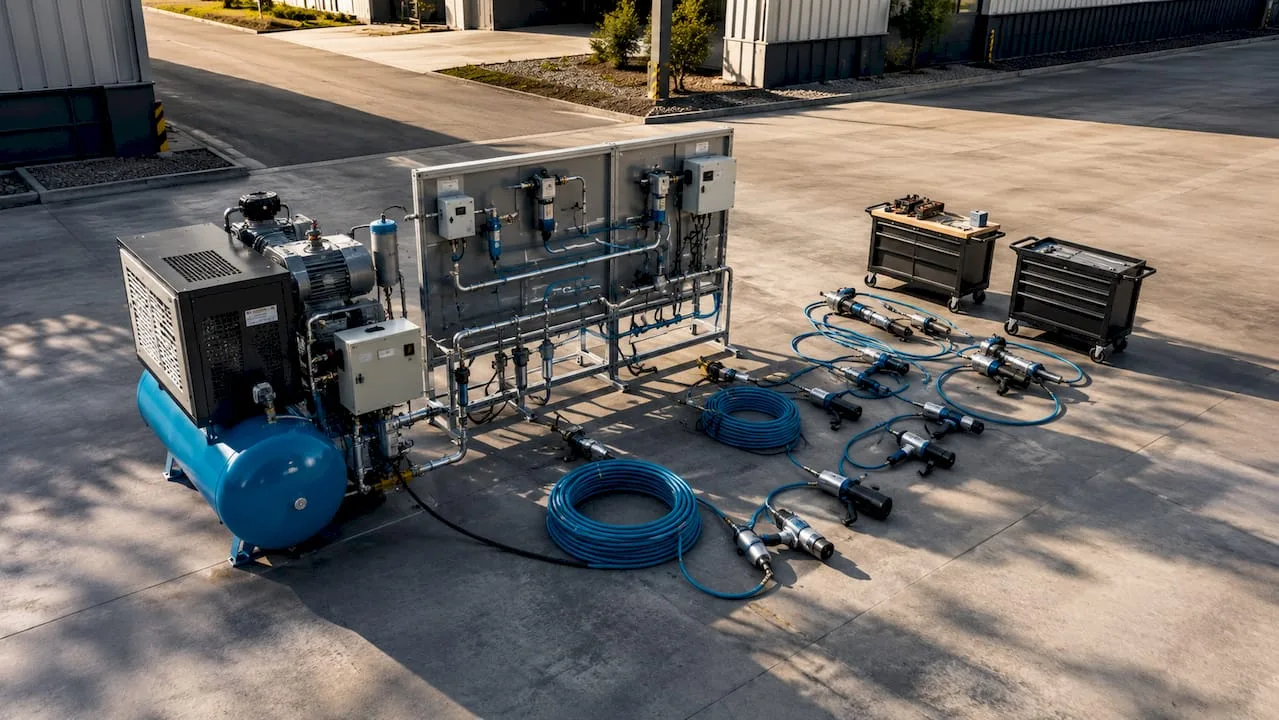
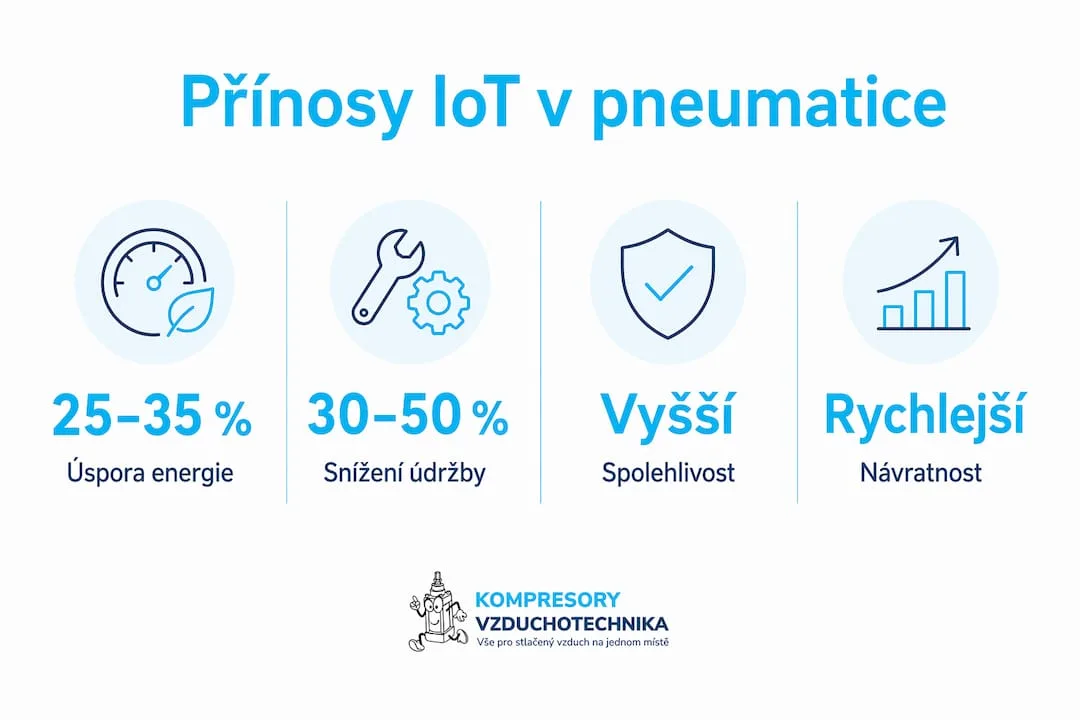
The role of IoT in pneumatic systems is defined as the connection of physical components through intelligent sensors, communication protocols, and edge computing for automated monitoring, control, and predictive maintenance. In industrial practice, this technology is referred to as IIoT (Industrial Internet of Things), with IIoT differing from consumer IoT mainly in scalability, interoperability, and low latency. IIoT deployment in pneumatics brings demonstrable results: energy savings reach 25–35%, and system reliability increases by 40–60%. These figures are not theoretical. They come from real industrial deployments where sensors, digital twins, and correctly selected protocols have replaced reactive maintenance with systematic control.
How IoT sensors and protocols work in pneumatic systems
The foundation of every intelligent pneumatic system consists of three types of sensors: pressure, flow, and temperature. Each type serves a different function and generates a different data stream.
- Pressure sensors measure operating pressure in piping and valve blocks. A deviation from the set value indicates a leak or seal wear.
- Flow sensors monitor air consumption in real time. Modern flow sensors store data locally for up to 8 days and transmit it via MQTT and OPC UA protocols. This function ensures data continuity even during a network outage.
- Temperature sensors detect overheating of compressors and drives. Excessive temperature anticipates a failure before it manifests mechanically.
Choosing a communication protocol determines the costs
Choosing the wrong communication protocol increases costs and reduces the efficiency of the entire system. IO-Link is more suitable for simple applications, where direct sensor-to-control-system communication with minimal infrastructure is sufficient. OPC UA, on the other hand, ensures interoperability in enterprise integrations, where the pneumatic system communicates with MES or ERP platforms. MQTT excels in applications with a high data volume and a requirement for low latency, typically when synchronizing multiple production lines.
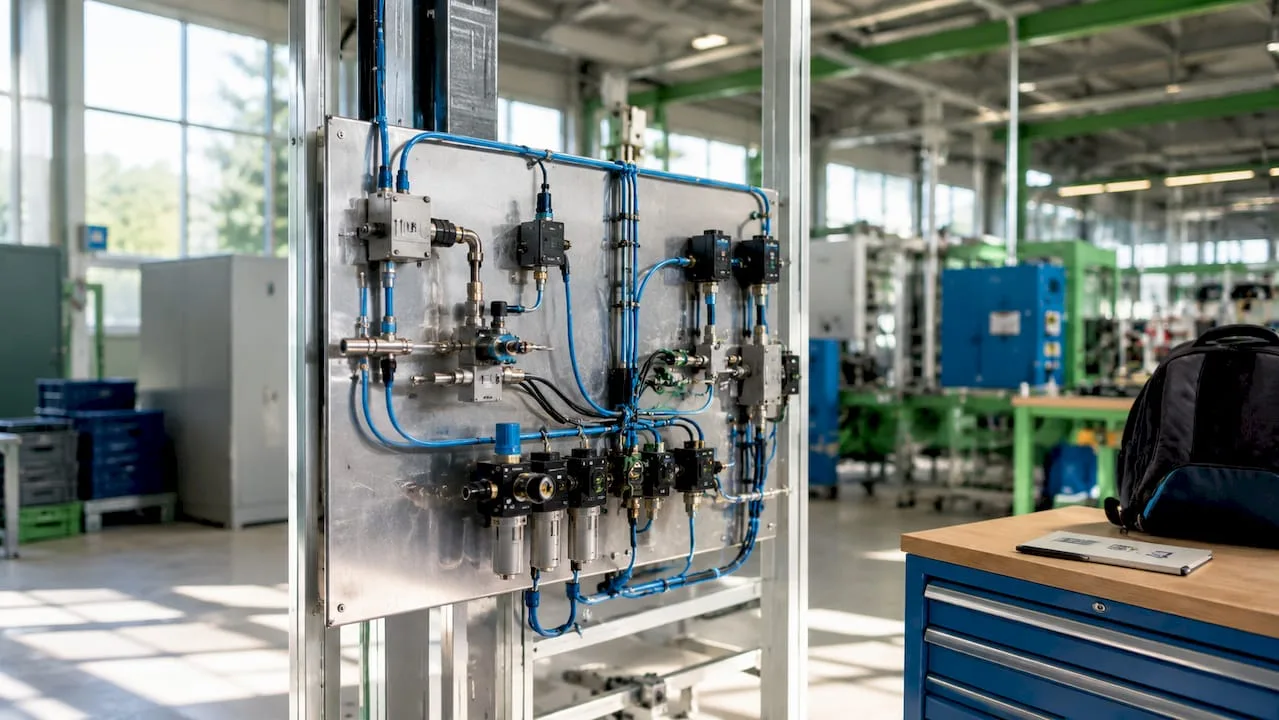
Real-time data visualization takes place via industrial SCADA systems or cloud dashboards. The technician sees current pressure, flow, and temperature on a single screen and can respond to anomalies immediately.
Digital twins and simulation accuracy
A digital twin of a pneumatic system is a virtual model that replicates the behavior of the physical equipment. The simulation must account for air compressibility and seal friction so that the results match reality with an accuracy of over 95%. This accuracy makes it possible to test configuration changes virtually before physical intervention. The result is a reduction in development and project integration time of up to 50%.
Professional tip: Before deploying a digital twin, measure the actual system parameters under various operating conditions. A simulation calibrated on real data achieves significantly higher accuracy than a model based solely on catalog values.
An overview of air pressure measurement options and the selection of the right sensors for intelligent systems can be found in a separate guide.
What are the benefits of IoT for energy savings and maintenance?
IoT technology is changing the way industrial companies approach energy efficiency and maintenance planning. The results are measurable and repeatable.
| Area of benefit | Result of IoT deployment | Mechanism |
|---|---|---|
| Energy consumption | Reduction of 25–35% | Precise control of pressure and flow according to current needs |
| Maintenance costs | Reduction of 30–50% | Transition from time-based to condition-based maintenance |
| System reliability | Increase of 40–60% | Early anomaly detection and predictive interventions |
| Project integration time | Reduction of up to 50% | Digital twins and thermodynamic simulations |
Traditional time-based maintenance operates on the principle of fixed intervals regardless of the actual condition of the equipment. The technician replaces a filter or seal after a specified number of operating hours have elapsed, even though the component is still functional. IoT replaces this approach with condition-based maintenance: intervention occurs when sensor data indicates actual wear.
"Transitioning to condition-based maintenance through IoT reduces maintenance costs by 30–50% and increases system reliability by 40–60%."
Predictive diagnostics goes even further. Algorithms analyze trends in the data and predict failures before they occur. For example, a gradual decrease in flow at constant pressure signals filter clogging or an emerging leak. The technician receives an alert with sufficient advance notice for a planned intervention outside peak production hours. The result is higher availability of the production line and lower costs for unplanned repairs.
The long-term ROI of deploying IIoT in pneumatics depends on proper calibration of alarm threshold values and on the quality of the data model. A system that generates too many false alarms loses the operator's trust. Conversely, a system with overly lenient thresholds will miss actual faults.
How to successfully integrate IoT into pneumatic systems?
Successful integration of IIoT into pneumatic systems requires a systematic approach. The most common mistakes arise from underestimating the compatibility of existing infrastructure and from incorrect selection of communication protocols.
-
Compatibility assessment is the first step. Check whether existing PLCs and control systems support industrial communication protocols. Older devices without IO-Link or OPC UA interfaces require protocol converters. Correct selection of converters shortens integration time and reduces maintenance costs.
-
Defining the use case before selecting technology. First determine what you want to measure and what decision you will make based on the data. Collecting data without a clear purpose does not bring value. Without the right context, IoT data is of little use for optimizing production processes.
-
IT/OT convergence and security. Connecting operational technology (OT) with information systems (IT) opens up new vectors for cyber threats. Network segmentation, communication encryption, and regular firmware updates are basic requirements, not optional extras.
-
Pilot project on a single line. Start with a single production node, verify functionality, and only then scale up. IIoT is a continuous process requiring data management and scalability from the start, not a one-off project.
-
Data management and data model. Raw data without context has no value. Each data point must be related to a specific machine, order, and operating state. Only then can the data be used to optimize processes.
-
Scaling plan. The system architecture must account for expansion from the start. Adding further sensors or production nodes must not require a complete redesign of the infrastructure.
Professional tip: When selecting a communication protocol, do not start from the technology, but from the latency and data volume requirements. For simple sensors at the machine level, IO-Link is sufficient. For integration with the enterprise ERP, choose OPC UA. Combining both protocols within a single architecture is common and functional.
The fundamentals of pneumatic automation and the principles of controlling pneumatic systems in production are described in detail in a separate guide.
Practical applications of IoT in industrial pneumatics
Intelligent pneumatic systems find application in specific operational scenarios, where direct connection of sensors with the control layer brings measurable results.
- Real-time monitoring of air consumption makes it possible to identify leaks and inefficient consumption at the level of individual machines. A flow sensor with local data storage detects nighttime consumption during idle production, which typically signals a leak in the piping.
- Predictive maintenance of actuators and valves works based on analysis of pressure and flow trends. The system alerts to seal or valve wear before a production line failure occurs.
- Synchronization of pneumatic movements with the production line is key in applications with precise timing, for example during assembly or packaging. The IoT layer ensures that the pneumatic actuator responds to a signal from the production system with minimal latency.
- Integration with MES and ERP systems connects data from pneumatic sensors with production planning. The production manager sees actual machine availability and can plan capacities more accurately.
- Remote diagnostics and device management allows a technician to check the system status without being physically present at the machine. This function reduces the cost of service visits and shortens the response time to faults.
The trend for 2026 is heading toward direct communication between sensors and intelligent control for synchronization with production and minimizing downtime. This architecture, referred to as smart pneumatics, eliminates intermediate layers and reduces latency to a minimum.
An overview of current trends in pneumatic tools and their impact on production efficiency is available in a separate article.
Key findings
IoT in pneumatic systems delivers proven energy savings, reduces maintenance costs, and increases reliability, provided the integration is built on the right data model and suitably chosen communication protocols.
| Point | Details |
|---|---|
| Energy savings | Deployment of IoT reduces the energy consumption of pneumatic systems by 25–35% thanks to precise pressure control. |
| Condition-based maintenance | The transition from time-based to condition-based maintenance reduces costs by 30–50% and increases reliability by 40–60%. |
| Protocol selection | IO-Link is used for simple applications, OPC UA for enterprise integrations with MES and ERP systems. |
| Data context | Raw data without a relationship to machine status and order has no value for process optimization. |
| Pilot approach | IIoT integration starts on a single line with a clear use-case and only then is scaled to the entire operation. |
Practical experience: what works and what doesn't
While working with pneumatic systems in industrial operations, I have repeatedly seen the same pattern. A company invests in sensors and communication infrastructure, starts collecting data, and after three months finds that nobody is using the data. The problem is not the technology. The problem is the absence of a data model and clear responsibility for interpreting the results.
The most successful implementations I have observed had one thing in common: they started with one specific question. For example: „Where in the piping are we losing compressed air overnight?" This question defined which sensors were needed, where to place them, and how to interpret the results. Only after answering the first question was the system expanded to predictive maintenance and integration with MES.
The second typical mistake is underestimating IT/OT convergence. Operations technicians and the IT department have different priorities and different vocabulary. Without coordination, security gaps or duplicate infrastructure arise. I recommend appointing a single project coordinator who understands both worlds.
The investment in IIoT pays off, but not automatically. It pays off when data is properly contextualized, protocols correctly chosen, and the team prepared for continuous system management. Pneumatics is a physical technology with precisely measurable parameters. IoT turns it into a system that learns and improves. That is real value, not a marketing promise.
— Zdeněk
Pneumatic components for IoT-ready systems
Quality physical infrastructure is a prerequisite for any successful IoT integration. Sensors measure accurately only when the piping is airtight, the air is properly treated, and the components are in good condition.
Kompresory-vzduchotechnika offers a range of components directly suitable for industrial IoT applications. Compressed air distribution tubing with push-in fittings ensures airtight and easily expandable piping, which is the foundation of reliable flow measurement. Air treatment units maintain the quality of compressed air at a level that protects sensors and actuators from premature wear. The Kompresory-vzduchotechnika team provides technical advice on selecting components for specific operating conditions and requirements for integration with IoT systems.
Frequently asked questions
What is IIoT and how does it differ from IoT in pneumatics?
IIoT (Industrial Internet of Things) is the industrial variant of IoT with higher scalability, reliability, and low latency. In pneumatics, it ensures safe real-time control that consumer IoT does not provide.
Which sensors are essential for monitoring pneumatic systems?
The basic set includes pressure, flow, and temperature sensors. Flow sensors with local data storage and transmission via MQTT or OPC UA cover most operational requirements.
Which communication protocol should be chosen for a pneumatic IoT system?
IO-Link is suitable for simple applications at the sensor level. OPC UA ensures interoperability when integrating with enterprise MES and ERP systems. The choice depends on the complexity of the architecture and the data flow requirements.
How quickly does the investment in IoT in pneumatics pay off?
The exact payback period depends on the scope of deployment and the initial state of the system. Condition-based maintenance reduces costs by 30–50 %, and energy savings reach 25–35 %, which typically ensures a payback period of under two years for medium-sized operations.
How to start integrating IoT into an existing pneumatic system?
Start with a pilot project on a single production line with a clearly defined use case. Verify the compatibility of existing control systems, choose a suitable communication protocol, and only scale to the entire operation once the results have been verified.
Recommended
- Pneumatic systems explained: a guide for technicians - Kompresory-Vzduchotechnika.cz
- What is pneumatic automation: a guide for industry - Kompresory-Vzduchotechnika.cz
- Why use pneumatics: efficiency, speed and safety - Kompresory-Vzduchotechnika.cz
- How to Safely Use Pneumatic Tools: A Guide - Kompresory-Vzduchotechnika.cz