


TL;DR:
- In 2025, pneumatic tools are characterized by compact design, lighter materials, and IoT sensors enabling predictive maintenance. Key innovations include flexible articulated constructions, advanced materials, and the integration of IoT technologies to increase efficiency and reliability. Proper selection and regular maintenance ensure long service life and optimal performance of systems in industry and service applications.
Pneumatic tools in 2025 are defined by three key shifts: compact construction for working in confined spaces, integration of intelligent sensors for predictive maintenance, and advanced materials reducing weight while maintaining performance. Models such as the ZIW340FA and ZIW410FA from China Pneumatic Corporation show where the development of pneumatic tools in industry, construction, and automotive service is heading. IoT integration enables real-time monitoring of tool condition, which reduces unplanned downtime and extends the lifespan of the entire system. The new generation of pneumatic tools brings measurable benefits for operational efficiency, which is why an overview of current technologies is essential for every professional who wants to keep their operation competitive.
What are the main innovations affecting pneumatic tools in 2025?
The development of pneumatic tools over the past two years has brought several technological shifts that have a direct impact on productivity in industrial operations. These are not cosmetic changes. They are fundamental structural redesigns of the tools.
Key innovations include:
- Dual-Flex articulated construction. China Pneumatic Corporation has introduced the ZIW340FA and ZIW410FA angle impact wrenches with two flexible joints. These models allow access to places where standard impact wrenches physically cannot fit, for example behind vehicle engines or inside body frame profiles.
- Advanced materials. Composite tool bodies made of aluminum alloys and engineering plastics reduce weight by 15 to 25% compared to older steel constructions. Lower weight directly reduces operator fatigue during repetitive work.
- Intelligent sensors and IoT. The integration of IoT sensors into pneumatic tools enables monitoring of pressure, temperature, and the number of work cycles. Predictive maintenance based on this data reduces the risk of unexpected failures on critical production lines.
- Ergonomics and safety. New models include non-slip surfaces, vibration damping, and ergonomically shaped handles. These features directly affect compliance with occupational health and safety standards and reduce the risk of occupational diseases caused by vibration.
- Energy savings. Modern 2025 pneumatic technologies operate with optimized airflows that reduce compressed air consumption while maintaining performance.
Professional tip: When acquiring new tools with IoT functions, verify the compatibility of their communication protocol with your existing production management system. Incompatible systems mean that data from the sensors will remain unused.
Trends in pneumatic tools clearly show that the future belongs to tools that are not only more powerful but also "smarter" and better adapted to specific applications. Automation of pneumatic tools is ceasing to be the privilege of large manufacturing plants and is becoming accessible to medium-sized service centers and workshops as well.

How to choose the right pneumatic tools for industry and service?
Choosing pneumatic tools without the correct technical foundation leads to undersized or oversized tools, with negative impacts on operation in both cases. The correct selection process is based on specific calculations and knowledge of the application.
- Calculate the required force. The calculation of force F = P × A is the basic step in sizing a pneumatic actuator. Add a safety factor of 25 to 30% to the result due to friction and system losses. This procedure ensures that the tool will operate in the optimal performance range, not at the limit of its capabilities.
- Define the type of application. Light assembly in electronics requires different parameters than heavy industrial assembly or truck servicing. Torque, rotation speed, and tool dimensions must match the specific work task.
- Choose the correct type of drive. Rodless cylinders save space and allow longer strokes in compact automated machines, but have lower side load capacity. For applications with high side loads, conventional cylinders with profiled rods or external guide systems are more suitable.
- Compare the parameters of the models. When choosing between models, pay attention to torque, air consumption in l/min, working pressure in bar, and tool dimensions. These four parameters form the basis of comparison.
- Take accessibility and ergonomics into account. For working in confined spaces, for example in vehicle underbodies or inside machines, compact dimensions and an articulated design are key.
Professional tip: The performance of a pneumatic tool cannot be evaluated by price alone. Correct force calculation with a safety margin is crucial for maintaining the efficiency and service life of the entire system.
Comparison of tools by application
| Application type | Recommended tool | Key parameter |
|---|---|---|
| Automotive service, heavy-duty assembly | ZIW410FA angle impact wrenches | High torque, articulated head |
| Surface preparation, renovation | Pneumatic sandblasting gun | Nozzle type, air consumption |
| Grinding and cutting in the workshop | MSW pneumatic die grinder | Speed up to 25,000 rpm |
| Industrial automation | Rodless pneumatic cylinder | Stroke length, side load |
| Easy installation, electronics | Compact pneumatic screwdriver | Torque, precision |

Choosing the right tools for the application directly affects work speed, result quality, and maintenance costs. An overview of available models and their technical data can be found in the drive selection guide.
Where are the latest pneumatic tools used in practice?
Practical deployment of new pneumatic tools in industry, construction, and automotive service shows that technological innovations have a measurable impact on productivity and quality of work.
- Automotive service. Angle impact wrenches with Dual-Flex construction, such as the ZIW340FA and ZIW410FA models from China Pneumatic Corporation, enable tightening bolts in places standard tools cannot reach. A typical example is the assembly of chassis components or work in the engine compartment of compact vehicles, where access is limited to a few centimeters.
- Surface preparation and renovation. Pneumatic sandblasting guns use various nozzles and abrasive materials for effective removal of rust, old coatings, and dirt. Performance and air consumption depend on the type of gun and the chosen abrasive, with the correct combination directly affecting the speed and quality of surface preparation before further treatment.
- Industrial grinding and cutting. The MSW pneumatic die grinder, with a speed of up to 25,000 rpm and a set of grinding stones and cutting discs, covers a wide range of applications from fine weld grinding to rough cutting in metalworking. Ergonomic design and quick tool changes increase comfort during long-term use.
- Construction and structural assembly. Pneumatic nailers and staplers remain the standard on construction sites, where speed and reliability are emphasized. New models with lower weight and better recoil damping reduce worker fatigue during all-day operation.
- Industrial automation. Rodless pneumatic cylinders are used in compact automated lines where space is limited and longer strokes are required. Their deployment in packaging and assembly machines is growing as manufacturers seek to save space while maintaining performance.
The new pneumatic tools of 2025 bring specific benefits to users in these industries: shorter task completion time, reduced physical strain on operators, and higher repeatability of results. These factors directly translate into operating costs and the competitiveness of the operation.
How to extend the service life of pneumatic tools and ensure reliable operation?
Proper maintenance and system sizing are crucial for the service life of pneumatic tools. Most premature failures are not caused by wear, but by errors in operating practice, which are easily avoidable.
- Oversize the compressor's output. Compressor output must be oversized by at least 20% compared to the theoretical tool consumption. A pressure drop caused by an overloaded compressor reduces tool performance and leads to unplanned downtime. A screw compressor with reserve output is standard for industrial operations with multiple tools.
- Regularly inspect and replace seals. Leaks in compressed air distribution cause a pressure drop and increase energy costs. Seal inspection should be part of a regular monthly check.
- Lubricate moving parts. Pneumatic tools with moving metal parts require regular lubrication with oil designed for pneumatic tools. Insufficient lubrication is the most common cause of premature wear in rotary tools.
- Clean and dry the compressed air. Moisture and impurities in compressed air damage the internal components of tools. Installing water separators and filters on the distribution system is a basic requirement for reliable operation.
- Monitor operating parameters using sensors. For tools equipped with IoT sensors, use data on cycle count and temperature to plan preventive maintenance. A predictive approach is significantly cheaper than reactive repairs after a failure.
- Choose the right accessories. Selecting a cylinder with anti-rotation protection must take into account load, space constraints, and required precision. Unsuitable accessories shorten the service life of the entire system.
Professional tip: The most commonly overlooked step in maintenance is checking safe tool usage and the condition of air hoses. A cracked or worn hose causes pressure losses that manifest as "weak tool performance," even though the tool itself is fine.
The efficiency of pneumatic tools depends on the entire system, not just the tool itself. The compressor, distribution system, air treatment, and regular maintenance form a whole, in which every link affects the resulting performance.
Key takeaways
Pneumatic tools in 2025 achieve the highest efficiency when they are correctly sized, regularly maintained, and selected according to the specific application using current technologies.
| Point | Details |
|---|---|
| Compressor sizing | Oversize the compressor output by at least 20% compared to the nominal tool consumption. |
| Calculating actuator force | Use the formula F = P × A and add a safety factor of 25 to 30% for reliable operation. |
| Tool selection according to application | Articulated wrenches for confined spaces, die grinders for grinding, sandblasting guns for surface preparation. |
| IoT and predictive maintenance | Sensors in tools enable maintenance to be planned before a failure occurs, not after. |
| Regular system maintenance | Checking seals, lubrication, and air cleanliness are crucial for tool service life. |
Pneumatics in practice: what really determines performance
I have been working with pneumatic tools and systems for many years, and I repeatedly encounter the same problem: operators invest in quality tools but neglect the system that powers them. They buy a powerful impact wrench, but the compressor cannot cover peak consumption when multiple tools are running simultaneously. The result is predictable. The tool underperforms, the operator complains about "weak tools" and the fault is looked for in the wrong place.
The second recurring problem is underestimating ergonomics. New models with composite bodies and vibration damping are not just a marketing feature. These are tools that reduce the risk of occupational diseases and maintain operator productivity throughout the entire shift, not just in the first two hours. Investment in ergonomically better tools pays off in lower sickness rates and higher quality of work.
What really interests me about the current development of pneumatic technologies 2025 is IoT integration. Predictive maintenance based on sensor data is an approach the industry knows from large machines. Transferring it to hand tools is a logical step, but it requires operators to have a system for collecting and evaluating data. Without this, sensors are pointless. I recommend starting simply: track the number of work cycles and plan replacement of wear parts based on data, not estimation.
The future of pneumatic tools belongs to tools that are smarter, lighter and more adaptable. But the fundamentals remain the same. Correct sizing, clean and dry air, regular maintenance. Technology has not abolished these fundamentals. It has only added new possibilities to them.
— Zdeněk
Equip your operation with Kompresory-vzduchotechnika
Kompresory-vzduchotechnika offers a complete range for professional pneumatic operations: from SCR screw compressors with reserve power for industrial applications to air treatment units ensuring clean and dry air for reliable tool operation.
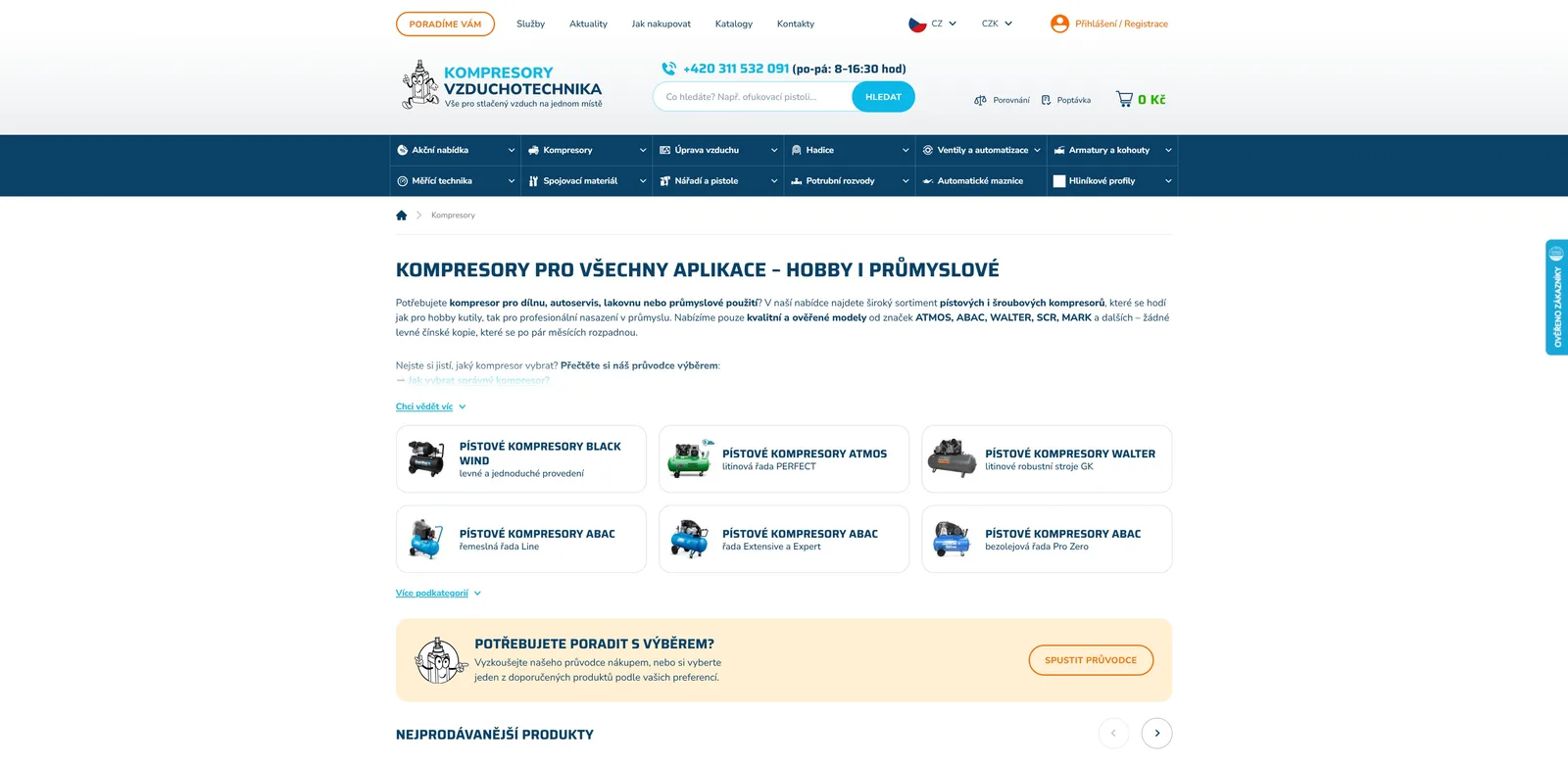
The range also includes compressed air distribution systems, M7 pneumatic guns for surface preparation, and complete accessories for installation and service. The Kompresory-vzduchotechnika team provides expert technical advice on component selection and system sizing. Contact us or visit the website for an overview of the current offer and technical specifications of the products.
FAQ
What are pneumatic tools in 2025?
Pneumatic tools in 2025 are tools powered by compressed air, equipped with advanced materials, compact design, and in new models also IoT sensors for monitoring operation. Compared to older generations, they offer lower weight, better ergonomics and higher performance with lower air consumption.
How to choose the right pneumatic tool for industrial operation?
The selection is based on calculating the required force using the formula F = P × A with a safety factor of 25 to 30%, the type of application, and the required parameters such as torque and tool dimensions. Comparing models based on air consumption and working pressure is essential before every purchase.
Why is it necessary to oversize the compressor by 20%?
An overloaded compressor causes a drop in operating pressure, which reduces tool performance and leads to unplanned downtime. Oversizing by at least 20% compared to the nominal tool consumption ensures stable pressure even under peak load.
What are the advantages of rodless cylinders in industrial automation?
Rodless cylinders save space and allow longer strokes in compact automated lines, but they have a lower side load capacity than conventional cylinders. For applications with high side loads, cylinders with profiled rods or external guide systems are more suitable.
How do IoT sensors improve the operation of pneumatic tools?
IoT sensors integrated into pneumatic tools monitor pressure, temperature, and the number of operating cycles in real time. This data enables predictive maintenance, which reduces the risk of unexpected failures and extends tool lifespan in critical industrial conditions.
Recommended
- How pneumatics works: a complete guide for industry 2026
- What is pneumatic automation: a guide for industry - Kompresory-Vzduchotechnika.cz
- Pneumatic spring cylinder: principle, specifications and use - Kompresory-Vzduchotechnika.cz
- What is pneumatic lubrication: a guide for technicians - Kompresory-Vzduchotechnika.cz