

TL;DR:
- A professional spray gun is designed for the even application of paints, varnishes and stains over large surfaces, and depends on the nozzle diameter, the bowl volume and the working pressure. Choosing the right type, for example HVLP or airless, affects work efficiency and material consumption on different types of surfaces. Quality spray guns from brands such as DeVilbiss, Sata, Iwata or Walther Pilot ensure precision, long service life and professional results.
A professional spray gun is defined as a pneumatic or electric device designed for the even application of paints, varnishes and stains over large surfaces with controlled material flow. The correct choice from the available list of professional spray guns depends on three key parameters: nozzle diameter, bowl volume and working pressure. Brands such as DeVilbiss, Sata, Iwata or Walther Pilot are among the reference manufacturers in the field. This overview provides a technically grounded comparison of models and types for professional craftsmen and painters who need reliable equipment for everyday work.
1. Key types of spray guns and their technical parameters
Professional spraying equipment is divided into four main categories: HVLP, LVLP, APS and airless. Each technology has different compressor requirements and different results on the surface. Choosing the right technology is the basis for efficient work without unnecessary material losses.
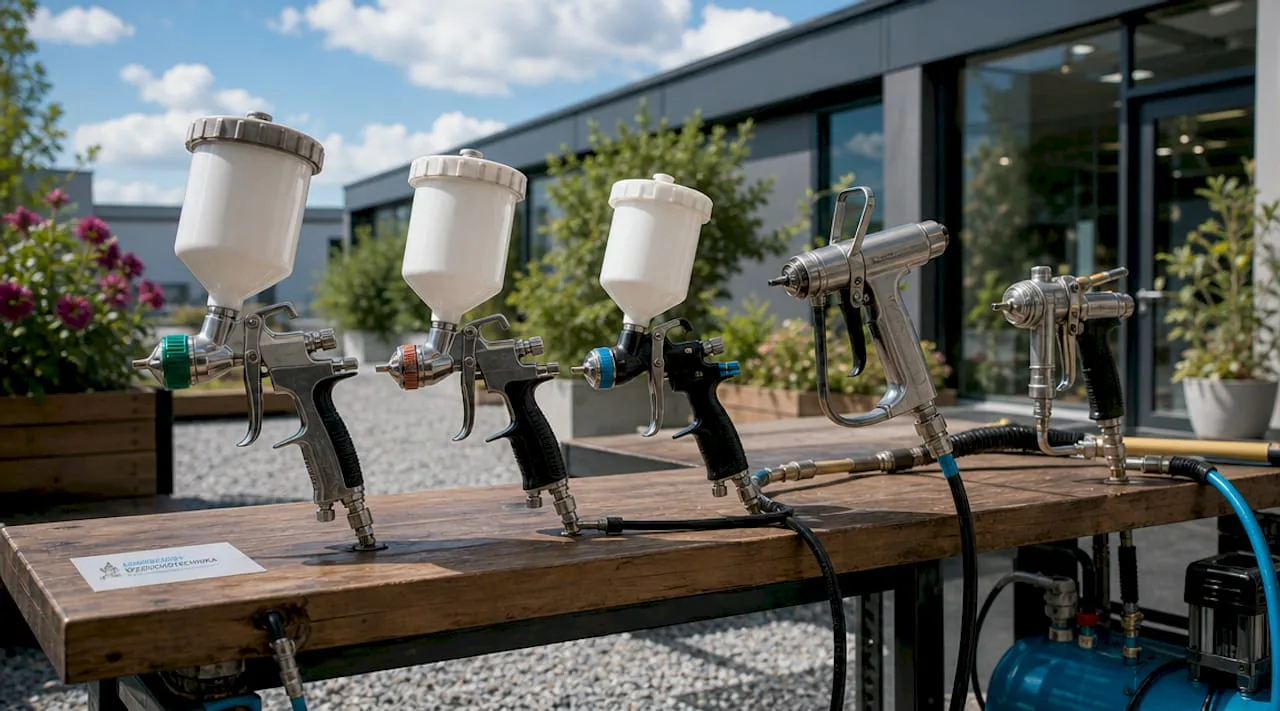
HVLP (High Volume Low Pressure) works with a high volume of air and low output pressure. This technology achieves high material transfer efficiency, typically 65 to 85%, and minimizes waste from atomization. HVLP spray guns are the standard in car body shops and joinery workshops.
LVLP (Low Volume Low Pressure) combines a low volume of air with low pressure. The advantage is lower air consumption compared to HVLP, so these spray guns also work with less powerful compressors. They are suitable for fine painting and work in smaller workshops.
APS (Air Pressure Spray) is a conventional technology with higher working pressure. It provides a very fine spray and fast application, but with higher material waste. It is used where speed and surface fineness are the priority.
Airless spray guns work without compressed air. The material is pushed by a pump directly through the nozzle at high pressure. They are ideal for large surfaces and dense materials such as facade paints or primers.
Professional HVLP, LVLP, APS spray guns have a working pressure of 3 to 6 bar and air consumption of 160 to 300 l/min. This means that for stable spraying you need a compressor with an output of at least 200 l/min and a tank of at least 50 litres.
| Technology | Working pressure | Air consumption | Typical use |
|---|---|---|---|
| HVLP | 1.5 to 3 bar | 200 to 300 l/min | Paints, varnishes, car paint shops |
| LVLP | 1.5 to 2.5 bar | 160 to 220 l/min | Fine paints, smaller workshops |
| APS | 3 to 6 bar | 200 to 350 l/min | Fast application, industry |
| Airless | without air | pump | Facades, primers |
Professional tip: For selecting the nozzle diameter, a direct rule applies: nozzles 0.5 to 1.4 mm are intended for paints and thin materials, while nozzles 1.7 to 2.5 mm are for thick decorating paints and primers. A bowl volume of 0.5 to 0.8 l is the optimal compromise for most professional work.
2. Ten best professional spray guns: model comparison
The following overview includes models that have proven themselves in professional operation. Each model is evaluated according to technical parameters, typical use, and performance-to-price ratio.
DeVilbiss GTi Pro Lite
DeVilbiss GTi Pro Lite is an HVLP gun designed for car paint shops and fine painting. The nozzle is available in diameters of 1.2, 1.3, and 1.4 mm. The gun body is made of anodized aluminum, with a weight of approximately 490 g. The gun is popular for its exceptionally even spray pattern and low paint consumption.
Sata Jet 5000 B HVLP
Sata Jet 5000 B is the reference model for professional painters. It offers nozzles from 1.2 to 1.8 mm and an ergonomic body with precise flow regulation. Air consumption is approximately 220 l/min at a pressure of 2 bar. Sata is synonymous with precision and long service life in demanding operation.
Iwata LPH-400
Iwata LPH-400 is a Japanese-made HVLP gun with a 1.3 or 1.4 mm nozzle. It features exceptionally fine atomisation of material and low paint consumption. The gun is popular in car paint shops as well as in industrial painting thanks to precise air cap regulation.
Walther Pilot WA 500
Walther Pilot WA 500 is an industrial HVLP gun with a nozzle of 1.4 to 2.0 mm. It is suitable for painting furniture, metal structures and industrial parts. The body is made of durable aluminium, the bowl has a volume of 600 ml. The gun can handle both thinned paints and thicker primers.
Kinekus Profi Jet S
Kinekus Profi Jet S is an HVLP gun with a 1.4 mm nozzle, working pressure of 3 to 6 bar and a 600 ml bowl. Air consumption of 160 to 300 l/min places it in the category of guns for powerful compressors. It is an affordable choice for tradespeople looking for a reliable basis for everyday work.
Graco Finishline 4 FLX
Graco Finishline 4 FLX is an HVLP gun with an adjustable nozzle from 1.0 to 1.8 mm. It allows spraying of both water-based and solvent-based materials. The bowl has a volume of 1 litre, the body is made of durable polymer. Graco is popular in carpentry workshops and for furniture painting.
Wagner Control Pro 350 M
Wagner Control Pro 350 M is an electric airless gun designed for facade paints and primers. It works without a compressor, the pump generates pressure of up to 210 bar. The 0.023 inch nozzle (approximately 0.58 mm) ensures fine atomisation even with thick materials. The gun is suitable for large areas and fast application.
Electric HVLP gun 1200 W
The electric HVLP gun from one of the premium global brands has a power input of 1200 W. The nozzle is adjustable from 1.8 to 3.0 mm, and the bowl has a capacity of 1.5 l. The gun handles paints, varnishes, and stains without the need for a compressor. It is a practical choice for craftsmen who do not work with a pneumatic system.
HIGH-END Z10507 cordless gun
The Z10507 cordless gun with a 36V Li-Ion battery, a bowl capacity of 800 ml, and a power of 800 W provides freedom of movement without being limited by a cable or hose. This technology is suitable for work on scaffolding, roofs, or in areas without an air supply. The uniform spray pattern is comparable to lower-class pneumatic guns.
Fuji Semi-PRO 2 HVLP
The Fuji Semi-PRO 2 is a turbine HVLP gun with its own turbine instead of a compressor. The working pressure is stable regardless of the hose length. The nozzle is available in diameters from 1.0 to 1.8 mm, and the bowl has a capacity of 400 ml. The gun is popular for furniture finishing and detail work, where precision is key.
Professional tip: When choosing a gun for an auto body shop, always check the compatibility of the air cap with the nozzle. An incorrect combination causes asymmetric atomization, which shows up as streaks on the surface.
3. How to choose a professional spray gun according to the type of work
The choice of gun depends primarily on the material you will be applying and the scope of work. There is no universal model for all situations.
For auto body shops and fine finishes, choose HVLP guns with a 1.2 to 1.4 mm nozzle. These guns provide the finest atomization and minimal material loss. The brands DeVilbiss, Sata, and Iwata are the standard in this segment.
For painting work and facade paints, guns with a 1.7 to 2.5 mm nozzle or airless systems are suitable. Correct paint viscosity is crucial for a flawless spray application. Professional painters measure viscosity with a viscometer before each spraying job.
When choosing, also consider the frequency of use. Guns for everyday professional use must have an easily disassemblable body and available spare parts. Cheap guns without service support can end up being more expensive than a pricier model with full manufacturer support.
Pneumatic guns require a powerful compressor. For stable operation with an HVLP gun, you need a compressor with a minimum air consumption matching the gun's parameters. Information on optimizing compressed air consumption will help you set up the system efficiently and reduce operating costs.
Procedure for correctly setting up the gun before work:
- Check the nozzle diameter and select the corresponding air cap.
- Set the working pressure on the compressor according to the gun manufacturer's recommendations.
- Measure the paint viscosity with a viscometer and adjust the consistency with thinner if necessary.
- Set the spray fan width and material flow rate on the gun.
- Perform a test spray on cardboard and check the pattern uniformity.
- Adjust the distance of the gun from the surface to 20 to 25 cm and maintain a perpendicular angle.
4. Comparing a spray gun with a roller: when to use which
A spray gun is more efficient than a roller for large areas. A roller, on the other hand, is faster and more practical for small or intricate spaces. This decision has a direct impact on working time and the resulting surface quality.
The gun applies material evenly and without tool marks. The resulting surface is smoother and more professional, especially with paints and enamels. However, preparation before spraying is more time-consuming: masking off surrounding surfaces, preparing the paint, and cleaning the gun after work takes longer than with a roller.
| Parameter | Spray gun | Roller |
|---|---|---|
| Speed on large surfaces | High | Medium |
| Surface quality | Very smooth | Slight texture |
| Preparation and cleanup | More demanding | Simple |
| Suitability for complex surfaces | Limited | High |
| Material consumption | Lower (HVLP) | Higher |
| Purchase cost | Higher | Low |
The choice between a spray gun and a roller depends on the scope of the job. For surfaces over 50 m², a spray gun always pays off. For small repairs or work in corners and behind radiators, a roller or brush is more practical.
Key findings
A professional spray gun requires the right combination of nozzle diameter, working pressure, and material viscosity to achieve a professional result without streaks or blotches.
| Point | Details |
|---|---|
| Nozzle diameter | Nozzles 0.5 to 1.4 mm for paints, 1.7 to 2.5 mm for thick paints and primers. |
| Spray gun technology | HVLP is the standard for car body shops, airless for façades and large surfaces. |
| Working pressure | Professional spray guns require a compressor with an output of 160 to 300 l/min and a pressure of 3 to 6 bar. |
| Material viscosity | Measuring viscosity with a viscometer before each spraying session prevents streaks and uneven surfaces. |
| Distance and angle | An optimal distance of 20 to 25 cm and a perpendicular angle of 90° are prerequisites for an even spray coat. |
Practical experience: what determines spray coat quality
I have worked with professional spray guns for years, and I can say that the biggest mistakes craftsmen make are not in choosing the gun, but in preparing the paint and setting up the equipment. A spray gun worth thousands of crowns won't help if the paint is improperly thinned or the pressure is set by guesswork.
Failure to maintain a distance of 20 to 25 cm and a perpendicular angle to the surface is the most common cause of streaks and uneven spraying. I see this repeatedly even with experienced craftsmen switching to a new gun model. Each gun behaves slightly differently, and the first spray should always be a test run on cardboard.
The second thing that gets underestimated is maintenance. A gun that is not thoroughly cleaned after every job will start clogging the nozzle and air channels. The result is dripping, uneven atomization, and eventually a damaged seal. Cleaning the gun takes 10 minutes and extends the equipment's lifespan by years.
As for choosing a specific model, I recommend starting with a spray gun that has an established service network and available spare parts in the Czech Republic. Sata, DeVilbiss, and Iwata meet this requirement. Cheaper models without service support may be tempting due to their price, but a breakdown during the season can halt your work for days.
— Zdeněk
Professional gun and accessory kits at Kompresory-vzduchotechnika.cz
Kompresory-vzduchotechnika offers professional craftsmen and painters a complete range of spray guns and pneumatic accessories. The selection includes guns for auto body shops, carpentry workshops, and industrial applications.
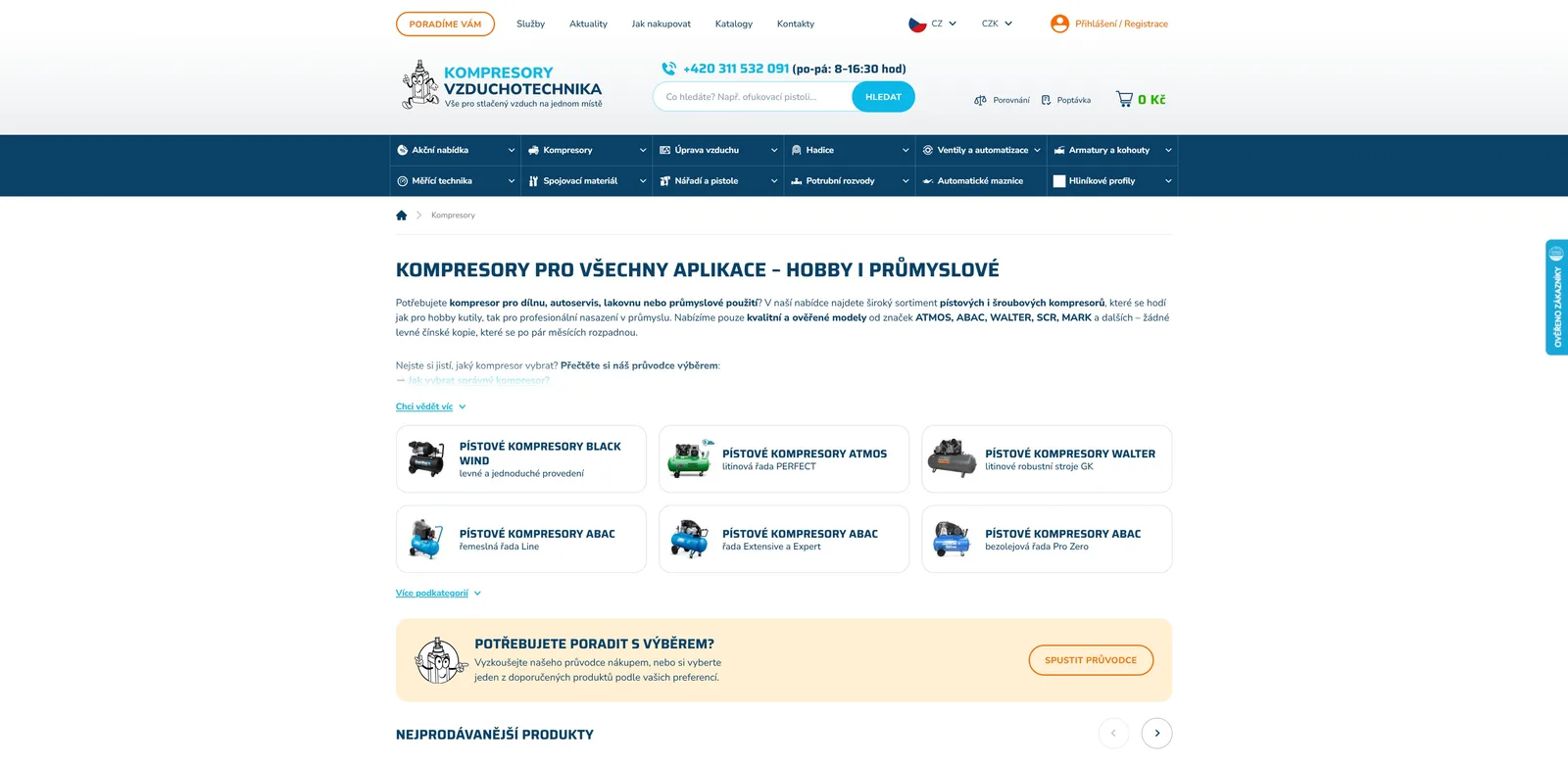
Professional gun kits intended directly for demanding operation are available on the Kompresory-vzduchotechnika.cz website. The range includes HVLP and LVLP guns as well as accessories for proper air treatment. The team of technical advisors provides support in selecting the right model according to specific working conditions. For an overview of the entire range of pneumatic tools, visit the website or contact technical support directly.
FAQ
What is an HVLP gun and why do professionals use it?
An HVLP (High Volume Low Pressure) gun works with a high volume of air and low output pressure, achieving high material transfer efficiency and minimal waste. Professionals prefer it for fine painting, auto body shops, and work where surface quality is key.
What compressor do I need for a professional spray gun?
Professional air guns have an air consumption of 160 to 300 l/min and a working pressure of 3 to 6 bar. For stable spraying, you need a compressor with a capacity of at least 200 l/min and an air tank of at least 50 liters.
What nozzle diameter should I choose for painting furniture?
For painting furniture and fine paints, nozzles of 1.0 to 1.4 mm are suitable. Nozzles of 1.7 to 2.5 mm are intended for thick paint colors and base coats on larger surfaces.
When is a roller better than a spray gun?
A roller is more practical for small areas, intricate spaces and quick repairs. A spray gun pays off on areas above 50 m², where it saves time and delivers a smoother finished surface.
How to properly maintain a professional spray gun?
After each use, completely disassemble the gun and clean all parts with thinner or a cleaning agent recommended by the manufacturer. Regular maintenance prevents nozzle clogging and extends the service life of both the seals and the entire device.
Recommended
- A guide to choosing pneumatic hoses for auto repair shops 2026 - Kompresory-Vzduchotechnika.cz
- What is pneumatic lubrication: a guide for technicians - Kompresory-Vzduchotechnika.cz
- M7 pneumatic washing, spray and sandblasting guns – surface preparation from washing to blasting
- The role of lubrication in a compressor: a guide for technicians - Kompresory-Vzduchotechnika.cz