
TL;DR:
- Compressed air is an expensive energy carrier and its leaks make up as much as 30 % of consumption.
- Carrying out an audit and regular checks makes it possible to reduce air consumption by up to 42 %.
- The elimination of leaks and the correct setting of pressure are the key to significant savings and a fast return on investment.
Compressed air is indispensable in industrial and construction plants, but it is also one of the most expensive energy carriers. The production of compressed air makes up 20 to 30 % of the total electricity consumption in many companies. Meanwhile a 1 mm leak at 7 bar means a loss of 1,2 l/s and annual costs of up to hundreds of euros. If dozens of joints, hoses and connections run in your plant without regular checks, you are overpaying every month without a visible reason. This guide will take you through specific steps from measuring consumption through eliminating leaks to setting the pressure and preventive maintenance, so that you achieve measurable savings with a fast return on investment.
Contents
- Preparation: How to find out the actual consumption and define goals
- Detection and elimination of leaks: the fastest way to savings
- Optimisation of the operating pressure: How to set the system correctly
- Regular maintenance and monitoring: Prevention of hidden losses
- Experience from practice: How to change the view of compressed air consumption
- Practical solutions and products for optimisation
- Most frequent questions about optimising compressed air consumption
Key findings
| Point | Details |
|---|---|
| An audit reveals losses | Without systematic monitoring and measurement you will never reveal the main sources of needless consumption of compressed air. |
| Leaks are the biggest threat | Even a small leak quickly increases costs; fast detection and repair means the fastest saving. |
| Optimising pressure saves energy | Reducing the operating pressure brings a saving without a negative influence on the performance of the end devices. |
| Maintenance and monitoring pay off | Regular service intervals and monitoring prevent hidden losses and reduce long-term costs. |
Preparation: How to find out the actual consumption and define goals
After you know why saving compressed air is fundamental, you have to find out how much you really consume and where the weak points are. Without specific data it is impossible to set realistic goals or evaluate the results of optimisation.
The first step is the choice of the right measuring point. Place the flow meter as close as possible to the compressor, ideally on the main line before the branching to the individual workplaces. Monitor the consumption for at least 7 to 10 days, because an audit of the system makes it possible to capture fluctuations in shift operation, weekend leaks and peak draws. A shorter measurement gives distorted results.
For accurate results we recommend monitoring these parameters:
- Total flow on the main line in l/s or m³/h
- Pressure in the network in each working section separately
- Consumption of the individual workplaces using sub-meter flow meters
- Night and weekend leaks with the machines shut down
- Switching frequency of the compressor as an indirect indicator of losses
Details of how to set up the whole process correctly can be found in the article about measuring air consumption.
After collecting the data it is advisable to compare the measured values with typical operating ranges. The table below shows the indicative air consumption for common industrial applications:
| Application | Pressure (bar) | Flow (l/s) | Annual costs (el. energy) |
|---|---|---|---|
| Hand-held pneumatic tools | 6 to 7 | 2 to 5 | low |
| Automated lines | 6 to 8 | 10 to 50 | medium to high |
| Painting and blasting workplaces | 4 to 6 | 5 to 20 | medium |
| Industrial cleaning | 5 to 7 | 3 to 10 | low to medium |
An audit of the system makes it possible to identify the actual need for air and leads to a reduction of consumption by up to 42 %. It is key to measure not only the total draw, but also the consumption of each workplace separately. Only then do you know where the biggest losses are and where it makes sense to invest in repairs or modernisation.
Detection and elimination of leaks: the fastest way to savings
After measuring consumption the most effective step is often the elimination of leaks, which are responsible for a large part of the energy losses. Leaks are insidious: they are not visible, but they cost money every hour of operation.
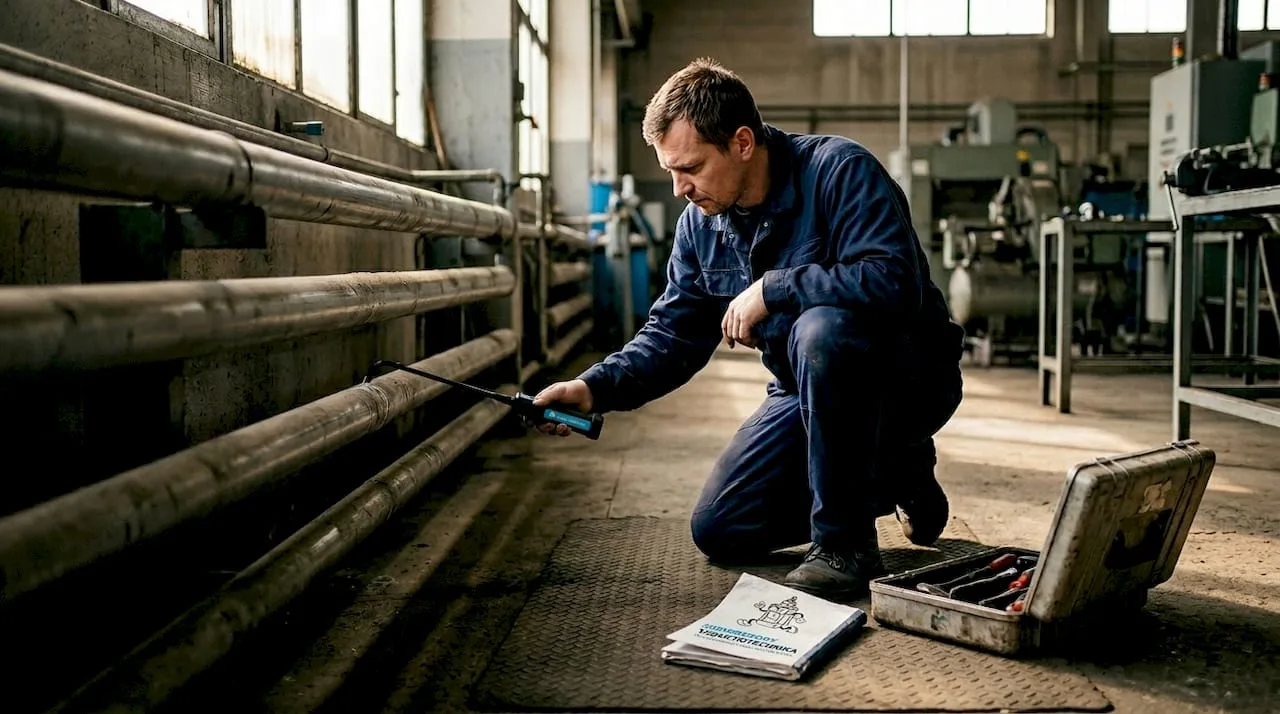
Typical leaks make up 20 to 30 % of the output of the compressor and a fast repair brings a return on investment often within a year. That is one of the best cost-benefit ratios in the whole area of energy optimisation.
There are three basic methods of detecting leaks:
- The foam test – apply a soap solution to joints, hoses and fittings. Bubbles reveal the exact place of the leak. The method is cheap, but time-consuming with extensive distribution systems.
- Ultrasonic detection – using an ultrasonic detector you catch even small leaks at a distance of several metres. Suitable for regular inspections in large plants.
- Listening check – with production shut down in a quiet plant small leaks can be heard. It works as a fast indicative method.
The table below shows how the size of a leak influences the annual costs:
| Diameter of the leak (mm) | Pressure (bar) | Loss (l/s) | Annual costs (estimate) |
|---|---|---|---|
| 1 | 7 | 1,2 | approx. 10 000 Kč |
| 2 | 7 | 4,8 | approx. 40 000 Kč |
| 3 | 7 | 10,8 | approx. 90 000 Kč |
| 5 | 7 | 30,0 | approx. 250 000 Kč |
For a systematic repair and monitoring we recommend proceeding as follows:
- Record every leak in a register with the exact place, size and estimated costs.
- Order the leaks by priority from the biggest loss to the smallest.
- Carry out the repairs in the shortest possible time, ideally during a planned shutdown.
- After the repair verify the result by a repeated measurement of the flow.
- Plan regular inspections, at least once a quarter.
A detailed procedure of how to repair an air leak in a compressor, and general principles for the elimination of compressed air leaks in pneumatic systems can be found in separate guides.
Professional tip: Introduce a register of leaks as part of the standard maintenance documentation. Record every new leak immediately after finding it and follow the trend. If the number of leaks grows despite regular repairs, it signals a degradation of the distribution system or unsuitable operating conditions.
Optimisation of the operating pressure: How to set the system correctly
After removing the leaks the next logical step is the adjustment of the operating pressure, which brings savings without further investment. Many plants run at a higher pressure than is really needed, and pay for every unnecessary bar.
By reducing the pressure by 1 bar you save approximately 7 % of the energy in the whole system. In a plant with annual energy costs of 50 000 Kč for the compressor that means a saving of 3 500 Kč a year for every bar by which you reduce the pressure. Without a single investment.
The most frequent mistakes in setting the pressure include:
- Oversizing the pressure for the whole distribution system because of a single machine with a higher requirement
- The absence of pressure regulators at the individual workplaces
- Setting the compressor to the maximum pressure regardless of the actual needs
- Ignoring pressure losses in the distribution, which lead to a needless increase of the pressure at the compressor
The procedure for optimising the pressure is straightforward. First map the pressure requirements of every end device. Then set the pressure of the compressor to the minimum needed for the most demanding device plus a reserve of 0,5 bar for losses in the distribution. At the other workplaces with lower requirements install reducing valves.
Detailed information about how the influence of the operating pressure influences the efficiency of pneumatic systems is available in a separate article.
Professional tip: Modern frequency-controlled compressors make it possible to adapt the pressure automatically to the current need, which brings savings of 15 to 35 % compared with a compressor with a fixed speed.
Regular maintenance and monitoring: Prevention of hidden losses
Even a well-set system cannot do without long-term care. It is precisely here that companies often lose money needlessly. Neglected maintenance gradually increases energy consumption without it being evident at first sight.
The preventive maintenance of a compressed air system includes these key areas:
- The intake filters of the compressor should be cleaned or replaced according to the manufacturer’s recommendation, usually every 500 to 1 000 operating hours. A clogged intake filter increases the power input of the compressor and reduces its output.
- Condensate separators and drains should be checked weekly, so that water does not accumulate in the system.
- Filters on the distribution should be replaced regularly, because clogged filters cause pressure losses and force the compressor to work at a higher pressure.
- Seals and joints should be checked visually at every planned shutdown.
Avoid the most frequent mistakes when using a compressor, which lead to premature wear and higher consumption. Quality intake filters for compressors and industrial filtration according to ISO are the basis of reliable and economical operation.
Regular maintenance of the filters and monitoring can significantly reduce consumption on shut-down machines. Clogged filters fundamentally increase the demands for energy.
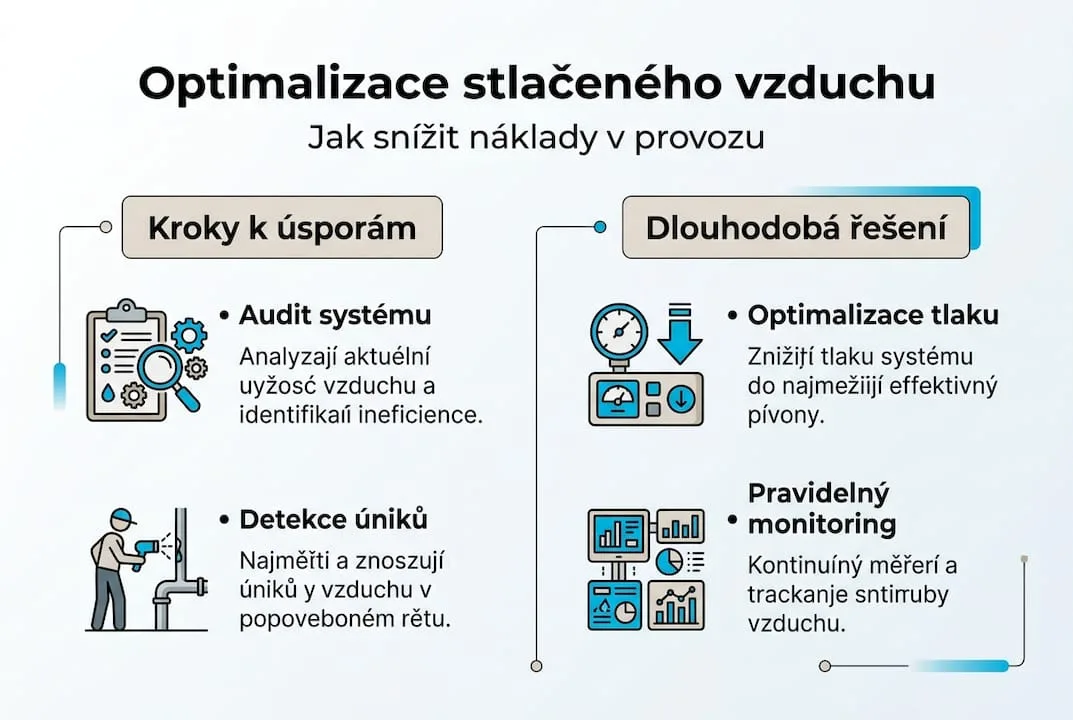
The introduction of continuous monitoring of consumption brings a fundamental advantage: you see immediately when consumption rises above normal and can react before the problem becomes expensive. If the indicator of air consumption increases, it signals either a new leak or a degradation of the equipment.
Experience from practice: How to change the view of compressed air consumption
In practice it turns out that one-off repairs of leaks bring a fast and visible saving, but without a systemic approach the losses gradually return. Companies which invest in trend monitoring of consumption achieve more sustainable results than those which deal with leaks only at a breakdown or an annual audit.
Energy costs make up 80 % of the total expenses on compressed air and savings of up to 50 % are achievable if the change is systemic. That is a figure worth the attention of every technical manager.
The key change we recommend is cultural, not just technical. Managers should convince the team that every leak deserves immediate attention and that regular evaluation of consumption is part of the standard operating routine, not an extraordinary action. The details about the importance of measuring consumption show why data decides more than intuition.
Practical solutions and products for optimisation
If you want to turn theory into effective practice, you can use products and solutions aimed at savings.
At Kompresory-vzduchotechnika.cz you will find a complete range for optimising the consumption of compressed air. From pneumatic tools with low demands on flow to economical screw compressors, where the savings of the SCR screw compressor reach tens of percent compared with piston alternatives. Do you need advice with the choice of meters, filters or dryers? Go to complete solutions for saving air and use the technical support of our specialists. We choose every solution according to the specific parameters of your plant.
Most frequent questions about optimising compressed air consumption
How quickly does the investment in repairing air leaks come back?
Usually within 6 to 12 months, because a fast repair of leaks often has a return within one year and even a small leak increases the costs by several thousand crowns a year.
What are the main benefits of an audit of the compressed air system?
An audit makes it possible to find out the real need for air as well as the losses and usually makes it possible to reduce consumption by up to 42 % thanks to the identification of specific causes of losses.
How much energy can be saved by reducing the operating pressure?
Reducing the pressure by 1 bar saves roughly 7 % of the energy in the whole system, without the need for any further investment.
What role do the maintenance of filters and dryers play?
Regular replacement of filters and checking of dryers minimises losses and prevents hidden costs, while energy monitoring can reduce consumption on shut-down machines by up to 90 %.
Recommended
- How to eliminate air leaks: a guide for a 42% energy saving - Kompresory-Vzduchotechnika.cz
- The function of an air receiver: how to increase the efficiency of pneumatic systems - Kompresory-Vzduchotechnika.cz
- Why measure air consumption: savings of up to 35 % of energy - Kompresory-Vzduchotechnika.cz
- Energy savings of the SCR screw compressor