

TL;DR:
- Choosing the right pneumatic connection affects the reliability of the whole system and minimises leaks or vibration.
- Selecting a suitable coupling type and clamp material is key to long service life and safe operation.
- Regular maintenance and inspection of connections significantly reduce costs and support trouble-free production.
The right choice of pneumatic connection determines the reliability of the entire compressed air system. Even so, the same mistakes keep recurring in industrial practice: the wrong coupling types, poorly sized clamps, or confusion between magnetic and mechanical connections in cylinders. The result is leaks, vibration and unplanned downtime. This article gives an overview of the types of pneumatic connections, explains the physical principles behind how they work, and offers specific recommendations for selection, installation and maintenance in industrial plants.
Contents
- Key takeaways
- Basic types of pneumatic connections
- How a pneumatic connection works
- Advantages and limitations of the individual connection types
- Installing pneumatic connections: best practices
- A personal view on selecting and maintaining connections
- Pneumatic connections and components from Kompresory-vzduchotechnika
- FAQ
Key takeaways
| Point | Details |
|---|---|
| The type of connection determines performance | The choice between a quick coupling, a hose coupling or a magnetic connection must match the operating conditions. |
| Clamp material affects service life | In corrosive environments, stainless steel is a necessity, not an option. |
| Incorrect fastening causes failures | Poorly tightened or unsuitable clamps are the most common source of leaks and vibration in pneumatic systems. |
| Mechanical connections transmit greater forces | Mechanical joint connections provide stable force transmission regardless of temperature or acceleration. |
| Regular maintenance extends service life | Systematic inspection of connections and fastening elements reduces operating costs and prevents breakdowns. |
Basic types of pneumatic connections
A pneumatic connection is any structural element that transfers compressed air or motion between two components of a pneumatic system. The function of the connection seems simple, but industrial applications place very strict technical demands on tightness, pressure resistance and vibration stability.
Quick couplings
Quick couplings allow hoses to be fitted without tools and considerably shorten service downtime. They are the standard solution wherever hoses or tools are frequently disconnected and reconnected, for example with air tools on assembly lines or in car workshops. The internal mechanism seals automatically on disconnection, so no pressure is lost from the system.
Hose couplings and clamps
Hose couplings form fixed connections between hoses and fittings or devices. To work properly they require fastening clamps matched to the hose diameter. Every hose coupling is potentially the weakest point of the system, and using clamps of the correct hose diameter is essential not only for tightness but also to prevent fatigue damage caused by vibration.

Mechanical and magnetic connections in cylinders
These two types are most often used in rodless pneumatic cylinders. They differ in the principle of motion transfer and in performance:
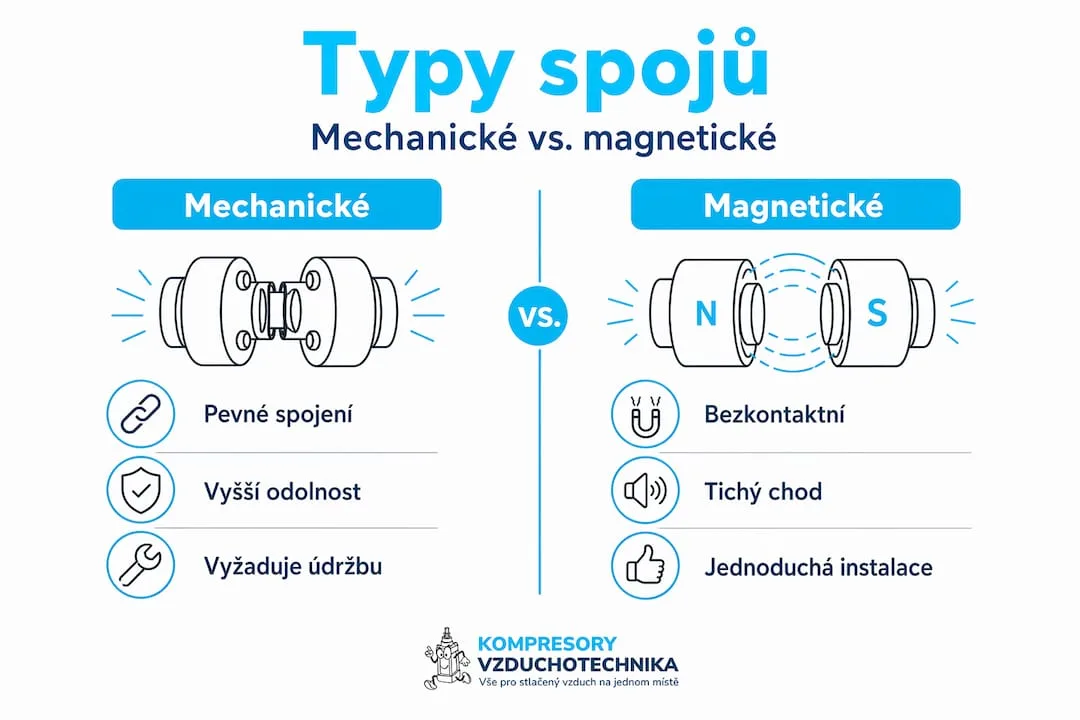
- Magnetic couplings: They use permanent magnets inside and outside the cylinder. Contactless motion transfer ensures smooth running with a damping effect.
- Mechanical joint connections: They transmit greater force than magnetic ones, with zero losses and immediate force transfer independent of temperature or acceleration.
Comparison of the main connection types
| Connection type | Main advantage | Limitation | Typical application |
|---|---|---|---|
| Quick coupling | Fast assembly without tools | Lower max. pressure than fixed connections | Air tools, servicing |
| Hose coupling with clamp | Firm and leak-tight connection | Requires correct assembly | Industrial compressed air lines |
| Magnetic coupling (cylinder) | Quiet running, shock damping | Limited force transfer | Lightly and moderately loaded cylinders |
| Mechanical joint connection | High force transfer | More prone to wear under overload | Heavily loaded rodless cylinders |
| Threaded coupling | Simple, durable | Slower assembly | Fixed pipe distribution systems |
How a pneumatic connection works
Transferring compressed air through a connection depends on three physical factors: the tightness of the joint, the flow cross-section and pressure resistance. Each of these factors directly influences the advantages of pneumatic systems in production.
Tightness and pressure losses
A poor-quality joint causes pressure losses that accumulate across extensive distribution systems. If the working pressure in the system drops below the operating minimum, air tools or cylinders stop working correctly. A temperature change of 6 °C alters the pressure in the system by roughly 0.06 bar per tyre, which illustrates how sensitive pneumatic systems are to ambient conditions.
Resistance to vibration
Vibration is one of the main enemies of pneumatic connections. It gradually loosens clamps, causes material fatigue and eventually leads to joint failure. Regular inspection of the fastening clamps is the key to suppressing vibration and keeping the whole pneumatic system stable.
Magnetic versus mechanical connections in practice
A magnetic coupling in a rodless pneumatic cylinder transfers motion without contact through the cylinder wall. It is quiet and requires no physical contact, but the force of the magnetic connection is physically limited. Under overload the magnet slips. A mechanical joint connection, by contrast, grips the guide firmly and transmits higher forces without slipping. Its design drawback is the need to distribute the load carefully to prevent premature wear of the guide.
Professional tip: If you are not sure whether a magnetic coupling is strong enough for a given application, calculate the required force from the mass of the load and the acceleration. Magnetic connections generally handle medium loads up to 500 N; above that value, choose a mechanical joint design.
Key operating aspects of a correct pneumatic connection:
- The maximum operating pressure must match the rated values of the coupling.
- The flow cross-section of the connection must not create a significant throttling loss.
- The sealing material must be compatible with the temperature of the medium and with the surrounding environment.
- Hose length affects the pressure drop; unnecessarily long hoses increase losses.
Advantages and limitations of the individual connection types
Choosing the right type of connection directly affects operating costs and production reliability. Incorrectly fastened couplings are the most common cause of leaks and vibration in industrial pneumatic systems. This fact is underestimated especially during rapid assembly, when technicians skip checking the tightening torque of the clamps.
Quick couplings: speed versus pressure limits
Quick couplings are ideal wherever service speed matters. Changing a tool or a hose takes seconds and needs no tools. Their limitation is usually a lower maximum working pressure compared with screwed or crimped couplings. In high-pressure applications above 16 bar they are therefore unsuitable.
Clamps: a detail with a big impact
The choice of clamp material is a detail that is overlooked in practice. Galvanised steel is sufficient for standard environments, but in the presence of chemicals, moisture or sea air it corrodes and loses its clamping force. In corrosive plants, choosing stainless steel clamps is a necessity for the long-term reliability of the joint.
Professional tip: When fitting a hose coupling, always check that the diameter of the clamp exactly matches the outer diameter of the hose. A clamp 2 mm larger than the hose will not provide the required clamping pressure and the joint will loosen under vibration.
Overview of advantages and limitations
| Connection type | Advantages | Limitations |
|---|---|---|
| Quick coupling | Fast changeover, no tools | Limited max. pressure, higher price |
| Hose coupling with stainless steel clamp | Corrosion-resistant, long service life | Slower assembly, exact size selection required |
| Magnetic coupling | Quiet running, maintenance-free | Limited transfer force |
| Mechanical joint connection | High force, reliability | Wear under overload |
| Threaded metal coupling | Durable, leak-tight | Fixed installation, cannot be reconnected quickly |
Installing pneumatic connections: best practices
Correct installation of pneumatic connections requires a systematic approach. Below are the steps that decide trouble-free operation in production practice.
-
Determine the operating conditions. Before selecting a coupling, establish the maximum working pressure, the temperature range and the chemical environment. Hoses and couplings rated for 10 bar cannot be used in a system operating at 14 bar.
-
Choose the right material. Brass or zinc couplings are sufficient for standard industrial environments. For food or pharmaceutical plants, choose the stainless steel version. For very low temperatures, check the temperature range of the seal.
-
Check the compatibility of the cross-section. The coupling must have an inner diameter that matches the flow requirements of the system. Too small a cross-section creates a throttling loss that reduces the performance of the entire system.
-
Assemble to the specified torque. Overtightening threaded couplings damages the thread or deforms the seal. Insufficient tightening causes leaks. Use a torque wrench in accordance with the manufacturer's specification.
-
Secure hoses with clamps at the prescribed intervals. Hoses without intermediate clamps vibrate along their entire length, which accelerates material fatigue. The recommended fastening interval varies with the hose diameter, but usually does not exceed 500 mm.
-
Carry out a pressure test. Once assembly is complete, check the whole distribution system at operating pressure. Use a foam leak detector or an ultrasonic detector. Mark leaks and repair them immediately, because they do not get smaller over time.
-
Set up a schedule of regular inspections. Effective servicing of pneumatic systems includes periodic checks of all connections, retightening them and replacing worn seals.
Professional tip: For moving hoses (for example on robotic arms or linear axes), choose hoses with a higher number of braids and couplings with a swivel ring. These components considerably extend service life under cyclic motion.
Regular maintenance of connections has a direct economic impact. An air leak 1 mm in diameter at a pressure of 7 bar represents a loss of roughly 1.1 litres of air per second. In a large plant with dozens of leaks, these losses translate into hundreds of hours of unnecessary compressor running every year.
A personal view on selecting and maintaining connections
I have worked with pneumatic systems for over ten years and I can say that the vast majority of operating problems do not come from the choice of compressor or cylinder. They come from underestimated details at the connections.
The pattern I see most often is a very specific one: a technician selects a quality hose and the right quick coupling, but then uses the first clamp that comes to hand from the store. Perhaps 3 mm larger than the hose diameter calls for. The system works. A week, two, a month. Then vibration does the rest and the joint fails at the least convenient moment.
My recommendation is simple: treat pneumatic connections the same way you treat pressure vessels. Every connection has a specification and it must be observed. A stainless steel clamp of the correct diameter is not an expense, it is prevention.
Another overlooked topic is the mixing of media in nitrogen-filled systems. Mixing nitrogen with air degrades the specific properties of the nitrogen filling and reduces pressure stability. If your system works with nitrogen, every coupling and every valve must prevent contamination. This is a detail that the manufacturer's documentation mentions in two sentences, but practice ignores it.
What has proved most effective for me in practice: schedule regular inspections of connections as part of preventive maintenance, not as a reaction to a failure. A system that is checked quarterly fails far less often than one that is only touched when it breaks down.
— Zdeněk
Pneumatic connections and components from Kompresory-vzduchotechnika
Kompresory-vzduchotechnika offers a complete range of pneumatic components and connections. Whether you are looking for quick couplings for an assembly line, hose accessories for compressed air distribution, or a complete compressor unit for industrial operation, you will find everything you need in one place, together with expert support.
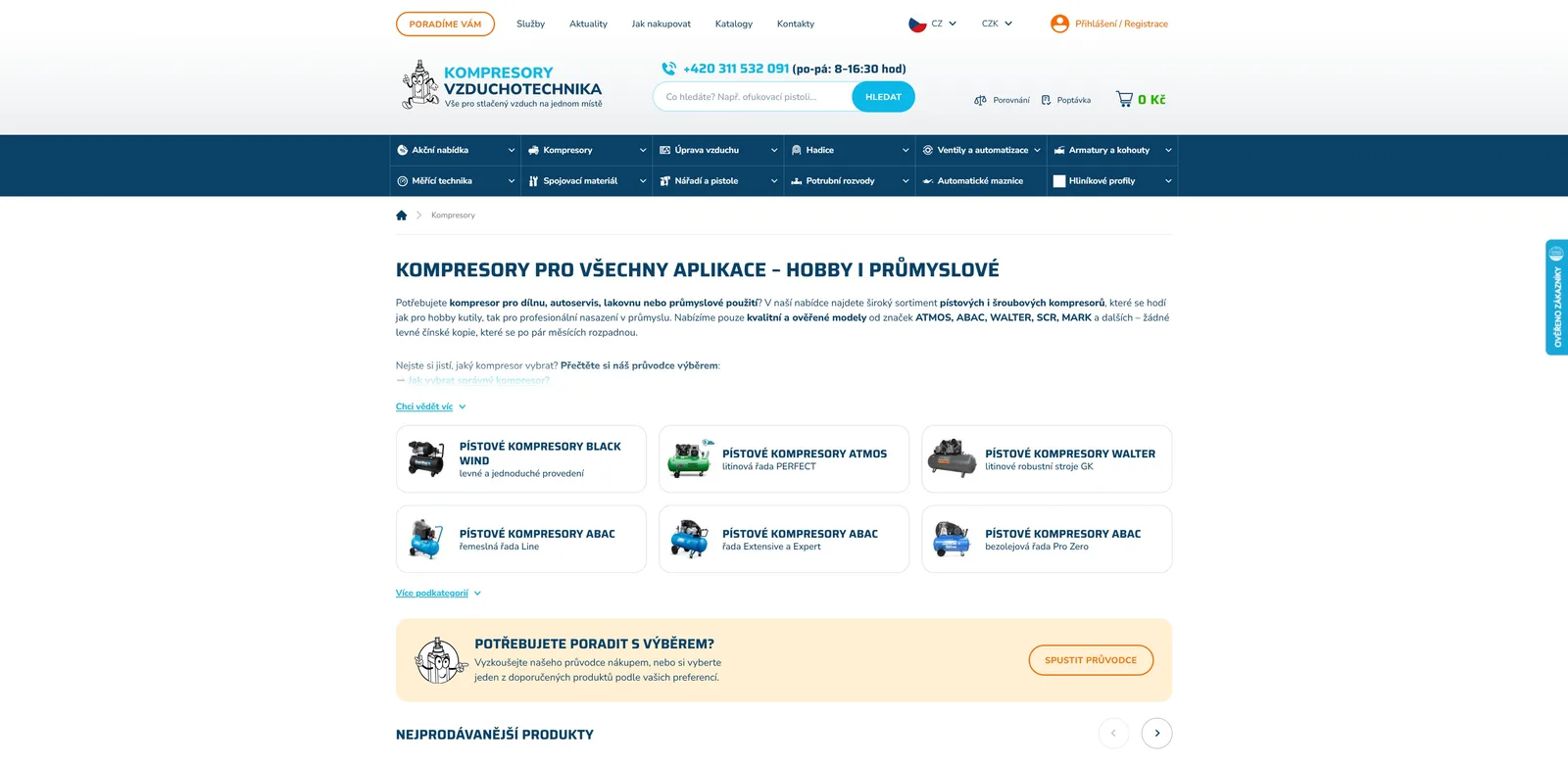
The range includes pipes for compressed air distribution in diameters from 15 to 28 mm, suitable for fixed industrial installations. To ensure the quality of the medium, air treatment units for systems up to 10 bar are also available. For plants that require high and stable performance, Kompresory-vzduchotechnika offers professional compressors of the MARK COMPRESSORS brand with complete service backup. Our expert team is available for technical consultation, help with choosing the right configuration and after-sales support.
FAQ
What is a pneumatic connection?
A pneumatic connection is a structural element that transfers compressed air or mechanical motion between components of a pneumatic system. It includes quick couplings, hose couplings with clamps, magnetic and mechanical connections in cylinders, and threaded fittings.
Which type of pneumatic connection should you choose for industrial operation?
The choice depends on the operating pressure, temperature, chemical environment and requirements for assembly speed. For frequent disconnection choose quick couplings, for fixed distribution systems screwed or crimped couplings, and for corrosive environments the stainless steel version.
How do you recognise that a pneumatic connection is failing?
The most common symptoms are an audible or measurable air leak, a drop in working pressure in the system, vibration of the hose at the joint, and visible deformation or corrosion on the clamp or the coupling body.
Why does vibration cause pneumatic connections to fail?
Vibration causes material fatigue and the gradual loosening of clamps. Correctly sized and tightened fastening clamps damp vibration and prevent mechanical failure of the joint.
How often do pneumatic connections need to be checked?
The recommended frequency depends on the intensity of operation, but a visual inspection is standard at every scheduled maintenance of the equipment, with a pressure test quarterly. In plants with heavy vibration, even more often.
Recommended
- Pneumatic spring cylinder: principle, specifications and use - Kompresory-Vzduchotechnika.cz
- What is pneumatic automation: a guide for industry - Kompresory-Vzduchotechnika.cz
- Why use pneumatics: efficiency, speed and safety - Kompresory-Vzduchotechnika.cz
- What is pneumatic lubrication: a guide for technicians - Kompresory-Vzduchotechnika.cz