
TL;DR:
- Multi-way valves are the key element of flow control in industrial systems and choosing them correctly is essential for stable operation. Thanks to their modular design they contain integrated safety elements and pressure compensation, which increase safety and reduce failure rates. The wrong choice or an incorrect connection can lead to pressure losses, uneven movement and higher energy consumption.
Multi-way valves are among the components found almost everywhere in industrial and pneumatic applications, yet their function and correct selection get far less attention than they deserve. Understanding what multi-way valves really do is not an academic exercise. A badly chosen or incorrectly connected valve causes fluctuating actuator speeds, needless pressure losses and, in the worst case, failure of the entire system. This article focuses on the technical principles, the types, the practical applications and the selection criteria for valves in industrial and pneumatic systems.
Contents
- Key takeaways
- Basic principles and design of multi-way valves
- Types of multi-way valves and their use
- Practical importance for efficiency and safety
- Applications in manufacturing and automation
- From practice: what catalogues will not tell you
- Kompresory-vzduchotechnika.cz: complete pneumatic solutions
- FAQ
Key takeaways
| Point | Details |
|---|---|
| Their function goes beyond switching flow on and off | Multi-way valves act as logic nodes that select and combine the flow paths of the medium. |
| The ISO designation determines the application | The number of ports and positions (e.g. 5/2 or 3/2) directly indicates which type of actuator the valve is intended for. |
| Modular design reduces failure rates | Integrated safety and compensation elements replace several separate components in a single body. |
| Select according to actuator type | Choose 3/2 for single-acting cylinders and 5/2 for double-acting ones. Mixing them up leads to inefficient operation. |
| Do not underestimate pressure compensation | Without load compensation the flow fluctuates whenever the load on the actuators changes. |
Basic principles and design of multi-way valves
A multi-way valve is a combined valve made up of two or more directional valves, which can integrate further auxiliary elements for controlling pressure, speed and distribution of the medium. It is therefore not a simple single-function part. It is a compact control node that combines several functions at once.
ISO designation of ports and positions
Valve designation follows the ISO standard and every engineer should be able to read these numbers without reaching for the manufacturer's catalogue. The first number gives the number of ports (inlets and outlets), the second the number of positions of the spool or valve core.
- 2/2 valve: 2 ports, 2 positions. The simplest configuration, used as a basic shut-off element.
- 3/2 valve: 3 ports, 2 positions. The standard configuration for single-acting pneumatic cylinders.
- 5/2 valve: 5 ports, 2 positions. The most widespread configuration for double-acting cylinders in pneumatics.
- 5/3 valve: 5 ports, 3 positions. The third (centre) position allows the system to be closed off or vented.
This designation is not merely formal. Through its direct link to the number of ports and positions it determines which control functions the valve can handle and which type of actuator it suits.
Directional, safety and compensation functions
The role of multi-way valves does not end with directing flow. The modular design of the valves includes safety valves, pressure compensation and speed control, which maintain a stable pressure difference and ensure smooth regulation. This means that a single valve block can replace an assembly that would otherwise require several separate elements.
The modular structure brings another benefit: when expanding the system you simply add a section to the existing block instead of adding entirely new components to the pipework. The result is fewer connections, fewer potential leak points and easier diagnostics.
Professional tip: When designing a system, always check whether the chosen multi-way valve includes an integrated safety element. If it does not, a safety valve has to be added externally and that increases both complexity and the risk of an assembly error. You will find more about how these elements work in the article on safety valves.
Types of multi-way valves and their use
Choosing the right valve type depends on three factors: the type of actuator (single- or double-acting), the medium being controlled (air or hydraulic fluid) and the required function (switching flow on only, or also redirecting it).
3/2 valves for single-acting actuators
The 3/2 valve is typical for single-acting actuators, where compressed air drives the piston into one position and a spring provides the return. The three ports provide: compressed air supply, output to the actuator and exhaust. This valve is compact and cost-effective for applications where controlling movement in one direction is enough.
Typical uses include clamping elements, closing flaps or operating simple signalling in production lines.
5/2 valves for double-acting actuators
The 5/2 multi-way valve has 5 ports and 2 positions. It actively supplies compressed air to one side of the piston and vents the other, enabling precise control in both directions. It is the standard configuration for double-acting pneumatic cylinders in manufacturing automation.
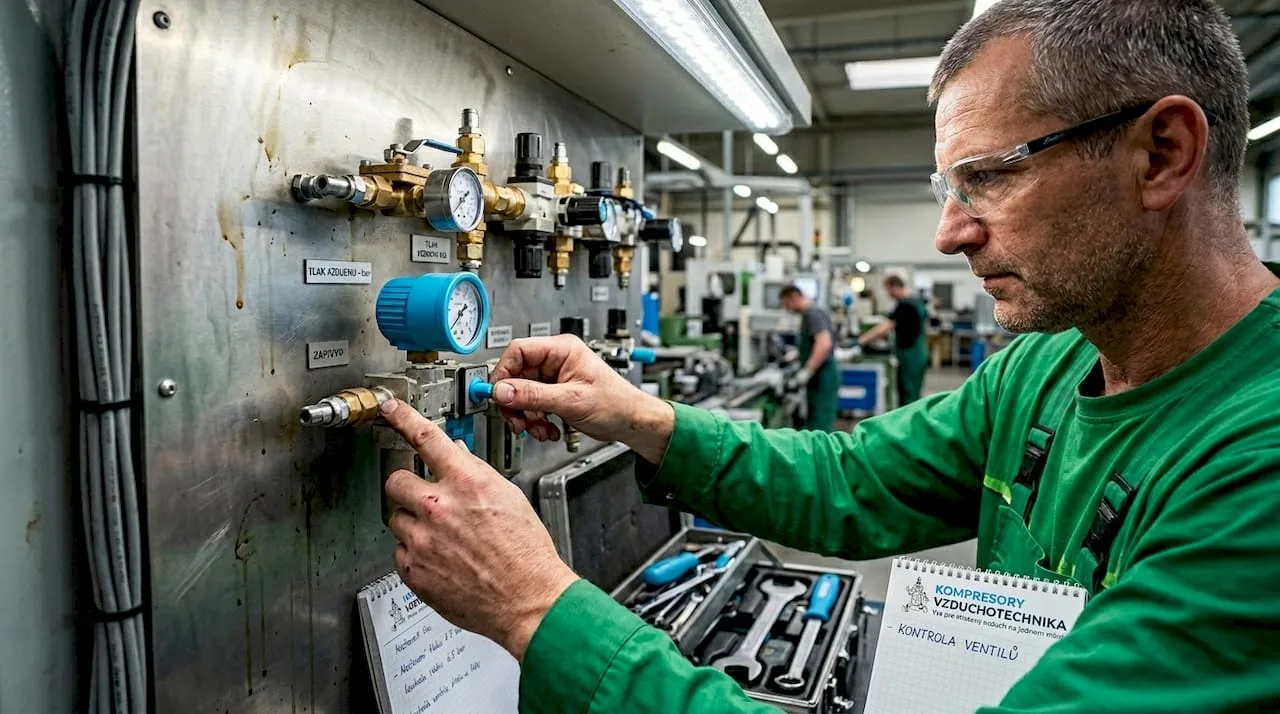
Variants with a dual exhaust (i.e. with two separate exhaust ports) allow a throttle valve to be fitted to each exhaust port separately. The result is independent control of piston speed in each direction, which is essential for precise synchronisation of the actuators.
2-way and 3-way hydraulic valves
Hydraulic systems follow a different logic from pneumatics. 3-way valves not only switch flow on, they also control where the medium goes. The third port adds diverting and mixing functions that are not possible with 2-way valves.
2-way hydraulic valves serve as a simple shut-off. 3-way valves are used wherever it is necessary to switch between two circuits or combine flows from two sources.
Overview of key configurations
| Valve type | Number of ports | Number of positions | Recommended application |
|---|---|---|---|
| 2/2 | 2 | 2 | Simple flow shut-off |
| 3/2 | 3 | 2 | Single-acting pneumatic cylinders, clamping |
| 5/2 | 5 | 2 | Double-acting cylinders, precise control in both directions |
| 5/3 | 5 | 3 | Applications requiring a centre (safe) position |
| 3-way hydraulic | 3 | 2 | Switching circuits, mixing media |
- In manufacturing and assembly the 5/2 valve is the most widespread type.
- A 5/3 valve with a closed centre position is chosen for safely stopping the actuator in the middle position.
- A 5/3 valve with a vented centre position is used in applications where the actuator has to move freely once the pressure is disconnected.
Practical importance for efficiency and safety
If you want to understand why multi-way valves matter operationally, knowing the schematic is not enough. What counts is what happens without correct valve function when the system is under real load.
Pressure control and load compensation
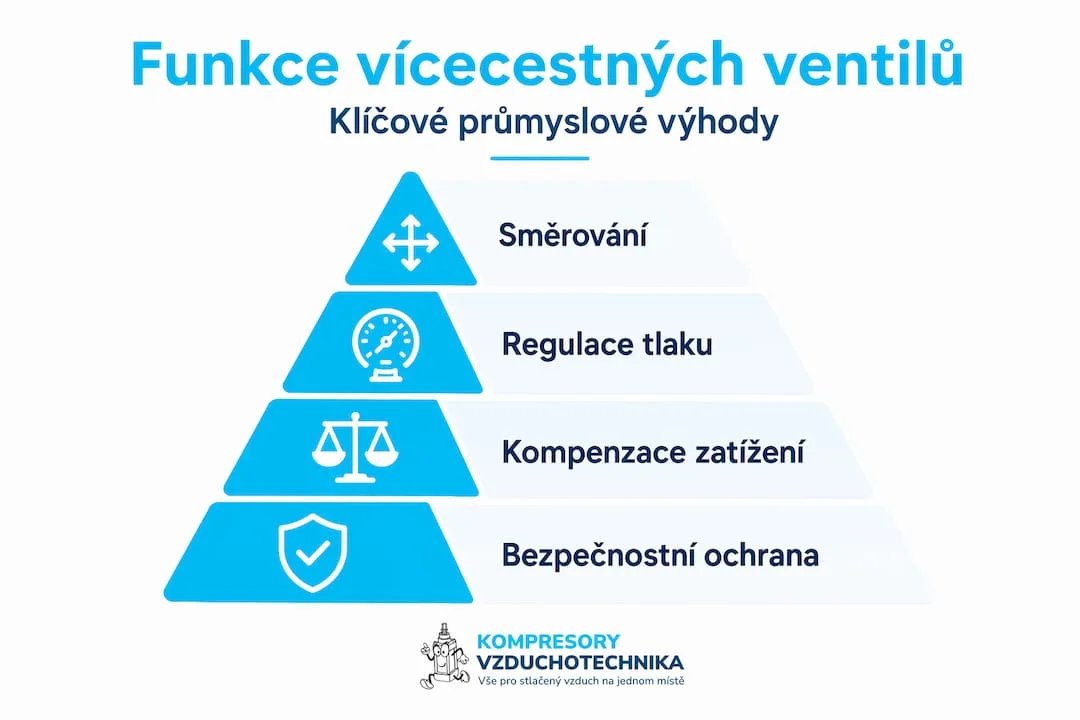
Multi-way valves make it possible to control flow and pressure in hydraulic systems and they integrate safety protection so that changes in load do not affect the flow. This is a direct answer to one of the most common problems in hydraulics: with a variable load on the actuators and no compensation, the speed fluctuates and movements become uncontrolled.
The pressure compensator inside the valve maintains a constant pressure difference across the control throttle regardless of how the load on the actuator changes. The actuator therefore moves at a constant speed even when load is added or removed. For hydraulic cranes, presses or manipulators this property is absolutely essential.
Integrated safety protection
Integrated safety valves prevent overloading and keep the system safe. In practice this means that in the event of a sudden pressure rise (for example when the actuator jams) the valve automatically opens the return circuit and protects both the hydraulic power unit and the actuator from damage.
Without integrated protection, separate safety valves would have to be added to every branch of the circuit, which increases the number of connections and the likelihood of leaks. A modular block handles this protection internally.
Simpler design and lower failure rates
The compact modular design of the valve replaces complex assemblies of many separate elements. Every joint in a hydraulic or pneumatic system is a potential leak point. Reducing the number of joints directly reduces the risk of failure and the cost of maintenance.
Specific benefits in practice:
- Fewer screwed connections in the circuit, lower risk of the medium leaking.
- Easier diagnostics: one block instead of scattered components.
- Shorter installation time when building a new system.
- Easier replacement during a service call.
Professional tip: When selecting a valve for a new circuit, always compare the total number of connections using a modular block against an assembly of separate elements. The modular solution usually pays off from three or more actuators in a single circuit. For a deeper understanding of how variable pressure affects a system we recommend the article on the stability of pneumatic systems.
Applications in manufacturing and automation
Pneumatic and hydraulic automation cannot do without multi-way valves. They are present in every system where several actuators have to be controlled from a single control block or where more complex movement sequences have to be coordinated.
Industrial sectors with the heaviest use
Multi-way valves are used in the following industrial sectors:
- Mechanical engineering and manufacturing: control of pneumatic and hydraulic presses, clamping fixtures and indexing tables.
- Metallurgy: control of the hydraulic drives of rolling stands, shears and manipulators.
- Shipbuilding and heavy machinery: operation of flaps, drive mechanisms and lifting equipment.
- Water treatment: switching filter circuits, controlling pumping stations.
- Food and pharmaceutical industry: hygienic stainless steel valve versions for sterile processes.
Coordinating multiple actuators
Coordinated control of several actuators using multi-way valves allows precise sequential or parallel arrangements in industrial applications. A single valve block can, for example, control three hydraulic cylinders in a precisely defined sequence without needing an external control system for each actuator separately.
This capability is key to pneumatic automation in production lines, where movements have to be timed to the millisecond.
Modern control options and modularity
Today's multi-way valves support manual operation, mechanical switching, electropneumatic control via solenoids and electrohydraulic proportional control. Proportional valves allow smooth control of flow and pressure by an analogue or digital signal, which opens up integration with industrial control systems (PLC, SCADA).
The trend is towards valves with integrated spool position diagnostics, pressure monitoring and communication protocols for industrial networks (e.g. IO-Link or CANopen). These functions enable predictive maintenance and rapid fault detection without having to inspect every valve physically.
From practice: what catalogues will not tell you
From my own experience, the most common mistake when working with multi-way valves is not a lack of technical knowledge but excessive trust in catalogue figures without understanding the dynamics of the particular system.
I have seen cases where a technician chose a 5/2 valve with a single exhaust port for an application that needed independent control of piston speed in both directions. The result was that the actuator worked correctly in one direction and moved uncontrolled in the other. A poor choice of 5/2 valve leads to a slower piston return and fluctuating speed. This is not theory. In practice it means scrap in production and an overloaded actuator.
Equally underestimated is choosing a valve without integrated pressure compensation in applications with a variable load. The system works beautifully when tested unloaded and then behaves erratically in real operation. Tracking down the cause takes hours, when the right valve with compensation would have eliminated the problem from the outset.
My recommendation is simple: before choosing a valve, describe the system in terms of load, number of actuators, required accuracy and safety requirements. Only then move on to selecting the configuration. And always check that the valve block has a safety element for every branch with a moving load. Sources such as technical articles on air valves or specialist manufacturer overviews provide a solid basis for that decision.
— Zdeněk
Kompresory-vzduchotechnika.cz: complete pneumatic solutions
A pneumatic system works as a whole. Multi-way valves, actuators and accessories deliver maximum performance only when they are supplied with stable, clean compressed air from a reliable source.
Kompresory-vzduchotechnika offers compressors and pneumatic accessories for industrial and professional applications. For systems with higher demands on flow and continuous operation there are industrial SCR screw compressors with energy-efficient operation. For applications that require a low noise level we offer oil-free ABAC Super Silent OS compressors. The Kompresory-vzduchotechnika team is available for technical consultation when selecting compressors and accessories for a specific pneumatic system.
FAQ
What is a multi-way valve and how does it work?
A multi-way valve is a combined control element made up of two or more directional valves that switches and distributes the flow of hydraulic or pneumatic medium by shifting the valve core. It integrates directional, pressure and speed control functions in a single block.
What is the difference between a 3/2 and a 5/2 valve?
The 3/2 valve has 3 ports and 2 positions and serves single-acting actuators with a spring return. The 5/2 valve has 5 ports and 2 positions and provides active control of double-acting pneumatic cylinders in both directions.
Why are multi-way valves important for system safety?
The safety valves integrated inside the modular block prevent the system from being overloaded during a sudden pressure rise and protect the actuators and the hydraulic power unit from damage without any external safety elements.
When should a 5/3 valve be used instead of a 5/2?
A 5/3 valve is chosen when a safe centre position of the actuator is needed: either closed (the actuator stays in place when the signal is disconnected) or vented (the actuator can be moved freely when the pressure is disconnected). The 5/2 valve does not offer this third position.
How does choosing the wrong valve affect operation?
The wrong number of ports or missing pressure compensation causes fluctuating actuator speeds, uneven movement under a variable load and higher energy consumption. In manufacturing applications this leads to scrap and a shorter service life of the actuators.
Recommended
- How air valves work: key role and efficient solutions - Kompresory-Vzduchotechnika.cz
- check valve in compressors: technical function and applications - Kompresory-Vzduchotechnika.cz
- Safety valves: Function, selection and the right capacity - Kompresory-Vzduchotechnika.cz
- The function of an air tank: How to increase the efficiency of pneumatic systems - Kompresory-Vzduchotechnika.cz