

TL;DR:
- Cyclic compressor operation, with its repeated switching on and off, differs from continuous running and affects both energy consumption and the service life of the machine. Piston compressors suit this mode well, while screw machines cope better with continuous operation. The correct pressure switch setting and the right air tank volume extend service life and improve efficiency.
Cyclic compressor operation is one of the most widely misunderstood concepts in pneumatics and compressed air technology. Many users assume that a compressor simply "runs or does not run" without understanding how repeated starting and stopping affects energy consumption, component wear and total operating costs. There are two main modes of operation: cyclic and continuous. Understanding the difference between them is the basic prerequisite for the right choice of compressor and for using it efficiently in practice.
Contents
- Key takeaways
- What cyclic compressor operation is
- Compressor types and their suitability for cyclic operation
- Advantages and disadvantages of cyclic operation
- How to control cyclic operation correctly
- Examples of cyclic operation in practice
- Experience from practice: a look at cyclic operation
- Compressors for cyclic and continuous operation from Kompresory-vzduchotechnika
- FAQ
Key takeaways
| Point | Details |
|---|---|
| Definition of cyclic operation | The compressor switches on and off repeatedly according to pressure demand rather than running continuously. |
| Suitability for piston compressors | Piston compressors are designed for cyclic operation better than screw compressors. |
| Risk of wear during starts | Frequent starting loads the bearings and couplings, so optimising the number of cycles is crucial. |
| Energy efficiency | Properly controlled cyclic operation reduces energy consumption compared with pointless idle running. |
| Modern operating control | Frequency inverters and control units limit the number of starts and extend the service life of the machine. |
What cyclic compressor operation is
Cyclic compressor operation is a mode in which the compressor repeatedly alternates between the on and off states. In practical terms: the motor starts, the compressor pumps air into the air tank, the set upper pressure limit is reached and the motor switches off automatically. As soon as the pressure drops below the set lower limit, the motor starts again. This cycle repeats throughout the entire time the machine is in service.
The definition of cyclic operation therefore covers three key phases: start, filling phase and stop. Each of these phases has its own technical impact on the compressor.

How cyclic operation works in practice depends on the size of the air tank, the pressure switch setting and the actual air consumption of the connected tools. A large air tank extends the intervals between starts. A small tank or high air consumption results in shorter cycles and a higher starting frequency.
The difference between continuous and cyclic operation is fundamental. In continuous operation the compressor runs without interruption and regulates its output in another way, for example by throttling the intake or using an unloading valve. In cyclic operation the motor is given a complete rest between starts, but every start brings a mechanical and electrical shock.
- Start and peak current: Every time the electric motor starts, an inrush current flows through the winding that is 5 to 7 times higher than the rated current.
- Pressure switch: Controls switching the motor on and off according to the pressure in the air tank.
- Air tank: Damps pressure fluctuations and extends the time between cycles.
- Cycle: One complete pass from start through filling to stop.
Professional tip: Set the lower and upper limits of the pressure switch far enough apart, usually 1,5 to 2 bar between the values. Too narrow a range causes excessively frequent starts and shortens the service life of both the motor and the mechanical parts.
Compressor types and their suitability for cyclic operation
Not all compressor types respond to cyclic operation in the same way. The design, the materials used and the lubrication system all play a decisive role in how well a given type copes with repeated starts and stops.
| Compressor type | Suitability for cyclic operation | Typical application | Note |
|---|---|---|---|
| Piston, oil-lubricated | High | Workshop, automotive, hobby | Designed for cyclic operation |
| Piston, oil-free | Medium | Laboratories, food industry | Shorter rest intervals because of cooling |
| Screw | Low to medium | Industry, larger plants | Prefers continuous operation, frequent starts increase wear |
| Scroll | Low | Medicine, clean rooms | Not suitable for cyclic operation |
| Diaphragm | High | Analytics, laboratories | Copes well with cyclic operation |
Piston compressors are designed for cyclic operation from the ground up. Oil lubrication works reliably at every start, and the working cylinder and piston rings are dimensioned for repeated temperature and pressure swings. Piston compressors are used in cyclic operation above all in workshops and service centres, where the demand for compressed air is naturally intermittent.
Screw compressors are built differently. Their lubrication system and bearings are optimised for continuous running. Compressors designed for continuous operation have a longer service life and a lower risk of faults caused by repeated starting. If a screw compressor starts and stops too often, there is a risk of the oil overheating, of insufficient lubricant circulation during short cycles and of a shortened bearing life.
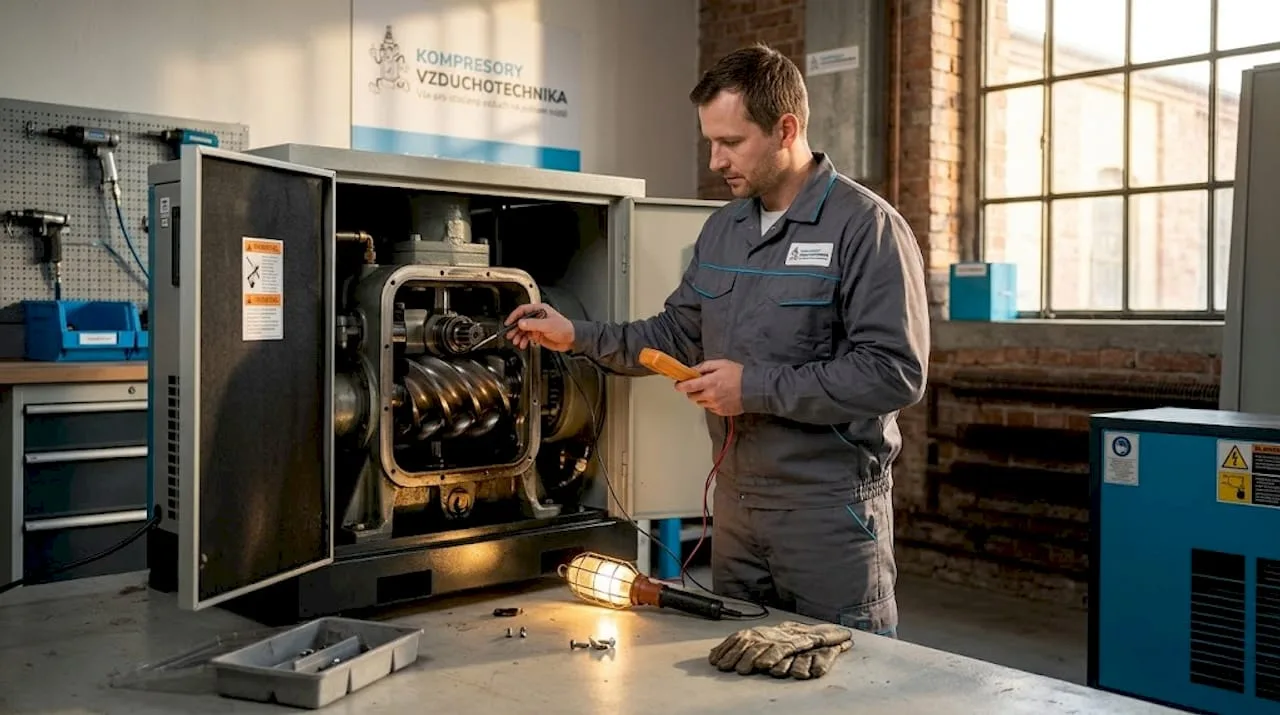
Oil-free piston compressors will tolerate cyclic operation, but they need enough time for the cylinder head to cool down. The recommended ratio of running time to rest time (duty cycle) for these machines is usually 50 %, meaning equal periods on and off.
Advantages and disadvantages of cyclic operation
Cyclic operation brings specific advantages, but also real risks. The assessment depends on the particular machine, the application and the way it is controlled.
Advantages of cyclic compressor operation:
- Lower energy consumption: The compressor draws no electrical power at times when air is not needed. With a compressor running continuously at idle, energy is simply wasted.
- Simpler control design: The pressure switch is an inexpensive and reliable device that needs no frequency inverter or complex automation.
- Natural cooling: The downtime between cycles allows the cylinder, head and oil to cool without active cooling.
- Lower purchase costs: Piston compressors for cyclic operation are considerably cheaper than screw units with variable speed control.
Disadvantages and risks:
- Wear during starts: Frequent start and stop cycles lead to mechanical wear of the bearings and couplings. Every start is a demanding event for the motor and the mechanical parts.
- Inrush current: Repeated current peaks at start-up shorten the service life of the motor winding and can cause problems in the electrical network.
- Limited capacity for continuous draw-off: If air consumption exceeds the capacity of the compressor in cyclic mode, the pressure does not fall smoothly but rapidly, and the compressor starts too often.
- Noise peaks: Every start of a piston compressor is a loud event. A high starting frequency increases the overall noise load in the room.
Professional tip: Keep an eye on the number of starts per hour. Most piston compressors are dimensioned for a maximum of 10 to 20 starts per hour. If you are exceeding that figure, it is time to enlarge the air tank or to reconsider the capacity of the compressor.
Correct control of cyclic operation can markedly reduce operating costs and extend the service life of the compressor. The key lies in the optimum length of the operating cycles and in eliminating unnecessary starts.
How to control cyclic operation correctly
Optimising cyclic operation is not complicated, but it does require a systematic approach. Below are specific steps that professionals and hobby users alike can apply straight away.
-
Size the air tank correctly. The tank volume directly influences the frequency of starts. For a workshop with an average consumption of 300 litres per minute, a tank with a volume of at least 200 litres is suitable. A larger tank extends the intervals and reduces the number of starts.
-
Set the pressure range of the switch. The span between switching off and switching on should be at least 1,5 bar, ideally 2 bar. A narrow range causes short cycles and overloads the motor.
-
Consider a frequency inverter. On screw compressors or larger piston machines, frequency inverters and control units allow smooth speed control instead of hard starts and stops. The result is lower wear and lower energy consumption.
-
Check the operating temperature. An overheated compressor that restarts before it has had time to cool down wears out quickly. Fit thermal protection and make sure the machine room is adequately ventilated.
-
Carry out regular maintenance. Oil changes, checks of the valves and filters and inspection of the bearings should all be part of the maintenance plan. A worn suction or discharge valve means the compressor has to work longer to reach the required pressure, which lengthens every cycle and increases the thermal load.
-
Monitor the number of starts. Modern control units record the number of starts, the operating hours and alarm messages. This data makes it possible to plan servicing preventively and to catch anomalies in the compressor's behaviour before they cause a breakdown.
-
Separate the draw-off branches according to the character of consumption. If you have tools with intermittent consumption in your plant and at the same time, for example, continuously running blasting, consider separate compressors or a combination of a compressor with storage tanks.
Examples of cyclic operation in practice
A practical understanding of where cyclic operation works and where it does not helps both in choosing the right machine and in setting it up. The examples below come from real operating conditions.
Where cyclic operation is ideal:
- Car and tyre service: Inflating tyres, driving pneumatic tools and lubrication equipment all work in short bursts. The compressor fills the air tank, the tool uses up a dose of air and the compressor starts to top it up again. This kind of operation is naturally cyclic and a piston compressor suits it perfectly.
- Joinery and carpentry workshop: Nailers, staplers and pneumatic sanders work intermittently. Between operations the compressor rests. Applications in workshops and production are typical cases for cyclic operation.
- Hobby and home use: Painting, blowing dust off tools or inflating bicycle and car tyres. Air consumption is small and irregular. A small portable compressor with a 24 or 50 litre air tank is entirely sufficient.
- Construction and assembly: Pneumatic hammers, chisels and drills on a building site work in intervals that match the rhythm of the work. A mobile piston compressor is the standard solution here.
Where cyclic operation causes problems:
- Continuous painting or blasting: If a spray gun or blasting unit consumes air continuously and the capacity of the compressor is not sufficient, the pressure drops below the minimum and the compressor either starts far too often or fails to hold the pressure at all.
- Industrial production lines: Here the demand for compressed air is constant and uninterrupted. Compressors for continuous operation are the right choice for such environments.
- Medical and laboratory applications: Strict requirements for air quality and reliability of supply leave no room for gaps between cycles. Continuous operation or standby systems are chosen here.
Switching between cyclic and continuous operation is technically possible on a whole range of modern compressors fitted with electronic control. The decision depends on an analysis of the average air consumption per hour compared with the nominal output of the compressor.
Experience from practice: a look at cyclic operation
I have worked with compressors in all kinds of operating conditions for many years, and I have to say that cyclic operation is most often misunderstood by the very people who use it every day.
The most common mistake I come across is the belief that "the shorter the cycle, the less wear, because the compressor runs less." In reality the opposite is true. A short cycle with a high starting frequency is far more destructive for the motor and the mechanical parts than one long cycle followed by a period of rest. I once saw a piston compressor in a car workshop that started 40 times an hour because the air tank was undersized. The result was a motor replacement after 18 months of operation instead of the usual 5 years.
The second mistake is the automatic assumption that a screw compressor will handle cyclic operation just as well as a piston one. It will, but at a price. If you run a screw compressor in cyclic mode with more than 8 to 10 starts per hour, you are measurably shortening its service life. An investment in a frequency inverter or in a larger air tank pays for itself faster than most operators realise.
What works most reliably for me in practice: a correctly sized air tank, a pressure range of at least 2 bar and a regular valve check every 500 operating hours. Simple measures, but the results are consistent.
— Zdeněk
Compressors for cyclic and continuous operation from Kompresory-vzduchotechnika
At Kompresory-vzduchotechnika you will find compressors for both modes of operation, from portable piston machines for hobby use and the workshop through to industrial screw units for continuous running.
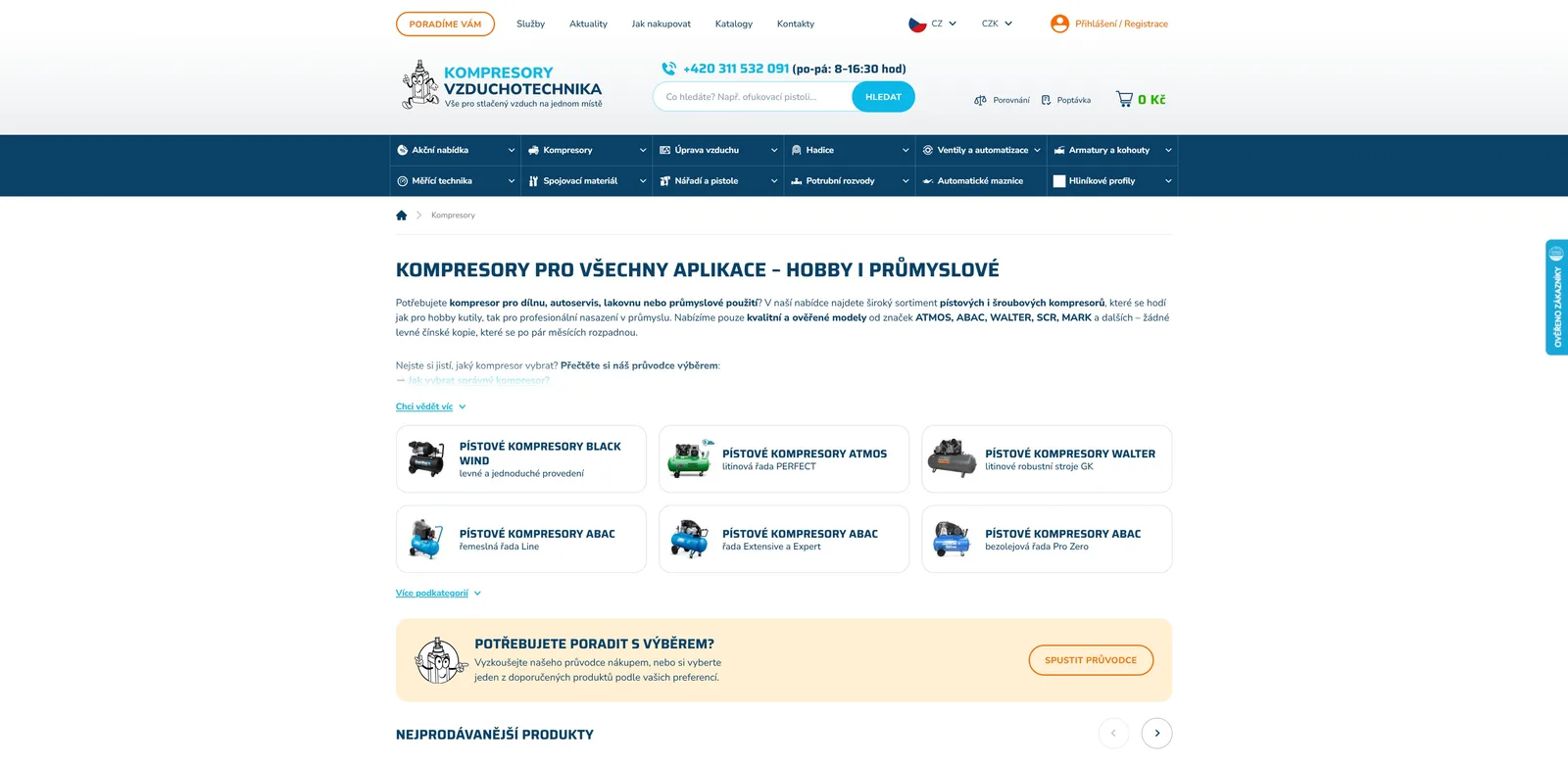
For cyclic operation, MARK compressors are a good fit, covering the needs of car workshops, joinery shops and the construction trade. For plants with a higher or continuous demand for compressed air we offer SCR screw compressors, which can be equipped with a frequency inverter for smooth output control. The Kompresory-vzduchotechnika team provides technical advice on choosing the right machine and on setting the optimum operating mode. Contact us for a recommendation of a specific model to match your application and your average air consumption.
FAQ
What does cyclic compressor operation mean?
Cyclic compressor operation is a mode in which the compressor repeatedly switches itself on and off automatically according to the pressure in the air tank. The compressor starts when the pressure falls below the set lower limit and stops when the upper limit is reached.
Which type of compressor is most suitable for cyclic operation?
Piston compressors are by design the best suited to cyclic operation. Screw compressors prefer continuous running, and frequent starts increase the risk of bearing wear and a shortened service life.
How many starts per hour are safe for a piston compressor?
Most piston compressors are dimensioned for 10 to 20 starts per hour. Exceeding this limit causes excessive wear of the motor and the mechanical parts and shortens the overall service life of the machine.
How can the number of compressor starts in cyclic operation be reduced?
The most effective measure is to increase the volume of the air tank and to widen the pressure range of the switch to 1,5 to 2 bar. On larger installations a frequency inverter can be fitted to replace hard starts with smooth speed control.
Is cyclic operation more energy efficient than continuous operation?
It depends on the particular application. With intermittent air consumption, cyclic operation is more economical, because the motor uses no energy while it is idle. With continuous consumption, on the other hand, continuous operation with output control is more efficient, because it eliminates the inrush currents that occur at every start.
Recommended
- A list of safety rules for working with a compressor in automotive 2026 - Kompresory-Vzduchotechnika.cz
- The working principle of a piston compressor for efficient operation - Kompresory-Vzduchotechnika.cz
- How pneumatics works: a complete guide for industry 2026
- Saving energy with a compressor: an expert guide 2026 - Kompresory-Vzduchotechnika.cz