

Pressure switches for compressors: Condor and NE-MA
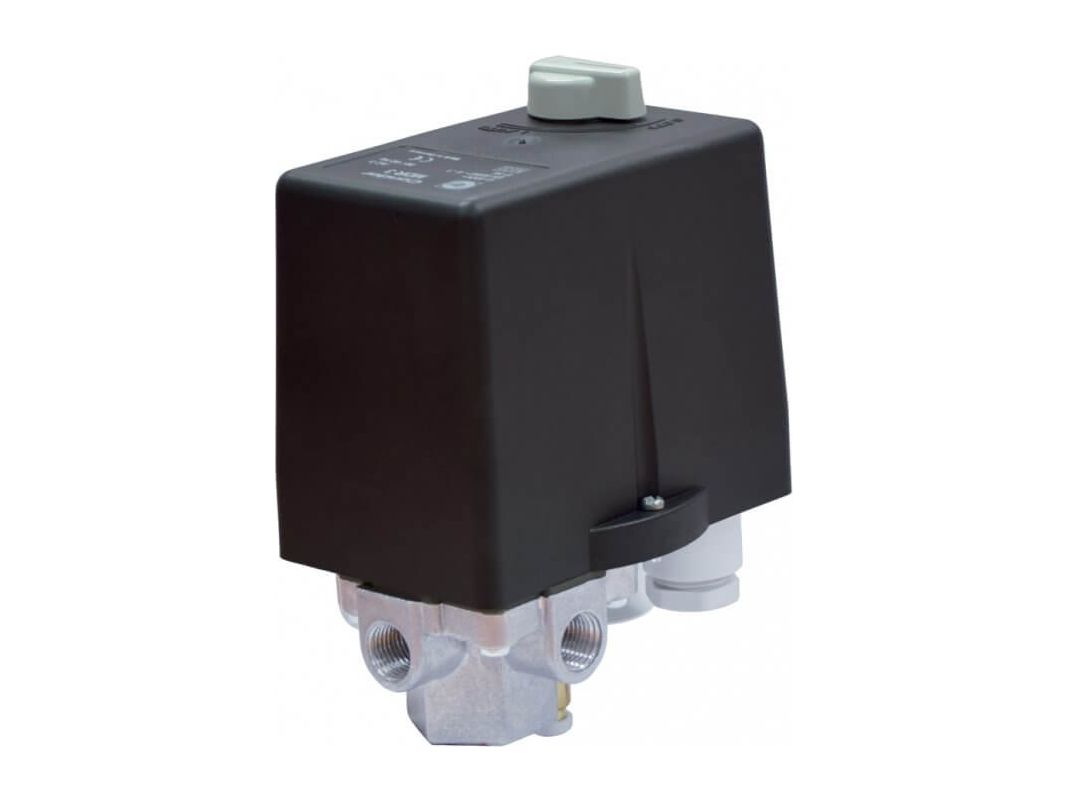
The pressure switch is the one thing that keeps a compressor running without you. It watches the pressure in the tank, starts the motor when it drops and stops it again at the upper limit — without it you would have to stand by the machine and switch it off by hand. Three things decide which one you need: the motor voltage, its rated current, and the pressure the machine is meant to work at.
Three questions before you choose
A switch is not chosen by how big the compressor is, but by what it has to switch on its output. Work through these three questions and one or two versions will be left.
What voltage is the motor?
The motor plate says either 230 V or 400 V. Single-phase machines need a two-pole switch, three-phase ones a three-pole switch. No adapter makes them interchangeable — a three-phase switch breaks three conductors, a two-pole one breaks two.
How many amps does the motor draw?
On three-phase switches a figure with an „A“ follows the dash. It is not the current the switch will take — it is the range of the overload relay that protects the motor. The relay must match the rated current from the motor plate, not the power in kilowatts.
What pressure should the machine run at?
Ordinary piston compressors run to 10 or 11 bar and the /11 version is enough. High-pressure machines above 12 bar need the /16 version with a range to 16 bar. The pressure is then trimmed with the screws under the cover.
Two-pole for 230 V, or three-pole for 400 V
The three-phase MDR 3 switches are the workhorses of this category. They switch motors to 7.5 kW, carry protection IP 54 and a mechanical life of over a million operations. They break three phases at once and an overload relay is included, so the motor needs no separate breaker with thermal protection.
There are two single-phase switches and they differ more than the names suggest. MDR 1 switches motors to 4.0 kW, MDR 2 to 2.2 kW. Both carry protection IP 44 and a life of over half a million operations. Neither has an overload relay — a single-phase motor carries its protection in the winding.
A single thread, or a block with four
The switch screws straight onto the tank. In the basic version it has one internal 1/4" thread — air is fed into it and nothing else connects. The gauge and the safety valve then need their own ports on the tank.
Versions with a connecting block have one 3/8" inlet and three 1/4" outlets: for the gauge, the safety valve and the air outlet. You recognise them by the letter X in the designation. If you are building a compressor from scratch, or replacing a switch on an older machine without ports, this is the version you want.
A switch with an unloader, and why a compressor needs one
When a compressor stops, compressed air stays between the head and the non-return valve. On the next start the motor would be turning against it and would barely manage. The unloader valve releases that remainder after shut-off — that is the short hiss you hear from a compressor a second after it runs down.
It is part of the switch, not of the compressor. The MDR 1/11 has the unloader valve as standard; on the MDR 2 and MDR 3 it is bought as an accessory. The TS220 and BW-0002 switches have a port for an unloader tube, 6/4 mm with a cutting ring.
Four versions side by side
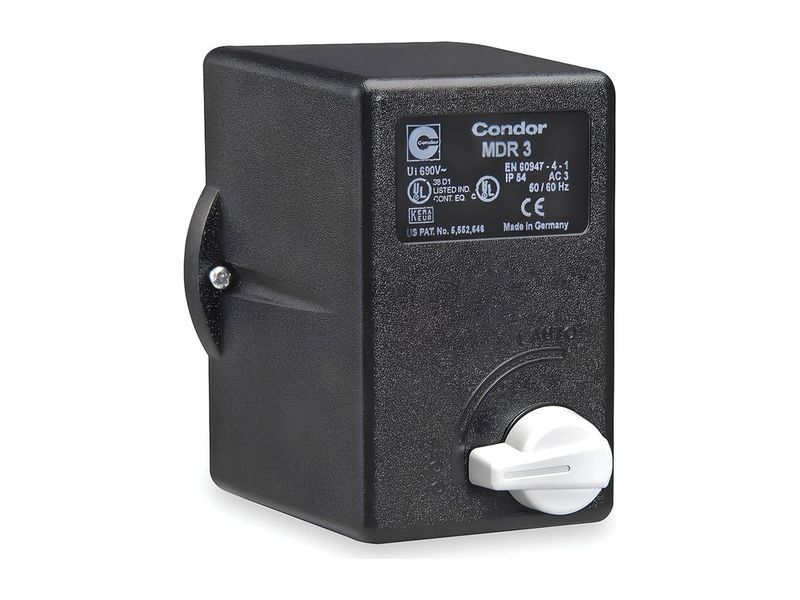
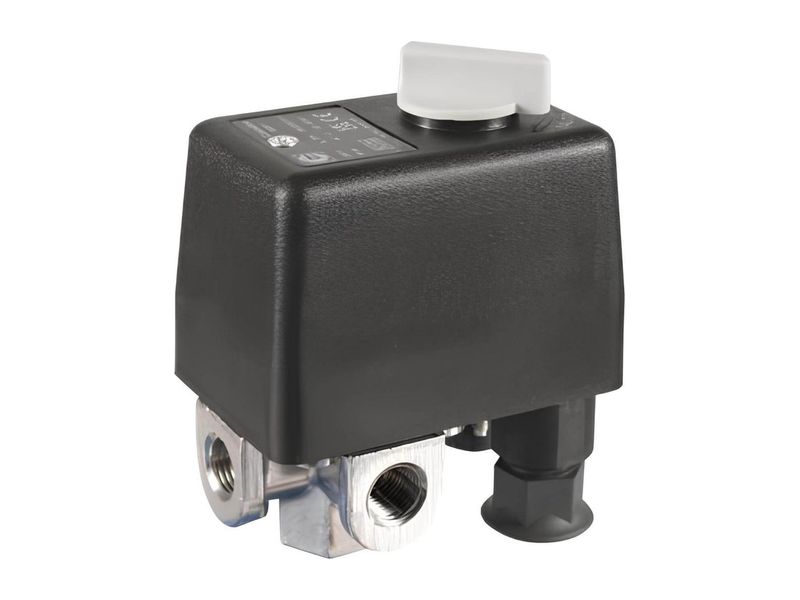
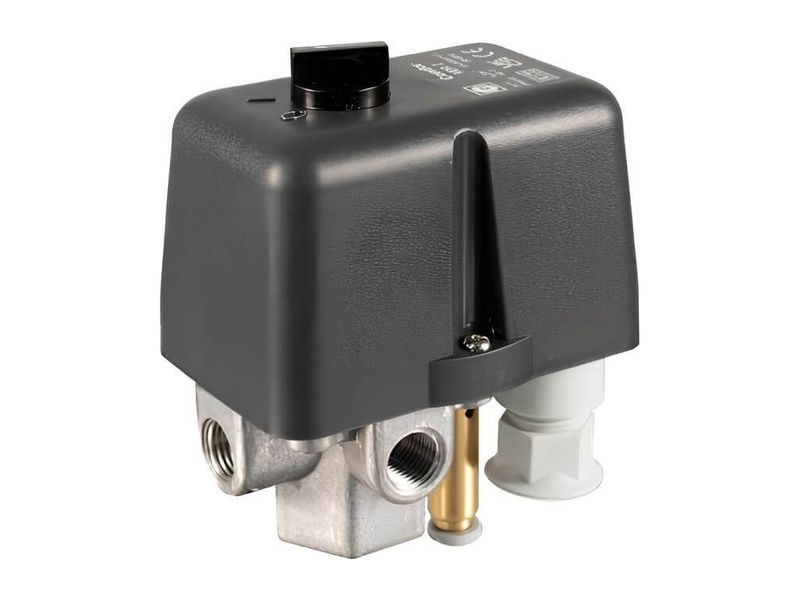
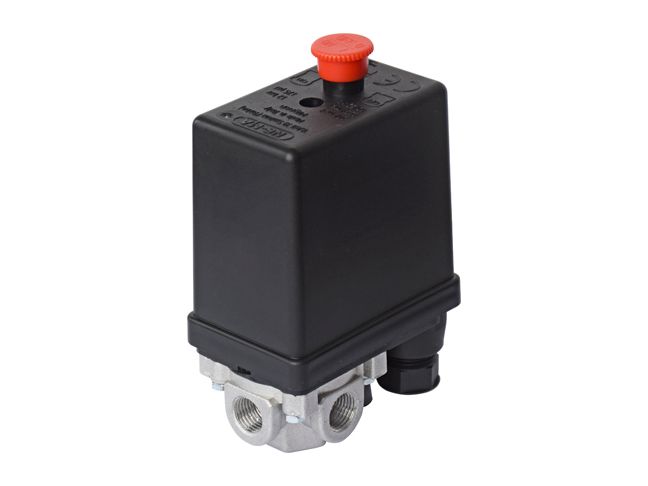
The switches differ in the number of poles, the connection and the control. This is how they look next to one another.
What „MDR3/11X-16A“ means
The designation looks complicated, but it is an instruction for reading the whole switch. Each part says something different, and together they tell you whether this one is yours.
MDR 1, MDR 2, MDR 3
MDR 1 and MDR 2 are two-pole for 230 V, MDR 3 is three-pole for 400 V. Note that MDR 1 is the stronger of the two — it switches motors to 4.0 kW against 2.2 kW.
The number after the slash
The highest cut-out pressure in bar. /11 is the ordinary version to 11 bar, /16 the high-pressure one to 16 bar. Below that limit the switch can be set, above it cannot.
The letter X
The version with a connecting block — one 3/8" inlet and three 1/4" outlets. Without the X the switch has a single 1/4" thread and nothing else connects to it.
The figure with „A“ at the end
The range of the thermal overload relay. 16A, for instance, means a relay adjustable from 10 to 16 A. It is motor protection, not a rating of what the switch itself carries.
Overload relay ranges
The relay is set to the rated current of the motor, which you will find on its plate. The figure must land inside the range — not at its edge.
| Switch designation | Relay range |
|---|---|
| -6A | 4.00 – 6.30 A |
| -10A | 6.30 – 10.00 A |
| -16A | 10.00 – 16.00 A |
| -20A | 16.00 – 20.00 A |
When the motor rated current falls exactly on the boundary of two ranges, take the higher one — a relay set at its lower edge trips imprecisely. The smallest range, 2.50 – 4.00 A, is carried by a single item, order number 09021; it suits motors around 1.1 kW.
All versions at a glance
| Pressure switches for piston compressors — technical data | |||||||
|---|---|---|---|---|---|---|---|
| Order number | Maker | Voltage (V/Hz) | Poles | Connection | Relay range | Max. pressure | Factory setting |
| MDR3/11X-6A | Condor | 400/50 | 3 | 3/8" + 3× 1/4" | 4,00 – 6,30 A | 11 bar | 8,0–10,0 bar |
| MDR3/11X-10A | Condor | 400/50 | 3 | 3/8" + 3× 1/4" | 6,30 – 10,00 A | 11 bar | 8,0–10,0 bar |
| MDR3/11X-16A | Condor | 400/50 | 3 | 3/8" + 3× 1/4" | 10,00 – 16,00 A | 11 bar | 8,0–10,0 bar |
| MDR3/16X-10A | Condor | 400/50 | 3 | 3/8" + 3× 1/4" | 6,30 – 10,00 A | 16 bar | 12,0–15,0 bar |
| 09021 | Condor | 400/50 | 3 | 3/8" + 3× 1/4" | 2,50 – 4,00 A | — | 4–10 bar |
| MDR3/11-6A | Condor | 400/50 | 3 | 1× 1/4" | 4,00 – 6,30 A | 11 bar | 8,0–10,0 bar |
| MDR3/11-10A | Condor | 400/50 | 3 | 1× 1/4" | 6,30 – 10,00 A | 11 bar | 8,0–10,0 bar |
| MDR3/11-16A | Condor | 400/50 | 3 | 1× 1/4" | 10,00 – 16,00 A | 11 bar | 8,0–10,0 bar |
| MDR3/11-20A | Condor | 400/50 | 3 | 1× 1/4" | 16,00 – 20,00 A | 11 bar | 8,0–10,0 bar |
| MDR1/11 | Condor | 230/50 | 2 | 3/8" + 3× 1/4" | — | 11 bar | 8,0–10,0 bar |
| MDR2/11 | Condor | 230/50 | 2 | 1/4" + 3× 1/4" | — | 11 bar | 6,0–8,0 bar |
| TS220 | NE-MA | 230/50 | 2 | 3/8" + 3× 1/4" | 20 A | 12 bar | 6,0–8,0 bar |
| BW-0002 | Black Wind | 230/50 | 2 | 1/4" + 3× 1/4" | 15 A | 12 bar | zapínací 6 / vypínací 8 bar |
The relay range is the span over which the motor protection is adjusted — it is set to the rated current from the motor plate. Max. pressure is the highest cut-out pressure the switch can be set to. The factory setting says what values the switch arrives at; the screws under the cover change it within the range.
#showmore#
How the switch is set
There are two screws under the cover. The larger changes the cut-out pressure, the smaller the differential — how far the pressure must fall before the compressor starts again. From the factory the differential is usually about 2 bar.
It does not pay to squeeze the differential to a minimum. The switches take 120 operations an hour and the motor has the same limit — if the machine cycles more often, either the tank is too small or the differential too narrow. The full procedure and the wiring are in our guide.
Where to go next
The pressure switch is one of the parts a compressor needs for ordinary running. The rest is here:
- Safety valves — the backstop if the switch fails
- Non-return valves — they hold the pressure in the tank while the motor stands
- Pressure regulators — setting the pressure for the tool itself
- Pressure sensors — electronic and digital versions outside compressors

Ventilek recommends
The relay is set from the motor plate, not from the size of the compressor.
The commonest mistake people phone about: buying a switch „for a two-hundred-litre compressor“. But tank volume has nothing to do with the switch — the motor rated current decides, and it is on the motor plate. If you are not sure, photograph the plate and send it to us; we will read it off in a minute.
Frequently asked questions
- How do I know a pressure switch has failed?
- It typically behaves in one of three ways: the compressor does not start at all, it does not stop and runs up to the safety valve, or it cycles in short bursts. Before replacing the switch, check the non-return valve and the tightness of the pipework as well — a leak does the same thing as too narrow a differential.
- Can I use a three-phase switch on a single-phase motor?
- You cannot. A three-pole switch breaks three phases, a two-pole one breaks two. Besides, three-phase switches carry an overload relay set to a current a single-phase motor will never reach, so the motor would not be protected.
- What is an overload relay and do I need one?
- It is a thermal protection that disconnects the motor when its current exceeds the set limit — for instance with a seized bearing or a lost phase. On three-phase MDR 3 switches it is included and is set to the motor rated current. Single-phase motors have thermal protection built into the winding.
- What pressure should I set?
- Set the cut-out pressure to the figure the compressor maker states — it is usually on the machine plate. Never higher than the opening pressure of the safety valve. The cut-in pressure then falls one differential below, typically 2 bar.
- What do IP 54 and IP 44 mean?
- They describe how far the housing resists dust and water. IP 54 on the three-phase MDR 3 means protection against dust and splashing water from every side; IP 44 on the single-phase MDR 1 and MDR 2 means protection against objects over 1 mm and splashing water. Neither is a version for rain — the compressor and the switch belong under a roof.
- How long does a pressure switch last?
- The mechanical life of the MDR 3 is over a million operations, and over half a million on the MDR 1 and MDR 2. The practical limit is frequency rather than total count: the switches take 120 operations an hour. When a compressor cycles more often, it shortens the life of both the switch and the motor.
Technical data follow the datasheets of Condor and NE-MA and the supplier catalogue. The switch must be installed by a person with the appropriate electrical qualification; the pressure is set under pressure, with the electrical supply disconnected.
Bestsellers


Product sorting
List of products

The simplest switch in the range. It arrives fixed at its setting, so nothing has to be trimmed after fitting.

A single-phase Condor that arrives set to a lower pressure than its sibling. The inlet thread is the narrower quarter-inch.

The stronger of the two single-phase Condors. It is the only one with an unloader valve included, so the motor does not start against pressure.

A basic single-phase switch from an Italian maker. It is switched on with a pull button, not with a rotary knob as the Condors are.

The highest protection range in the catalogue. It helps where the motor draws more than the other versions will cover.

A three-phase Condor for smaller workshop compressors. The connecting block has one inlet and three outlets, so a single port on the tank is enough.

A strong relay without a connecting block. For large three-phase machines whose tank offers only one port.

The leaner version for tanks that already have their own ports. It screws in with a single thread and nothing else connects to it.

The middle relay in the plain threaded version. The commonest replacement for a worn-out switch on a production three-phase compressor.

The only version in the range that works above eleven bar. For machines where an ordinary switch runs into its ceiling.

The only switch in the range whose relay will protect a weak motor of about one kilowatt. Stronger versions would never trip for it.

The most ordered three-phase Condor. It fits most mid-sized workshop compressors, and the block makes up for ports the tank does not have.

The strongest relay in the ordinary pressure version. It covers motors at the very top of what an MDR 3 switch will handle at all.