

Pressure regulator for a compressor, mounted on the receiver
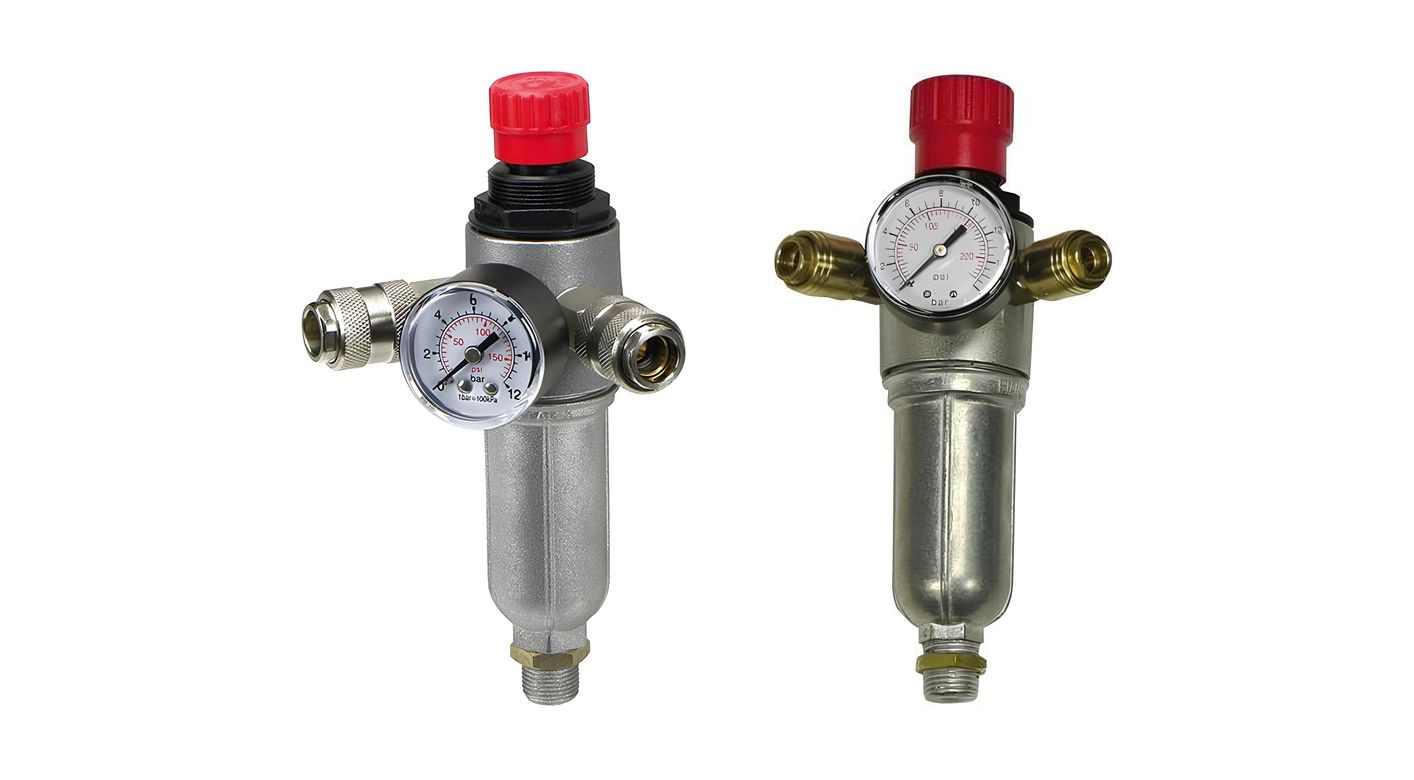
A compressor fills its receiver to its cut-out pressure — eight, ten, sometimes eleven bar. But most air tools are built for around six. This regulator screws straight into the outlet on the receiver and turns a horizontal compressor into a distribution point: it drops the pressure to what the tool can take, shows it on a gauge, and offers two quick couplers, so you can keep two hoses connected at once. No pipework, no bracket on the wall.
Is this the regulator you are after?
There is more than one kind of pressure regulator, and what mainly separates them is where they mount. This one screws into the thread on the receiver — everything is on the one body and the hoses connect straight to it. It suits a workshop where the compressor stands on the floor and the hoses run from the machine to the tool.
If instead you are building pipework around the shop, want a wall-mounted regulator, a filter-regulator unit with a water separator, or precise regulation for measuring equipment, you belong in precision pressure regulators — there are over a hundred of them and you will choose far better there than here.
Why regulate right at the receiver
Feeding a spray gun the full ten bar is a reliable way to spoil the work and shorten the tool’s life. A tool has its own working pressure, and it is usually well below what the compressor fills to. The regulator closes that gap — and because it sits right at the receiver, it covers everything you draw from the machine.
The second thing is consumption. Air that passes through a tool only because it is at a higher pressure does no extra work, but the compressor still had to make it. Setting the pressure to what the tool actually needs is the cheapest saving there is in compressed air.
And the third: two quick couplers. Leave one hose on the blow gun and the other on the impact wrench, and you never swap them over. An ordinary horizontal compressor becomes a two-person bench.
What it looks like
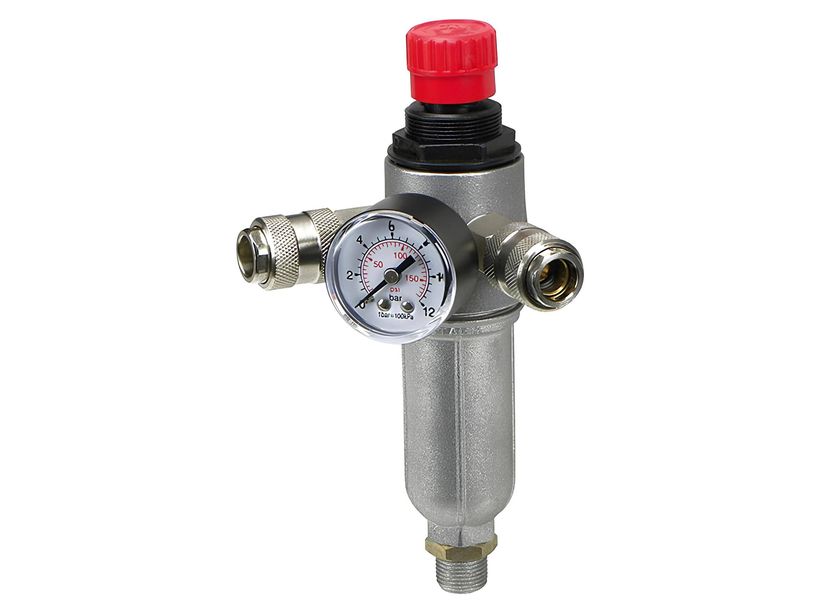
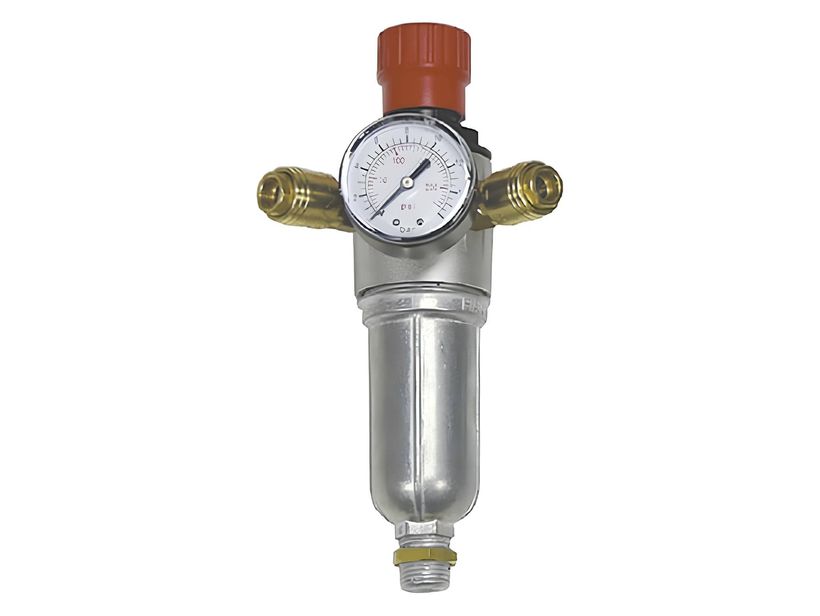
The red knob on top sets the pressure, the gauge shows it, and there are two quick couplers on the sides. The thread at the bottom is what screws into the receiver.
One thing decides the choice — the thread
The two items are otherwise identical. What decides is the thread on your receiver outlet.
RTV-38 — G 3/8" thread
The smaller of the pair. It fits 3/8" outlets, found on small and mid-sized workshop compressors. If you are unsure, unscrew whatever is in the outlet now and measure the outside diameter of the thread.
RTV-12 — G 1/2" thread
The larger version for 1/2" outlets. Everything else is the same as the RTV-38 — the same two quick couplers, the same gauge, the same maximum inlet pressure.
Overview
| Pressure regulators for mounting on the receiver — thread and connections | |||
|---|---|---|---|
| Order code | Thread into receiver | Quick couplers | Gauge connection |
| RTV-12 | G 1/2" | 2× | 1/4" |
| RTV-38 | G 3/8" | 2× | 1/4" |
Both regulators take a maximum inlet pressure of 18 bar and are for compressed air, so that is not repeated in the rows. A regulator never delivers more than it is given at the inlet — eighteen bar is the limit of the design, not what will come out of the compressor.
#showmore#
Fitting and setting
How to seat it
The regulator screws into the outlet on the receiver and the thread is sealed with PTFE tape or hemp. The vessel must be depressurised while you fit it — drain it with the drain valve first, and only then start loosening. Tighten on the body, never on the gauge or the quick couplers.
How to set the pressure
The red knob on top pulls out, turns to set the pressure, and pushes back in to lock so it cannot drift. Always set it with the machine running and the tool connected: the pressure with no draw and the pressure under work are different, and it is the second one that matters. If you overshoot, come back down and approach again — regulators are always set upwards.
What to watch
The regulator itself needs no maintenance, but the air passing through it carries water and oil from the receiver. If the quick couplers drip, replacing the regulator will not help — the answer is draining the condensate regularly from the bottom of the vessel, or filtration downstream of the compressor.
What goes with it
The regulator is one of the things that mount on the receiver. Here is the rest.
- Precision pressure regulators — regulators for pipework and filter-regulator units, over a hundred items
- Compressed air treatment — filtration and drying, for when water comes out of the hose
- Drain valves — releasing condensate from the bottom of the vessel
- Check valves — another part between the compressor and the receiver
- Air receivers — the regulator screws into their outlet

Ventilek says
Ten bar into a spray gun is a recipe for ruined work.
Friends, most air tools are built for around six bar. Feed them whatever happens to be in the receiver and you will not only spoil the finish or over-torque the bolt — the tool pays for it. What is good about these regulators is that they turn an ordinary horizontal compressor into a proper distribution point: one hose on the blow gun, the other on the impact wrench, and you are set. Just measure the hole in the receiver honestly before you order, so you know whether to take the three-eighths or the half inch. That is the only thing separating the two.
Frequent questions about pressure regulators
- How do I tell whether I need 3/8" or 1/2"?
- By the outlet on the receiver. Unscrew whatever is in it now and measure the outside diameter of the thread. There is no other difference between the RTV-38 and the RTV-12 — same quick couplers, same gauge, same maximum inlet pressure.
- What pressure should I set the tool to?
- Whatever the tool maker states — for ordinary air tools that is usually around six bar. Set it with the machine running and the tool connected: the pressure with no draw and the pressure under work differ, and it is the working one that counts.
- Can I have two hoses connected at once?
- Yes, that is what the two quick couplers are for. Both come off the same regulated outlet, so they carry the same pressure — you cannot set one differently from the other. For two different pressures you need two regulators.
- Can it be used on a compressor other than an ABAC?
- Yes. What decides is the thread on the receiver, not the make of the machine — G 3/8" and G 1/2" are standard threads. Measure the outlet and choose accordingly.
- Water drips from the quick couplers. Is the regulator faulty?
- Probably not. The regulator only passes on the air that reaches it from the receiver — and condensate forms in the receiver. The answer is to drain the vessel regularly with a drain valve, or to add filtration downstream of the compressor.
- Is this the same as a regulator for pipework?
- No. This one screws straight into the receiver and has everything on one body. Regulators for pipework, filter-regulator units with a water separator, and precision versions are in a separate category, linked above.
The figures follow the data held against the products in our catalogue. The maximum inlet pressure is the limit of the regulator, not the pressure the compressor will deliver.


Product sorting
List of products

Pressure regulator from ABAC as an accessory for ABAC piston compressors. The regulator is suitable for mounting directly on the air receiver of ABAC piston compressors in 1/2"...

Pressure regulator from ABAC as an accessory for ABAC piston compressors. The regulator is suitable for mounting directly on the air tank of ABAC piston compressors in 3/8"...