

Compressor safety valves: 8 and 11 bar
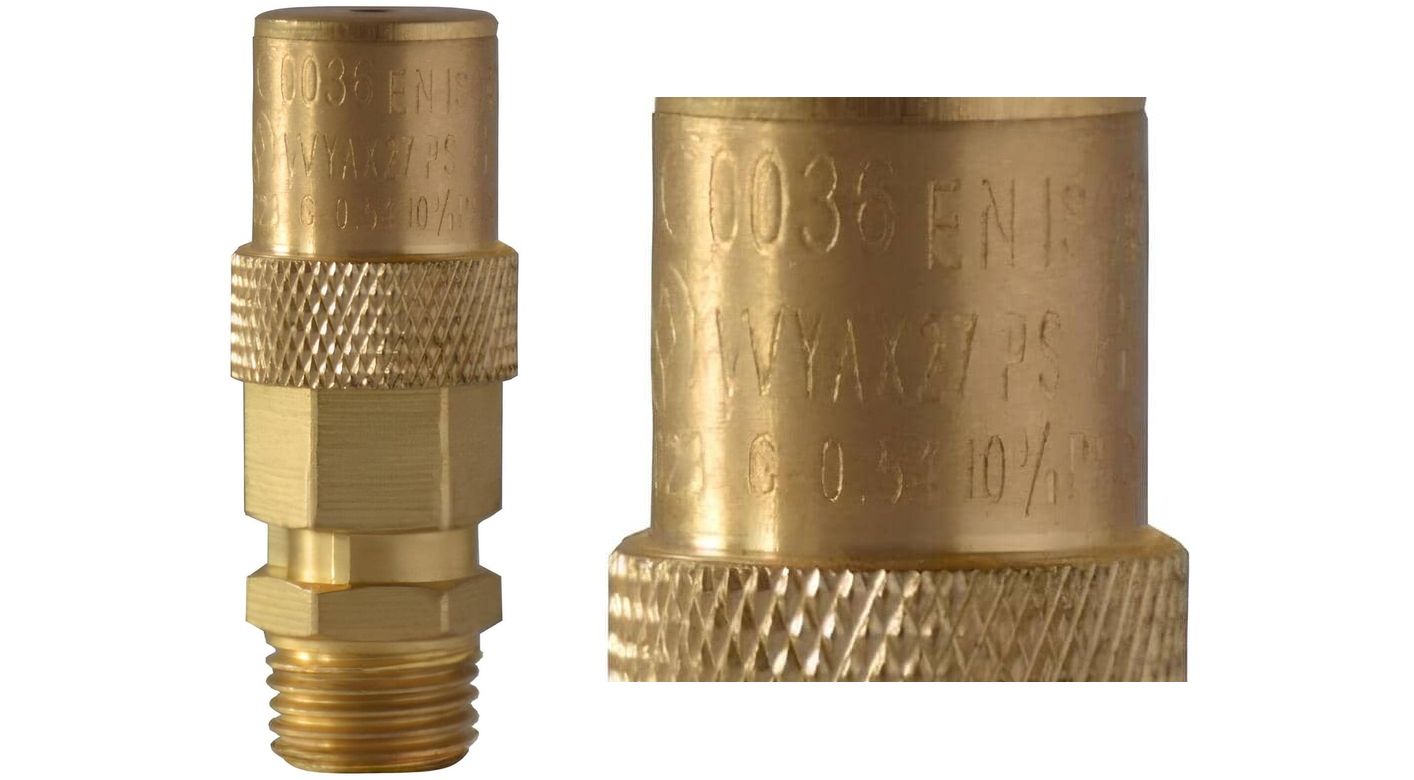
A safety valve is the receiver’s last line of defence. When the pressure switch fails to cut out and the compressor keeps pushing air in, it is the one thing that lets the pressure out before the tank takes more than it can hold. We stock two settings — 8.8 bar and 11.0 bar — both with an R 1/4" thread, which fits most ordinary piston compressors.
Which setting you need
Your receiver’s plate decides: the valve’s set pressure must match the tank’s maximum working pressure and may never exceed it. For an ordinary compressor with a tank rated to 10 bar that is 8,8 bar; for machines running higher, 11,0 bar.
| Black Wind safety valves for compressors — set pressure and flow | ||||||
|---|---|---|---|---|---|---|
| Order code | Thread | Set pressure | Flow area | Flow at set pressure | Material | Seal |
| BW-0008 | R 1/4" | 8,8 bar | 28 mm² | 76 Nm³/h | brass | FPM |
| BW-0009 | R 1/4" | 11,0 bar | 28 mm² | 120 Nm³/h | brass | FPM |
The flow figure says how much air the valve can let out. It has to be more than the compressor puts into the tank — otherwise the pressure would keep rising even with the valve open. Your compressor’s output is on its plate; if you are unsure, write to us.
#showmore#
What a safety valve does
A spring holds the valve shut. While the pressure in the tank stays below the set value, the spring keeps the disc on its seat and the valve does nothing at all. The moment the pressure passes that value, the force from the pressure overcomes the spring, the valve opens and the air escapes freely into the surroundings. When the pressure drops, the spring seats the disc again.
In practice this happens when the pressure switch fails — it does not cut the motor when it should. The compressor then keeps pushing, and without a safety valve the pressure in the tank would rise until something gave way. That is why the valve is required equipment on every pressure vessel, and why there is no sense in bypassing or readjusting it.
The knurled nut on top
The nut lets you lift the valve by hand and blow it off. It is there to confirm the valve has not gummed up with deposits — the test is done at the maximum working pressure and kept brief. It is not a way to empty the tank; condensate is drained through the valve in the bottom of the receiver.
What is stamped on the valve
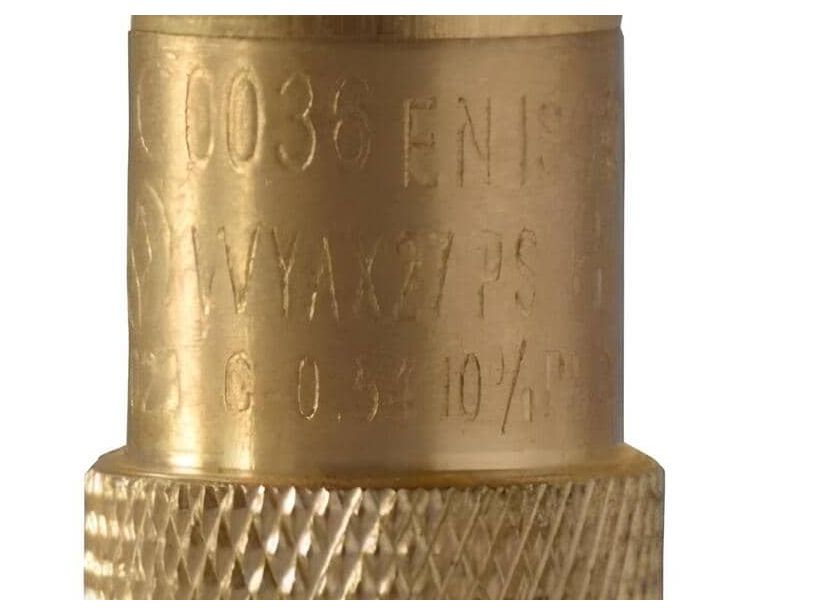
The markings are not decoration — they are the proof that the valve passed conformity assessment. On the body you will find:
- 0036 — the number of the notified body that carried out the assessment
- EN ISO 4126-1 — the standard the valve is built to
- 28 — the flow area in mm²
- 10 % PS — how far the pressure may rise before the valve is fully open
The valves comply with directive 2014/68/EU (PED) and are built for compressed air to standard EN ISO 4126-1.
The setting certificate
The setting certificate is not part of the delivery. The valves arrive set at the stated pressure from the factory, but with no accompanying document and no seal. For an ordinary workshop compressor that is enough. If your inspector requires a certificate — which is often the case for pressure vessels under a regular inspection regime — reach for the industrial version, which we supply set, sealed and with a certificate.
Fitting
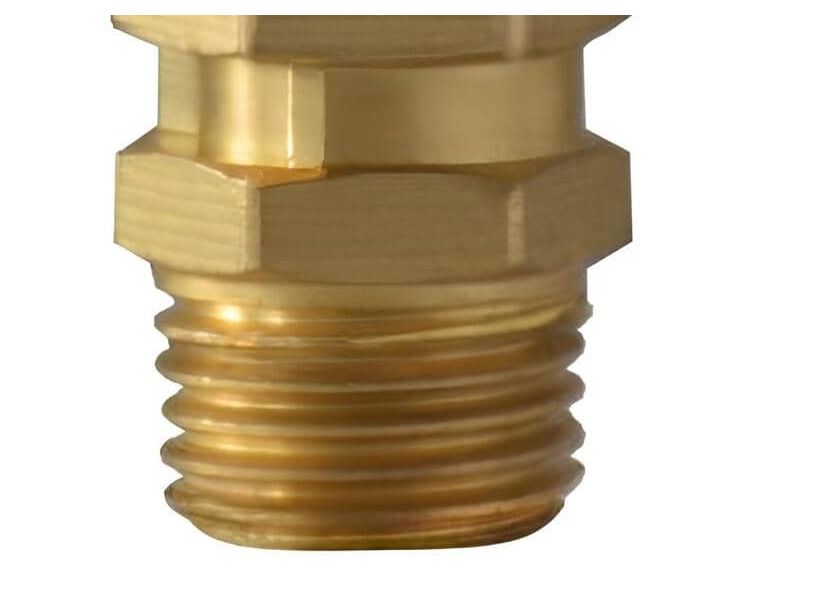
The valve screws straight into the receiver, into a free R 1/4" outlet. The thread is a male taper, so it seals on its own shape; just wrap it with PTFE tape or hemp. The outlet must stay clear — nothing goes over it and nothing stands in front of it, or the valve will not get the pressure out in time.
It is fitted into the upper part of the tank, into the air space, not below the condensate level. If the compressor already has a valve and you are only replacing it, use the same setting the original had.
What goes with it
The safety valve is one of the parts that watch the pressure. These are the others.
- Pressure switches — the one whose failure the safety valve answers
- Drain valves — for draining condensate from the bottom of the tank
- Check valves — they hold the pressure in the tank while the compressor is idle
- Industrial versions — larger bores, with a certificate and a seal

Ventilek says
You do not save money on a safety valve, and above all you do not touch it.
Folks, this is the cheapest part on the whole compressor and at the same time the only one that will save you when the pressure switch goes haywire and fails to cut out. Two pieces of advice. First: choose by the receiver’s plate, not by what you have the switch set to — the valve’s set pressure must never be higher than the tank’s maximum working pressure. Second: lift the nut now and then and let it blow off. A valve that has not opened for years can gum up — and you find that out exactly when you need it.
Frequently asked questions about safety valves
- Which pressure should I choose?
- Go by the receiver’s plate — the valve’s set pressure must never be higher than the tank’s maximum working pressure. An ordinary workshop compressor with a tank rated to 10 bar takes the 8,8 bar valve; machines running higher take 11,0 bar. When replacing an old one, use the setting it had.
- Will the valve fit my compressor?
- Both have an R 1/4" thread, that is a male taper 1/4" — the commonest size on piston compressors. It screws into a free outlet on the receiver. If your machine takes another size, we stock industrial versions from 1/2" upwards.
- Do I get a setting certificate?
- No — with these valves it is not part of the delivery. The valve is set at the factory, but without a document and without a seal. When you need the certificate, for instance for a pressure vessel inspection, order the industrial version.
- What is the knurled nut on top for?
- For the manual test. Lifting the nut makes the valve blow off briefly and tells you it has not gummed up. It is done at the maximum working pressure and kept brief. It is not for emptying the tank — condensate is drained through the bottom valve.
- What do the figures 76 and 120 mean?
- How much air the valve can let out at the set pressure, in Nm³/h. It has to be more than the compressor puts into the tank — that figure is on the machine’s plate. A higher set pressure means a higher flow as well, because the pressure pushes the air out of the valve harder.
- How do I tell the valve has failed?
- Two ways. It blows off during normal running although the pressure never reached the set value — then the seat is not sealing. Or it will not lift by the nut and releases nothing when tested — then it has gummed up. Either way the valve is replaced, not repaired and not readjusted.
- Can I readjust the set pressure myself?
- No. The valve is set and assessed as a whole; interfering with the spring voids the conformity assessment and any certainty about the pressure at which it will open. When you need a different pressure, you take a different valve.
The figures follow the manufacturer’s datasheet and catalogue. A safety valve is a safety component of a pressure vessel — if you are not sure what pressure your receiver’s plate states, get in touch and we will go through it with you.


Product sorting
List of products

Protection for the receiver in case the pressure switch fails to cut out. Once the set pressure is passed it lets the air out and keeps the tank from being overpressured. It...

Protection for the receiver in case the pressure switch fails to cut out. Once the set pressure is passed it lets the air out and keeps the tank from being overpressured. It...