


TL;DR:
- An isolation valve is a fitting for hermetically closing a section of pipework without regulating the flow, which affects the safety and service life of the system. Correct installation, choosing the right type and observing the standards are key to the reliability and safety of operation. Incorrect use, installation or confusion with a control valve cause the most common faults and premature failure.
The isolation valve is among the basic elements of every pneumatic or industrial pipework system, yet a good deal of inaccuracy circulates about it. Many technicians confuse isolation valves with control valves or consider them a back-up element without a specific function. The opposite is true. What an isolation valve is can be explained simply: it is a fitting that hermetically closes or opens the flow of the medium in the pipework without continuously regulating that flow. The right choice and installation of this element directly affect the safety of operation, the service life of the whole system and the cost of maintenance.
Contents
- Key findings
- Types of isolation valve and their technical parameters
- How an isolation valve works
- Advantages of the isolation valve in industry and pneumatics
- Installation, operation and maintenance of isolation valves
- A view from practice: what actually fails
- Isolation valves and complete compressed air systems from Kompresory-vzduchotechnika
- FAQ
Key findings
| Point | Details |
|---|---|
| Definition of the isolation valve | A fitting for hermetically separating part of a pipework system, not for regulating the flow. |
| Tightness standards | The standard ISO 5208 defines leakage classes from A to G; the class must be stated when ordering. |
| The most common cause of faults | Roughly 90% of problems arise from faulty installation, not from a manufacturing defect in the valve. |
| Anti-freeze protection | A frost protection valve responds automatically below 3 °C without needing electricity or an operator. |
| The basis of correct installation | The valve must have its own supports and the system must be properly flushed before installation. |
Types of isolation valve and their technical parameters
The market offers several designs of isolation valve. Every type has different properties, a different range of use and different technical limits. Confusing the types is one of the most common causes of operating failures.
Ball valve
The ball valve is the most widespread type of isolation valve in pneumatics and industry. The closing element is a ball plug with a through hole. Turning it by 90 degrees closes or opens the flow completely. Ball valves are known for low flow resistance, fast response and a long service life. They suit air, water, steam and aggressive media depending on the material of the seal.
Gate valve
The gate valve works with the linear movement of a closing wedge. It suits applications with large pipe diameters and where minimal flow resistance in the fully open position is key. It is not designed for regulating the flow. Using a gate valve in a partly open position leads to rapid wear of the seat and to leaks. This error in selection, as the correct functioning of the valves confirms, causes premature failure.
AB valve with a double seat structure
The AB valve belongs to the category of specialised industrial fittings. The double seat structure prevents two different media from mixing. The AB valve is used in pharmaceutical production for the safe transfer of materials and the isolation of hazardous chemical substances. It is a solution for environments with strict hygienic or safety requirements.
Anti-freeze valve
The frost protection valve works on a thermostatic principle. It automatically opens the flow at a temperature below 3 °C, thereby preventing the pipework from freezing. It works without electricity and without any intervention by an operator. It is installed above all in outdoor pipework, heat pumps and outdoor air handling systems.
A comparison of the main types of isolation valve:
| Valve type | Main use | Control | Key advantage |
|---|---|---|---|
| Ball valve | Pneumatics, water, gas | Manual / pneumatic | Fast switching, low resistance |
| Gate valve | Large pipework, liquids | Manual | Minimal resistance in the open position |
| AB valve | Pharmaceutical industry | Automatic / manual | Separation of two media |
| Anti-freeze valve | Outdoor piping | Automatic (temperature) | Protection without electricity |
Professional tip: When ordering an isolation valve, always state the required tightness class. The standard ISO 5208 defines classes from A (no visible leakage) to G. For safety applications class A or B is as a rule mandatory, and confusing them can have serious operating consequences.
How an isolation valve works
The working principle of an isolation valve is straightforward: the closing element either blocks the flow completely or permits it completely. There is no continuous regulation. That is precisely what distinguishes the isolation valve from the control valve, where the aim is to set a specific flow or pressure.
Actuation and triggering mechanisms
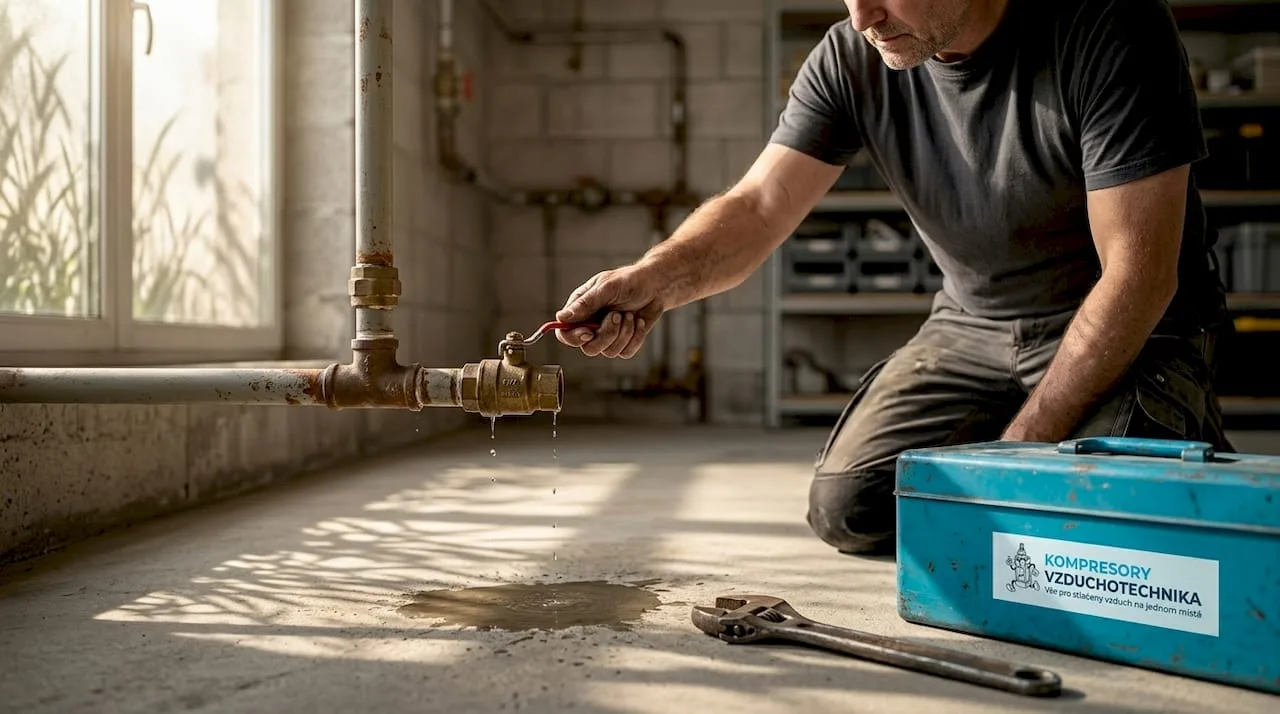
Isolation valves can be actuated in several ways:
- Manually by a handwheel, lever or handle, with the operator deciding the position of the valve
- Pneumatically by supplied compressed air, which moves a piston and closes or opens the seat
- Electrically by a servo actuator on the basis of a signal from the control system or the PLC
- Automatically by temperature, as in the case of the frost protection valve, where the temperature trigger responds without any external impulse
The frost protection valve is specific in that it works as an independent safeguard even during a power failure. For outdoor pipework of heat pumps and air handling systems that is a fundamental property.
Risks of incorrect use
Using an isolation valve as a control element is a serious operating mistake. In a partly open position the medium passes the seat at high speed and causes cavitation or erosion. The result is leaks and premature replacement. Just as problematic is using a control valve where hermetic isolation is needed. Under the standard API 598, isolation valves must show no visible leakage, whereas control valves have a defined leakage tolerance. Confusing the types can therefore directly endanger the safety of the system.
Professional tip: If you have a system where you need both isolation and flow regulation, always install two separate valves. One isolation valve for complete closing and one control valve for setting the flow. Combining both functions in one element leads to the failure of both.
Advantages of the isolation valve in industry and pneumatics
A correctly chosen and installed isolation valve brings measurable operating advantages. It is not only about safety. It is about reduced downtime, the protection of investments and simpler maintenance.
-
Safety of operation. Hermetically closing part of the system makes it possible to work safely on pipework or equipment without having to shut down the whole operation. The pharmaceutical industry uses AB valves to separate hazardous substances, where mixing the media would cause contamination or an explosion.
-
Protection against freezing. The frost protection valve protects outdoor pipework without any intervention by an operator. Pipework that freezes and bursts causes outages measured in days and damage measured in tens of thousands of crowns. Automatic protection eliminates this scenario.
-
Simpler maintenance. The ability to isolate individual branches of the system shortens the time needed for service work. The technician closes the relevant section, vents it and works in a safe environment. Without an isolation valve they have to shut down the whole line.
-
Protection of the components behind the valve. Closing the supply prevents surges or contamination in the event of an outage or a fault on the supply side. Compressors, filters and production machines therefore have a markedly longer service life.
-
Energy savings. Closing unused branches of a pneumatic system eliminates compressed air leaks. Untight pipework represents one of the biggest sources of operating losses in industrial halls.
-
Compliance with standards. Industrial regulations in a number of sectors, from food production to petrochemicals, require isolation valves to be installed at specific points. Correct certification of the valve (ISO 5208, API 598) is a condition for the operation to be approved by the inspection body.
Installation, operation and maintenance of isolation valves
The statistics speak clearly: 90% of valve problems arise from faulty installation, not from a manufacturing defect. The technical quality of the valve guarantees nothing if it is badly built into the system.
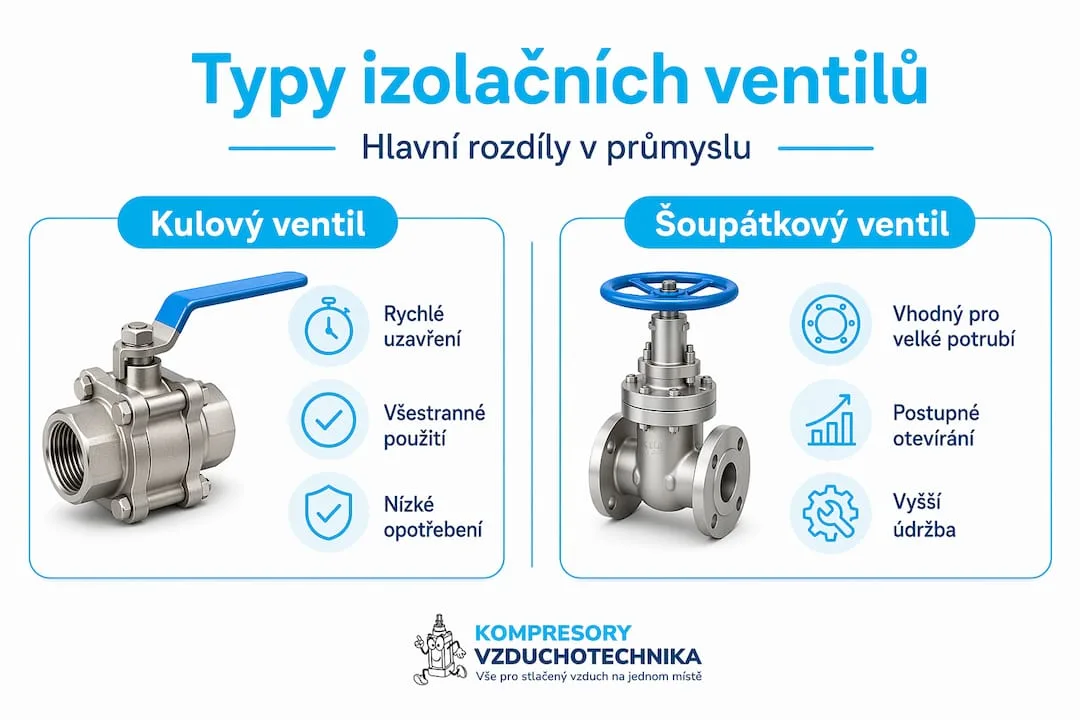
Principles of correct installation
Before starting the installation, several parameters need to be verified:
- Orientation of the valve. Most types have a prescribed direction of flow marked with an arrow on the body. Installation in the opposite direction can cause functional failure or damage to the seal.
- Cleanliness of the system. Before installation the whole pipework must be flushed to prevent damage to the sealing seats. Even small particles cause scratches on the seat and thereby permanent leaks.
- Support of the valve. Heavier valves must have their own supports. Loading the valve with the weight of the pipework causes deformation of the body and premature wear.
- Length of the supply pipework. The inlet pipework should be short and straight so that the vibration transferred to the valve is minimised.
- Tightness check after installation. After installing and pressurising the system, carry out a check of the tightness of the joints and the flange connections.
Operating recommendation
An isolation valve should not remain in one position without movement for a long time. Valves that go unopened for years tend to seize or corrode. Regular movement, ideally once a quarter, prevents jamming during an emergency closure. For pneumatic systems with air valves and automation, the additional recommendation is to check the cleanliness of the air filter for the control medium, because moisture or dirt in the control air damages the actuator of the valve.
Professional tip: Applying the standard FCI 70-2 Class VI to isolation valves is a technical error. That standard applies to control valves and confusing the standards in safety applications can endanger the operating safety of the whole system. Always verify that the supplier refers to the standard valid for the given type of valve.
Preventive maintenance
The recommended frequency of checking depends on the medium and the operating conditions. Air systems without corrosive substances manage with an annual cycle. Aggressive media, high temperatures or an outdoor environment require a check every six months. At every check, focus on the tightness of the flange connections, the condition of the outer surface and the operability of the manual mechanism.
A view from practice: what actually fails
Over years of work with pneumatic systems and industrial installations I have met one recurring pattern. Technicians come with a faulty valve, the customer complains to the manufacturer and the result of the inspection always shows the same thing: an installation error, not a manufacturing defect. A worn seat, a jammed mechanism, leaking flanges. The cause meanwhile lies in dusty pipework, in poor support or in confusing the isolation and control valve.
I also see one persistent myth: that a more expensive valve will automatically survive poor installation. It won't. A top-tier ball valve certified to ISO 5208 class A will fail within a month if you install it in unflushed piping without supports and with a pressure surge at the inlet.
What really works is the combination of choosing the right type, careful preparation of the system and a check after installation. The rest is administration. Safety valves have a similar story, and anyone who wants to refresh the principles of choosing them will find useful information in the article about safety valves and their capacity.
The most common specific problem I deal with? A frost protection valve installed first in a branch without a water drain. The result is that even though the valve correctly opens the flow below 3 °C, the water has nowhere to run and the pipework freezes a few centimetres further along. The function of the valve is faultless, but the hydraulic connection is wrong.
— Zdeněk
Isolation valves and complete compressed air systems from Kompresory-vzduchotechnika
Isolation valves are part of a wider system. The valve alone will not deliver the required performance without a good compressor, correct pipework and clean compressed air.
Kompresory-vzduchotechnika offers complete equipment for industrial and pneumatic installations. The foundation is SCR screw compressors for a stable and reliable source of compressed air suitable for supplying whole valve systems. For the pipework it then offers pipes for compressed air in diameters of 15 to 28 mm with a push-in system for fast and tight installation. The range also includes tubing made of polyamide PA12 for fine branches and control lines. The expert team provides technical consultation when choosing components, sizing the system and designing valve assemblies. Contact details and the whole range are available on the website Kompresory-vzduchotechnika.cz.
FAQ
What is an isolation valve and what is it for?
An isolation valve is a fitting intended for hermetically separating part of a pipework system. It makes it possible to close the flow of the medium for the purpose of maintenance, safety or the protection of part of the system, without having to shut down the whole operation.
What is the difference between an isolation and a control valve?
An isolation valve works only in two positions: fully open or fully closed. A control valve makes it possible to set the flow continuously. Confusing the two types leads to rapid wear or a safety risk.
How does a frost protection valve work?
A frost protection valve contains a temperature trigger that automatically opens the flow when the temperature drops below 3 °C. It works without electricity and without an operator, so it protects the pipework even during a power failure.
Which standard must an isolation valve for industrial applications meet?
For industrial isolation valves the standard ISO 5208 applies, which defines tightness classes from A to G. For safety applications class A or B is as a rule required. The standard FCI 70-2 Class VI applies to control valves and is unsuitable for isolation valves.
Why does an isolation valve leak even though it is new?
The most common cause is faulty installation. Dirt in the pipework damages the seat of the valve during the first flow, or the valve carries the weight of the pipework without its own support and the body deforms. A manufacturing defect is statistically a markedly less likely cause of failure.
Recommended
- How air valves work: their key role and efficient solutions - Kompresory-Vzduchotechnika.cz
- The check valve in compressors: technical function and application - Kompresory-Vzduchotechnika.cz
- How to install air handling equipment correctly: a practical procedure - Kompresory-Vzduchotechnika.cz
- How to eliminate air leaks: a guide to a 42% energy saving - Kompresory-Vzduchotechnika.cz