

TL;DR:
- A cyclone separator generates centrifugal forces in the order of tens of thousands of G and removes solid particles without any filter element. It works on the principle of a rotating vortex that separates contaminants and allows continuous operation without clogging. Its benefits include low maintenance costs, high reliability and suitability as a first stage of filtration.
A cyclone separator is not just a simple filter. It is a device that generates centrifugal forces in the order of tens of thousands of G and thereby separates solid particles from the air stream without a single filter element. How a cyclone separator works is a question that interests industrial engineers and advanced hobbyists working with compressed air alike. This article explains the principle of the cyclone separator step by step, compares it with other technologies and gives specific advice on selection and operation.
Contents
- Key takeaways
- How a cyclone separator works step by step
- Applications and benefits of a cyclone system
- Physical aspects: pressure, geometry and separation efficiency
- How to choose a separator: parameters and maintenance
- Air cyclones versus hydrocyclones
- Field experience with cyclone separators
- Separators and air systems from Kompresory-vzduchotechnika
- FAQ
Key takeaways
| Point | Details |
|---|---|
| Operating principle | The cyclone creates a rotating air vortex whose centrifugal force pushes particles towards the walls and into the collection container. |
| No filter medium | Cyclone separators work without filters, so they do not clog and keep the suction power constant. |
| Benefits of a cyclone system | Low maintenance, high reliability and operation without moving parts ensure a long service life. |
| Choosing the right separator | The key parameters are air flow rate, inlet velocity and the geometry of the cyclone in relation to the application. |
| Combining technologies | Cyclones perform best as a first stage of filtration ahead of finer filter systems. |
How a cyclone separator works step by step
The principle of the cyclone separator rests on the physics of centrifugal force. Air enters a cylindrical or conical chamber tangentially, that is at an angle to the wall. This immediately sets the air column rotating.
What happens inside the cyclone can be described in four phases:
- Air inlet: Contaminated air enters the upper part of the cyclone body through a tangential opening. A high inlet velocity, ideally 15 to 25 m/s, creates a strong rotating vortex.
- Rotation and centrifugation: The vortex rotates along the inner wall. Heavier solid particles, dust and liquid droplets are thrown against the cyclone wall by centrifugal force. These forces can reach tens of thousands of G, which is incomparably more than gravity.
- Separation and fall-out: Particles clinging to the wall lose their kinetic energy, slide down the conical section and drop into the collection container at the bottom of the device.
- Clean air outlet: The inner air column, now free of contaminants, turns upwards through the centre of the cyclone and leaves through the outlet tube.
The whole process runs continuously and without interruption, because the device contains no filter medium that could clog. That is the fundamental difference from conventional dust filters.
Professional tip: If you run a cyclone in a high-humidity environment, watch for condensate in the collection container. Accumulating liquid can disrupt the separation of solid particles and reduce overall efficiency.
The effectiveness of cyclone separators depends on how precisely the geometry of the body and the inlet velocity are sized. A poorly chosen diameter or an unsuitable length of the conical section will significantly reduce the performance of the device even with correct installation.
Applications and benefits of a cyclone system
Cyclone separators are used across industries. Their specific operating principle makes them a reliable solution wherever solid particles have to be removed continuously from a stream of air or gas.
Typical areas of use include:
- Industrial recycling of plastics and films, where cyclones remove dust and fine particles without any need to change filters.
- Woodworking shops, where sawdust and coarse dust place a constant load on extraction systems.
- The food industry, where cyclones separate dry powders and granulates without the risk of contamination from a filter medium.
- Pneumatic conveying systems, where they separate the conveyed material from the carrier air.
- A pre-cleaning stage in complex systems, where they protect finer filtration equipment from premature clogging.
The benefits of a cyclone system over conventional filtration technologies are measurable:
| Parameter | Cyclone separator | Conventional filter |
|---|---|---|
| Moving parts | None | None or minimal |
| Filter medium | Not required | Requires regular replacement |
| Suction power over time | Constant | Drops as the filter clogs |
| Operating costs | Low | Medium to high |
| Efficiency for fine dust | Medium | High (HEPA, filter bags) |
| Suitability as a first stage | Yes | Rather not |
With no moving parts, continuous operation with minimal service requirements is possible. You will appreciate this above all in plants where a failure of the extraction system means a direct loss of productivity.
Professional tip: Use a cyclone separator primarily for coarse and medium-fine fractions. To capture very fine particles below 5 microns, add a secondary filter to the system. Combining technologies gives the best results, as practice with filtration systems for production also confirms.
Physical aspects: pressure, geometry and separation efficiency
The performance of a cyclone is not governed by air flow rate alone. The pressure difference between the centre of the cyclone and its wall plays a decisive role, as does the geometry of the body itself.
The pressure difference arises from the rotation of the air column. The centre of the cyclone has a lower pressure, the wall a higher one. This pressure gradient works together with the centrifugal force and the two drive separation jointly. Inlet velocity and the diameter ratios of the individual sections of the cyclone directly determine the resulting separation force.
| Parameter | Effect on performance |
|---|---|
| Air inlet velocity | Higher velocity increases centrifugal forces, but energy consumption rises |
| Diameter of the cylindrical section | A smaller diameter increases separation efficiency for fine particles |
| Length of the conical section | A longer cone extends the residence time of particles and improves separation |
| Ratio of cylinder to cone | A key design parameter for maximum efficiency and low consumption |
| Size of the outlet tube | Affects the back-flow of air and the risk of particle re-entrainment |
For industrial cyclones, an optimum inlet velocity of 15 to 25 m/s provides sufficient centrifugal force without wasting energy. Operating outside this range either reduces efficiency or raises operating costs disproportionately.
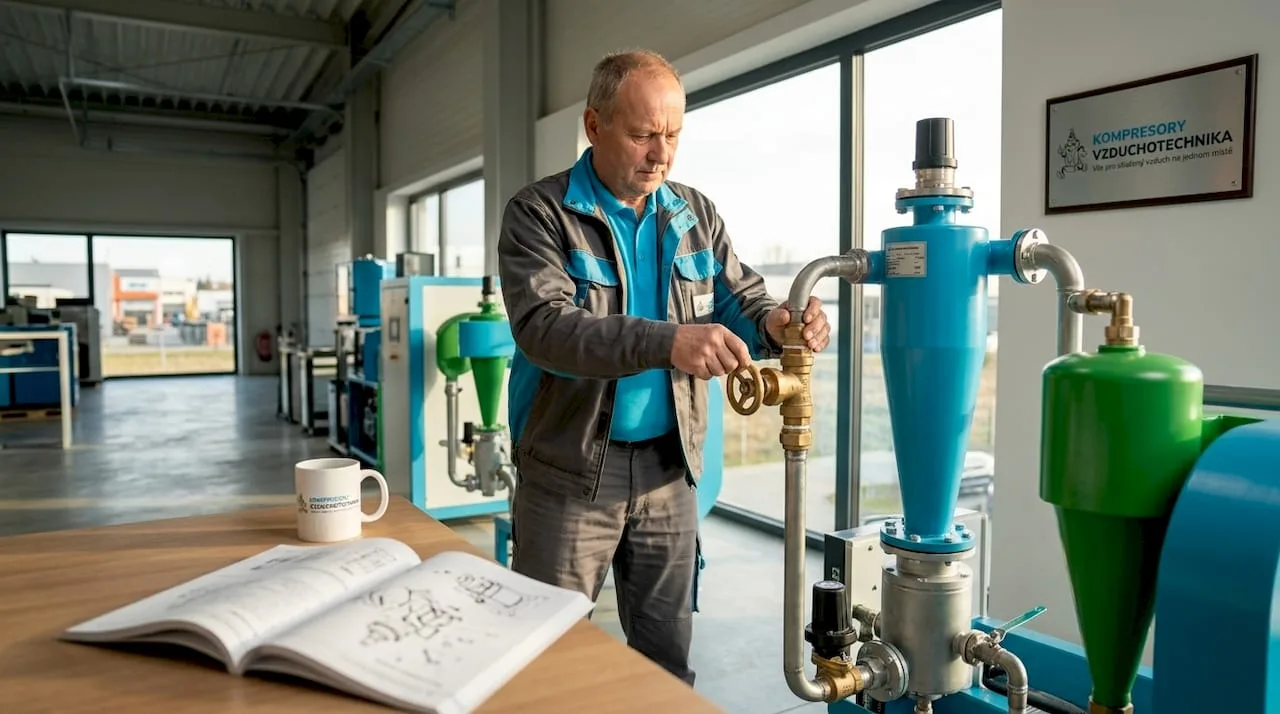
Proper optimisation of the pressure system and the geometry is therefore essential when designing or selecting a cyclone. It cannot be replaced by a higher flow rate or by adjustments made after installation.
How to choose a separator: parameters and maintenance
Choosing the right cyclone separator starts with defining the application. Every plant has different requirements for flow rate, type of contaminant and the required separation efficiency.
Key parameters when choosing:
- Air flow rate (m³/h): The cyclone must be sized for the actual flow rate, not for the nominal compressor output.
- Type and size of particles: For coarse dust above 10 microns, a standard version is sufficient. For finer fractions, choose multi-cyclone or multi-stage units.
- Operating pressure: Make sure the cyclone body matches the maximum operating pressure of the system.
- Body material: Corrosive environments or abrasive materials call for special coatings or a stainless steel version.
- Volume of the collection container: A container that is too small will need frequent emptying and can disrupt operation.
Typical mistakes during installation and operation:
- Leaking joints that cause a loss of vacuum and reduce efficiency.
- Installation at an unsuitable point in the system, where the air arrives at too low a velocity.
- Neglected correct installation decides the effectiveness and incorrect air routing can significantly reduce performance.
Professional tip: When assessing cyclone separators, read product reviews with an eye on the operating conditions of the tests. Results measured in a laboratory can differ significantly from real industrial operation. Always ask for data sheets with values measured at a specific inlet velocity and flow rate.
Regular maintenance is minimal, but it cannot be skipped entirely. Check the tightness of the collection container, the condition of the seals and of the outlet tube. From time to time, visually inspect the inner surface of the cyclone for wear or deposits.
Air cyclones versus hydrocyclones
Both types work on the same physical principle, but in different media and for different applications. Understanding the differences helps in choosing the right technology.
Air cyclones separate solid particles or liquid droplets from an air stream. They are used in industrial extraction, pneumatic conveying, compressor protection and everywhere that air cleaning or the cleaning of technical gas is required.
Hydrocyclones work on the principle of the density difference between solids and liquid. They separate sediments, sludge and solid contaminants from liquid streams. They are used in wastewater treatment, the mining industry and coolant circulation systems.

| Property | Air cyclone | Hydrocyclone |
|---|---|---|
| Medium | Air, gas | Liquid |
| Separated fraction | Solid particles, droplets | Solid particles, sludge |
| Typical application | Industrial extraction, air handling | Water treatment, mining |
| Operating pressure | Low to medium | Medium to high |
| Environmental impact | Low | Low, cost-effective |
The choice between the two technologies is straightforward: an air cyclone for gaseous media, a hydrocyclone for liquid ones. Where both media are combined, deploy the devices in sequence or choose specialised combined separators, available for example as condensate separators.
Field experience with cyclone separators
In my experience, the biggest mistake users make is underestimating the inlet air velocity. I see it again and again: a technically well chosen device, but installed at a point in the pipework where the air flows too slowly. The result is a weak vortex, minimal centrifugal force and a separator that separates almost nothing.
The second problem that keeps surprising me is excessive trust in a single separation stage. Cyclones are excellent for coarse fractions and medium-fine dust. But anyone expecting a cyclone alone to replace complete filtration will be disappointed. The right combination of a cyclone as a pre-cleaning stage with a downstream fine filter or an air treatment unit delivers consistent results in long-term operation.
I appreciate that cyclone manufacturers have significantly improved their documentation in recent years. Data sheets today contain real separation curves for various flow rates. A few years ago, a single efficiency figure without context was the standard. That was the source of many misunderstandings during selection. Today you can compare specific values and choose a device that genuinely matches the operating conditions.
What I would stress to professionals in particular: the performance of a cyclone does not depend on the manufacturer alone, but to a large extent on correct installation and the sizing of the whole system. A correctly installed average cyclone will outperform a badly installed premium product.
— Zdeněk
Separators and air systems from Kompresory-vzduchotechnika
Kompresory-vzduchotechnika offers technical advice on choosing separators, compressors and downstream components for compressed air treatment. Whether you are equipping an industrial plant or a smaller workshop, our specialists will help you design a system that matches your specific conditions.
The range includes SCR screw compressors for industrial applications, compressed air treatment units, condensate separators and complete accessories for air distribution. For those looking for a simple solution up to 10 bar, air treatment A2 is also available. All products are backed by service and technical documentation.
FAQ
What is a cyclone separator?
A cyclone separator is a device that separates solid particles or droplets from an air stream using the centrifugal force of a rotating air vortex, without using any filter element.
What is the efficiency of cyclone separators?
Efficiency depends on the size of the particles being separated, the inlet velocity and the geometry of the device. For coarse fractions above 10 microns, cyclones reach very high efficiency; for finer dust, a combination with an additional filter is advisable.
How do I choose a separator for a specific application?
The decisive parameters are air flow rate, type and size of contaminants, operating pressure and environment. To choose correctly, always compare data sheets with values measured under real operating conditions.
Does a cyclone separator need regular maintenance?
Cyclones do not require filter changes and have no moving parts. The collection container has to be emptied regularly, the tightness of the joints checked and internal wear inspected visually.
What is the difference between a cyclone and a hydrocyclone?
An air cyclone works with gaseous media and separates solid particles from air. A hydrocyclone works in a liquid medium and separates solid particles or sludge from liquids, for example in wastewater treatment.
Recommended
- Applications of pressure regulators: a guide to efficient control - Kompresory-Vzduchotechnika.cz
- A guide to industrial air distribution: operating efficiency - Kompresory-Vzduchotechnika.cz
- How the electric motor affects the performance and reliability of a compressor
- What is pneumatic automation: a guide for industry - Kompresory-Vzduchotechnika.cz