


TL;DR:
- Industrial air distribution is an important system which influences energy consumption and the reliability of production.
- Correctly designed and dimensioned piping with minimised pressure losses and regular maintenance increases efficiency and reduces costs.
- The combination of piped systems and mobile filters together with predictive maintenance fundamentally improve operation and reduce losses.
Industrial air distribution tends to be underestimated. Many managers imagine under this term only piping leading from the compressor to the work stations. In reality it is a complex technical system which directly influences energy consumption, the reliability of production and operational safety. A badly designed or neglected distribution can cause losses of 20 to 40 % of the compressed air through mere leakage, which immediately shows up in the costs. In this guide you will find a description of the basic principles, an overview of the components, a comparison of the types of system, the choice of material and practical tips for maximum efficiency.
Contents
- What industrial air distribution is and how it works
- The main components of industrial air distribution and their importance
- The choice of the material of the piping
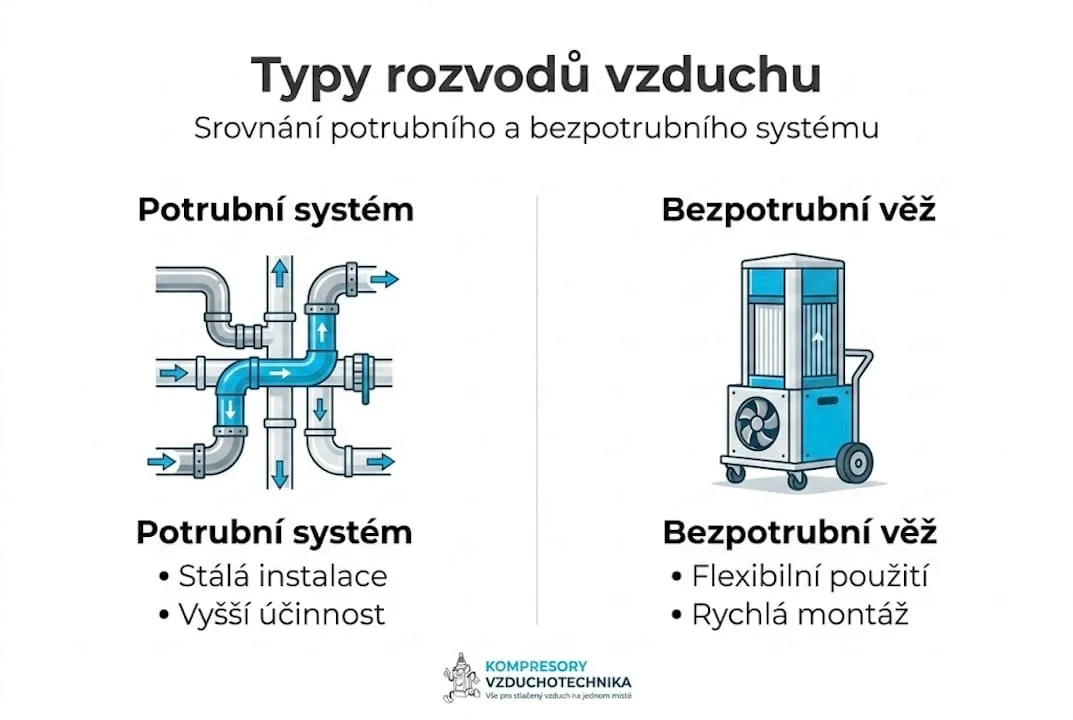
- Types of industrial air distribution: piped vs. pipeless systems
- Dimensioning and installation of the distribution
- Efficiency, optimisation and maintenance of industrial air distribution
- An expert view: what most firms underestimate about air distribution
Key findings
| Point | Details |
|---|---|
| The right setting of the system | The key to efficient air distribution is a well-thought-out design and the choice of a suitable type for the specific plant. |
| Dimensioning with a reserve | Doubling the diameter of the piping reduces pressure losses approximately 32 times. Choose the diameter with a reserve of 20 to 30 % above the current consumption. |
| A pressure drop costs money | Every bar of unnecessary overpressure increases the energy consumption of the compressor by approximately 7 %. |
| Optimisation saves costs | Ongoing optimisation and monitoring of air leaks reduce the costs of energy and service by 15 to 30 %. |
What industrial air distribution is and how it works
Industrial air distribution is a system of equipment and lines which brings compressed air from the place of production (the compressor) up to the end consumers. This includes pneumatic tools, automated lines, nozzles, valves and other equipment. The system begins at the compressor, continues through the air receiver (pressure store), filtration, treatment units and piping, until it ends at the specific consumer.
Correctly designed distribution ensures a stable pressure at all points of consumption, minimal pressure losses and clean air without moisture and solid particles. Every link of the chain must be dimensioned according to the actual consumption and working pressure.
The basic parts of the system:
- A compressor (screw, piston or vane)
- An air receiver for evening out pressure peaks
- A cooler of the compressed air
- Filters (pre-filters, fine filters, activated carbon filters)
- An adsorption or refrigeration dryer
- Piping (steel, aluminium or plastic)
- Pressure regulators and end fittings
- Pneumatic tools and consumers
One of the basic principles of function is the correct topology of the piping. A ring (loop) line supplies the consumers from two sides at the same time, whereby it ensures an even supply even with uneven consumption and considerably reduces the pressure drop. Dead branches are a source of condensate and lower pressure at the end of the route. Direct (branched) piping is simpler to install and suits smaller workshops with one or two consumers; for halls with several points of consumption a ring system is the standard.
With high dustiness or with the operator moving around the hall, pipeless filtration towers are a more effective variant than classic piped filtration. The modern trend of predictive maintenance using ultrasonic detectors moreover makes it possible to reveal leaks or damaged seals before they cause an outage.
For most industrial plants piped air distribution of aluminium profiles are suitable. They offer resistance to corrosion, a low hydraulic resistance and easy fitting. Steel distribution is the choice where there are higher working pressures or where the piping passes through mechanically stressed sections.
A fundamental factor is the correct fall of horizontal lines, at least 1 % (ideally 1 to 2 %) in the direction of the flow of the air. The condensate thus flows away into the separators and does not gather at critical places where it could damage the consumers or cause microbial contamination. Always route branches from the upper side of the main piping, so that condensate and impurities do not run directly into the branches to the consumers. Every dead branch and the lowest points of the distribution must have a condensate drain, preferably an automatic one.
The main components of industrial air distribution and their importance
After the basic description of the system we will focus on the individual elements which form it. Every component fulfils a specific function and its failure or incorrect dimensioning influences the whole chain.
The order of correct installation of the components:
- Compressor (source of compressed air)
- Cooler of the discharge air (reduction of temperature, condensation of moisture)
- Air receiver (evening out of pressure peaks, separation of condensate)
- Coarse pre-filter (capture of solid particles and droplet moisture)
- Dryer (adsorption or refrigeration)
- Fine filter and activated carbon filter (according to the requirements for the cleanliness of the air)
- Piping to the points of consumption
- Pressure regulators before the consumers
- Treatment units (filter, regulator, automatic lubricator) directly at the tools
| Component | Main function | Influence on the system |
|---|---|---|
| Compressor | Production of compressed air | Determines the total output and pressure |
| Air receiver | Evening out of consumption, store | Stabilises the pressure, reduces switching |
| Filter | Capture of impurities and moisture | Protects the consumers and the operator |
| Dryer | Removal of moisture | Prevents corrosion and freezing |
| Piping | Transfer of air | Influences the pressure losses |
| Pressure regulator | Setting of the working pressure | Protects the consumers, saves energy |
| Treatment unit | Filtration, regulation, lubrication | Extends the service life of the tools |
The filtration of the air is key not only for the reliability of the machines, but also for the safety and health of the workers. Air contaminated with oil, dust or moisture can cause diseases of the respiratory tract or damage to sensitive automation elements. The quality of compressed air is defined by the standard ISO 8573-1, which divides contamination into classes according to the content of solid particles, moisture and oil. Place the filtration and drying elements as close as possible to the compressor, so that the rest of the distribution already works with treated air.
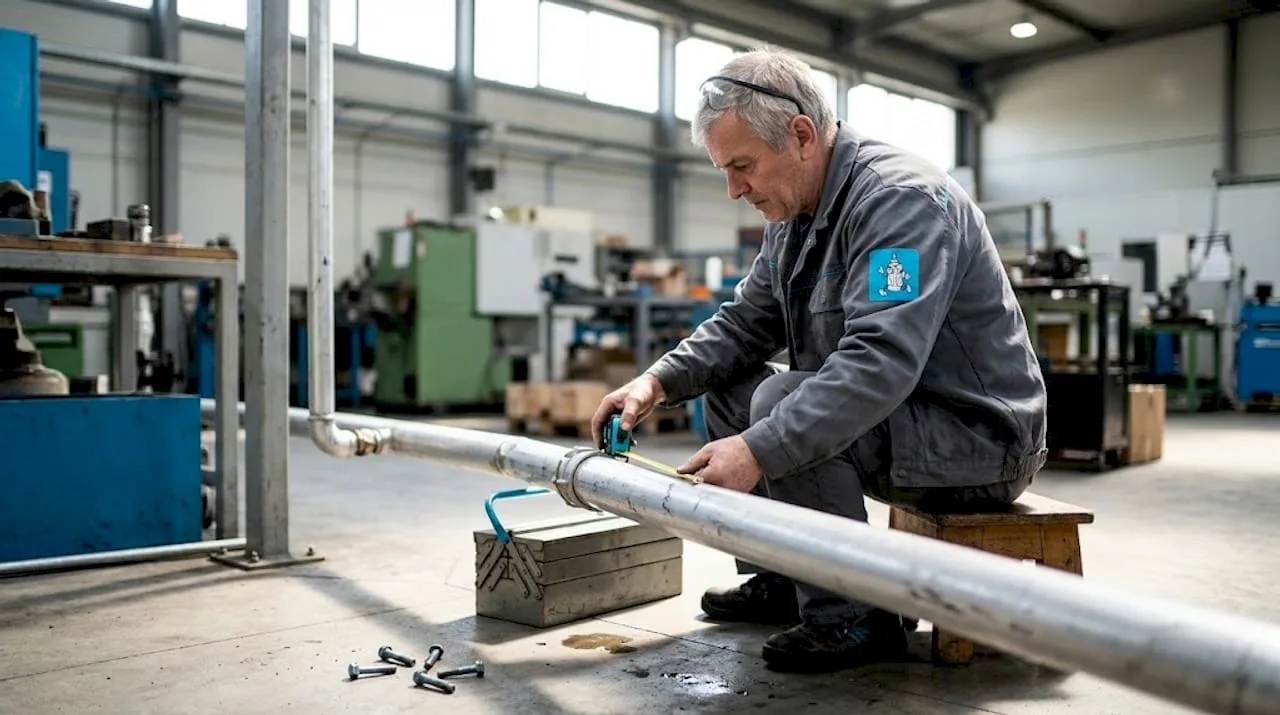
Air treatment units combine a filter, a regulator and an automatic lubricator (FRL) in one compact unit directly before the consumer. They ensure the final treatment of the air and protect pneumatic tools from impurities and an unsuitable pressure. In a proven industrial arrangement a central filter removes coarse impurities and moisture at the source, local regulators then fine-tune the pressure exactly according to the need of the specific machine.
The choice of the material of the piping
The choice of material influences not only the purchase price, but above all the pressure drop, which is reflected in the consumption of electricity throughout the whole service life of the distribution. The rougher the internal surface, the higher the resistance to flow and the greater the drop of pressure between the compressor and the tool.
- Aluminium – the standard for backbone distribution in workshops and in industry. A smooth internal surface, a low pressure drop, no corrosion even with condensation, fitting with pressed or push-in fittings without welding.
- Galvanised steel – the cheapest choice for short, simple installations. The internal roughness is higher, the zinc coating degrades with time and internal corrosion worsens the quality of the air as well as the roughness of the walls.
- Stainless steel – the first choice for the food industry, pharmacy and aggressive environments. More expensive and more demanding to weld, but a practically unlimited resistance to corrosion, high temperatures and pressures.
- Plastics (PA, PU, PP) – a smooth surface close to aluminium, light, fast fitting with push-in couplings. A limitation is the lower maximum working pressure and temperature; they suit shorter branches and flexible connections of tools.
An investment in a more expensive material pays off in multi-shift continuous operation, where the difference in the purchase price between steel and aluminium is returned within a few years thanks to the lower pressure drop. With occasional operation in a small workshop, on the contrary, the lower purchase price of steel or plastic often makes more sense.
Professional tip: In systems with a higher concentration of oil (above approximately 5 mg/m³) choose O-rings of fluoroelastomer (FPM) instead of the usual EPDM, which oil gradually degrades. Before ordering quick couplings verify the type of profile (e.g. EURO, ARO) — mixing two incompatible profiles in one distribution is one of the most frequent mistakes when re-equipping older workshops.
Types of industrial air distribution: piped vs. pipeless systems
The choice of the right type of distribution depends on the character of the plant, the spatial conditions and the requirements for flexibility.
Piped systems are the standard for fixed industrial installations. Aluminium or steel piping leads the compressed air through the whole hall, while the points of consumption are fixed. An advantage is a high capacity of transfer, low pressure losses and a long service life of the installation.
Pipeless filtration towers (spatial filtration, so-called flooding of production halls) are suitable especially where a piped installation is impractical or where the conditions of operation change. These units work independently and filter the air directly in the working zone.
| Criterion | Piped system | Pipeless towers |
|---|---|---|
| Investment costs | Medium to high | Lower, modular |
| Flexibility | Low (fixed installation) | High (mobile) |
| Suitability for dusty plants | Limited | High |
| Capacity of air transfer | High | Limited |
| Demands of maintenance | Regular, planned | Simple, operational |
| Suitability with movement of people | Yes | Yes, especially advantageous |
| Hygienic requirements | Depends on the filtration | High standards |
Dusty plants such as woodworking workshops, foundries or textile production generate a large quantity of solid particles. In these conditions pipeless filtration towers protect the working environment more effectively than fixed piping, because they carry out the filtration directly at the place where the contamination arises.
Where which system has the best results:
- Piped systems: production lines with fixed workplaces, press shops, paint shops, car services
- Pipeless towers: woodworking plants, warehouses with movement of material, temporary workplaces
- A combination of both: large halls with fixed production and mobile workplaces
Piped systems for workshops with a diameter of 22 mm cover most workshop plants with pneumatic tools. For more extensive industrial installations it is necessary to carry out a hydraulic calculation which takes into account the lengths of the routes, the number of points of consumption and the maximum simultaneous consumption.
Dimensioning and installation of the distribution
The diameter of the piping and the velocity of flow decide whether the distribution will be quiet and economical, or whether the compressor will run unnecessarily at a higher pressure. Physics is implacable: doubling the diameter of the piping reduces pressure losses approximately 32 times (according to the fifth power of the velocity of the air). A seemingly small increase of the diameter therefore brings dramatic energy savings.
Always choose the diameter of the piping with a reserve of 20 to 30 % above the current consumption. Production capacities grow and a rebuild of the piping is considerably more costly than a slight oversizing at the first installation. For presses and large-capacity consumers count on a diameter of 50 mm and above, for workshop distribution 22 to 28 mm is enough.
Approximate recommended diameters according to length and flow:
| Length of the distribution | Flow up to 500 l/min | Flow 500–1 500 l/min |
|---|---|---|
| up to 10 m | 15–22 mm | 28–35 mm |
| 10–30 m | 22–28 mm | 35–42 mm |
| over 30 m | 28–35 mm | 42–54 mm |
The values are approximate, the exact calculation depends on the number of points of consumption, the pressure and the kind of tools.
Approximate velocities of flow:
- Main backbone distribution: 6 to 10 m/s, so that the pressure drop stays low even on long routes
- Secondary branches and connections: up to 15 m/s, where a slightly higher velocity no longer matters because of the shorter length
- Connections to the tools: short sections, where it is rather the diameter of the hose that decides
Every elbow, T-piece or narrowing adds a local resistance, which is calculated as an equivalent length of straight piping. Sharp 90° elbows increase the loss considerably more than wide-radius bends, which is why they are practically not used in quality installations.
The procedure of fitting and commissioning:
- Draw a diagram marking the compressor, the air receiver, all the points of consumption, filters, regulators and condensate drains.
- Dimension the cross-sections of the piping with a reserve. Install the backbone line with a fall of 1 to 2 % in the direction of the flow.
- Fit push-in or pressed joints: cut the tube to length, deburr the cut and push it into the coupling as far as it will go. Screwless systems are commonly pressure resistant up to 15 bar and require neither welding nor soldering.
- Fix the piping with clamps at intervals of at most 1.5 m for horizontal and 2 m for vertical sections. The clamps dampen vibrations and must not deform the piping.
- Route branches with a T-piece from the upper side of the piping; at the lowest points and the ends of dead branches place condensate collectors.
- Before starting, pre-set the flow valves to a quarter to a half of their opening and open them slowly during operation. A fully open valve causes sudden surges into the pneumatic cylinders and rapid wear of the seals.
- Bring the pressure into the system gradually, not all at once to the working value.
Pressure test: close all the points of consumption, pressurise the system to the working pressure and let it stabilise for at least 30 minutes (with larger installations up to 24 hours). The drop in pressure should not exceed 0.2 bar. Check every joint with a soap solution or an ultrasonic detector and remove all leaks before permanent operation. Document the final setting of pressure and flow at every point of consumption for the purposes of future diagnostics.
Beware of thermal expansion: both aluminium and plastic routes need expansion sections, otherwise leaks arise at the joints. If the distribution leads through an unheated warehouse or an outdoor space, insulate even short sections — the difference of temperature between the compressor room and the outdoor piping is the most frequent cause of condensation inside the system.
Efficiency, optimisation and maintenance of industrial air distribution
Efficient air distribution is not only a correctly designed system, but also a correctly operated and maintained one.
The most frequent causes of losses and inefficiency: Leaks of air from untight joints, damaged hoses or worn seals form the biggest item of unnecessary costs. Unmaintained systems lose 20 to 40 % of the compressed air produced through mere leakage. Every bar of unnecessary overpressure increases the energy consumption of the compressor by approximately 7 %. An unsuitably set working pressure (too high) is therefore a direct loss.
Steps towards higher efficiency:
- A regular audit of the system: mapping all points of consumption, routes and consumers
- Detection of leaks with an ultrasonic detector along the whole route of the distribution
- Repair of leaks and replacement of worn seals
- Optimisation of the setting of the working pressure to the minimum necessary for the specific consumers
- Checking and replacement of the filters according to the actual contamination, not only according to the calendar
- Introduction of monitoring of pressure at the key points of the system
- Regular calibration of the pressure regulators and safety valves
- Documentation of consumption and the creation of a baseline value for comparison
Recommended cycles of preventive maintenance:
- A weekly visual check of the joints and hoses, draining of the condensate from the air receiver and the drains (if they are not automatic)
- Quarterly cleaning or replacement of the filters in the air treatment units
- A half-yearly check of the setting of the pressure regulators and flow valves
- An annual comprehensive audit of leaks with an ultrasonic detector and calibration
The optimisation of air consumption is a systematic process with measurable results. Firms which have introduced regular monitoring and auditing report a reduction of the costs of compressed air by 15 to 30 % without the need for an investment in new compressors.
Professional tip: Focus first on the prevention of leaks. An ultrasonic detector is an investment which pays back within months. Carry out the measurement during operation under pressure, record every leak found in a map of the system and then carry out the repair in a planned way, without unplanned shutdowns. Set the compressor so that outside working hours it automatically reduces the pressure in the network to a minimum — leaks are directly proportional to the pressure, so you will thereby reduce the losses and extend the service life of the seals.
Monitoring of pressure in real time using data loggers makes an immediate reaction to anomalies possible. A sudden drop in pressure in part of the system signals either a high consumption or a new leak. The elimination of air leaks is worth addressing systematically — every leak removed reduces the load on the compressor, extends its service life and directly reduces the consumption of electrical energy.
An expert view: what most firms underestimate about air distribution
The biggest mistake which we see repeatedly in plants is a one-off approach to air distribution. A firm invests in new piping or a new compressor, and then does not check the system for years. Air distribution, however, is not static infrastructure. The load changes, consumers are added, seals age.
The most frequent problem does not arise during fitting, but during later extensions. A technician adds a new branch, connects a more powerful compressor and assumes that the existing piping will manage the capacity. The result is a drop in pressure at distant points of consumption and operators reporting that the tool “has no power". In practice we measured on an 80 metre linear route a drop in pressure of 1.5 bar compared with the compressor — after a rebuild to a ring line and the correct setting of the valves the pressure drop fell to 0.2 bar and it was possible to reduce the set pressure of the compressor by a whole 1 bar with a corresponding energy saving.
The choice of material itself is also underestimated. Firms deal only with the purchase price of the tubes, yet the decision which is reflected in the electricity bill is the pressure drop and the quality of the air. Replacing old corroded steel with aluminium can reduce the consumption of the compressor without you changing a single machine.
Monitoring and a regular analysis of losses are in practice the exception, not the rule. Yet the efficiency of pneumatic systems depends on the state of the whole distribution, not only on the compressor. The air receiver, the filters and the pipe joints are just as important as the source of air itself. I recommend introducing an annual ultrasonic audit as a standard part of the maintenance plan, not as a reaction to a fault.
A solution for your air distribution
At Kompresory-vzduchotechnika.cz you will find a complete range for industrial air distribution: from MARK compressors for demanding plants, through pipes for air distribution of various diameters, up to filtration, treatment units and accessories. The advantage of a complete solution from one place is the mutual compatibility of the components.
Our specialists will help with the dimensioning of the system, the choice of components and the solution of specific operating situations. Describe the current state of the distribution and the planned consumers and you will get specific tailored recommendations.