
TL;DR:
- Pneumatic systems are suitable for areas with a high speed of reaction and easy maintenance.
- The advantages include lower costs, higher safety and modularity for various industrial applications.
- The right choice and optimisation of the system significantly reduces operating costs and increases productivity.
The choice of the right drive system is among the decisions which directly influence productivity, maintenance costs and the safety of the whole plant. In production and construction, technicians and managers compare pneumatics, hydraulics and electric drives according to a whole range of parameters. Pneumatic systems repeatedly come out as the winner where the speed of reaction, simplicity of operation and low operating costs matter. This overview will guide you through the key criteria of choice, the specific advantages of pneumatics, a comparison with the alternatives and practical examples from industry, so that you can take an informed decision for your plant.
Contents
- Criteria for choosing a pneumatic system
- The main advantages of pneumatic systems
- Comparison of pneumatic systems with other solutions
- Pneumatics in practice: where it brings the greatest value
- How to think about pneumatic systems differently
- How to introduce pneumatic systems with maximum savings and reliability
- Most frequent questions
Key findings
| Point | Details |
|---|---|
| Speed and safety | Pneumatics makes lightning-fast reactions possible and is significantly safer than hydraulics or an electric drive. |
| Simple maintenance | Technicians appreciate the easy checking and replacement of elements without the need for complicated specialist knowledge. |
| An advantageous price/performance ratio | Lower costs and long-term reliability make pneumatics the ideal choice for modern industry. |
Criteria for choosing a pneumatic system
Having outlined the importance of the right choice of systems, we will focus on the main evaluation criteria. Every technician or manager facing a decision about the automation or modernisation of a production line has to evaluate several fundamental parameters. Underestimating a single one of them can lead to unnecessary outages, high repair costs or safety risks.
Criteria such as reliability, simplicity of maintenance and low operating costs are among the most frequently evaluated parameters when choosing a drive technology. Understanding the principle of pneumatic systems is the basis for the correct setting of the whole assembly.
When evaluating systems follow especially these parameters:
- Purchase and installation costs: Pneumatic distribution lines are as a rule cheaper to install than hydraulic or electric systems of comparable performance.
- Operational safety: Compressed air presents neither a fire risk nor a risk of contamination in the event of a leak, unlike hydraulic oil.
- Modularity and expandability: Pneumatic assemblies can easily be expanded or rearranged according to the changing needs of production.
- Availability of spare parts: Standardised components are available from many manufacturers, which shortens the time of downtime.
- Simplicity of maintenance: Pneumatic elements do not require complicated operation and regular changes of operating fluids.
- Reliability in critical processes: Pneumatic actuators have a long service life and withstand demanding industrial conditions.
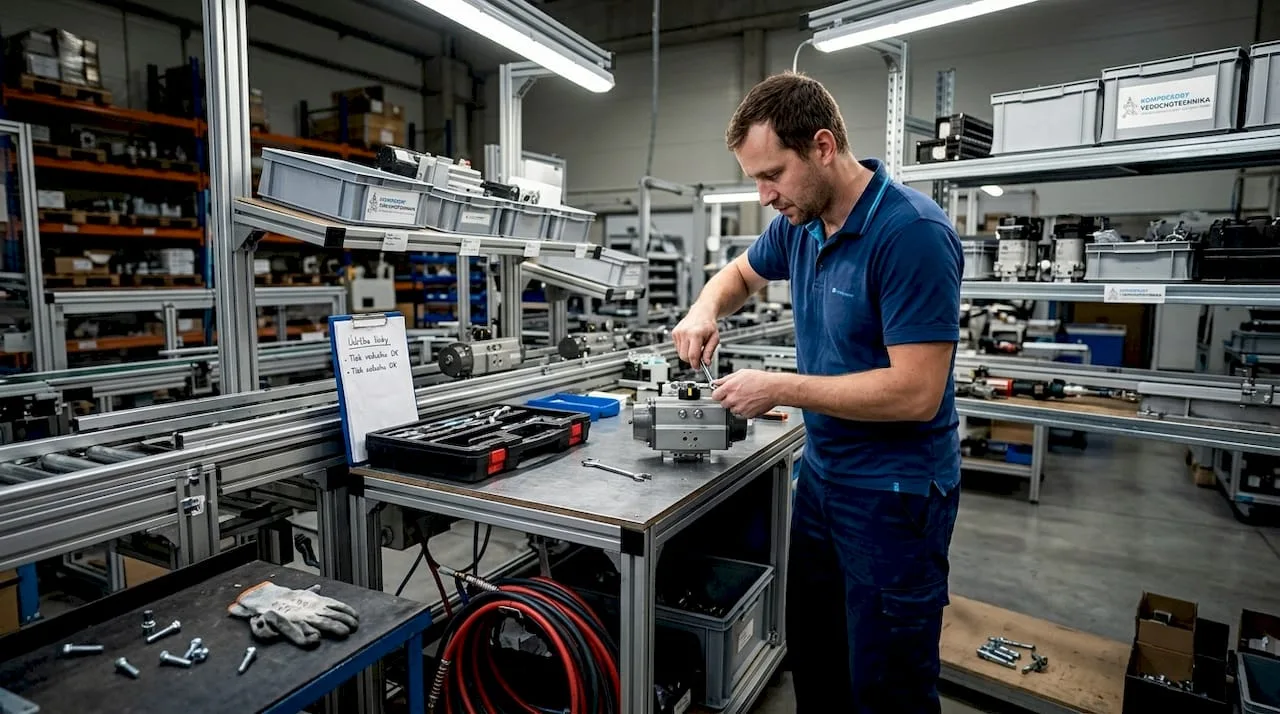
Simplicity of maintenance is key in an industrial environment. The outage of a production line because of a complicated repair of a hydraulic unit can cost considerably more than the cost of the repair itself. Pneumatic systems are designed so that service interventions can be managed even by less specialised personnel without the need to call an external technician.
Reliability in critical processes is another decisive factor. Production lines in automotive or the food industry cannot tolerate unplanned shutdowns. Pneumatic systems have a simple construction with a minimum of moving parts, which directly reduces the probability of a fault.
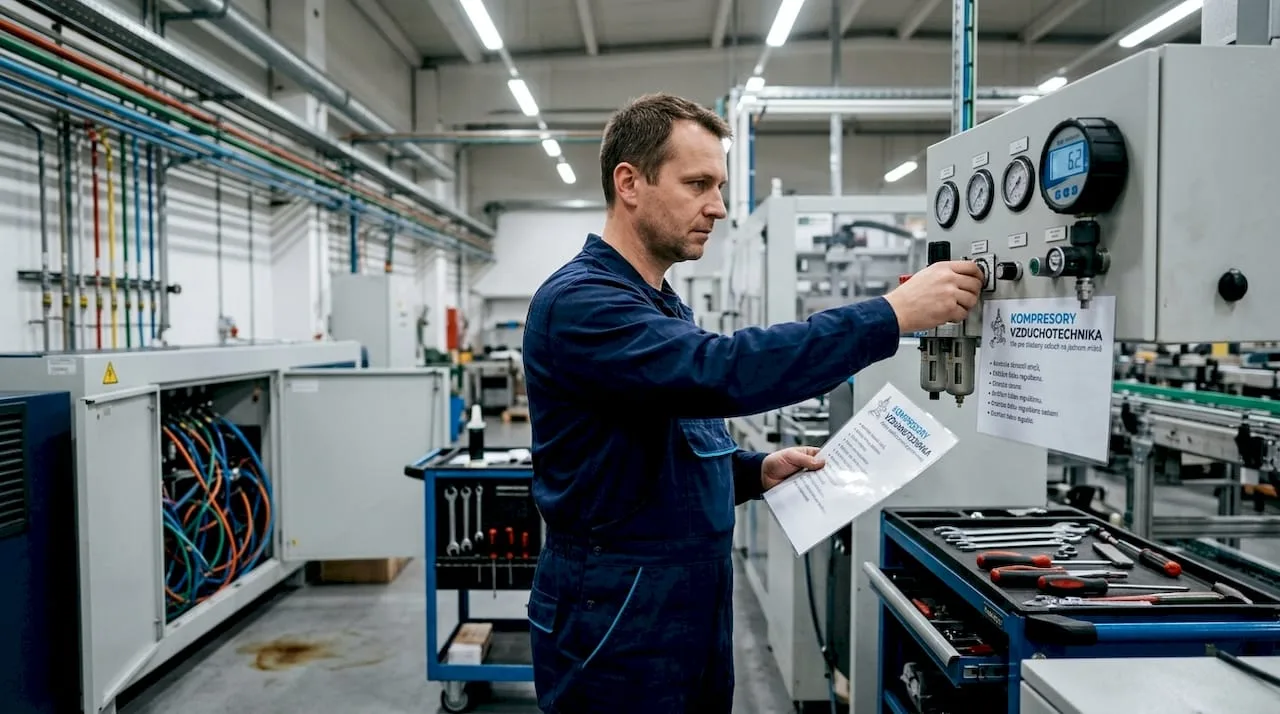
Professional tip: Involve the maintenance team in the choice of system already at the design stage. Maintenance staff know the weak points of the existing equipment and can identify in advance the components which will require the most frequent service. Their feedback can save thousands of crowns on unnecessary repairs in the first year of operation.
The main advantages of pneumatic systems
Once the selection criteria are clear, we can break down the specific advantages of this technology. Pneumatics offers a combination of properties which in many industrial applications places it ahead of hydraulics and electric drives.
Pneumatic systems show higher safety and lower weight compared with hydraulic and electric systems, which is a fundamental advantage in environments with limited space or increased risk. Take a look at the specific benefits:
- Immediate reaction and high speed: Pneumatic actuators react in the order of milliseconds. That is key for assembly lines where the cycles are measured in seconds.
- Safety without the risk of overheating or a leak of oil: Compressed air is an inert medium. In the event of a failure of the seal there is no contamination of the products or a fire.
- Low weight of the components: Pneumatic cylinders and tools are lighter than hydraulic equivalents, which makes integration into robotic arms or portable devices easier.
- Lower operating costs: The absence of hydraulic oil eliminates the costs of its purchase, disposal and regular changes.
- Easy regulation of force and speed: The air pressure can simply be set with a reducing valve, without the need for complicated electronics.
- Long service life of the tools: The service life of pneumatic tools is with correct maintenance considerably longer than that of electric tools of comparable power.
Pneumatic systems make it possible to achieve high efficiency and safety even in environments where electric or hydraulic systems would present an unacceptable risk, for example in areas with a danger of explosion or in food production.
The flexibility of pneumatics also shows itself when production changes. Modular pneumatic assemblies can be rearranged or expanded without intervening in the overall infrastructure. Adding a new workplace to the line means only the connection to the existing the compressed air distribution and the installation of the relevant valves and actuators.
Professional tip: When designing a production line consider modular pneumatic assemblies with quick couplings. They will make it possible for you to change the configuration of the line in hours instead of days, which is a fundamental advantage when changing over to a new product or with seasonal changes in production.
Comparison of pneumatic systems with other solutions
After a detailed analysis of the advantages we will add a comparison with other popular technologies. Every system has its strengths and suitable applications. The key is to choose the technology which best corresponds to the specific requirements of your plant.
Thanks to easy regulation and a lower installation price, pneumatics tends to be more suitable for robotised lines in ordinary production. An overview of the efficiency of pneumatic systems shows where this technology brings the greatest added value.
| Parameter | Pneumatics | Hydraulics | Electric drives |
|---|---|---|---|
| Speed of reaction | Very high | Medium | High |
| Purchase costs | Low | High | Medium |
| Safety | High | Medium | Medium |
| Maintenance costs | Low | High | Medium |
| Suitability for a damp environment | Good | Limited | Limited |
| Accuracy of positioning | Medium | High | Very high |
| Risk of contamination | None | High | Low |
Hydraulic systems have an advantage where it is necessary to transfer very high forces in a small space, for example in press shops or construction machines. Electric drives dominate in applications requiring precise positioning, such as CNC machine tools or robotic welding lines with millimetre accuracy.
Pneumatics, on the contrary, excels in these situations:
- Fast cyclical movements with a high frequency (packaging machines, assembly lines)
- Environments with a risk of explosion or contamination (food industry, chemical industry)
- Applications with a requirement for a low weight of the components (portable tools, robotic arms)
- Plants with limited service facilities, where easy repair by one’s own effort is key
The decision about the choice of technology should always proceed from an analysis of the specific process, not from general preferences. In practice we often encounter a combination of all three technologies within one plant, each covering the area where it is most efficient.
Pneumatics in practice: where it brings the greatest value
We will close the comparison with a look into practice and cases where pneumatics demonstrably saves means and time. Specific industrial deployments show that the advantages of pneumatics are not only theoretical.
The use of pneumatic hoses in the car service as well as in production lines significantly simplifies maintenance and increases safety. Pneumatic automation finds application in a whole range of sectors where it brings measurable savings.
An overview of the key applications and their benefits:
| Sector | Typical application | Main benefit |
|---|---|---|
| Automotive | Tightening of screws, assembly of parts | Speed, low weight of the tools |
| Food industry | Packaging lines, transport of products | Safety, no contamination |
| Construction | Demolition hammers, compressors | Mobility, high performance |
| Mechanical engineering | Clamping of workpieces, handling | Reliability, cyclical load |
| Warehouses and logistics | Pneumatic conveyors | Low operating costs |
The return on an investment in a pneumatic system depends on the intensity of use and the existing technology. When changing from hydraulics to pneumatics in a suitable application one can expect:
- A reduction of maintenance costs by 30 to 50 percent thanks to the absence of hydraulic oil and the simpler construction.
- A shortening of downtime during repairs, because pneumatic components are easily available and replacement takes a fraction of the time.
- An increase in the speed of the production cycle in applications with fast movements, where pneumatics surpasses hydraulics and electric drives.
- Energy savings with the right setting of the pressure and the elimination of air leaks, which can make up as much as 30 percent of the consumption of the compressor.
In the automotive industry pneumatic nutrunners are the standard on assembly lines all over the world. Their low weight reduces the fatigue of the operator, the speed of tightening increases the cycle of the line and the simplicity of changing the tool minimises downtime during changeover.
How to think about pneumatic systems differently
After summarising the specific benefits we will add practical experience which can change the way you think about pneumatics. Most firms treat pneumatics as a finished thing: they install the system, start operation and wait until something breaks down. That is exactly the approach which makes operation unnecessarily expensive.
The optimisation of the right pressure setting is one of the most underestimated tools of energy saving. Many plants run at a higher pressure than is necessary, because nobody has carried out an analysis of the real requirements of the individual applications. Every extra bar means unnecessary energy consumption by the compressor.
The elimination of air leaks is another topic which firms systematically underestimate. Leaks in the air distribution can, without regular monitoring, reach 20 to 30 percent of the total production of the compressor. That is real money which literally goes into the air. A regular audit of the tightness of the distribution and training of the operators in identifying leaks pays back within a few months.
Correct training of the operators and the introduction of monitoring of air consumption are investments with a fast return. Technicians who understand the system can identify problems before they cause an outage of production.
How to introduce pneumatic systems with maximum savings and reliability
At the close of our series of recommendations you can visit the offer of specific solutions. A correctly designed pneumatic system begins with the choice of a reliable source of compressed air.
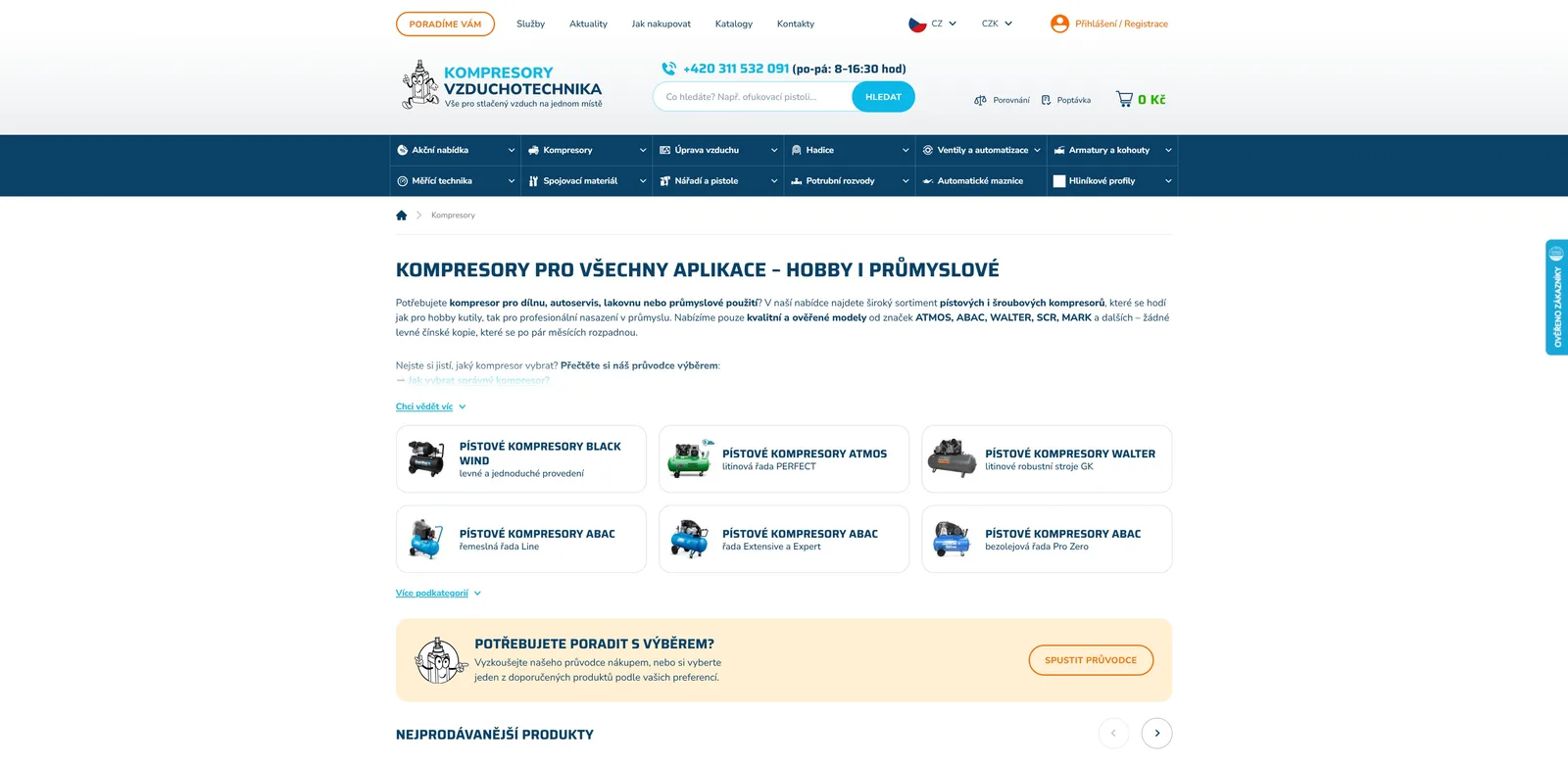
At Kompresory-vzduchotechnika.cz you will find a complete offer for industrial and construction applications. SCR screw compressors are suitable for continuous operation with high demands on a stable pressure and flow. To ensure the quality of the compressed air, products for the treatment of compressed air are available, including filters, dryers and pressure regulators. The offer of compressors and accessories covers needs from small workshops up to large production plants. A team of specialists is ready to help with the choice of the optimal solution for your specific plant.
Most frequent questions
What are the greatest operating savings with pneumatic systems?
Pneumatics is advantageous from the point of view of operating savings especially thanks to a low energy consumption, minimal maintenance and the absence of expensive repairs typical for hydraulics or electric drives. With the right optimisation of pressure and the elimination of leaks further savings in the order of tens of percent can be achieved.
When is it better to choose a pneumatic system rather than a hydraulic one?
Choose pneumatics where a fast reaction, safety, low weight and simplicity of maintenance are needed. Pneumatics has higher safety and lower weight compared with hydraulics, which is decisive in environments with a risk of contamination or fire.
What are frequent mistakes in introducing pneumatic systems?
The most frequent mistakes are underestimating the seals, a bad setting of the pressure or neglected monitoring of air leaks. Mistakes in the design lead to losses of efficiency which show up in an unnecessarily high energy consumption and a shortened service life of the components.
What are frequent applications of pneumatic systems?
The most frequent use is in production lines, automotive, construction and the automation of warehouses. Pneumatic systems find use in production and transport everywhere where speed, reliability and operational safety are key.
Recommended
- Why use pneumatics: efficiency, speed and safety - Kompresory-Vzduchotechnika.cz
- Advantages of pneumatic tools 2026: 40% longer service life - Kompresory-Vzduchotechnika.cz
- How pneumatics works: a complete guide for industry 2026
- The function of the air receiver: how to increase the efficiency of pneumatic systems - Kompresory-Vzduchotechnika.cz