
Pressure vessels to the PED Directive 2014/68/EU

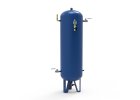
Pressure vessels manufactured to Directive 2014/68/EU on pressure equipment (PED) — 87 vessels from 5 to 10000 litres. They include the large positive-pressure vessels from 1000 l, all stainless steel, high-pressure and oxygen vessels, the vessels rated down to −20 °C and for group 1 fluids, and the fully equipped vessels from 1000 to 3000 l.
The carbon steel vessels are made painted in blue RAL 5015, hot-dip galvanised or with an ALM internal coating for the food industry, and the oxygen vessels in white RAL 9010 paint with the ALM coating inside. The stainless steel vessels are made of AISI304 or AISI316L steel with no coating. You will find standard air receivers up to 720 l and vacuum vessels in our overview of all pressure vessels and air receivers.
Six series of PED vessels
The PED vessels come from six categories. The table shows the volumes, pressures and finishes of each; the dimensions and connections are on the vessel product pages.
| Pressure vessels to the PED Directive by category | ||||
|---|---|---|---|---|
| Category | Items | Volumes | Working pressure | Finish |
| Stainless vessels | 22 | 5–3000 l | 11 bar or 12 bar | stainless AISI304 or AISI316L |
| Vessels down to −20 °C and for group 1 fluids | 20 | 1000–10000 l | 8 bar, 12 bar or 16 bar | paint, hot-dip zinc, ALM |
| High-pressure vessels for 32 and 42 bar | 19 | 100–5000 l | 32 bar or 42 bar | paint, hot-dip zinc |
| Vessels from 1000 to 3000 l | 15 | 1000–3000 l | 12 bar or 16 bar | paint, hot-dip zinc, ALM |
| Oxygen vessels | 7 | 500–5000 l | 11 bar or 12 bar | white RAL 9010 paint, ALM inside |
| Fully equipped vessels with fittings | 4 | 1000–3000 l | 12 bar | paint, hot-dip zinc |
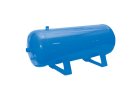
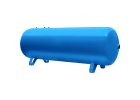
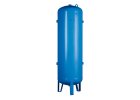
Horizontal vessels exist only among the stainless steel vessels from 5 to 1000 l and the large vessels from 1000 to 3000 l; the other series are vertical.
#showmore#
Why these vessels fall under the PED
Simple pressure vessels under Directive 2014/29/EU (SPVD) have a limit: the product of the maximum working pressure in bar and the volume in litres must not exceed 10000. The 1000-litre vessel for 12 bar comes to 12000 and the 5000-litre vessel for 8 bar to 40000, which is why all positive-pressure vessels from 1000 l, stand-alone and fully equipped, are manufactured to Directive 2014/68/EU on pressure equipment.
Stainless steel, high-pressure and oxygen vessels are made to the PED in all sizes, even the smallest horizontal stainless steel 5 l vessel or the high-pressure 100 l vessel for 32 bar. The PED also divides fluids by their hazard: group 1 covers explosive, flammable, toxic and oxidising substances, such as oxygen; group 2 covers the rest, for example air and nitrogen. Oxygen and other group 1 fluids except hydrogen can be held by the oxygen vessels, the vessels rated down to −20 °C and the high-pressure vessels.
Which PED vessel to choose
Downstream of a screw compressor or in a compressor station with several machines, the right choice is a large air receiver from 1000 to 3000 l, vertical or horizontal, for 12 or 16 bar. A 12-bar vessel is suitable for compressors that cut out at no more than 11 bar; a compressor that cuts out higher belongs with a 16-bar vessel. How to calculate the size is shown in our advice centre on choosing the size of an air receiver.
For an outdoor compressor station or an unheated hall, the vessels rated down to −20 °C are suitable: vertical vessels from 1000 to 10000 l for 8, 12 or 16 bar with a working temperature of −20 to +80 °C. For oxygen, there is a series from 500 to 5000 l for 11 and 12 bar, in white RAL 9010 paint on the outside and with an ALM epoxy coating on the inside.
Where air purity matters, stainless steel vessels from 5 to 3000 l are chosen. There is no coating inside that could peel off, and they are intended for compressed air, nitrogen and compressed air with water. High-pressure compressors and systems need vessels from 100 to 5000 l for 32 or 42 bar, painted or galvanised.
A ready-made assembly is offered by the fully equipped vessels from 1000 to 3000 l for 12 bar, with ball valves, a pressure gauge and a safety valve set to 10.5 bar already mounted and with TÜV certification of the pressure assembly. They suit compressors that cut out at no more than 10 bar.


Documents and inspections
The vessels bear the CE marking, and each one comes with a declaration of conformity stating its data-plate details and with the instructions for use and maintenance. The fully equipped vessels also come with complete documentation, including the TÜV certification of the pressure assembly.
Inspections and their intervals are set by national regulations according to the vessel’s volume and pressure. What an operator in the Czech Republic must arrange is covered in our article on the obligations of a pressure vessel operator, and the inspection deadlines are summarised in our article on pressure vessel inspections.
Where next: other regulations, pressures and volumes
The other two regulations, and pages with vessels of the same pressure, finish or volume.
| Related pages | ||
|---|---|---|
| Page | What you will find | Items |
| Vessels to the Simple Pressure Vessels Directive (SPVD) | standard air receivers from 5 to 720 l for 11 and 16 bar | 33 |
| Vacuum vessels to the EN 286-1 standard | vertical vessels from 100 to 3000 l for vacuum down to −1 bar | 6 |
| Pressure vessels for 12 bar | large and fully equipped vessels, oxygen vessels and small stainless steel ones | 29 |
| Pressure vessels for 16 bar | vessels from 270 to 10000 l to the SPVD and the PED | 19 |
| Galvanised pressure vessels | hot-dip galvanised vessels and fittings kits for them | 78 |
| Pressure vessels with no coating | stainless steel vessels from 5 to 3000 l for clean air | 23 |
| Pressure vessels with ALM coating | internal coating for contact with food, including oxygen vessels | 38 |
| Pressure vessels 1000 l | all series of this volume, including the vacuum vessel | 15 |
| Pressure vessels 5000 l | vessels rated down to −20 °C, high-pressure and oxygen vessels | 6 |
Ventilek’s tip
The vessel’s data plate is what counts. The compressor must not deliver a higher pressure into the vessel than the one on the data plate, and the safety valve must open at no more than this pressure. With 32-bar and 42-bar vessels, the pressure gauge, shut-off valves and hoses must withstand the same pressure too.
- What is the PED?
- The European Directive 2014/68/EU on pressure equipment; PED stands for Pressure Equipment Directive. It governs pressure vessels that are not simple pressure vessels under Directive 2014/29/EU.
- What is the difference between the PED and the SPVD?
- The SPVD applies to simple pressure vessels for which the product of pressure in bar and volume in litres does not exceed 10000; in our range, these are the air receivers from 5 to 720 l. Vessels with a larger product and all stainless steel, high-pressure and oxygen vessels are made to the PED.
- Is a PED vessel better than an SPVD vessel?
- It is not about quality but about the type of vessel. Choose by volume, pressure, medium and environment; the directive follows from these.
- What documents come with the vessel?
- A declaration of conformity with the data-plate details and the instructions for use and maintenance; the vessel bears the CE marking. The fully equipped vessels also come with documentation including the TÜV certification of the pressure assembly.
- Does the vessel need regular inspections?
- Yes. The types of inspection and their intervals are set by national regulations according to the vessel’s volume and pressure; links to the details are in the section Documents and inspections.
Not sure which PED series to choose? Send us the volume, pressure and medium, and we will be glad to advise you.
.jpg)

Product sorting
List of products


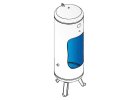
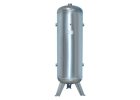
A vertical pressure vessel for oxygen, 4000 l at 12 bar, for a central oxygen reserve. White RAL 9010 paint, ALM epoxy coating inside.

The largest vertical pressure vessel for oxygen, 5000 l at 12 bar. White RAL 9010 paint outside, ALM epoxy coating inside, manufactured to the Pressure Equipment Directive (PED).


