
High-pressure vessels for 32 and 42 bar
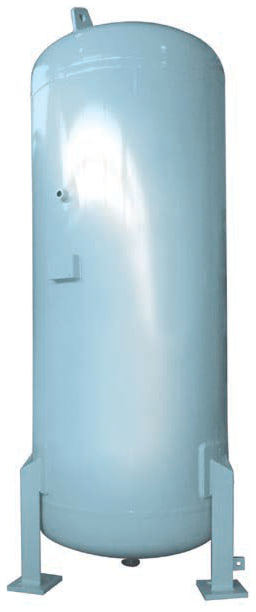
High-pressure vessels from 100 to 5000 litres with a maximum working pressure of 32 or 42 bar, for compressed air, nitrogen, argon, helium, oil and even oxygen. All of them are vertical, and each size is made both painted in blue RAL 5015 and galvanised.
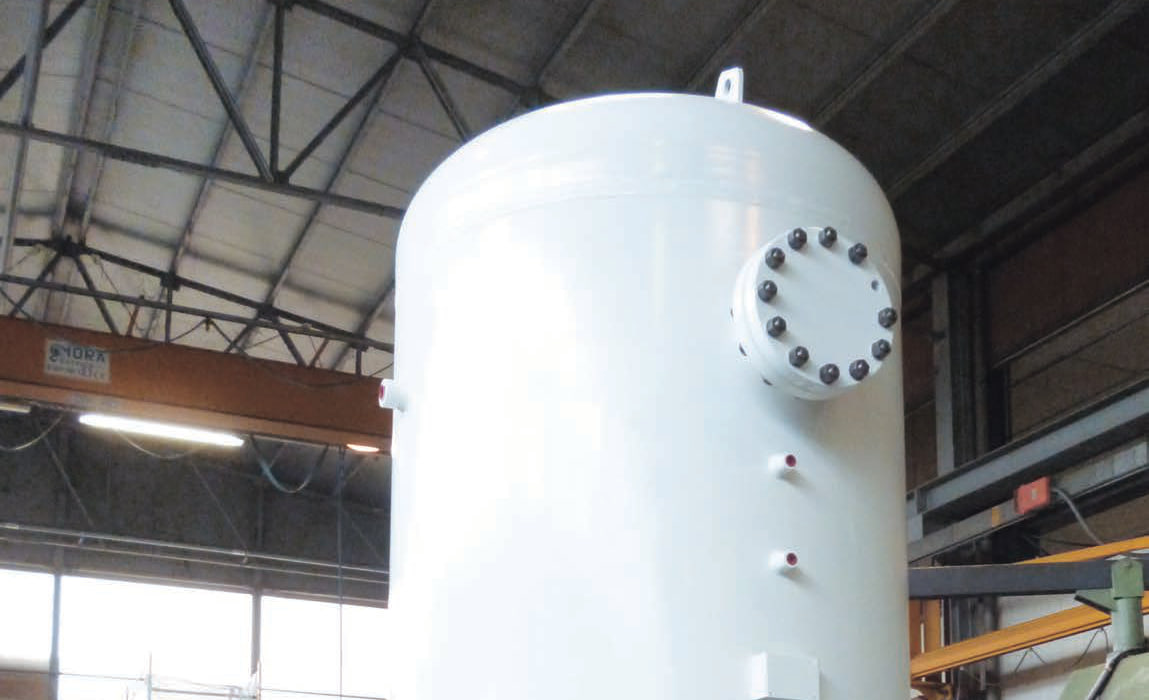
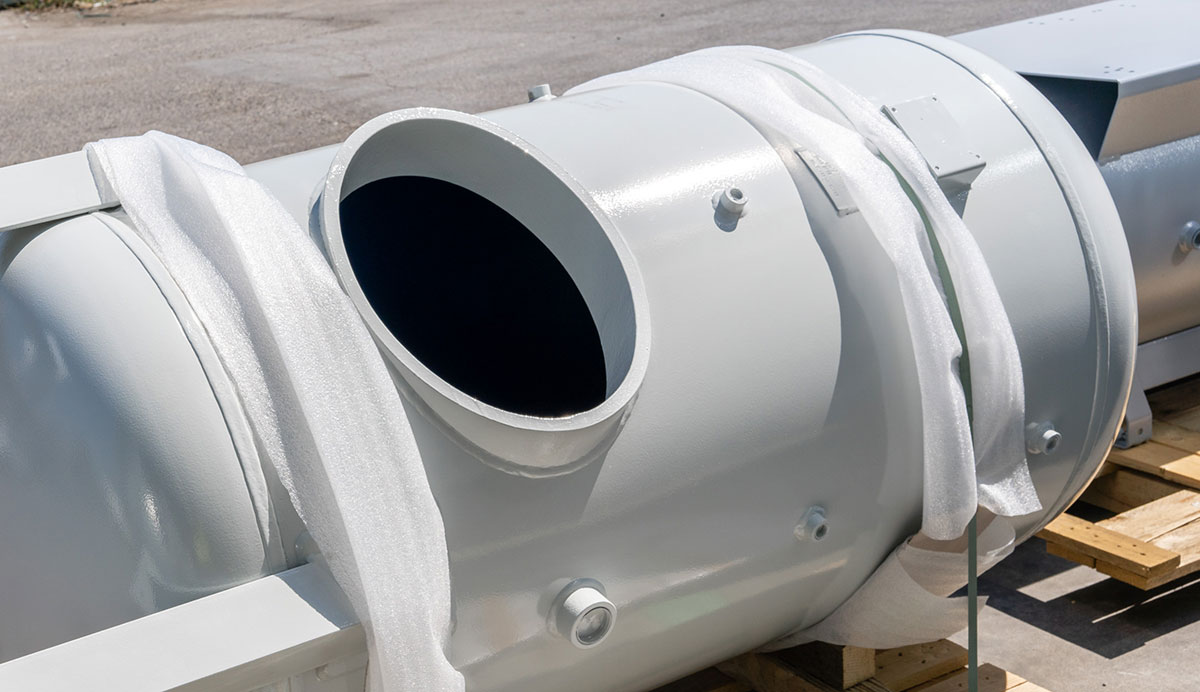
They are made by the Italian Baglioni group from carbon steel to Directive 2014/68/EU on pressure equipment (PED). The photo shows a custom-built version with a flanged inspection opening; the standard vessels only have threaded connections.
Painted or galvanised?
Painted (P)
Blue RAL 5015 powder coating on the outside, bare steel inside. The standard version for dry, heated compressor rooms.
Galvanised (G)
Hot-dip galvanised inside and out, so condensate cannot corrode the steel from the inside either. Suitable for damp rooms and for operations that produce a lot of condensate.
Same dimensions
Both versions have the same dimensions, connections and weight. You can tell them apart by the third letter of the order code: VVP is painted, VVG galvanised.
All sizes
For 32 bar, we offer nine sizes from 100 to 5000 l, and for 42 bar ten, with an extra size of 200 l. All of them stand on three legs and have connections in both ends and on the shell. You will find more vertical vessels on the page for vertical pressure vessels.
| Vessels for 32 bar — 100 to 5000 l | ||||||||||
|---|---|---|---|---|---|---|---|---|---|---|
| Order codes painted / galvanised | Volume | Ø × height | Weight | 1 | 2 | 3 | 4 | 5 | 6 | 7 |
| VVP100-32 / VVG100-32 | 100 l | Ø 370 × 1213 mm | 89 kg | 2" | 3/4" | – | 3/8" | 3/8" | – | 3/4" |
| VVP270-32 / VVG270-32 | 270 l | Ø 500 × 1648 mm | 192 kg | 2" | 1" | 1" | – | 3/8" | 1" | 1" |
| VVP500-32 / VVG500-32 | 500 l | Ø 600 × 2050 mm | 308 kg | 2" | 2" | 2" | 1/2" | 1/2" | 2" | 2" |
| VVP1000-32 / VVG1000-32 | 1000 l | Ø 800 × 2350 mm | 470 kg | 2" | 2" | 2" | 3/8" | 3/8" | 2" | 2" |
| VVP1500-32 / VVG1500-32 | 1500 l | Ø 1000 × 2305 mm | 665 kg | 2" | 2" | 2" | 1/2" | 1/2" | 2" | 2" |
| VVP2000-32 / VVG2000-32 | 2000 l | Ø 1000 × 2740 mm | 1100 kg | 2" | 2" | 2" | 1/2" | 1/2" | 2" | 2" |
| VVP3000-32 / VVG3000-32 | 3000 l | Ø 1200 × 2990 mm | 1535 kg | 2" | 2" | 2" | 1/2" | 1/2" | 2" | 2" |
| VVP4000-32 / VVG4000-32 | 4000 l | Ø 1450 × 2790 mm | 1950 kg | 2" | 3" | 3" | 3/4" | 3/8" | 3" | 3" |
| VVP5000-32 / VVG5000-32 | 5000 l | Ø 1450 × 3390 mm | 2280 kg | 2" | 3" | 3" | 3/4" | 3/8" | 3" | 3" |
| Vessels for 42 bar — 100 to 5000 l | ||||||||||
|---|---|---|---|---|---|---|---|---|---|---|
| Order codes painted / galvanised | Volume | Ø × height | Weight | 1 | 2 | 3 | 4 | 5 | 6 | 7 |
| VVP100-42 / VVG100-42 | 100 l | Ø 370 × 1213 mm | 100 kg | 2" | 3/4" | – | 3/8" | 3/8" | – | 3/4" |
| VVP200-42 / VVG200-42 | 200 l | Ø 446 × 1587 mm | 150 kg | 2" | 1" | – | 1/2" | 3/8" | – | 1" |
| VVP270-42 / VVG270-42 | 270 l | Ø 500 × 1648 mm | 215 kg | 2" | 1" | 1" | – | 3/8" | 1" | 1" |
| VVP500-42 / VVG500-42 | 500 l | Ø 600 × 2050 mm | 355 kg | 2" | 2" | 2" | 1/2" | 1/2" | 2" | 2" |
| VVP1000-42 / VVG1000-42 | 1000 l | Ø 800 × 2350 mm | 675 kg | 2" | 2" | 2" | 3/8" | 3/8" | 2" | 2" |
| VVP1500-42 / VVG1500-42 | 1500 l | Ø 1000 × 2305 mm | 1100 kg | 2" | 2" | 2" | 1/2" | 1/2" | 2" | 2" |
| VVP2000-42 / VVG2000-42 | 2000 l | Ø 1100 × 2490 mm | 1460 kg | 2" | 2" | 2" | 1/2" | 1/2" | 2" | 2" |
| VVP3000-42 / VVG3000-42 | 3000 l | Ø 1200 × 2990 mm | 1950 kg | 2" | 2" | 2" | 1/2" | 1/2" | 2" | 2" |
| VVP4000-42 / VVG4000-42 | 4000 l | Ø 1450 × 2790 mm | 2540 kg | 2" | 3" | 3" | 3/4" | 3/8" | 3" | 3" |
| VVP5000-42 / VVG5000-42 | 5000 l | Ø 1450 × 3390 mm | 2845 kg | 2" | 3" | 3" | 3/4" | 3/8" | 3" | 3" |
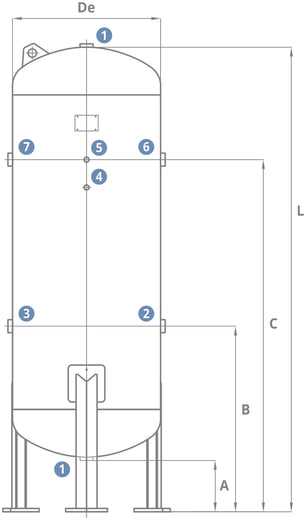
Connection numbers correspond to the drawing; a dash means that a vessel of that size does not have the connection. Connection 1 is in both ends. The dimensions, connections and weight apply to both the painted and the galvanised version. Ground clearance A is measured from the floor to the bottom connection, and B and C are the heights of the shell connections above the floor.
#showmore#
How they differ from standard vessels
Heavier and stronger
A high-pressure vessel weighs two to almost four times as much as a standard 11- or 12-bar vessel of the same volume. The thicker shell and ends add the extra weight.
Fits the same space
Almost all sizes have the same external dimensions as standard vessels of the same volume. A high-pressure vessel fits into the same space, but the floor has to carry more weight.
Large connections
The connections in both ends have a 2" thread even on the smallest 100 l vessel. The 4000 and 5000 l vessels have 3" side connections.
Typical uses
- Downstream of a 30-bar compressor. The ABAC Tech ATH 30-bar compressors are supplied without an air receiver. A 32-bar vessel matches their pressure.
- For pressures up to 40 bar. The 42-bar vessels serve pipework and compressors with a working pressure of up to 40 bar, for example in the PET industry or at test stations.
- Air, nitrogen and other gases. The vessels are intended for group 1 fluids except hydrogen, so besides compressed air and nitrogen they can hold argon, helium, oil and even oxygen.
- Temperature. The 32-bar vessels work at −20 to +100 °C, and the 42-bar vessels at −20 to +80 °C.
Hydrogen does not belong in the vessels. With oxygen, the fittings, seals and lubricants must also be designed for oxygen, and neither oil nor grease must come into contact with it.
Fittings for high pressure
The vessels are supplied without fittings. Everything you mount on the vessel must withstand its working pressure of 32 or 42 bar.
Safety valve
It must open at no more than the pressure on the vessel’s data plate and be able to discharge the full output of the compressor. You will find valves for compressed air with set pressures of up to 42 or 50 bar among our safety valves.
Pressure regulator
Where machines need a lower pressure than the vessel, fit a high-pressure regulator with an inlet pressure of up to 200 bar downstream of it.
Filtration
Air from a high-pressure compressor is cleaned by HF high-pressure filters up to 50 bar, ranging from coarse filters to activated carbon filters.
Choose a pressure gauge with a range above the vessel’s working pressure, and shut-off valves, threaded fittings and hoses with a nominal pressure of at least 32 or 42 bar.
Transport and installation
The vessels weigh from 89 kg (100 l at 32 bar) to 2845 kg (5000 l at 42 bar). They stand on three upright legs made of bent sheet metal with foot plates, and they have a lifting lug on the top end.
The base must carry the vessel’s weight concentrated on the three foot plates. Vibration dampers belong under the foot plates, and the vessel is not rigidly anchored to the floor or to any structure.
Documents and inspections
The vessels are manufactured to Directive 2014/68/EU on pressure equipment (PED) and bear the CE marking. They come with a declaration of conformity stating their data-plate details, together with the instructions for use and maintenance.
The operator must have the vessel inspected regularly. Which inspections apply, and at what intervals, depends on the vessel’s volume and pressure. You will find the details in our article on operator obligations.
Versions on request
On request, the manufacturer can supply the vessels with a 100 × 150 mm handhole or a 300 × 400 mm manhole for internal inspection, with flanged connections or with an internal ALM epoxy coating.
For pressures up to 16 bar, lighter and less expensive vessels are sufficient; you will find them among our vessels from 100 to 720 l and vessels from 1000 to 3000 l. The whole range is shown in our overview of pressure vessels.
Ventilek’s tip
Fit the vessel only with fittings rated for the same pressure. The safety valve, the pressure gauge, the shut-off valves and the hoses must all withstand the pressure on the vessel’s data plate. A single part rated for a lower pressure is the weakest point of the entire pipework.
- What pressure can the vessels withstand?
- The maximum working pressure is 32 or 42 bar. You can tell which from the end of the order code: -32 means 32 bar, -42 means 42 bar.
- Is a 32-bar vessel suitable for a 30-bar compressor?
- Yes, the vessel is designed for a higher pressure than the compressor delivers. The safety valve must open at no more than 32 bar.
- Which medium are the vessels intended for?
- For compressed air, nitrogen, argon, helium, oil and oxygen, that is, for group 1 fluids except hydrogen.
- Can I use the vessel for oxygen?
- Yes, oxygen is one of the media the vessels are intended for. The fittings, seals and lubricants, however, must be suitable for oxygen, and oil and grease must not come into contact with it.
- What temperature can the vessels withstand?
- The 32-bar vessels withstand −20 to +100 °C, and the 42-bar vessels −20 to +80 °C.
- Do the vessels have an inspection opening?
- Not as standard; all connections are threaded. The manufacturer can supply a 100 × 150 mm handhole or a 300 × 400 mm manhole on request.
- Which fittings go with the vessel?
- A safety valve, a pressure gauge and shut-off valves rated for the vessel’s pressure. The vessels are supplied without fittings.
Manufactured to Directive 2014/68/EU on pressure equipment (PED). Medium: compressed air, nitrogen, argon, helium, oil, oxygen (group 1 fluids except hydrogen). Working temperature −20 to +100 °C (32 bar), −20 to +80 °C (42 bar).


