
ABAC Tech ATH 30 bar: two-stage high-pressure machines
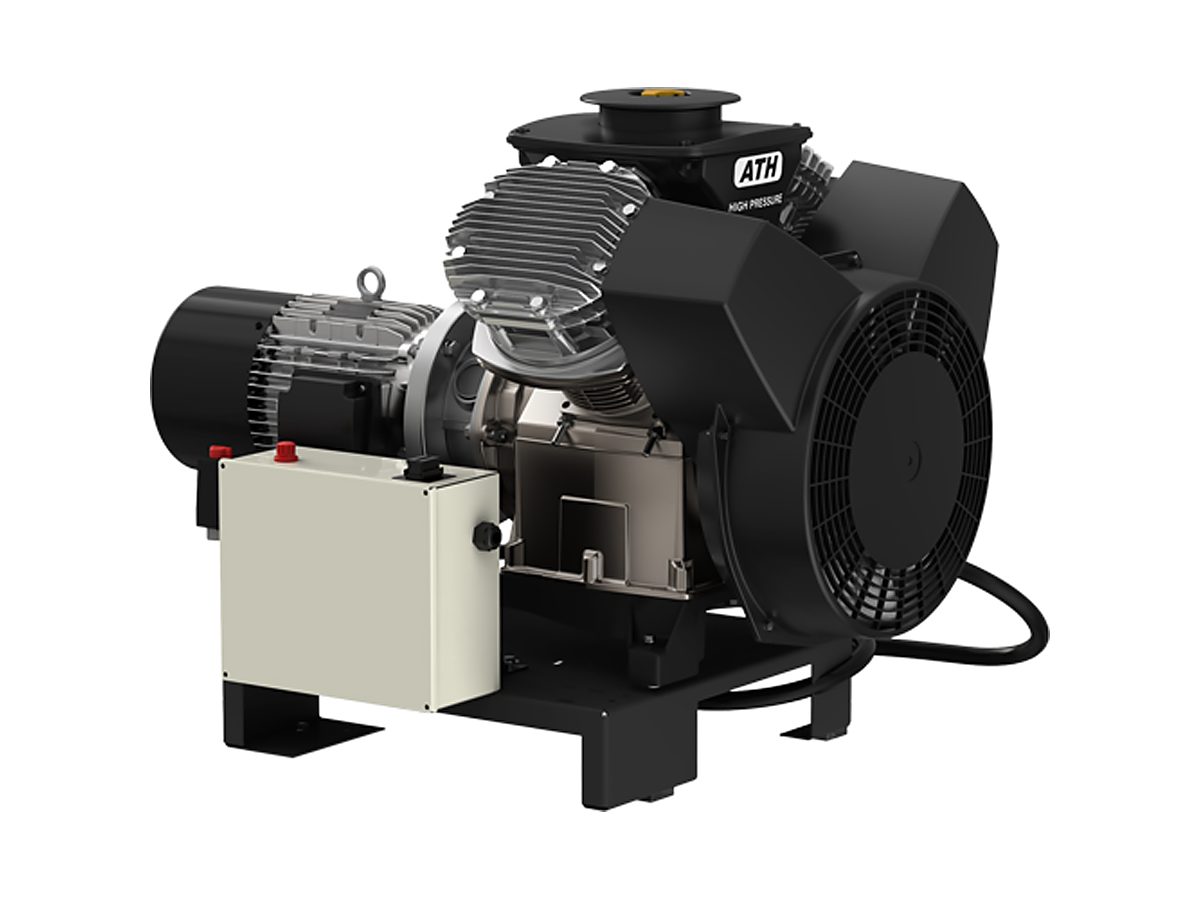 ABAC Tech ATH · 30 bar · two-stage
Thirty bar is three times what an ordinary workshop compressor manages, and the top of the whole ABAC Tech ATH range. There is only one way to get there — two stages of compression: the large low-pressure cylinder pre-compresses the air, an intercooler takes the heat out of it and the smaller high-pressure cylinder pushes it up to working pressure. Unlike the fifteen- and twenty-bar branches, not one machine here sits on a receiver — all six are an airend with motor on a base frame, and the pressure vessel is yours to provide. Motor ratings from 2.2 to 15 kW.
Three things that decide the choice
All six machines are oil lubricated, two-stage for 30 bar, direct driven, on a base frame and running on a three-phase 400 V supply. They differ in three things.
1. How much air at thirty bar?
What matters is the delivery at 30 bar, not the intake — that is the air which actually reaches your process. The range is 150 to 1,020 l/min. Mind the step between 7.5 and 11 kW: you add three and a half kilowatts and the delivery rises only from 510 to 558 l/min. The real jump comes at fifteen kilowatts.
2. Do you have a thirty-bar vessel?
No machine in this category has a receiver — it is an airend with motor on a base frame with a control cabinet. The pressure vessel has to be yours, built for thirty bar and with a valid inspection; a vessel rated for ten, fifteen or twenty bar cannot be connected here.
3. Will your supply take a direct start?
Five machines carry an X in the code — the motor starts through a star-delta sequence, so the inrush current is gentler. From 4 kW up it is a necessity. Only the smallest 2.2 kW machine starts directly.
How to read the machine code
The code ATH-5.5/30-BTX has four parts: ATH is the high-pressure range, the first number is the motor input in kilowatts, /30 is the working pressure in bar and the letters at the end define the version.
ATH — the high-pressure range
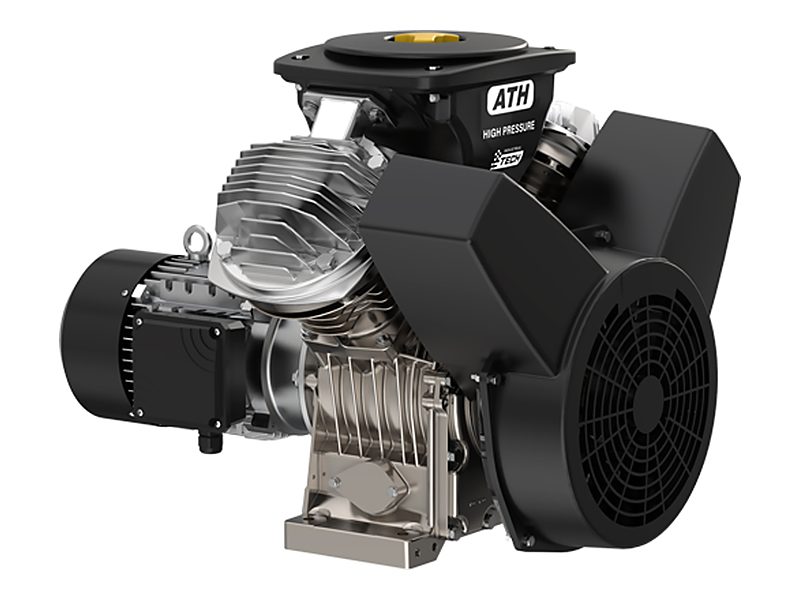
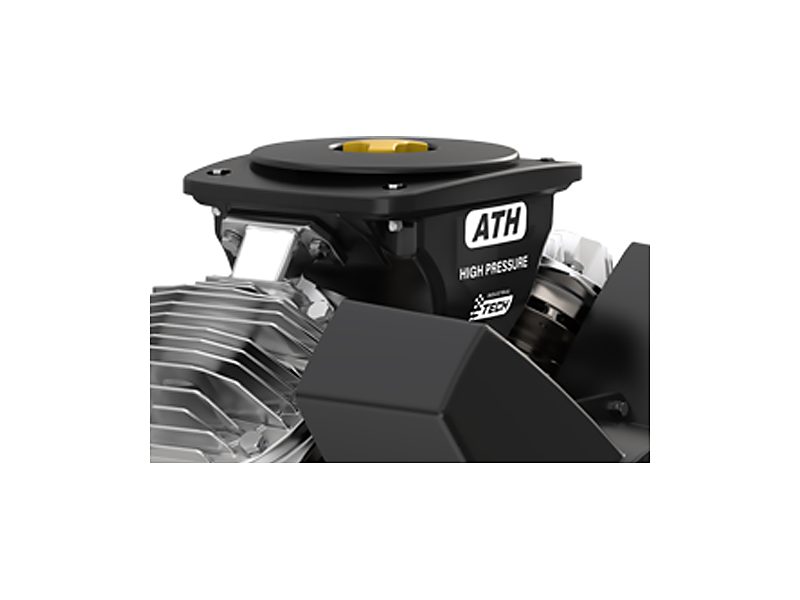
A two-stage airend with V-arranged cylinders and a head marked HIGH PRESSURE. The number after the slash is the working pressure — besides the thirty-bar branch there is a fifteen- and a twenty-bar one.
BT — on a base frame
All six machines, 73 to 250 kg. The airend mounted on a steel frame, with a control cabinet and a pressure switch. The air goes into the pipework or into your own pressure vessel — which has to be certified for 30 bar.
X — star-delta
Five machines from 4 kW up. The motor starts in two steps, so the current peak at start-up is markedly lower. Once running, it makes no difference.
Why two stages and not one
Thirty bar cannot be reached in a single stage even in theory — the outlet temperature would be far beyond what the oil and the valves will take. ATH therefore uses two cylinders connected in series: the larger low-pressure one draws the air in and pre-compresses it, the intercooler takes the heat out between the stages and the smaller high-pressure cylinder pushes it to 30 bar. Without that intercooling a two-stage design would make no sense.
The figures show it: the 2.2 kW airend draws in 252 l/min and at a full thirty bar delivers 150 l/min, which is 60 % of the intake volume. The rest of the build is the same as in the other ABAC Tech ranges: an oil-lubricated airend with V-arranged cylinders, stainless steel valves, bearings greased for their whole service life, a large fan and a four-pole motor at 1,500 rpm.
Duty cycle: here it is 85 %, not 100 %
For the fifteen- and twenty-bar branches of ATH the manufacturer states the motor as S1 100 % — the machine may run continuously. For the thirty-bar branch it is S1 85 %, and it says so in the same table, right below the twenty-bar one. Higher pressure means more heat, and that has its price.
In practice the machine expects a short pause roughly after every fifty minutes of running — about nine minutes out of every hour. It is still an industrial duty type, one an ordinary workshop compressor with S3 will never reach. But it is not non-stop. If you need genuinely continuous running, the right choice is the twenty-bar branch, where the duty is S1 100 %.
All six machines side by side
ABAC Tech ATH 30 bar high-pressure compressors — 6 machines on a base frame, two-stage, S1 85 %, 2.2 to 15 kW, 150 to 1,020 l/min delivered | |||||||
|---|---|---|---|---|---|---|---|
| Model | Starting | Input | Intake | Delivery at 30 bar | Lwa / Lwp | Weight | Dimensions |
| ATH-2,2/30-BT | direct | 2.2 kW | 252 l/min | 150 l/min | 99 / 79 dB(A) | 73 kg | 686 × 575 × 671 mm |
| ATH-4/30-BTX | star-delta | 4 kW | 456 l/min | 264 l/min | 99 / 79 dB(A) | 80 kg | 686 × 575 × 671 mm |
| ATH-5,5/30-BTX | star-delta | 5.5 kW | 570 l/min | 384 l/min | 100 / 80 dB(A) | 101 kg | 1,073 × 693 × 761 mm |
| ATH-7,5/30-BTX | star-delta | 7.5 kW | 780 l/min | 510 l/min | 101 / 81 dB(A) | 121 kg | 1,073 × 693 × 761 mm |
| ATH-11/30-BTX | star-delta | 11 kW | 996 l/min | 558 l/min | 105 / 85 dB(A) | 160 kg | 1,073 × 820 × 840 mm |
| ATH-15/30-BTX | star-delta | 15 kW | 1,710 l/min | 1,020 l/min | 106 / 86 dB(A) | 250 kg | 1,118 × 820 × 840 mm |
Delivery is the amount of air the machine actually supplies at a working pressure of 30 bar; intake is the volume drawn in by the low-pressure cylinder. Lwa is the sound power level from the rating plate, Lwp the sound pressure level at a distance of four metres. Dimensions are length × width × height. All values are manufacturer data.
#showmore#
Noise without window dressing
These machines are loud and there is no point hiding it: the sound power level Lwa is 99 to 106 dB. It is an open industrial machine with no enclosure at all, designed for output and heat removal, not for quiet in the room. It belongs in a plant room, an annex or behind a wall, not next to a workbench.
🔴 Be careful when comparing offers. Catalogues often quote 79 to 86 dB for the same machine — but that is the sound pressure Lwp measured at four metres, roughly 20 dB(A) below the sound power Lwa on the rating plate. Both figures are correct, each simply measures something different. We list both for every machine.
The machine up close
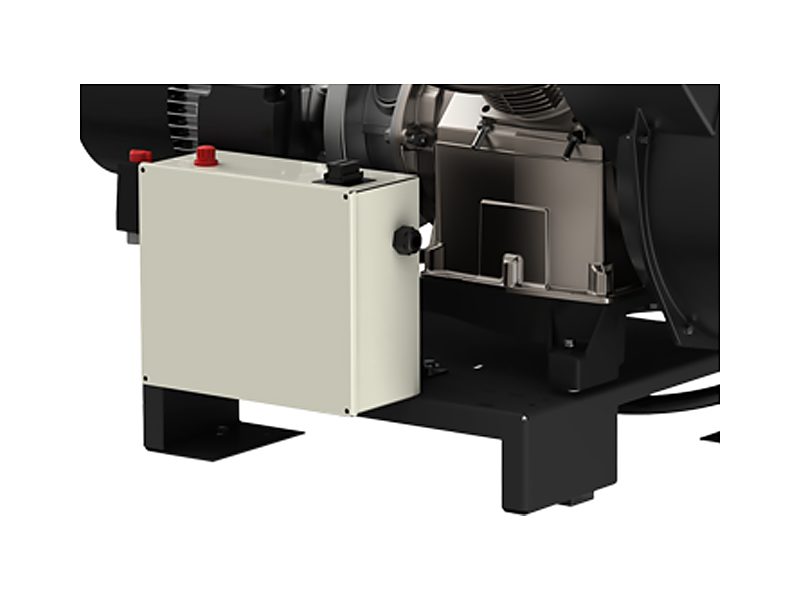
What you can see on the machine close up: the head of the two-stage airend and the control cabinet on the base frame.
What all the machines share
Two-stage compression to 30 bar
The low-pressure cylinder pre-compresses, the intercooler removes the heat and the high-pressure cylinder pushes the air up to working pressure.
Motor in duty type S1 85 %
An industrial duty with a short pause roughly after fifty minutes of running. Not non-stop, but in a different league from workshop S3.
Direct drive without belts
The airend sits directly on the motor. No belt tensioning and no belt replacement.
V-arranged finned cylinders
Heavy finning carries away the heat, of which thirty bar produces the most in the whole range.
Stainless steel valves
A stainless valve plate takes high temperatures and the cyclic load of continuous duty.
Bearings greased for life
The crankshaft bearings are not greased at service intervals — they are filled at the factory.
Three-phase 400 V supply
The whole range runs on 400 V / 50 Hz. From 4 kW up with star-delta starting.
Two-year warranty
A two-year warranty applies to every machine in the range.
Ventilek recommends
Between seven and eleven kilowatts almost nothing changes. The jump comes at fifteen. It looks illogical, but these are the manufacturer’s figures: 7.5 kW delivers 510 l/min, 11 kW only 558 l/min — nine per cent more for half again the power input. Only 15 kW jumps to 1,020 l/min, twice as much. If the 7.5 kW machine is not quite enough, taking the eleven usually makes no sense; either stay where you are or go straight to fifteen. And the vessel: at thirty bar it has to be certified, and not one machine here includes one.
Frequently asked questions
- Can this machine really not run non-stop?
- For the thirty-bar range the manufacturer states duty type S1 85 %, while for the fifteen- and twenty-bar ranges it is S1 100 %. In practice that means a short pause roughly after fifty minutes of running, about nine minutes out of every hour. It is an industrial duty — an ordinary workshop compressor has S3, where the ratio is roughly half and half. If you need genuinely continuous running, the right choice is the twenty-bar branch.
- Why does the eleven-kilowatt machine deliver only a little more than the 7.5 kW one?
- Because its airend is smaller than you would expect: it draws in 996 l/min against 780 l/min on the 7.5 kW machine, and at thirty bar it delivers 558 against 510 l/min out of that. It is the manufacturer’s figure, checked in their own table. If you need markedly more air, the jump is at fifteen kilowatts — 1,020 l/min.
- What do I get in this category and what do I have to provide myself?
- You get an airend with motor on a steel base frame, with a control cabinet and a pressure switch — the machine is placed, anchored and connected. A pressure vessel is not included and not one machine in this category has one; it has to be yours, built for thirty bar and with a valid inspection. The same goes for the pipework, hoses and fittings.
- Does the whole system have to be certified for 30 bar?
- Yes, and it matters more here than at lower pressures. The pressure vessel, pipework, hoses and fittings have to be rated for the working pressure and the vessel must have a valid inspection. A vessel rated for 10, 15 or 20 bar cannot be connected. In this category the vessel does not even come with the machine — it has to be yours.
- Why does the table show delivery instead of intake?
- Because delivery is the air that actually reaches your process at a working pressure of 30 bar. Intake is the volume drawn in by the low-pressure cylinder — on the ATH-2.2/30 that is 252 l/min against 150 l/min delivered. Delivery decides the choice of machine; we list both so it is clear which is which.
- Is it really that loud?
- Yes. The sound power Lwa is 99 to 106 dB, which is what an open industrial machine without an enclosure sounds like. The figure of 79 to 86 dB that appears for these machines is the sound pressure at four metres — a different quantity, roughly 20 dB(A) lower. If you need a machine for a room where people work, look for a version in a sound-insulated enclosure.
- Can the machine run on 230 V?
- No. Every machine in this category runs on a three-phase 400 V / 50 Hz supply. Five of the six also start through a star-delta sequence, so matching protection is required.
Where to go next
This category is the highest pressure of the ABAC Tech ATH range. The other branches of the industrial range look like this: You will find an overview of every range in the Compressors category.
- ATH at 20 bar — ten bar lower, but with an S1 100 % duty cycle and with versions on a receiver
- ATH at 15 bar — the lowest pressure of the high-pressure range — the most air for the same kilowatts
- All 30 bar compressors — an overview of thirty-bar machines from the whole offer, across all ranges
- The ten-bar ATL range — when high pressure is not needed — single-stage S1 machines for 10 bar
- ATL on a receiver — complete assemblies for 10 bar — 90 and 270 litres
- How to choose a compressor — from the consumption of your tools through output to the size of the receiver
Performance data are measured to ISO 1217, Annex C, latest edition; noise to ISO 2151. Under the European machinery directive the sound power level Lwa is stated on the machine rating plate, while the sound pressure level Lwp is measured at a distance of four metres and is roughly 20 dB(A) lower. All values are manufacturer data.
Bestsellers


Product sorting
List of products

The strongest machine of the category: fifteen kilowatts and over a thousand litres of air per minute at thirty bar. Twice what the eleven-kilowatt machine gives.

Eleven kilowatts on a base frame. Against the 7.5 kW machine it adds only nine per cent of air, but runs more easily and is 39 kg heavier.

The smallest machine of the category. The only one that starts directly — from four kilowatts up star-delta is a must.

Four kilowatts on a base frame. The first machine of the category where the manufacturer softens the current peak at start-up with star-delta starting.

Five and a half kilowatts on a base frame. Of all the machines in the category it gives back the largest share of the air it draws in — two thirds.

Seven and a half kilowatts on a base frame. The last machine before output gets expensive — the eleven-kilowatt one adds only nine per cent of air.