
ABAC Tech ATL compressors with no receiver: continuous duty
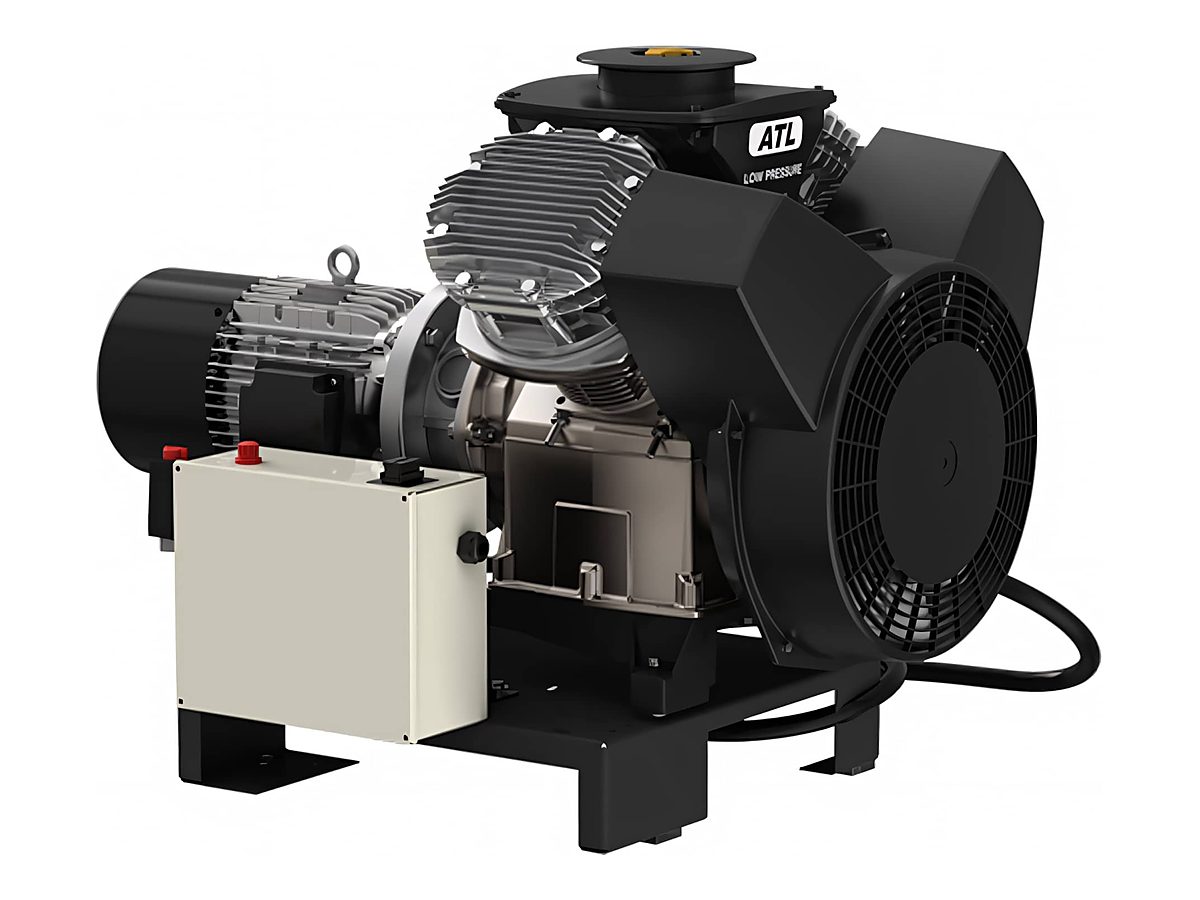 ABAC Tech ATL · S1 100 %
An ordinary workshop compressor has an S3 motor — it has to cool down for roughly half the time. The ABAC Tech ATL range has an S1 motor, that is a 100% duty cycle: you switch it on in the morning and it can run the whole shift without a break. It is an oil-lubricated, single-stage machine for 10 bar with a slow-running pump whose cylinders sit in a V and turn at only 1,500 rpm. Eight machines from 1.5 to 7.5 kW, all of them without a pressure vessel — the air goes straight into the pipework or into a tank you stand separately.
Three things that decide the choice
All eight machines are oil-lubricated, single-stage at 10 bar, direct-driven and run on a three-phase 400 V supply. None of them has a receiver of its own. They differ in three things.
1. How much air will you really use?
On this range we look at the air delivered at 10 bar, not at the intake — that is the air which actually reaches the tools. The span is 144 to 786 l/min. Since the motor may run without a break, what counts is the average draw per shift, not the peak; the machine has no receiver to cover a peak from.
2. Bare unit, or on a frame?
The T version is a pump with a motor on a common plate — bought into an existing assembly, onto your own frame or to a tank you already have. The BT version is the same thing on a steel base frame with a terminal box: it can be bolted to the floor or set on anti-vibration mounts and is ready to connect.
3. Will your supply take a direct start?
Four machines carry an X in the code — they run the motor up through star-delta, so the current surge at start-up is gentler. At 4 kW and above it is closer to a necessity than an extra. The rest start directly.
How to read the machine code
The code has three parts: ATL is the range, the number is the motor rating in kilowatts, and the letters at the end say in which form the machine arrives.
T — bare unit with a motor
Three machines, 45 to 102 kg. Pump and motor on a common plate, with no frame and no tank. The lightest and cheapest way to S1 output if you handle the mounting yourself or are adding to an existing assembly.
BT — on a base frame
Five machines, 70 to 120 kg. The same pump set on a steel frame. The frame adds 18 to 25 kilos, but the machine stands firm, can be bolted down and is ready to connect without further work.
X — star-delta
Four machines from 4 kW upwards. The motor runs up in two steps, so the current peak at start-up is markedly lower. Once it is up to speed it makes no difference.
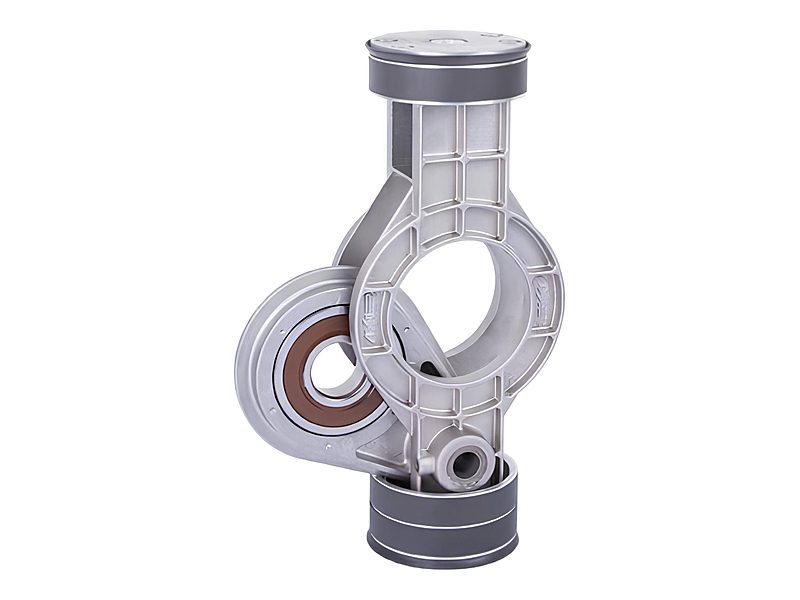
Why an ATL keeps running
What sets it apart from a workshop compressor is not one part but the build of the whole pump. The cylinders are of an aluminium-silicon alloy with heavy finning, the connecting rod is cast so that it carries heat away from the gudgeon pin, and the bearings are greased for life. On top of that a high-capacity fan pushes air straight onto the cylinder heads.
The result is a machine that works at a low operating temperature and does not have to stop to cool down — hence S1 and a 100% duty cycle. The slow 1,500 rpm and the direct drive without belts add fewer parts that can wear: no belts to tension and no pulleys to align.
All eight machines side by side
ABAC Tech ATL compressors with no receiver — 8 machines, S1 100 %, 10 bar, 1.5 to 7.5 kW, 144 to 786 l/min | ||||||||
|---|---|---|---|---|---|---|---|---|
| Model | Version | Starting | Motor | Intake | Delivered at 10 bar | Lwa / Lwp | Weight | Dimensions |
| ATL-1,5-T | bare unit | direct | 1.5 kW | 408 l/min | 144 l/min | 98 / 78 dB(A) | 45 kg | 686 × 530 × 547 mm |
| ATL-1,5-BT | on a frame | direct | 1.5 kW | 408 l/min | 144 l/min | 98 / 78 dB(A) | 70 kg | 686 × 575 × 631 mm |
| ATL-2,2-T | bare unit | direct | 2.2 kW | 504 l/min | 210 l/min | 99 / 79 dB(A) | 49 kg | 686 × 530 × 547 mm |
| ATL-2,2-BT | on a frame | direct | 2.2 kW | 504 l/min | 210 l/min | 99 / 79 dB(A) | 71 kg | 686 × 575 × 631 mm |
| ATL-4-BTX | on a frame | star-delta | 4 kW | 918 l/min | 402 l/min | 99 / 79 dB(A) | 92 kg | 686 × 575 × 631 mm |
| ATL-5,5-BTX | on a frame | star-delta | 5.5 kW | 1,146 l/min | 576 l/min | 100 / 80 dB(A) | 101 kg | 1,073 × 693 × 721 mm |
| ATL-7,5-TX | bare unit | star-delta | 7.5 kW | 1,560 l/min | 786 l/min | 101 / 81 dB(A) | 102 kg | 860 × 591 × 625 mm |
| ATL-7,5-BTX | on a frame | star-delta | 7.5 kW | 1,560 l/min | 786 l/min | 101 / 81 dB(A) | 120 kg | 1,073 × 693 × 721 mm |
The delivered figure is the air the machine actually supplies at a working pressure of 10 bar; the intake is the volume the pump draws in. Lwa is the sound power level from the machine plate, Lwp the sound pressure level at a distance of four metres. Dimensions are length × width × height. All figures are manufacturer data.
#showmore#
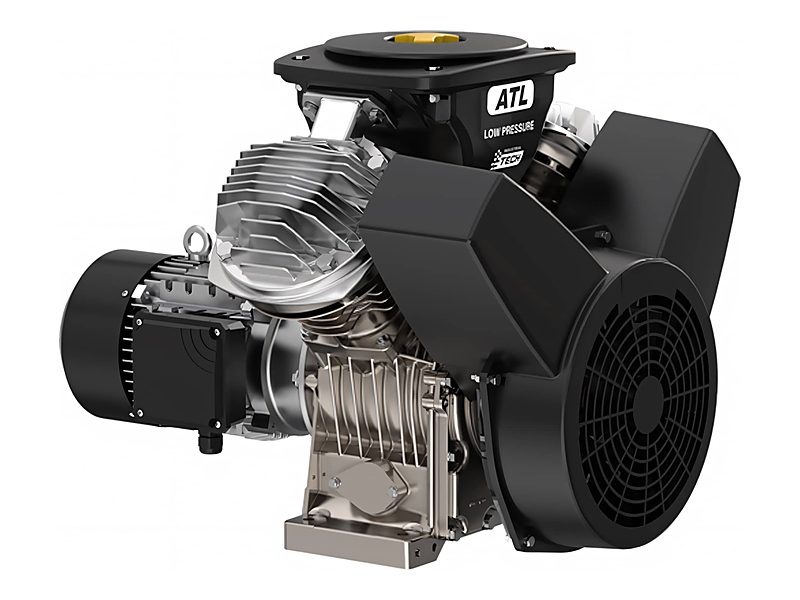
Noise without dressing it up
These machines are loud, and there is no point hiding it: the sound power level Lwa is 98 to 101 dB. This is an open industrial machine with no enclosure at all, built for output and heat removal, not for quiet in the room. It belongs in a machine room, a lean-to or behind a wall, not next to a workbench.
🔴 Be careful comparing with other offers. Catalogues often quote 78 to 81 dB for the same machine — but that is the sound pressure Lwp measured at four metres, which is roughly 20 dB(A) below the Lwa power figure on the plate. Both numbers are correct; they simply measure different things. With us every machine states both, so that apples can be compared with apples.
What all the machines share
S1 motor on a 100 % cycle
A four-pole motor rated for continuous load. It needs no pauses to cool down, which is exactly what separates this range from workshop compressors with an S3 motor.
Direct drive without belts
The pump sits straight on the motor. No belts to tension or replace, and nothing for the drive to lose along the way.
Aluminium-silicon cylinders
Heavy finning carries the heat away and the alloy reduces friction. The V arrangement of the pistons keeps the machine balanced at low speed.
Stainless valves
A stainless valve plate takes the high temperatures and the cyclic load of continuous duty.
Bearings greased for life
The bearings are not greased at service intervals — they are filled at the factory for the whole service life.
No pressure vessel
The air goes straight into the pipework or into a separate receiver. The machine can therefore stand where it is out of the way while the tank sits by the workstation.
Two-year warranty
Every machine in the range carries a two-year warranty.
Ventilek recommends
A workshop compressor on continuous duty will burn out. An ordinary machine with an S3 motor has to stand and cool for roughly half the time. Put it on two shifts in a paint shop and you will burn it out — and no warranty will cover that. The ATL range is the opposite case: slow speed, direct drive and a motor rated for continuous load. Do reckon with paying for that output in noise, though: 98 to 101 dB of sound power is not a machine for a workshop where people work. And since it has no receiver, it needs pipework or a separate tank — without one the motor will cut in over and over.
Frequently asked questions
- What exactly does S1 mean and why does it matter?
- S1 is the standard designation for a motor duty type: the machine may run continuously at full output as long as it is cooled. Ordinary workshop compressors are S3, which means a period of running must be followed by a pause to cool down — usually about half and half. Leave an S3 machine running non-stop and it overheats, cutting its life to a fraction.
- What is the difference between the T and BT versions?
- The machine inside is the same. T is a pump with a motor on a common plate; BT is the same thing set on a steel base frame with a terminal box. The frame adds 18 to 25 kg depending on the size of the machine and lets you bolt it to the floor or set it on anti-vibration mounts. T is bought where you handle the mounting yourself.
- Why does the table show delivered air rather than intake?
- Because the delivered figure is the air that actually reaches the tools at a working pressure of 10 bar. The intake is the volume the pump draws in — on the ATL-1.5 that is 408 l/min against 144 l/min delivered. For choosing a machine the delivered figure decides; we state both so it is clear which is which.
- Is it really that loud?
- Yes. The sound power Lwa is 98 to 101 dB, which is what an open industrial machine with no enclosure does. The figure of 78 to 81 dB that turns up for these machines is the sound pressure at four metres — a different quantity, roughly 20 dB(A) lower. If you need a machine for a room where people work, look for a version in a sound cabinet.
- Do I have to buy a receiver as well?
- Either a receiver or pipework long enough to act as a reserve in itself. Without one of the two the motor would cut in many times an hour. The tank volume is chosen by the peak draw, not by the output of the compressor — and the advantage is that you can stand it by the workstation and hide the compressor elsewhere.
- Can the machine run on 230 V?
- No. Every machine in this category runs on a three-phase 400 V / 50 Hz supply. The four most powerful also start through star-delta, so the protection has to be sized accordingly.
Where to go next
This category is the basic version of the ATL range. The other branches of the industrial ABAC Tech range look like this: You will find an overview of every range in the Compressors category.
- ATL on a receiver — the same pumps already on a pressure vessel, with no assembly to put together
- The oil-free ATF range — the same S1 principle without a drop of oil in the air — for food production and laboratories
- The soundproofed ATFS range — industrial output in a sound cabinet, for when the machine has to stand in the workshop
- The high-pressure ATH range — when ten bar is not enough — 15, 20 and 30 bar
- Separate compressor units — pumps with and without a motor across brands and ratings
- How to choose a compressor — the path from what your tools use through output to receiver volume
Performance data measured according to ISO 1217, Annex C, latest edition; noise according to ISO 2151. Under the European machinery directive the sound power level Lwa is stated on the machine plate, while the sound pressure level Lwp is measured at a distance of four metres and is roughly 20 dB(A) lower. All figures are manufacturer data.
Bestsellers


Product sorting
List of products

A bare unit with a two-point-two kilowatt motor. Sixty litres more air than the smallest machine in the range, in the same mounting and for only four kilos more.

The smallest machine in the range on a steel base frame with a terminal box. Ready to be bolted down or set on anti-vibration mounts, with no further work. It weighs 70 kg.

The smallest machine in the range and the cheapest way into continuous duty. A pump with a motor on a common plate, no frame and no tank — for your own mounting. It weighs 45 kg.

A two-point-two kilowatt machine on a steel base frame. The usual choice for a smaller workshop with an air main, where the compressor is to stay put. It weighs 71 kg.

A four-kilowatt machine on a base frame with soft motor starting. Almost twice the air of the two-point-two kilowatt machine, in the same mounting. It weighs 92 kg.

A five-and-a-half kilowatt machine on a base frame with soft starting. A sturdier build than the smaller ratings — 101 kg and a longer frame. For a shop with a steady draw from...

The most powerful machine in the range on a base frame, ready to be bolted down. Ninety litres of air more than the five-and-a-half kilowatt machine. The heaviest machine on...

The most powerful machine in the range as a bare unit with a motor. No frame, for your own mounting or an existing assembly. At 102 kilograms it is the heaviest bare version on...