
ABAC Tech ATF compressors: oil-free, no air receiver
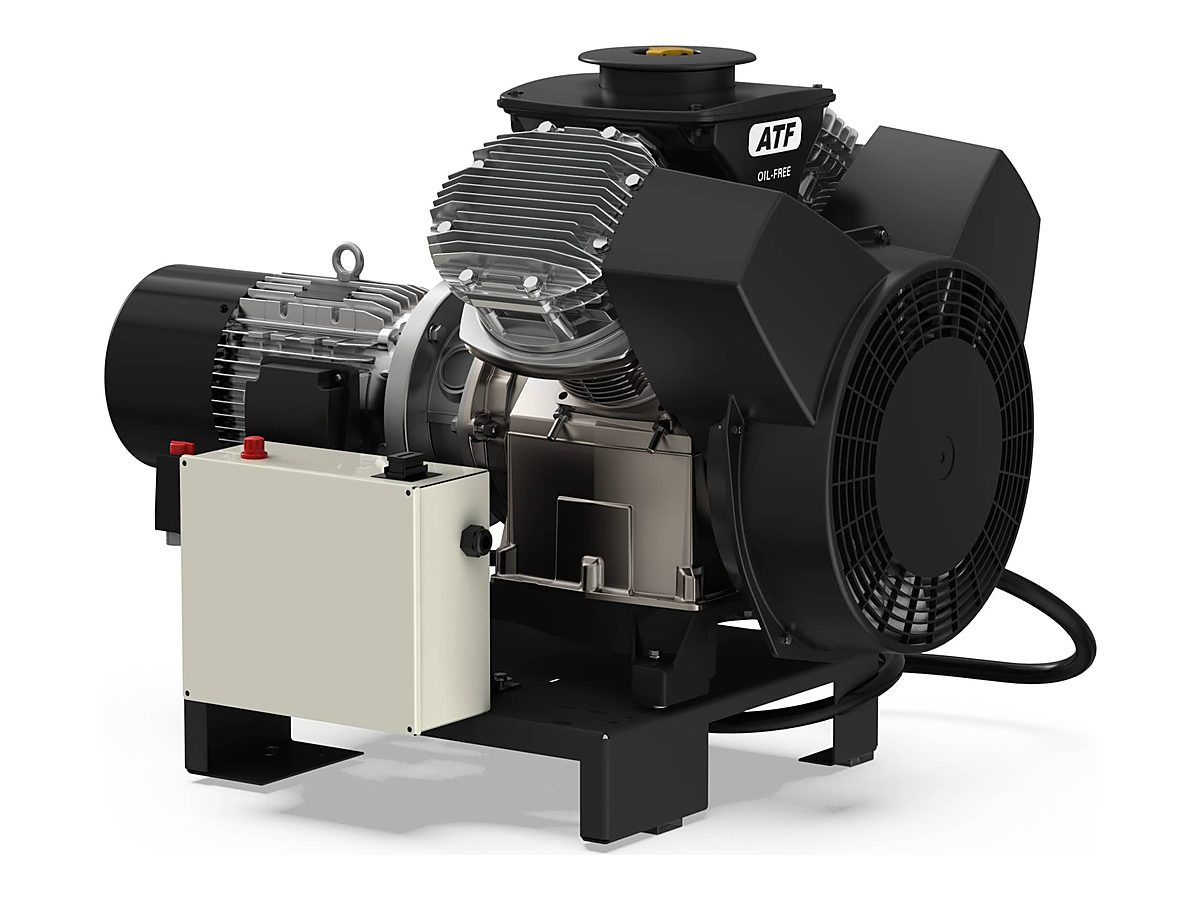 ABAC Tech ATF · oil-free · S1 100 %
Oil-free machines usually share one weakness: they run for a while and then have to cool down. The ABAC Tech ATF range is built the other way round — it is an oil-free piston airend with an S1 motor, that is a 100% duty cycle. There is no lubricant in the cylinders, so nothing can reach the air, and the machine may still run a full shift without a break. Single-stage design for 10 bar, two cylinders in a V, slow 1,500 rpm and direct drive without belts. Seven machines from 1.5 to 7.5 kW, all of them without a pressure vessel — the air goes straight into the pipework or into a receiver you place separately.
Three things that decide the choice
All seven machines are oil-free, single-stage for 10 bar, direct driven and run on a three-phase 400 V supply. None of them has its own air receiver. They differ in three things.
1. How much air do you really use?
What matters is the delivery at 10 bar, not the intake — that is the air which actually reaches your tools or your process. The range is 132 to 786 l/min. Because the motor may run continuously, work with the average consumption per shift, not with the peak; the machine has no receiver to cover a peak from.
2. Bare unit, or on a frame?
The T version is the airend and motor on a common base plate — bought for an existing set-up or for a receiver you already own. The BT version is the same machine mounted on a steel base frame with a control box: it can be anchored to the floor or set on anti-vibration mounts and is ready to be wired up.
3. Will your supply take a direct start?
Three machines carry an X in the code — the motor starts through a star-delta sequence, so the inrush current is gentler. From 4 kW up it is a necessity rather than an extra. The other four machines start directly.
How to read the machine code
The code has three parts: ATF is the range (the letter F stands for free of oil), the number is the motor input in kilowatts and the letters at the end say which version arrives.
T — bare unit with motor
Three machines, 45 to 102 kg. Airend and motor on a common base plate, no frame and no receiver. The lightest way to oil-free air if you handle the installation yourself or extend an existing set-up.
BT — on a base frame
Four machines, 71 to 101 kg. The same airend on a steel frame together with a control box. The frame adds roughly 25 kilos, but the machine stands firm, can be anchored and is ready to wire up with no further assembly.
X — star-delta
Three machines from 4 kW up. The motor starts in two steps, so the current peak at start-up is markedly lower. Once running, it makes no difference.
How air can be compressed without a drop of oil
In an ordinary piston compressor the oil does two jobs at once: it lubricates the rings against the cylinder and carries heat away. Leave it out and the materials themselves have to cope. ATF therefore uses nickel-plated aluminium cylinders and Teflon-coated pistons, a pair that slides without lubricant and takes the heat. The valve plate is stainless steel and the crankshaft bearings are filled with grease at the factory for their whole service life — the lubricant is sealed where the compressed air never passes.
The rest of the design does what oil does elsewhere: V-arranged cylinders with heavy finning and a large fan blowing air straight onto the heads. The machine runs at a low 1,500 rpm and the motor is coupled to the airend directly, without belts. Oil-free running has its price, though: the airend runs hotter and louder than the oil-lubricated ATL range, and on the smaller machines it delivers slightly less air — 132 against 144 l/min at 1.5 kW. From 5.5 kW up the delivery of both ranges is the same.
All seven machines side by side
ABAC Tech ATF compressors, oil-free and without a receiver — 7 machines, S1 100 %, 10 bar, 1.5 to 7.5 kW, 132 to 786 l/min delivered | ||||||||
|---|---|---|---|---|---|---|---|---|
| Model | Version | Starting | Input | Intake | Delivery at 10 bar | Lwa / Lwp | Weight | Dimensions |
| ATF-1,5-T | bare unit | direct | 1.5 kW | 408 l/min | 132 l/min | 102 / 82 dB(A) | 45 kg | 686 × 530 × 547 mm |
| ATF-1,5-BT | on a frame | direct | 1.5 kW | 408 l/min | 132 l/min | 102 / 82 dB(A) | 71 kg | 686 × 575 × 671 mm |
| ATF-2,2-T | bare unit | direct | 2.2 kW | 504 l/min | 192 l/min | 103 / 83 dB(A) | 49 kg | 686 × 530 × 547 mm |
| ATF-2,2-BT | on a frame | direct | 2.2 kW | 504 l/min | 192 l/min | 103 / 83 dB(A) | 73 kg | 686 × 575 × 671 mm |
| ATF-4-BTX | on a frame | star-delta | 4 kW | 918 l/min | 396 l/min | 103 / 83 dB(A) | 80 kg | 686 × 575 × 671 mm |
| ATF-5,5-BTX | on a frame | star-delta | 5.5 kW | 1,146 l/min | 576 l/min | 104 / 84 dB(A) | 101 kg | 1,073 × 693 × 761 mm |
| ATF-7,5-TX | bare unit | star-delta | 7.5 kW | 1,470 l/min | 786 l/min | 106 / 86 dB(A) | 102 kg | 860 × 591 × 625 mm |
Delivery is the amount of air the machine actually supplies at a working pressure of 10 bar; intake is the volume the airend draws in. Lwa is the sound power level from the rating plate, Lwp the sound pressure level at a distance of four metres. Dimensions are length × width × height. All values are manufacturer data.
#showmore#

Noise without window dressing
These machines are loud and there is no point hiding it: the sound power level Lwa is 102 to 106 dB. It is an open industrial machine with no enclosure at all, designed for output and heat removal, not for quiet in the room. An oil-free airend is a few decibels louder than an oil-lubricated one on top of that. It belongs in a plant room, an annex or behind a wall, not next to a workbench.
🔴 Be careful when comparing offers. Catalogues often quote 82 to 86 dB for the same machine — but that is the sound pressure Lwp measured at four metres, roughly 20 dB(A) below the sound power Lwa on the rating plate. Both figures are correct, each simply measures something different. We list both for every machine. When the machine has to stand where people work, the answer is the sound-insulated ATFS range.
The machine up close
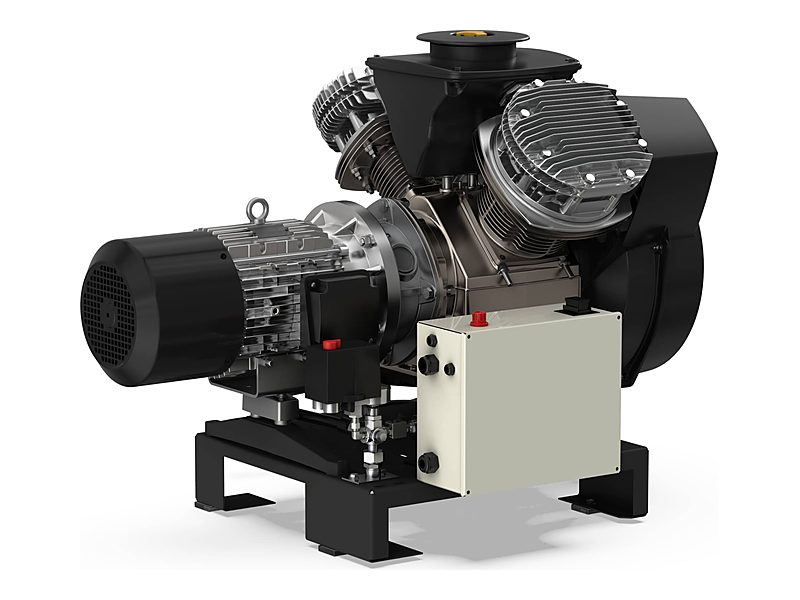
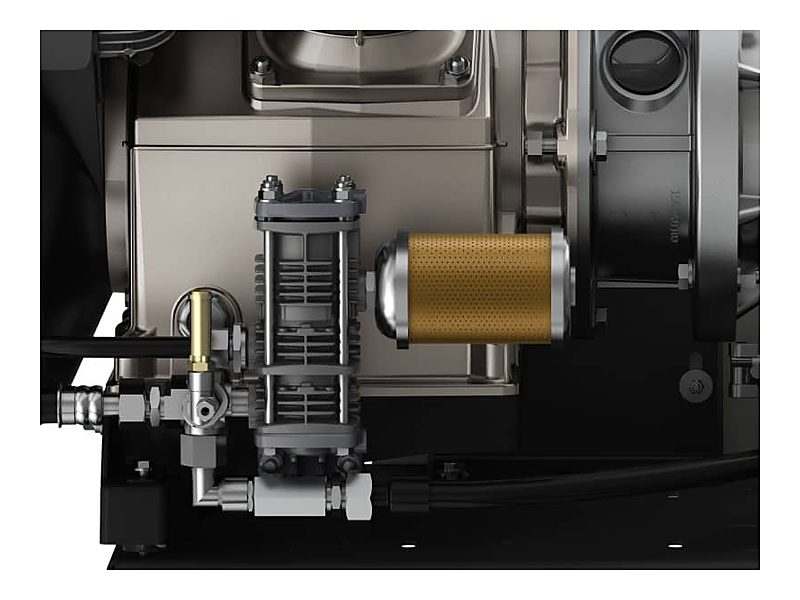
The frame-mounted assembly from two sides — all seven machines use the same airend, only its size changes.

What all the machines share
No oil anywhere in the airend
There is no lubricant in the cylinders, so nothing can reach the compressed air. Oil changes and oil disposal disappear as well.
S1 motor at 100 % duty
A four-pole motor rated for continuous load. It needs no cooling breaks — that is exactly what separates this range from small oil-free machines with an S3 motor.
Nickel-plated cylinders, Teflon pistons
A pair of materials that takes running without lubricant. The aluminium cylinders are nickel plated, the pistons have a Teflon surface.
Direct drive without belts
The airend sits directly on the motor. No belt tensioning, no belt replacement, and no place for the power transfer to lose out.
Stainless steel valves
A stainless valve plate takes high temperatures and the cyclic load of continuous duty.
Bearings greased for life
The crankshaft bearings are not greased at service intervals — they are filled at the factory for their whole service life.
No pressure vessel
The air goes straight into the pipework or into a separate receiver. The machine can stand where it is out of the way and the receiver next to the workplace.
Two-year warranty
A two-year warranty applies to every machine in the range.
Ventilek recommends
Oil-free does not mean the air is clean straight away. ATF really will not put a drop of oil into the air — there is none in the cylinders. What stays, though, is water: every compressor draws in humidity and it condenses in compressed air. If you feed a process that cannot take moisture, a dryer and filters belong downstream of the machine. And count on the noise: 102 to 106 dB of sound power is not a machine for a room where people work. If oil in the air is not a problem for you, the oil-lubricated ATL range delivers more on the smaller machines and is a few decibels quieter.
Frequently asked questions
- What exactly does S1 mean and why does it matter?
- S1 is the standard designation of a motor duty type: the machine may run continuously at full output as long as it is cooled. Small oil-free compressors usually have S3, which means that after a certain running time a cooling break has to follow — usually roughly half and half. Leave an S3 machine running non-stop and it will overheat, cutting its life to a fraction.
- Is the air from an ATF really completely oil-free?
- From the compressor, yes — there is no lubricant in the compression chamber that could reach the air. That does not mean the air is free of water and dust: the humidity drawn in condenses in the compressed air and whatever floats in the hall comes along too. Sensitive processes therefore need a dryer and filtration downstream.
- What is the difference between the T and BT versions?
- The machine inside is the same. T is the airend with motor on a common base plate, BT is the same unit mounted on a steel base frame with a control box. The frame adds roughly 25 kg and allows the machine to be anchored to the floor or set on anti-vibration mounts. T is bought where you handle the installation yourself.
- Why does the table show delivery instead of intake?
- Because delivery is the air that actually reaches the tools at a working pressure of 10 bar. Intake is the volume the airend draws in — on the ATF-1.5 that is 408 l/min against 132 l/min delivered. Delivery decides the choice of machine; we list both so it is clear which is which.
- Is it really that loud?
- Yes. The sound power Lwa is 102 to 106 dB, which is what an open industrial machine without an enclosure sounds like. The figure of 82 to 86 dB that appears for these machines is the sound pressure at four metres — a different quantity, roughly 20 dB(A) lower. If you need a machine for a room where people work, look for a version in a sound-insulated enclosure.
- Do I have to buy a receiver as well?
- Either a receiver, or pipework long enough to build the reserve itself. Without one of the two the motor would cut in many times an hour. The volume is chosen according to the peak demand, not according to the compressor output — and the advantage is that you can place it next to the workplace and hide the compressor elsewhere.
- Can the machine run on 230 V?
- No. Every machine in this category runs on a three-phase 400 V / 50 Hz supply. The three strongest ones also start through a star-delta sequence, so matching protection is required.
Where to go next
This category is the basic version of the oil-free ATF range. The other branches of the industrial ABAC Tech range look like this: You will find an overview of every range in the Compressors category.
- ATF on a receiver — the same oil-free airend already mounted on a pressure vessel, no assembly to put together
- Sound-insulated ATFS range — oil-free air in a sound enclosure, for when the machine has to stand in the workshop
- Oil-lubricated ATL range — the same build and the same S1 duty, but oil lubricated and with a higher delivery
- Every oil-free machine — from small workshop machines to dental and laboratory versions across brands
- High-pressure ATH range — when ten bar is not enough — 15, 20 and 30 bar
- How to choose a compressor — from the consumption of your tools through output to the size of the receiver
Performance data are measured to ISO 1217, Annex C, latest edition; noise to ISO 2151. Under the European machinery directive the sound power level Lwa is stated on the machine rating plate, while the sound pressure level Lwp is measured at a distance of four metres and is roughly 20 dB(A) lower. All values are manufacturer data.
Bestsellers


Product sorting
List of products

Bare unit with a motor rated at an input of two point two kilowatts. Sixty litres more air than the smallest machine in the range, with the same footprint and only four...

The smallest machine of the range on a steel base frame with a control box. Ready to be anchored to the floor or set on anti-vibration mounts, with no further assembly. It...

The smallest machine in the series as a bare unit with motor on a common base plate, without frame and without a tank — for integration into your own installation. At 45...

Two point two kilowatts on a steel base frame with a control box. The strongest machine of the range that still starts directly, without a star-delta sequence.

Four kilowatts on a steel base frame with a control box and star-delta starting. Twice the air of the 2.2 kW machine for seven kilograms more.

Five and a half kilowatts on a steel base frame, with star-delta starting. The largest machine of the range that comes ready mounted on a frame.

The most powerful machine in the series. Supplied as a bare unit with motor, with star-delta starting — for your own installation or integration into an existing setup.