
ABAC Tech industrial compressors: piston machines for continuous duty
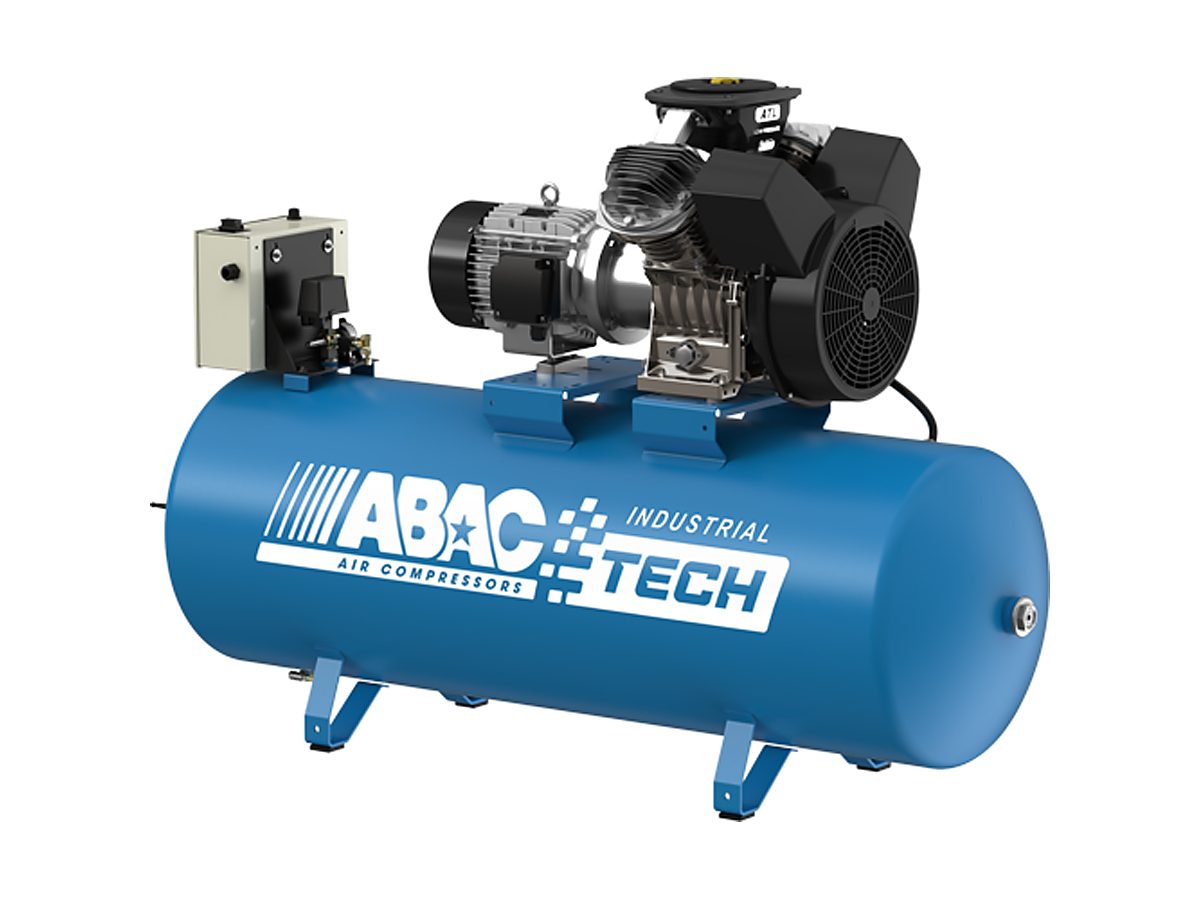 ABAC Tech · industrial range · S1 100 %
An ordinary workshop compressor has an S3 motor — after a while it has to stop and cool down. ABAC Tech is built the other way round: an S1 motor at a 100% duty cycle may run without a break as long as it is cooled. ABAC Tech industrial compressors are eight branches and 50 machines from 1.5 to 15 kW that differ in three things — whether they use oil, how many bar they reach, and whether they stand on a tank or only on a carrying frame.
Three questions that decide the choice
All eight branches share the same industrial base: an S1 motor, a cast-iron pump and running without pauses for cooling. They differ in this.
1. May there be oil in the air?
Lubricated machines deliver more air for the same motor power and cost less to run — for a workshop, a tyre service, hand tools. Oil-free machines are needed wherever oil would be a problem: paint shops, food production, laboratories, healthcare. The range has 36 lubricated and 14 oil-free machines.
2. How many bar do you need?
Ordinary tools are happy with 10 bar — that is what the single-stage ATL, ATF and ATFS branches do. When the process wants more, the two-stage ATH at 15, 20 or 30 bar takes over: the air is compressed twice and cooled in between. The range has 25 two-stage machines, exactly half.
3. A tank, or just the pump unit?
A complete set on a 90 or 270 l tank is simply put in place and plugged in — there are 17 of those. The remaining 33 are a pump with a motor on a carrying frame: you supply the pressure vessel yourself, but you choose it to match your consumption and the machine also fits where there is no room for a tank.
Lubricated, or oil-free
This is the first fork in the road and there is no way around it: it decides the branch, not the individual machine.
ATL — lubricated, 10 bar
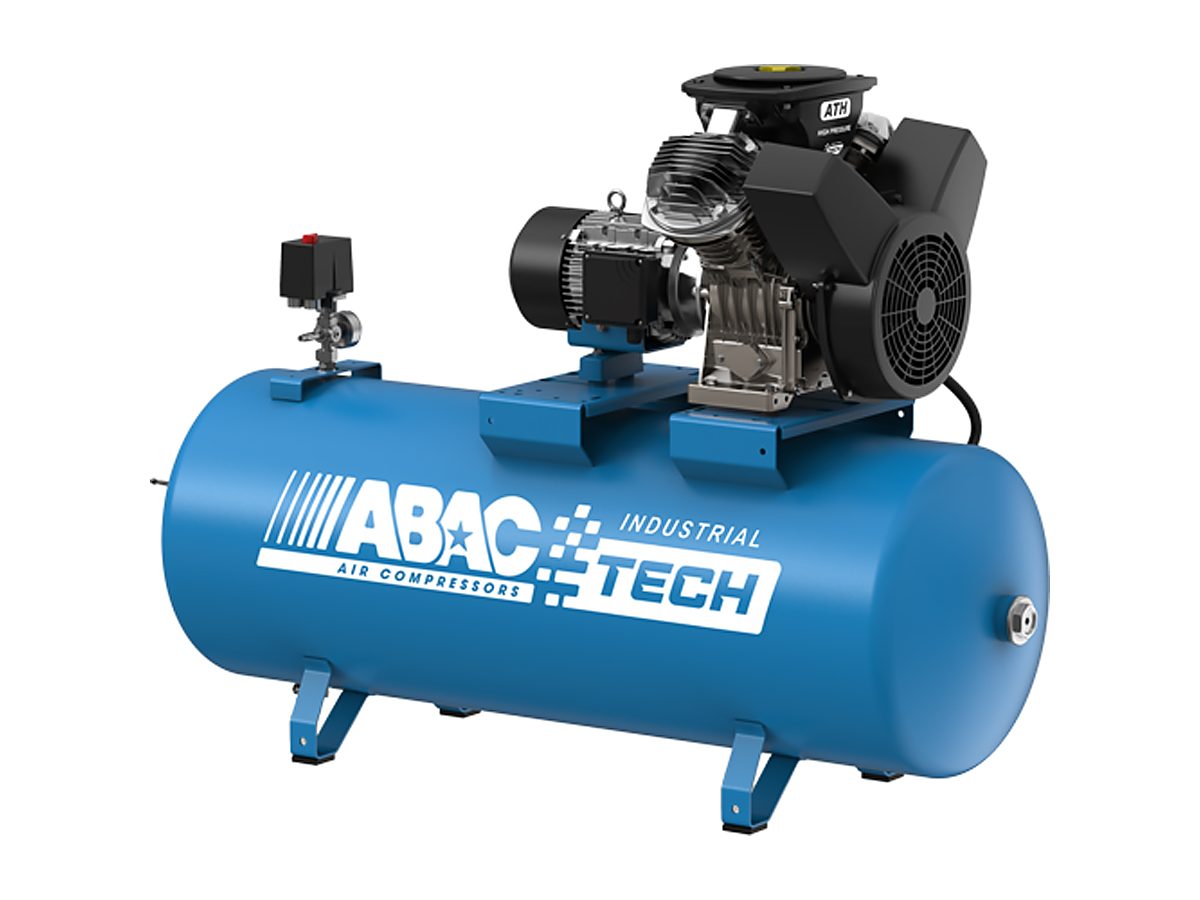
Eleven machines in two branches. The most air per kilowatt in the whole range: 408 to 1,560 l/min at 1.5 to 7.5 kW. Either a bare pump on a frame, or a complete set on a 90 and 270 l tank.
ATF — oil-free, 10 bar
Eight machines in two branches. PTFE piston rings and a ceramic cylinder surface — no oil can reach the air. The output is of the same order as ATL; the price is noise of 102 to 106 dB.
ATFS — oil-free and portable
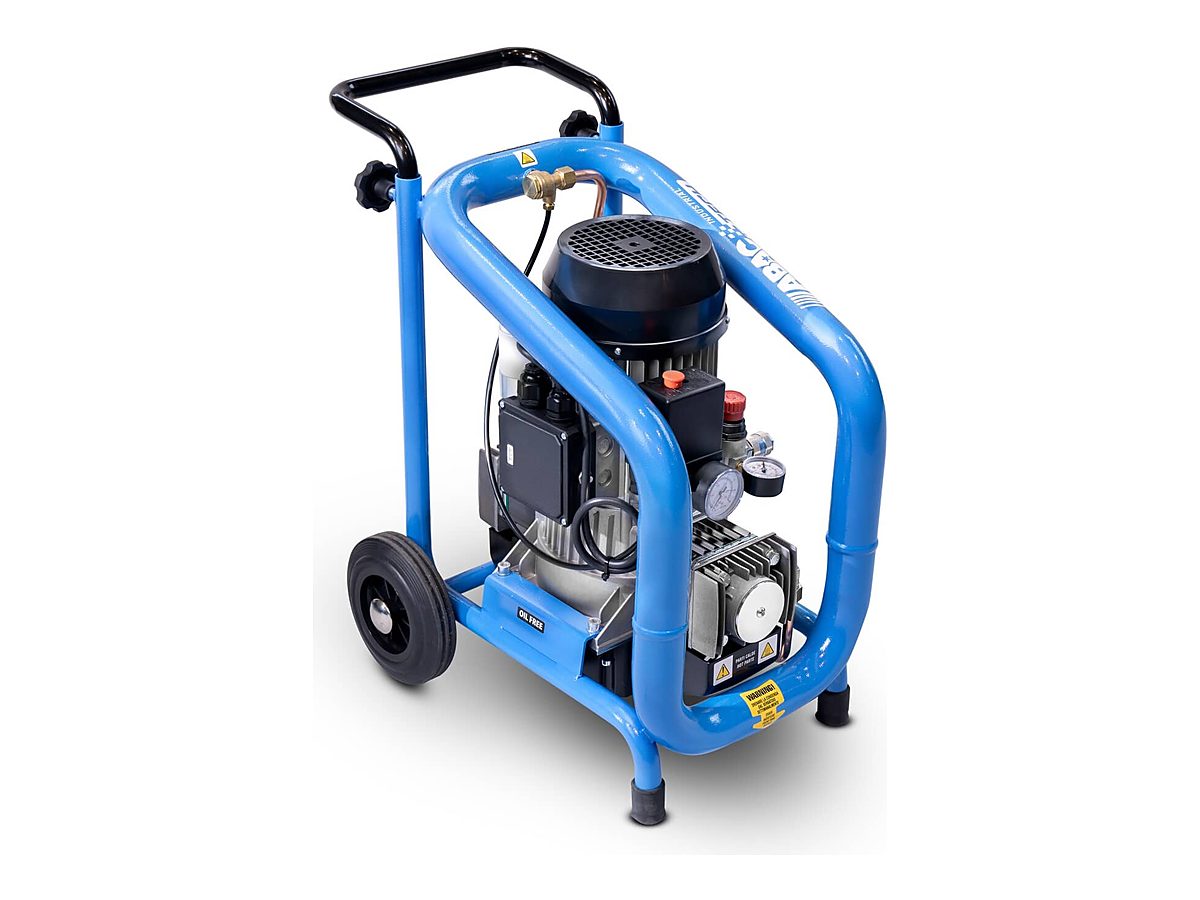
Six machines. The only branch you can move yourself: 32 to 76 kg, wheels, a handle and a tank from three to one hundred litres. It is also the quietest branch of the range — 88 to 92 dB.
ATH — lubricated, two-stage
Twenty-five machines in three branches. Pressure of 15, 20 or 30 bar for processes that ten bar cannot serve. The strongest machines of the range have 15 kW and draw in 1,716 l/min.
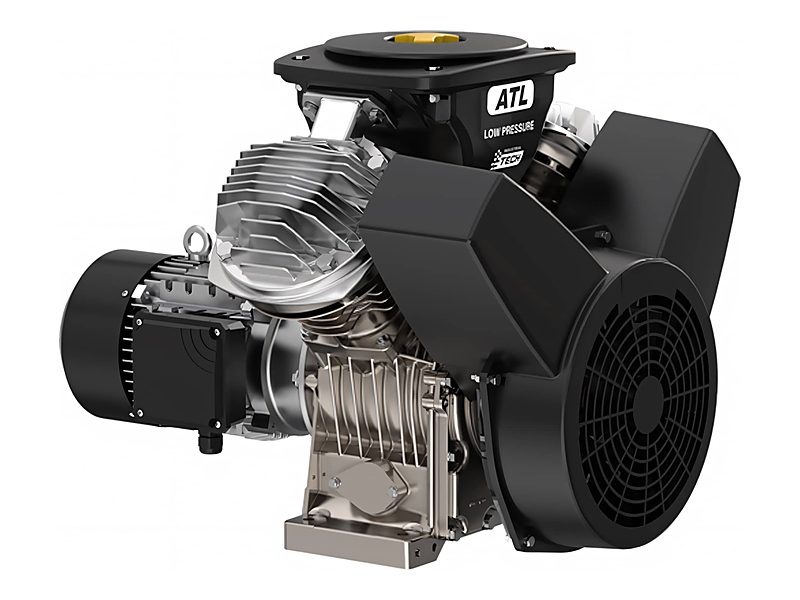
What makes a compressor industrial
Ordinary piston compressors for trade work are meant for a few hours a day in intermittent duty. After a working cycle they have to stand for a while so the operating temperature drops — the whole build follows from that, above all the electric motor marked S3. At a higher load, typically in industry, a different design is needed and a motor built for continuous duty S1 at 100 %. The other parts of the pump unit are dimensioned to match.
An industrial machine costs more to buy than a trade version, but thanks to its lower operating temperature it is more efficient. And because it needs no forced stops for cooling, it produces air even while an ordinary compressor rests. The result: over a shift it delivers more air, more efficiently and at a lower running cost.
One stage, or two
The number of stages is not a marketing figure — it decides how far the machine can compress and how hot it gets doing it.
Single-stage at 10 bar
Twenty-five machines. The air is compressed in one step. A simpler build, fewer parts and the best ratio of air to motor power. All the ATL, ATF and ATFS branches belong here.
Two-stage at 15 to 30 bar
Twenty-five machines. A large low-pressure cylinder pre-compresses the air, an intercooler takes the heat out of it and a smaller high-pressure cylinder brings it to the working pressure. Cooling between the stages is why the machine sustains high pressure continuously.
How much air is left
The higher the pressure, the smaller the share of the drawn-in air that reaches the outlet. On the ten-bar branches it is around two thirds of the intake, on the thirty-bar ones closer to half. That is why machines are not chosen by intake but by delivery at the working pressure.
All eight branches side by side
Industrial compressors ABAC Tech — 8 branches, 50 machines, 10 to 30 bar, 1.5 to 15 kW, S1 motor at a 100% duty cycle | ||||||||
|---|---|---|---|---|---|---|---|---|
| Branch | Machines | Pressure | Lubrication | Stages | Tank | Motor power | Intake | Lwa |
| ATL on a frame | 8 | 10 bar | lubricated | one | no tank | 1.5–7.5 kW | 408–1,560 l/min | 98–101 dB(A) |
| ATL on a tank | 3 | 10 bar | lubricated | one | 90 a 270 l | 2.2–5.5 kW | 504–1,146 l/min | 99–100 dB(A) |
| ATF on a frame | 7 | 10 bar | oil-free | one | no tank | 1.5–7.5 kW | 408–1,470 l/min | 102–106 dB(A) |
| ATF on a tank | 1 | 10 bar | oil-free | one | 270 l | 4 kW | 918 l/min | 103–103 dB(A) |
| ATFS portable | 6 | 10 bar | oil-free | one | 3 až 100 l | 2.2–3 kW | 330–430 l/min | 88–92 dB(A) |
| ATH 15 bar | 8 | 15 bar | lubricated | two | 90 a 270 l · 5× no tank | 1.5–7.5 kW | 252–1,002 l/min | 98–101 dB(A) |
| ATH 20 bar | 11 | 20 bar | lubricated | two | 90 a 270 l · 7× no tank | 1.5–15 kW | 204–1,716 l/min | 98–106 dB(A) |
| ATH 30 bar | 6 | 30 bar | lubricated | two | no tank | 2.2–15 kW | 252–1,710 l/min | 99–106 dB(A) |
Intake is the volume drawn in by the pump unit; the delivery at working pressure is given on each branch separately. Lwa is the sound power level from the machine rating plate. The machine counts match what is visible in the shop. All values are manufacturer data.
#showmore#
What the range looks like
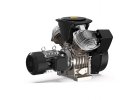
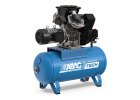
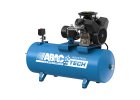
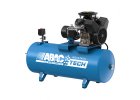
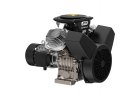
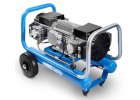
Three branches side by side: oil-free on a frame, oil-free and portable, and high-pressure two-stage.
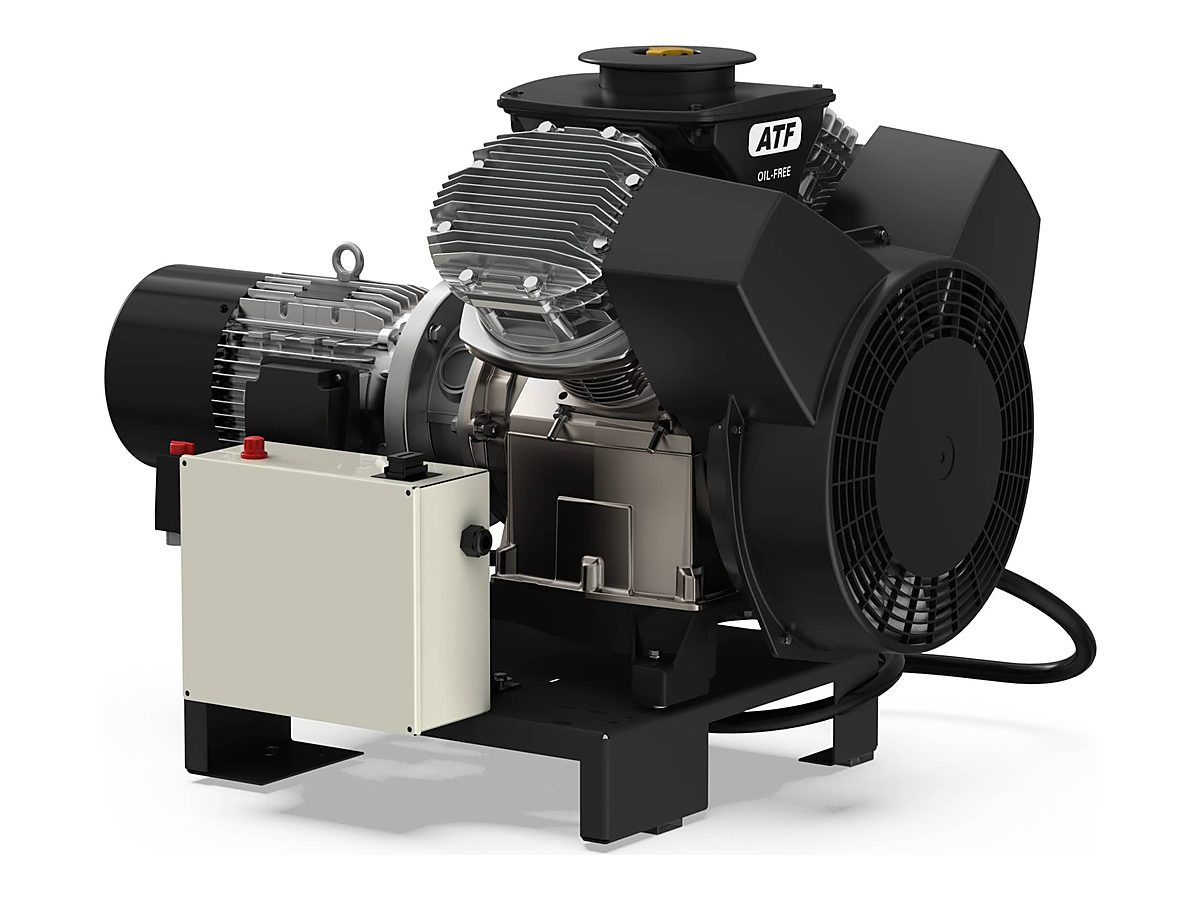
What all ABAC Tech machines share
S1 motor at a 100 % duty cycle
It may run continuously at full output as long as it is cooled. No forced breaks.
Cast-iron pump unit
A massive block with a large heat capacity — it takes continuous load and a warmer workshop.
Cooling sized for nonstop duty
A large fan and finned cylinders keep the temperature down, which raises efficiency.
Reinforced bearings
Dimensioned for continuous running, not for a few hours a day.
Direct drive and V-belts
Depending on the branch and size — always so that the pump speed stays low.
Two-year warranty
A two-year warranty applies to every machine in the range.
Serviced by us
ABAC is an Atlas Copco brand and we service it — from warranty work to spare parts for the whole Tech range.
Ventilek advises
The motor rating plate tells you everything about how much the machine will take. If it says S3 (or a percentage, for example S3 50 %), it is an ordinary compressor that has to stand and cool for roughly half the time. Run it continuously and sooner or later you will burn it out. For two-shift or three-shift operation look for S1: these motors have heavier windings and better cooling, so they can run without a break.
Frequently asked questions
- What exactly does S1 100 % mean?
- It is the motor duty designation according to the standard. S1 means continuous duty: the machine may run without interruption at full output as long as it is cooled. Ordinary workshop compressors are rated S3, where a pause for cooling has to follow after a certain running time — with S3 50 % that is about half the time. You can read the duty on the motor plate.
- Will an industrial compressor really run nonstop?
- Yes, provided its cooling is taken care of, which means an air supply and a sensible room temperature. The whole build is made for it: a cast-iron pump, reinforced bearings and cooling sized for continuous load. That is exactly why it produces more air over a shift than a machine that has to rest.
- Should I choose by intake or by delivery?
- By delivery at the working pressure. Intake is the volume the pump draws in; delivery is the air that actually reaches the tool or the process. The gap between them grows with pressure — on ten-bar machines about two thirds of the intake is left, on thirty-bar ones closer to half.
- When does an oil-free machine make sense?
- Wherever oil in the air would be a problem — paint shops, food production, laboratories, healthcare, packaging. Oil-free pump units have no oil charge at all, so checking and changing oil falls away too. The price is higher noise and a somewhat shorter piston-ring life than on lubricated machines.
- Why do some machines have no tank?
- Because customers often choose the pressure vessel themselves — by consumption, by space and by local rules. A pump on a carrying frame also fits where a complete set would not, and it can be connected to a tank you already have. The range has 33 machines without a tank and 17 on a tank.
- What about the noise?
- None of these branches has a sound enclosure, so the values run from 88 to 106 dB of sound power Lwa. The quietest is the portable oil-free ATFS branch (88 to 92 dB); the loudest are the largest oil-free and high-pressure machines. If the machine stands in a room where people work, plan for a separate compressor room or a sound enclosure.
- Does ABAC also make screw compressors for continuous duty?
- Yes, and for a sustained high demand they are usually the better answer. An industrial piston machine makes sense where the draw comes in bursts or where you need more than ten bar. The link to the screw machines is below.
Where to go next
This page is the signpost of the ABAC Tech industrial piston range. If you are looking for something else: An overview of all ranges is in the Compressors category.
- The ABAC Pro Line range — machines for a workshop and trade work, where nothing runs nonstop
- Screw compressors — for a sustained high demand for air
- Air dryers — condensate forms in every compressor, oil-free ones included
- Everything from ABAC — the brand piston and screw machines in one place
- How to choose a compressor — from tool consumption through output to receiver size
- Compressor noise — why the figures in offers differ by twenty decibels
Performance data are measured according to ISO 1217, annex C, as currently in force; noise according to ISO 2151. Under the European machinery directive the sound power level Lwa is stated on the machine rating plate. The machine counts and parameter ranges match the current offer. All values are manufacturer data.
-
 Abac Tech ATL Compressors; 10 bar - basic version
-
Abac Tech ATL Compressors; 10 bar - on air receiver
-
Abac Tech ATF Compressors; 10 bar - Oil-free Basic Design
-
Abac Tech ATF Compressors; oil-free 10 bar - on the air receiver
-
Abac Tech ATH Compressors; 15 bar - all versions
-
Abac Tech ATH Compressors; 20 bar - all models
-
Abac Tech ATH Compressors; 30 bar - all models
-
Abac Tech ATFS Compressors; 10 bar - Soundproofed Machines
Bestsellers


Product sorting
List of products

The strongest machine of the category: fifteen kilowatts and over a thousand litres of air per minute at thirty bar. Twice what the eleven-kilowatt machine gives.

Eleven kilowatts on a base frame. Against the 7.5 kW machine it adds only nine per cent of air, but runs more easily and is 39 kg heavier.

Eleven kilowatts on a base frame. Two thirds more air than the 7.5 kW machine and a different weight class — 185 kg and five decibels louder.

The strongest machine of the category: fifteen kilowatts and over a thousand litres of air per minute at twenty bar. On a base frame, with star-delta starting.

The largest tank a two-kilowatt pump gets in this range. Fifty litres, 44 kg, still on wheels and with a handle.

A bare unit with a motor rated two point two kilowatts. Sixty litres more air than the smallest machine of the range, in the same installation space and only four kilos heavier.

A bare unit with a two-point-two kilowatt motor. Sixty litres more air than the smallest machine in the range, in the same mounting and for only four kilos more.

The smallest machine of the range on a steel base frame. Fifteen bar in two stages, without a vessel — the air goes straight into the pipework or into a receiver you already own.

The smallest complete assembly of the range: a two-stage airend mounted on a horizontal ninety-litre receiver. Place it, connect the supply and the pipework.

The smallest machine of the twenty-bar range on a steel base frame. Twenty bar in two stages, no pressure vessel — the air goes straight into the pipework or into a receiver you...

A complete assembly: a two-stage airend mounted on a horizontal ninety-litre vessel. The machine arrives assembled — it only has to be placed and connected.

Two point two kilowatts on a base frame. The strongest machine of the range that still starts directly, without a star-delta sequence.

A complete assembly with a horizontal ninety-litre receiver and a direct start. The strongest machine of the range you can place and connect without dealing with star-delta.

Two point two kilowatts on a base frame. The strongest machine of the range that still starts directly, without star-delta starting.

The smallest machine of the category. The only one that starts directly — from four kilowatts up star-delta is a must.

Four kilowatts on a base frame with star-delta starting. A two-stage airend that delivers over four hundred litres a minute at a full fifteen bar.

Four kilowatts on a base frame with star-delta starting. The first machine of the range where the manufacturer softens the current peak at start-up.

Four kilowatts on a base frame. The first machine of the category where the manufacturer softens the current peak at start-up with star-delta starting.

A complete assembly on a horizontal two-hundred-and-seventy-litre vessel. A 5.5 kW two-stage airend with star-delta starting, ready to be placed and connected.

Five and a half kilowatts on a base frame, with star-delta starting. For plants that have their own certified fifteen-bar vessel.

Five and a half kilowatts mounted on a horizontal two-hundred-and-seventy-litre receiver. A complete assembly for continuous duty that only has to be placed and connected.

Five and a half kilowatts on a base frame with star-delta starting. The mid-range machine for plants that have their own twenty-bar pressure vessel.

Five and a half kilowatts on a base frame. Of all the machines in the category it gives back the largest share of the air it draws in — two thirds.

The largest complete assembly of the range: seven and a half kilowatts on a horizontal two-hundred-and-seventy-litre vessel, with star-delta starting.

The strongest machine of the range on a base frame. Seven and a half kilowatts, two-stage compression and over seven hundred litres a minute at fifteen bar.

The largest complete assembly of the category: seven and a half kilowatts on a horizontal two-hundred-and-seventy-litre receiver. The highest delivery you will get here on a...

Seven and a half kilowatts on a base frame, star-delta starting, no pressure vessel. Of all the machines in the category it gives back the largest share of the air it draws in.

Seven and a half kilowatts on a base frame. The last machine before output gets expensive — the eleven-kilowatt one adds only nine per cent of air.

The smallest machine in the range on a steel base frame with a terminal box. Ready to be bolted down or set on anti-vibration mounts, with no further work. It weighs 70 kg.

The smallest machine in the range and the cheapest way into continuous duty. A pump with a motor on a common plate, no frame and no tank — for your own mounting. It weighs 45 kg.

The smallest and shortest machine in the category. A ninety-litre tank fits even where there is no room for a two-hundred-and-seventy. A finished assembly, 93 kg.

A two-point-two kilowatt machine on a steel base frame. The usual choice for a smaller workshop with an air main, where the compressor is to stay put. It weighs 71 kg.

A four-kilowatt machine on a two-hundred-and-seventy-litre tank. Almost twice the air of the smallest machine and a reserve that covers a bursty draw. It weighs 150 kg.

A four-kilowatt machine on a base frame with soft motor starting. Almost twice the air of the two-point-two kilowatt machine, in the same mounting. It weighs 92 kg.

The most powerful machine in the category with soft motor starting. The same tank as the four-kilowatt one, but 174 litres of air more. It weighs 189 kg.

A five-and-a-half kilowatt machine on a base frame with soft starting. A sturdier build than the smaller ratings — 101 kg and a longer frame. For a shop with a steady draw from...

The most powerful machine in the range on a base frame, ready to be bolted down. Ninety litres of air more than the five-and-a-half kilowatt machine. The heaviest machine on...

The most powerful machine in the range as a bare unit with a motor. No frame, for your own mounting or an existing assembly. At 102 kilograms it is the heaviest bare version on...

The smallest machine of the range on a steel base frame with a control box. Ready to be anchored to the floor or set on anti-vibration mounts, with no further assembly. It...

The smallest machine of the range as a bare unit with motor on a common base plate, no frame and no receiver — for your own installation. At 45 kilograms two people can carry it.