
Piston compressors ABAC Pro Line — oil-lubricated twin cylinders from 1.5 to 7.5 kW
 11 ranges · 94 machines · 1.5–7.5 kW
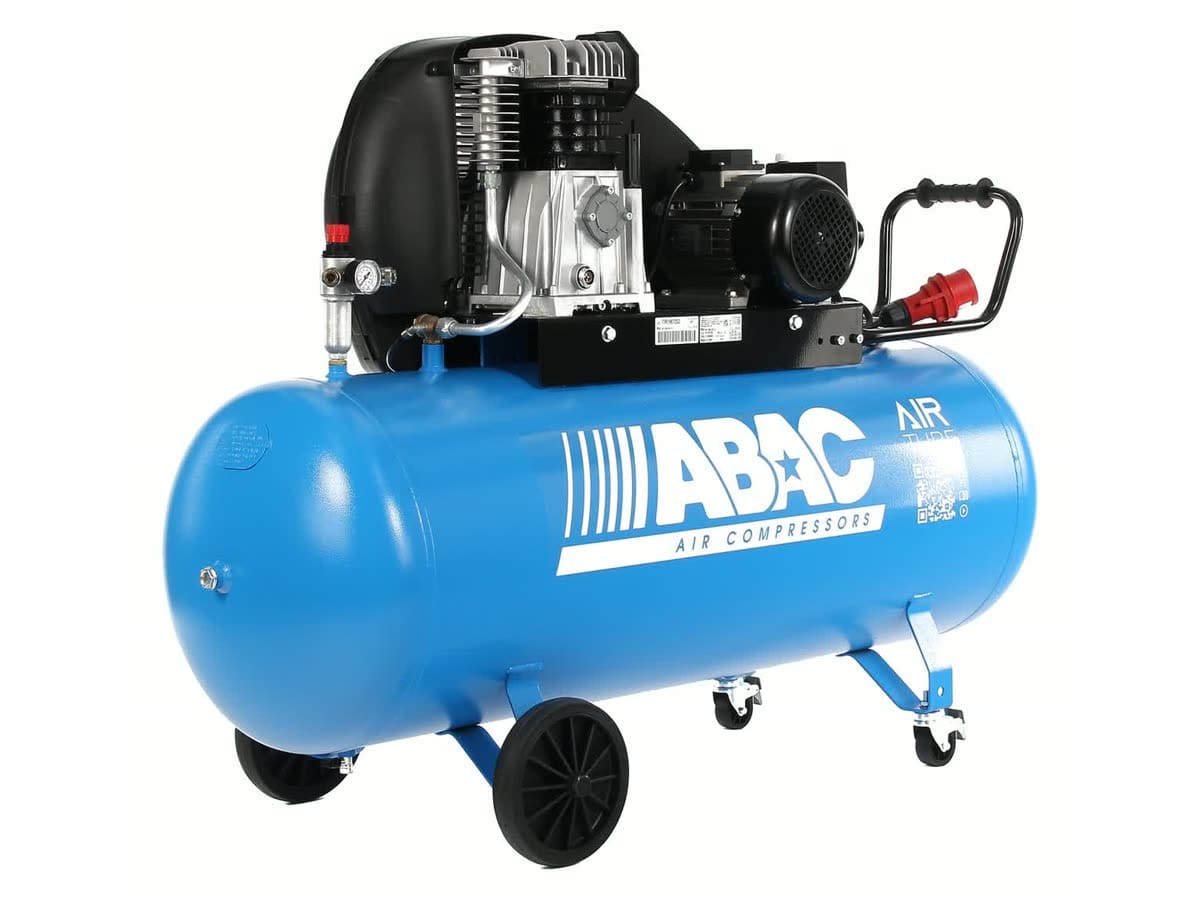
Pro Line is the ABAC range for the workshop and the garage, where air is drawn every day and in large volumes. The pump is driven by V-belts, runs on oil and sits on a tank of its own — eleven ranges, 94 machines, motors from 1.5 to 7.5 kW and a displacement of 178 to 2,420 litres a minute. Tanks from fifty to nine hundred litres, a pressure of 10, 11 or 15 bar, 230 and 400 V. You choose in two steps: first the pump, which sets how much air a minute the machine gives, then the version, which settles the pressure, the space in the workshop and the moisture in the pipework. We service the ABAC brand.
Four questions that decide
You do not choose by tank litres or by price, but by the pump and by what it will be asked to do. The answers point to one particular range.
How much air a minute?
The pump is the heart of the machine and its displacement is the first figure to look at. In the basic ranges the A29B gives 255 or 320 l/min, the A39B 393 or 486 and the two-stage A49B 444 to 595; geared down, the same pumps give less. The cast-iron B59B, B60 and B70 pumps run from 653 to 1,210 l/min, and two pump units on one tank give up to 2,420. Every tool has its consumption in the manual; add up the ones that will run at the same time and allow a reserve for the cycles.
One stage, or two?
A single-stage pump compresses the air in one go and stops at 10 bar; there are 36 of those in the range. A two-stage pump takes it through two cylinders one after the other with an intercooler and gives 11 or 15 bar — there are 58 of those. The difference is not only in the pressure: with the same 2.2 kW the single-stage A39B draws in 393 l/min, the two-stage A49B 444. For the same input power you therefore get more air and a higher pressure as well.
An ordinary socket, or a three-phase supply?
An ordinary 230 V socket is enough for 22 machines in the range — the A29B, A39, A39B and A49B pumps, all with a 1.5 or 2.2 kW motor. The other 72 are three-phase on 400 V, the whole B range without exception. Voltage is therefore the second question straight after the pump, because it decides what you can bring into the workshop at all.
Where will the machine stand?
On castors with a handle, 63 machines in the range travel round the workshop and out to site; the other 31 stand on feet or on legs and are connected permanently into the pipework. A vertical tank saves floor space, two pump units on one tank cover the peaks, and a dryer on the tank takes the water out of the air before it leaves for the pipes.
Four basic ranges, by pump
From the smallest single-stage pump to the cast-iron two-stage ones. Inside each range you then choose the tank, the voltage and the spec; the table below has them all side by side.
Pro Line A29B
When one person works at the machine and the tool blows only for a moment. The smallest single-stage pump in the range: 255 l/min with a 1.5 kW motor, or 320 l/min with 2.2 kW, 10 bar, a horizontal 50 to 200 l tank on castors. Eleven machines; the Extensive spec is the base, the Expert adds a closed handle and an outlet filter.
11 machines · 1.5 and 2.2 kW · 255 and 320 l/min · 50–200 l
Pro Line A39B
When an impact wrench and a spray gun join the stapler. The stronger single-stage pump: 393 l/min with a 2.2 kW motor, or 486 l/min with 3 kW, 10 bar, a 50 to 270 l tank. Fourteen machines in the Extensive and Expert spec levels, on 230 and 400 V — five tank sizes, more than any other basic range.
14 machines · 2.2 and 3 kW · 393 and 486 l/min · 50–270 l
Pro Line A49B
When the tank has to hold 11 bar and the job runs longer. The first two-stage pump in the range: the air goes through two cylinders one after the other with an intercooler between them, and the result is 11 bar and 444 to 595 l/min according to the 2.2, 3 or 4 kW motor. Fourteen machines: a tank from 90 to 270 l, for an ordinary socket or for a three-phase supply.
14 machines · 2.2–4 kW · 444–595 l/min · 90–270 l
Pro Line B59B, B60 and B70
When several people are on the tools at once. Cast-iron two-stage B59B, B60 and B70 pumps with 4, 5.5 and 7.5 kW motors on 400 V: 653, 827 or 1,210 l/min, 11 bar, a 200 to 500 l tank; the fourteenth machine in the range is a ninety on castors at 15 bar. The CT version has castors, a handle and a regulator and follows the work about, the FT version comes without a chassis and stays in one place, connected into the pipework.
14 machines · 4–7.5 kW · 653–1,210 l/min · 90–500 l
What the second stage changes
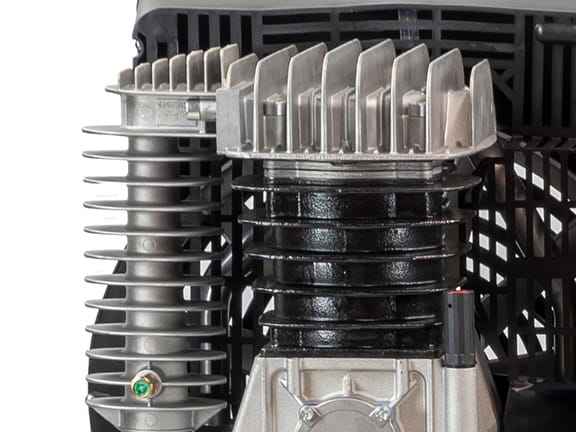
A single-stage pump draws the air in and compresses it to 10 bar in one go. A two-stage pump first compresses it in the first cylinder to an intermediate pressure, sends it through a finned intercooler, and only then does the second cylinder push it up to 11 bar — 15 in the high-pressure version. Work split in two means a lower air temperature at the outlet and less strain on the piston rings and the valves; that is why the two-stage pumps in the range turn up wherever the machine is expected to run for longer.
Pro Line has the single-stage A29B, A39 and A39B pumps, the two-stage A49B and four pumps of the B range: B59B, B60, B70 and B79. Besides the pressure, the practical difference is how long the machine keeps working between pauses and how quickly it fills the tank back up after a draw.
Five ranges that solve something extra
The same pumps, a different version. Each of these ranges answers one particular need — a lower speed, dry air, space in the workshop, peaks in demand, a higher pressure.
Low-speed B60, B70 and B79
When the machine cuts in over and over and has to last. The same pumps, turned more slowly by the pulley: the B60 and B70 run at 1,100 rpm, the biggest B79 at 900. Fewer revolutions mean fewer piston strokes a minute and a cooler pump; a displacement of 660, 1,023 or 1,130 l/min, a tank of 270 or 500 l.
8 machines · 4–7.5 kW · 660–1,130 l/min · 270–500 l
With a dryer on the tank
When no condensate may reach the pipework. The refrigerant dryer sits on the tank from the factory and holds a pressure dew point of +3 °C, so downstream of the machine there is nothing left to condense. Five machines with B59B, B60 and B70 pumps, a tank of 270 or 500 l, a direct-on-line start or a start through a star-delta starter panel.
5 machines · 4–7.5 kW · 653–1,210 l/min · 270–500 l
With a vertical tank
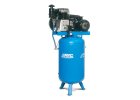
When floor space in the workshop is short. The tank stands on end with the pump on a plate above it: the smallest upright machine takes up 832 × 472 mm of floor. Neither the air nor the litres suffer for it, only the footprint changes. Seven machines with A39B, A49B, B59B and B60 pumps, a tank of 150 to 270 l.
7 machines · 2.2–5.5 kW · 393–827 l/min · 150–270 l
Tandems — two pump units
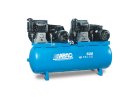
When the whole workshop must not stop because of one pump unit. Two identical pump units, each with its own motor, on one horizontal tank of 500 or 900 l. One of them handles the everyday demand, the second joins in after a moment for the peak; when you take one out for service, the workshop keeps its air. The two displacements add up to 1,306 to 2,420 l/min, at a pressure of 11 bar.
6 machines · 2 × 4 to 2 × 7.5 kW · 1,306–2,420 l/min · 500 and 900 l
At 15 bar
When ten bar at the nozzle is not enough. The B60 and B70 pumps geared down to 1,000 rpm, a 500 l tank rated for the higher pressure and a star-delta starter panel: 570 or 930 l/min at 15 bar. The only machine on wheels at this pressure is the ninety, the B59B-4-90CTH — for the tyre shop that travels to the customer; in the table below it belongs to the B59B, B60 and B70 range.
2 machines · 5.5 and 7.5 kW · 570 and 930 l/min · 500 l
Two ranges at a lower price
The same A29B, A39, A39B and A49B pumps — once turned more slowly by the pulley, once from the previous generation.
Pro Line Export
When a smaller displacement will do and the machine has to run from an ordinary socket. Four machines with A29B and A39B pumps for a 230 V socket, with the same moulded belt guard, aftercooler and regulator as the basic A ranges. The pulley turns them more slowly — 178 and 355 l/min at 750 and 950 rpm — and the tank is 50 or 90 l.
4 machines · 1.5 and 2.2 kW · 178 and 355 l/min · 50 and 90 l
Pro Line A-X — clearance
When an older generation at a lower price is no problem. Nine machines of the previous generation with A29B, A39, A39B and A49B pumps: 320 to 595 l/min, 10 or 11 bar, a tank of 50 to 270 l, 230 and 400 V. You know them by the wire belt guard in place of the moulded one.
9 machines · 2.2–4 kW · 320–595 l/min · 50–270 l
#showmore#
The pumps the range is built from
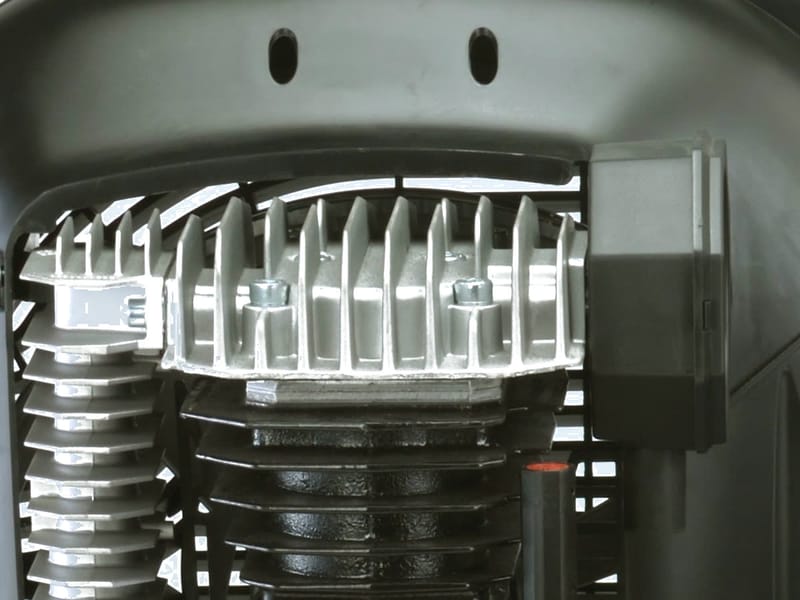
The range rests on eight pumps, and these six carry 89 of the 94 machines. The shape and the size of a pump give away how much air the machine will deliver: the A pumps have finned cylinders, the B59B, B60 and B70 pumps cylinders cast in iron.
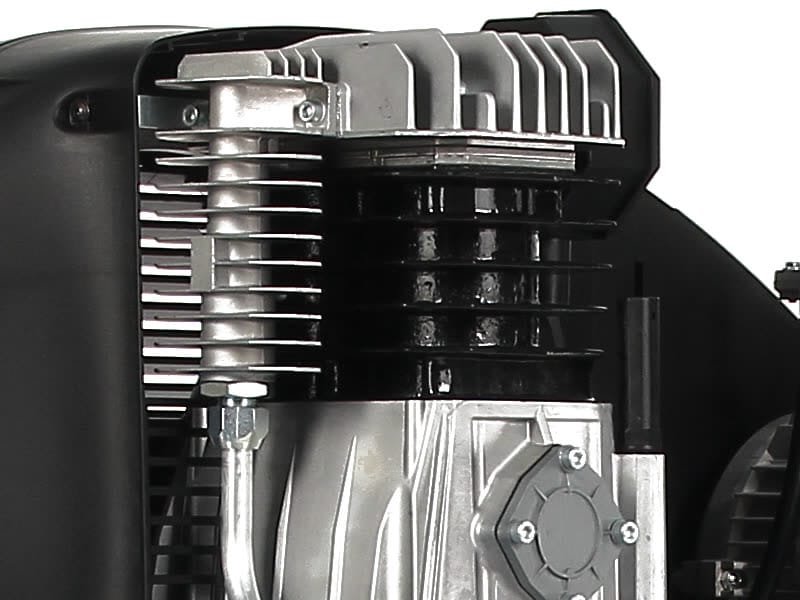
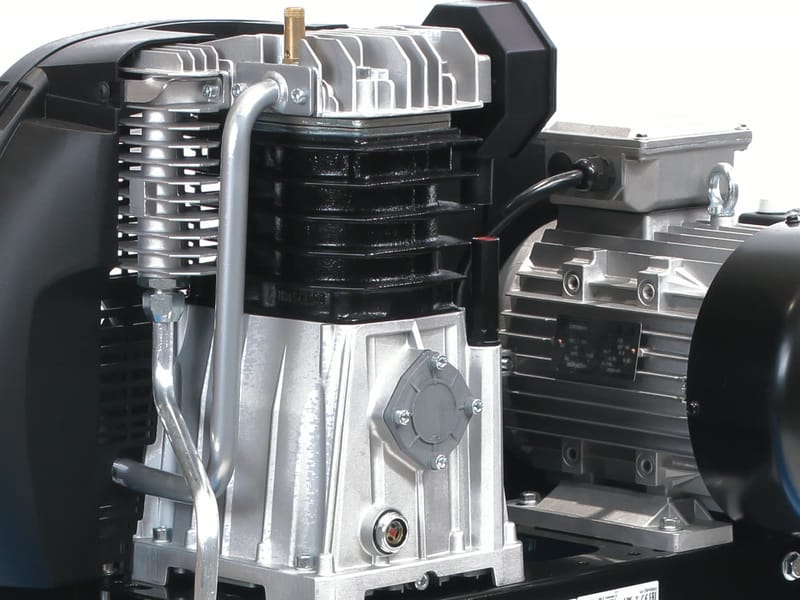
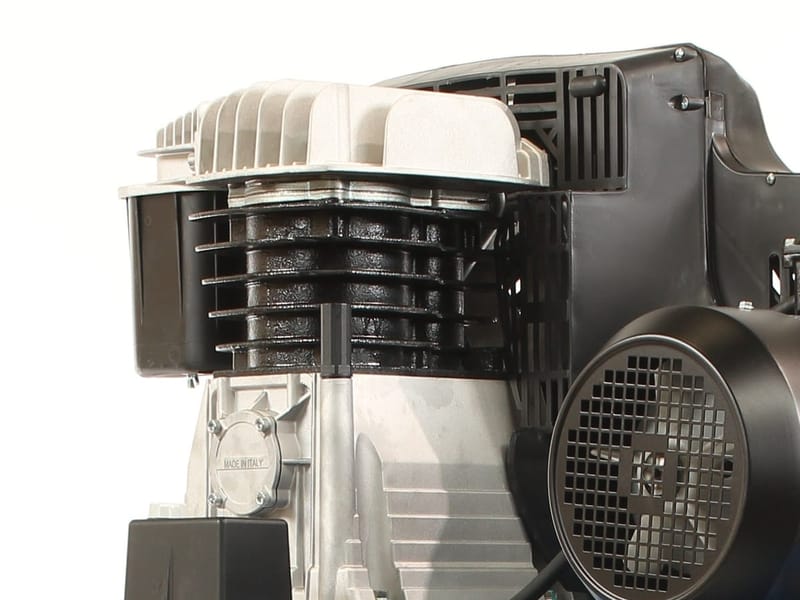
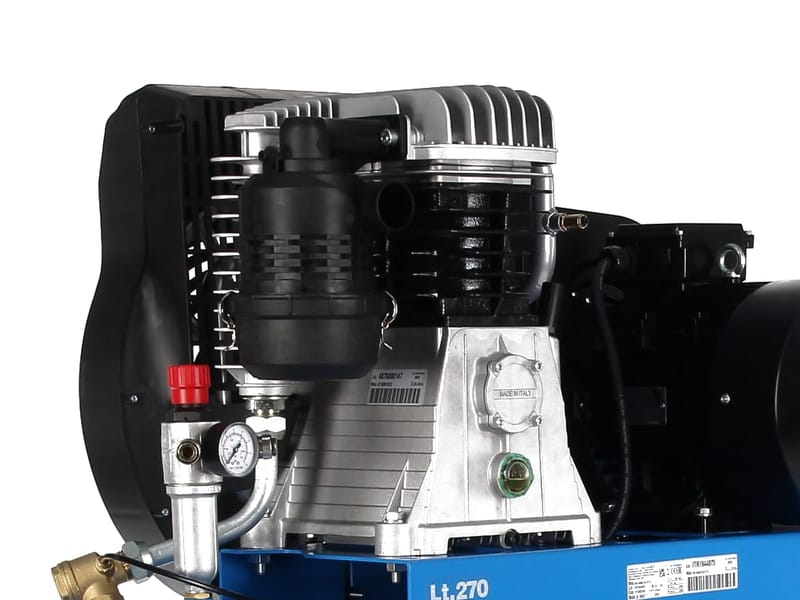
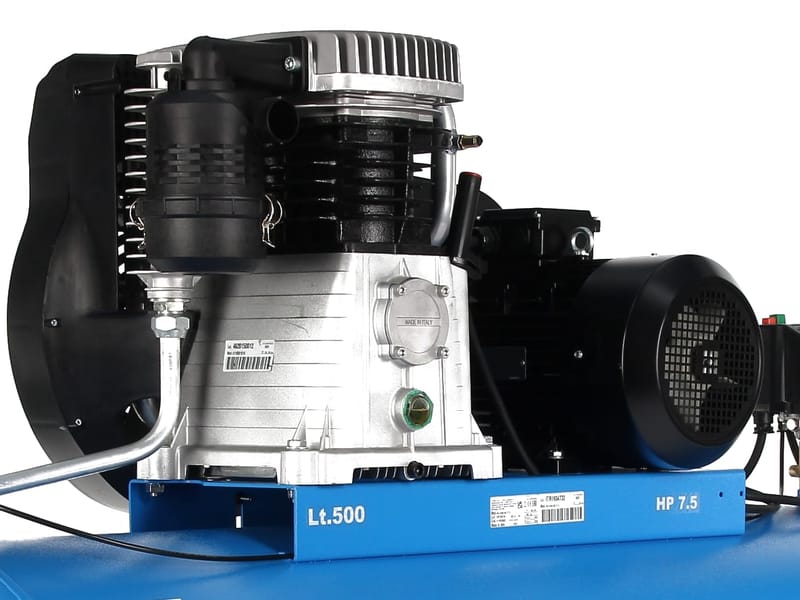
The eleven ranges side by side
| The eleven ranges side by side | ||||||||
|---|---|---|---|---|---|---|---|---|
| Range | Pump | Stages | Motor | Air displacement | Tank | Voltage | Version | Machines |
| Pro Line A29B | A29B | 1 | 1.5 and 2.2 kW | 255 and 320 l/min | 50–200 l | 230 and 400 V | on castors | 11 |
| Pro Line A39B | A39B | 1 | 2.2 and 3 kW | 393 and 486 l/min | 50–270 l | 230 and 400 V | on castors | 14 |
| Pro Line A49B | A49B | 2 | 2.2–4 kW | 444–595 l/min | 90–270 l | 230 and 400 V | on castors | 14 |
| Pro Line B59B, B60 and B70 | B59B, B60, B70 | 2 | 4–7.5 kW | 653–1,210 l/min | 90–500 l | 400 V | on castors or on feet | 14 |
| Low-speed B60, B70 and B79 | B60, B70, B79 | 2 | 4–7.5 kW | 660–1,130 l/min | 270–500 l | 400 V | on castors or on feet | 8 |
| With a dryer on the tank | B59B, B60, B70 | 2 | 4–7.5 kW | 653–1,210 l/min | 270–500 l | 400 V | on feet with a dryer | 5 |
| With a vertical tank | A39B, A49B, B59B, B60 | 1 and 2 | 2.2–5.5 kW | 393–827 l/min | 150–270 l | 230 and 400 V | vertical tank | 7 |
| Tandems — two pump units | 2 × B59B, B60 or B70 | 2 | 2 × 4 to 2 × 7.5 kW | 1,306–2,420 l/min | 500 and 900 l | 400 V | on feet | 6 |
| At 15 bar | B60, B70 | 2 | 5.5 and 7.5 kW | 570 and 930 l/min | 500 l | 400 V | on feet | 2 |
| Pro Line Export | A29B, A39B | 1 | 1.5 and 2.2 kW | 178 and 355 l/min | 50 and 90 l | 230 V | on castors | 4 |
| Pro Line A-X — clearance | A29B, A39, A39B, A49B | 1 and 2 | 2.2–4 kW | 320–595 l/min | 50–270 l | 230 and 400 V | on castors or on feet | 9 |
Air displacement is the amount of air the pump draws in per minute; less of it reaches the tool. For the tandems the figure given is the sum of both pump units. The pressure follows from the Stages column: a single-stage pump gives 10 bar, a two-stage one 11 — and only machines with the letter H in the code go to 15 bar. What the ranges share and where they part company is summed up in the cards below the table.
What the Pro Line ranges have in common — and where they differ
V-belt drive
The motor does not turn the pump directly, but through a pulley and V-belts. The reduction lets the pump turn more slowly than the motor — from 750 to 1,400 rpm according to the range — and the belt damps the shocks at the same time. A guard covers the pulley and the belts.
Oil-lubricated pump
All 94 machines have an oil-lubricated pump with a sight glass that shows the level. Maintenance comes down to watching that level and draining the condensate through the valve under the tank; every machine has its intervals in the manual. An aftercooler on the pump outlet is fitted to 88 of the 94 — it is missing only on part of the A-X clearance.
Extensive and Expert on the A ranges
Two spec levels, and they apply to only three of the eleven ranges — A29B, A39B and A49B. They differ in the chassis, the handle and what sits on the air outlet: against the Extensive, the Expert has one castor more, a handle closed all the way round and a filter after the regulator. Exactly what each level carries is set out on the pages of those three ranges; on the other eight it is the version or the pump that decides, not the spec.
Supply and motor starting
Machines with a 1.5 or 2.2 kW motor run from an ordinary 230 V socket; from 3 kW upwards the motor is always three-phase on 400 V and the supply is wired in by a qualified electrician. Some of the machines with the strongest motors take an X at the end of the code — a starter panel with a star-delta start, with which the motor runs up at a lower current.
Service and warranty
We give two years' warranty on the machines, extendable to three for a surcharge, and ten years on the tank against rusting through. The AirTube QR code on the machine itself opens the manuals and the service videos. We service the ABAC brand in our own workshop — in and out of warranty, with original parts and service kits for the pumps.
Ventilek advises
In Pro Line you do not choose by the litres of the tank, but by the pump — that is what decides how much air a minute the machine really gives. The tank is only a reserve for the peaks: when the pump cannot keep up, a bigger tank does not put it right, it merely postpones the moment. Add up the consumption of the tools that will run at the same time, allow a reserve on top of it, and only then pick the litres. And the noise? A machine without a sound-insulated enclosure has a sound power level of 91 to 105 dB — not a thing for the office next to the workshop.
Frequently asked questions
- How does Pro Line differ from the Line, Silent, Zero and Super Silent OS ranges?
- Pro Line has V-belt drive and an oil-lubricated pump — from 1.5 to 7.5 kW, with one stage or with two. The lighter machines, on which the pump sits straight on the motor, run only from a 230 V socket and stop at 2.2 kW; they belong to the direct-drive Line range. Zero machines are oil-free, belt-driven as well, for air without a drop of oil. Super Silent OS are small oil-free direct-drive machines whose low noise comes from the way the pump is built, not from an enclosure. Anyone who needs a machine inside a sound-insulated enclosure looks to the Silent range.
- When is a single-stage pump enough and when do you need a two-stage one?
- Up to 10 bar and for work with breaks a single-stage pump will do: the A29B, A39 or A39B. As soon as the tool needs more than eight bar at the nozzle, the job runs longer at a stretch or the air is drawn in large volumes, reach for the two-stage A49B or for the B range. All the two-stage machines in one place are to be found among the two-stage piston compressors.
- What do Extensive and Expert mean, and which machines does it apply to?
- They are two spec levels for the A29B, A39B and A49B pumps; in the machine code they are carried by the letters BT (Extensive) and BP (Expert) — the A39BT-2.2-150CM is therefore an Extensive, the A39BP-2.2-150CM an Expert of the same size. Both levels have an aftercooler and a regulator with two gauges; where they part company is summed up in the card above. On the B ranges the spec is not split this way — the version decides: CT on castors with a regulator, FT on feet, piped permanently into the pipework.
- Ten, eleven or fifteen bar — which pressure do I need?
- Ten bar is the tank pressure on the single-stage machines and it is ample for ordinary air tools, because the air reaches them through a regulator set to six to eight bar. Eleven bar comes from the two-stage pumps and suits a long pipe run or air drawn in large volumes. Fifteen bar is wanted only by tools and processes that need more than ten bar right at the nozzle — machines at that pressure carry the letter H in the code.
- On 230 V, or on 400 V?
- The ceiling for an ordinary socket in Pro Line is 444 l/min: single-phase means only the 1.5 and 2.2 kW motors, and more air than that one phase will not give you. From 3 kW upwards there is no option other than a three-phase supply, and that wants its own protection and a short, heavy-gauge cable — so talk the compressor socket over with an electrician before we deliver the machine. Which range runs on which voltage is shown by the column in the table above; anyone without 400 V in the workshop chooses across brands among the 230 V compressors.
- Which Pro Line for a garage or a tyre shop?
- For a smaller garage with one workstation the A39B or the A49B with a tank of 150 to 270 l is enough. Where a tyre shop is busy all day and two people are on the tools, it starts with the cast-iron B59B and B60 pumps and a tank of 270 or 500 l. A mobile service takes a machine on castors, the version on feet belongs in the hall. What else goes with it is set out in our article on choosing a compressor for the workshop.
- When is a machine with a dryer worth it and when will a separator do?
- Five machines of the ninety-four have a dryer on the tank, and it deals with the moisture before the air leaves for the pipework — worth having in a paint shop, for sandblasting, or where the pipes run through a cold hall. Where you spray only now and then, a separator with a filter at the workstation and regular draining of the condensate will do. Separate dryers to go with any machine are to be found among the air dryers.
- What does a code like A39BP-2.2-200CT or B60-5.5-500FTXH mean?
- The first part is the pump (A39B, B60), then comes the motor power in kilowatts and the volume of the tank in litres. The last letters give the version: C means castors, F feet, V a vertical tank, T a three-phase motor on 400 V and M a single-phase one on 230 V. An X at the end of the code means a star-delta starter panel, D a dryer on the tank and H a pressure of 15 bar; an X straight after the pump (A49BX) is, on the contrary, the mark of the A-X clearance generation. P and T on the A ranges tell an Expert from an Extensive.
Where next if Pro Line is not the right fit
Pro Line is a belt-driven, oil-lubricated range for work with breaks. If you need air without oil, running without a break for a whole shift, or, the other way round, a machine a class lower, the alternatives are just below. You will find the whole range, with filters by power, tank and voltage, among all compressors.
- the oil-free ABAC Expert Zero range — The same belt drive, but a pump without oil — 255 to 486 l/min, 10 bar, 50 to 270 l.
- the quiet oil-free Super Silent OS — Small oil-free machines with direct drive and two pistons, 140 to 230 l/min, a tank of 6 to 50 l.
- industrial ABAC Tech machines — Piston machines built for running without pauses, also in versions for 15, 20 and 30 bar.
- screw compressors — When the air has to flow steadily for a whole shift and a piston machine is no longer enough.
- semi-professional workshop compressors — Piston machines for the workshop, the garage and the demanding DIYer, across brands.
- the whole range of the ABAC brand — All the ABAC ranges in one place, from the suitcase to the screw compressor.
The figures apply at 50 Hz; on the pages of the individual ranges you will find them machine by machine. Air displacement is the volume the pump draws in; less of it gets through to the tool. Noise across the range runs from 91 to 105 dB of sound power, that is, 71 to 85 dB at four metres from the machine. No Pro Line range is built for running without pauses — every one of them allows for cycles and for the breaks in between.
-
 Pro Line A-X compressors; clearance, V-belt drive, 2.2 to 4 kW
-
Pro Line Export; A29BE and A39BE, 230 V, price / quality / output
-
Pro Line Extensive / Expert; A29B, 1.5 and 2.2 kW
-
Pro Line Extensive / Expert; A39B, 2.2 and 3 kW
-
Pro Line Extensive / Expert; A49B, 11 bar, 2.2–4 kW
-
Pro Line B59B / B60 / B70; 11 bar, 4–7.5 kW
-
Low-speed B60-4 / B70-5.5 / B79-7.5; 11 bar
-
Pro Line B59B / B60 / B70 with a dryer; 11 bar
-
Pro Line with a vertical tank; 150–270 l
-
Pro Line tandem B59B–B70; 500 and 900 l
-
Pro Line B 15 bar; B59B–B70, 90 and 500 l
.jpg)
Bestsellers


Product sorting
List of products

The only machine in the range for a 230 V socket: A29B pump with 2.2 kW, 320 l/min at 1,300 rpm, 10 bar, 50 l tank on castors, 58 kg. Regulator, two gauges, DN 7.2 quick...

The most powerful single-stage machine in the range: A39B with 3 kW on 400 V, 486 l/min at 1,300 rpm, 10 bar, 90 l tank on castors, 94 kg. Regulator, two gauges, DN 7.2 quick...


A hundred on 400 V: A39 pump with 2.2 kW, 393 l/min at 1,050 rpm, 10 bar, 100 l tank on castors, 70 kg. Outlet via regulator and DN 7.2 quick coupling, two gauges; 93 dB Lwa and...

50 l oil-lubricated compressor for the garage and smaller workshop: 1.8 kW L25P pump from an ordinary socket, 270 l/min, 10 bar, horizontal 50 l tank, 36 kg on wheels....

50 l oil-lubricated compressor with the L30P pump: 2.2 kW from an ordinary socket, 310 l/min, 10 bar, horizontal 50 l tank, 37 kg on wheels. Regulator, two gauges, DN 7.2 quick...


The lightest machine in the range, 55 kg: A29B pump with 1.5 kW on 230 V, 178 l/min at 750 rpm, 10 bar, 50 l tank on castors. Aftercooler, regulator, two gauges, DN 7.2 quick...


Two-stage A49B pump with 2.2 kW on 400 V: 444 l/min at 1,050 rpm, 11 bar, 150 l tank on castors, 114 kg. Intercooler, aftercooler, regulator, DN 7.2 quick coupling; 91 dB Lwa /...


The fifty with the A39B pump: 2.2 kW (3 hp) on 230 V, 355 l/min at 950 rpm, 10 bar, 67 kg on castors. Belt guard that guides the cooling air, aftercooler, DN 7.2 quick coupling;...

The A39B pump on the biggest tank in the range: 2.2 kW on 230 V, 355 l/min at 950 rpm, 10 bar, 90 l tank on castors, 80 kg. Reserve for longer bursts, aftercooler, regulator; 95...


The ninety with the A29B pump: 1.5 kW on 230 V, 178 l/min at 750 rpm, 10 bar, 69 kg on castors. In stock; moulded belt guard, aftercooler, regulator; noise 93 dB Lwa and 73 dB...


No longer supplied, available on request: a single-phase 150 with the A39 pump, 2.2 kW on 230 V, 393 l/min, 10 bar, 150 l, 103 kg. Today the range offers a belt-driven 150 as...


24 l oil-lubricated compressor with the stronger L30P pump: 2.2 kW from an ordinary socket, 310 l/min, 10 bar, horizontal 24 l tank, 29 kg on wheels. Regulator, two gauges, DN...

The most air in the range on castors: two-stage A49B with 4 kW, 400 V, 595 l/min at 1,400 rpm, 11 bar, 90 l tank, 118 kg. Intercooler, aftercooler, DN 7.2 quick coupling; 95 dB...