
Pro Line A39BP, A49BP, B59B and B60 compressors with a vertical tank — the same pumps, a smaller footprint
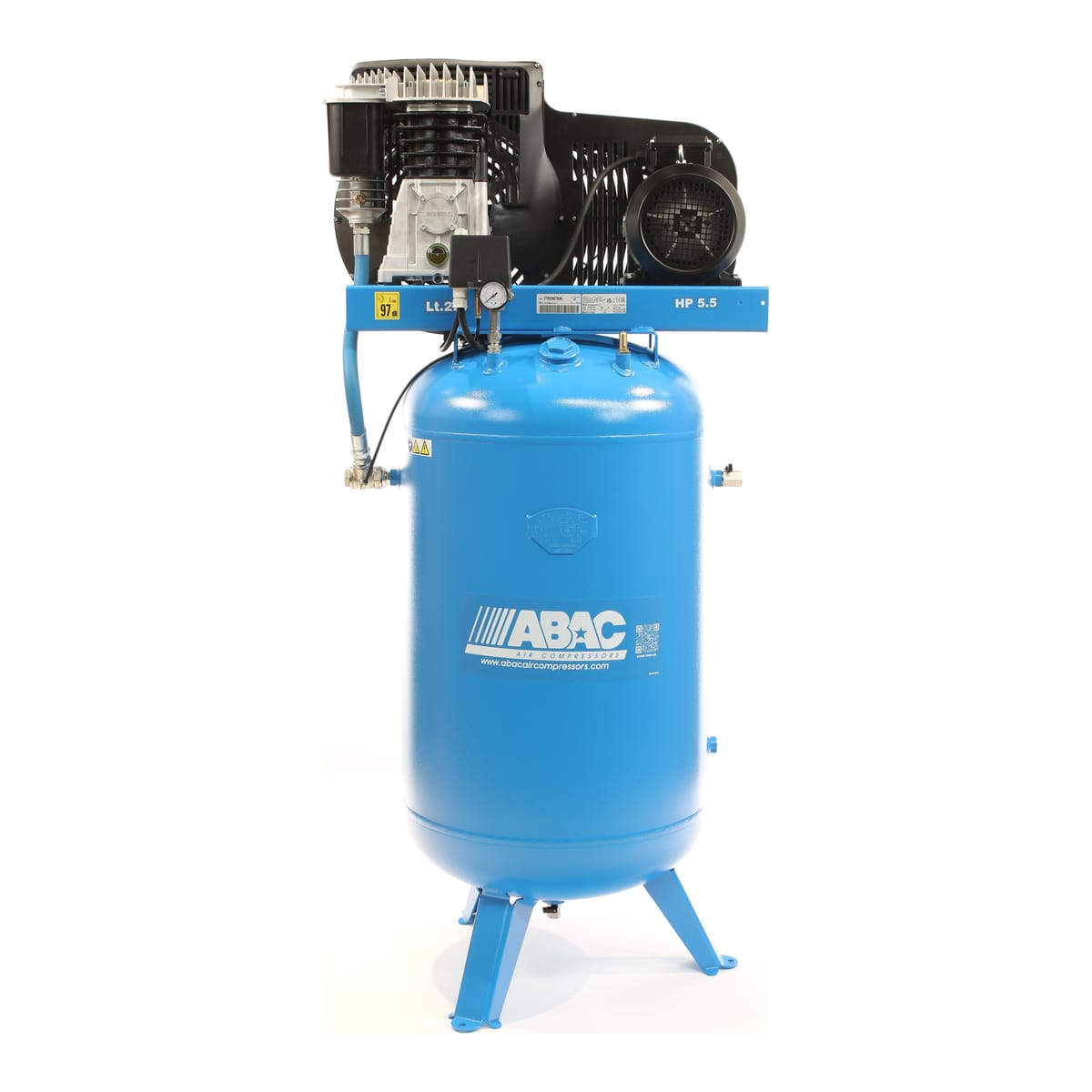 A39BP, A49BP, B59B and B60 · vertical tank · 150–270 l · 230 / 400 V
Seven vertical — or upright — ABAC compressors, where the tank stands on end and the pump sits on a plate above it: the single-stage A39B on 150 l, the two-stage A49B on 270 l, the cast-iron two-stage B59B on 200 or 270 l and the B60 on 270 l. In the workshop the machine takes up a footprint of 832 × 472 mm (A39BP), 830 × 644 mm (A49BP) or 850 × 970 mm (B) instead of the 1.4 to 1.6 m length of the horizontal version — and yet it has the same pump, the same displacement and the same tank volume as its siblings on castors and on feet. Displacement of 393 to 827 l/min; the A39BP-2.2-150VM and A49BP-2.2-270VM run from an ordinary 230 V socket (VM), the others on 400 V (VT); 10 bar on the single-stage A39BP-2.2-150VM, 11 bar on the six two-stage machines. We service the ABAC brand.
Which vertical machine — pump, tank and socket
The vertical tank is common to all seven; you choose by how much air the pump has to deliver, how big a reserve the tank should hold and whether your workshop has 230 or 400 V.
A39B: 393, A49B: 444–595, B59B: 653, or B60: 827 l/min
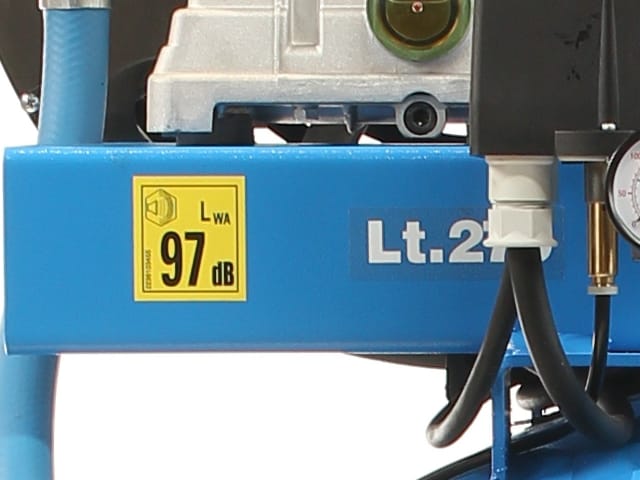
The same four pumps as in the horizontal ranges. The single-stage A39B with a 2.2 kW (3 hp) motor draws in 393 l/min at 1,050 rpm and fills the tank to 10 bar. The two-stage A49B with an intercooler gives 444 l/min with 2.2 kW at 1,050 rpm, 553 l/min with 3 kW at 1,300 rpm and 595 l/min with 4 kW at 1,400 rpm, always to 11 bar. The cast-iron two-stage B59B (4 kW, 653 l/min) and B60 (5.5 kW, 827 l/min) pumps run at 1,400 rpm and also fill to 11 bar. Noise 93 to 97 dB Lwa and 73 to 77 dB at 4 m on the A machines and the B59B, 102 dB Lwa and 82 dB at 4 m on the B60.
A 150, 200 or 270 l tank
The tank does not add displacement, it only extends the time the tool draws air before the motor cuts in. We carry 150 l only on the A39BP-2.2-150VM for blowing off and smaller spraying jobs; 200 l only on the B59B-4-200VT for a tyre shop with an impact wrench; 270 l on the three A49BP machines, the B59B-4-270VT and the B60-5.5-270VT, where a sander, a gun or two people on the tools draw air for long stretches. The bigger the tank, the taller the machine — with 270 l allow for a height of over two metres on the B range and 1.7 m on the A49BP.
VM on 230 V, or VT on 400 V
VM is a single-phase machine for an ordinary 230 V socket: the A39BP-2.2-150VM and A49BP-2.2-270VM, both with a 2.2 kW motor. VT is a three-phase machine on 400 V: the A49BP-3-270VT, A49BP-4-270VT, B59B-4-200VT, B59B-4-270VT and B60-5.5-270VT. If your workshop has only one phase, you choose between the two VMs; if you have a three-phase supply, you go by displacement.
Seven machines side by side
| Pro Line A39BP, A49BP, B59B and B60 with a vertical tank — seven ABAC machines, 150 to 270 l | ||||||||
|---|---|---|---|---|---|---|---|---|
| Model | Voltage | Tank | Pressure | Motor power | Air displacement | Speed | Noise Lwa / at 4 m | Weight |
| A39BP-2.2-150VM | 230 V | 150 l | 10 bar | 2.2 kW (3 hp) | 393 l/min | 1,050 rpm | 95 / 75 dB | 120 kg |
| A49BP-2.2-270VM | 230 V | 270 l | 11 bar | 2.2 kW (3 hp) | 444 l/min | 1,050 rpm | 93 / 73 dB | 161 kg |
| A49BP-3-270VT | 400 V | 270 l | 11 bar | 3 kW (4 hp) | 553 l/min | 1,300 rpm | 96 / 76 dB | 166 kg |
| A49BP-4-270VT | 400 V | 270 l | 11 bar | 4 kW (5.5 hp) | 595 l/min | 1,400 rpm | 97 / 77 dB | 168 kg |
| B59B-4-200VT | 400 V | 200 l | 11 bar | 4 kW (5.5 hp) | 653 l/min | 1,400 rpm | 97 / 77 dB | 205 kg |
| B59B-4-270VT | 400 V | 270 l | 11 bar | 4 kW (5.5 hp) | 653 l/min | 1,400 rpm | 97 / 77 dB | 210 kg |
| B60-5.5-270VT | 400 V | 270 l | 11 bar | 5.5 kW (7.5 hp) | 827 l/min | 1,400 rpm | 102 / 82 dB | 242 kg |
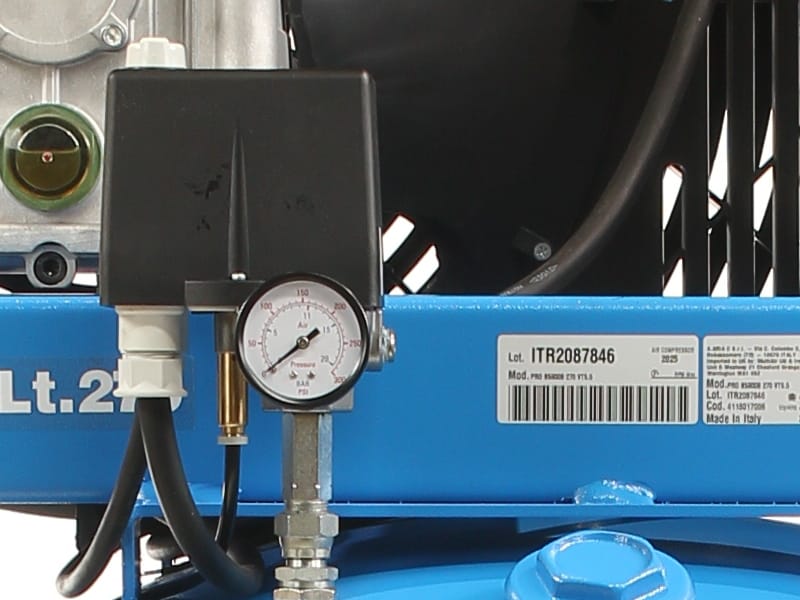
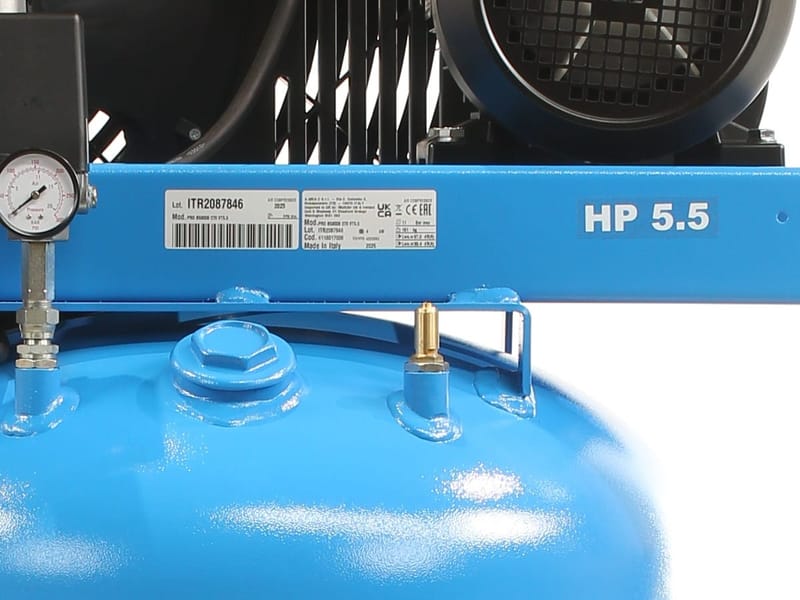
All of them: a vertical tank on three legs, an oil-lubricated pump with an oil sight glass on the plate above the tank, V-belt drive under a belt guard, an aftercooler on the pump outlet, an electric motor with thermal overload protection, a pressure switch with a gauge, the air outlet through a ball valve into the pipework, a condensate drain valve in the bottom of the tank. A39BP: single-stage A39B pump, 10 bar. A49BP, B59B and B60: two-stage pumps with an intercooler, 11 bar; the B59B and B60 with cast-iron cylinders. Noise: the first figure is the sound power level Lwa, the second the sound pressure at 4 m from the machine. The same pumps on horizontal tanks have their own categories — the links are further down.
#showmore#
Vertical, or horizontal — the same pump, a different tank
The vertical machines have no pump or displacement of their own: we also carry the A39B, A49B, B59B and B60 on horizontal tanks on castors or on feet. The difference is in how much floor the machine takes up, where its outlet is and whether it can be wheeled around the workshop.
Footprint instead of length
A horizontal 270 l tank stretches the machine to a metre and a half — 1,495 × 588 mm on the A49BP-4-270CT, 1,575 × 680 mm on the B59B-4-270FT. The vertical version with the same pump and the same tank volume stands on 830 × 644 mm (A49BP-4-270VT) or 850 × 970 mm (B59B-4-270VT) — in the corner of the workshop, behind the door, next to the racking. You pay for it in height: 1,714 mm on all three A49BP machines, 2,050 mm on the B59B-4-200VT and 2,100 mm on the B59B-4-270VT and B60-5.5-270VT.
Outlet through a ball valve, no castors and no regulator
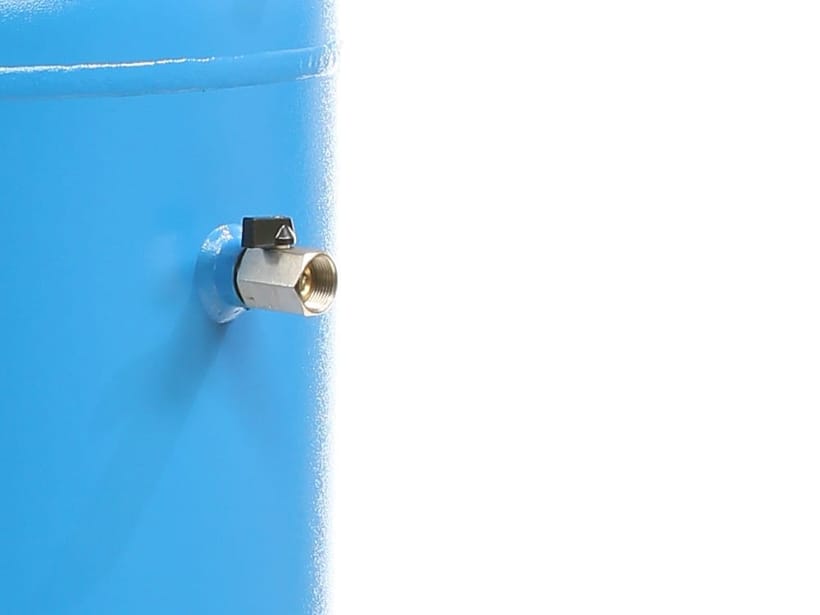
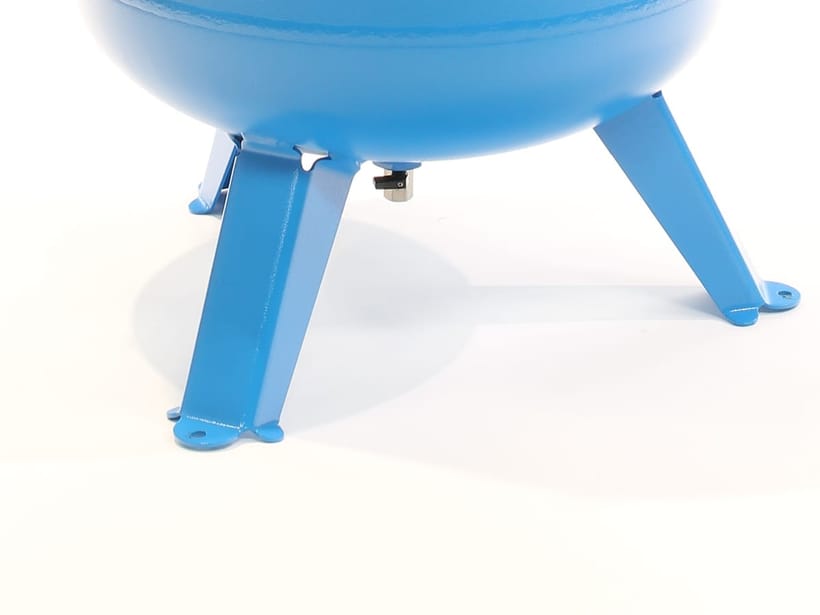
A vertical machine stays where it is: it has no castors or handle and no regulator with quick couplings on the tank. The air leaves through a ball valve on the side of the tank into the pipework or a hose; the regulator with a filter belongs at the workstation, where everyone sets their own pressure. The pressure switch with a gauge monitors the pressure in the tank; the condensate is drained through a valve in the bottom of the tank between the legs.
When to go horizontal instead
If you move the machine around the workshop to wherever the work is, take the version on castors with a handle and a regulator with two quick couplings — say the B59B-4-270CT. And everything that has no vertical version here we carry horizontal only: 500 l tanks, machines with a dryer, 15 bar, low-speed versions, tandems and the B70 pump.
Pump on a plate, tank on end — what is inside
Single-stage A39B, two-stage A49B, B59B and B60
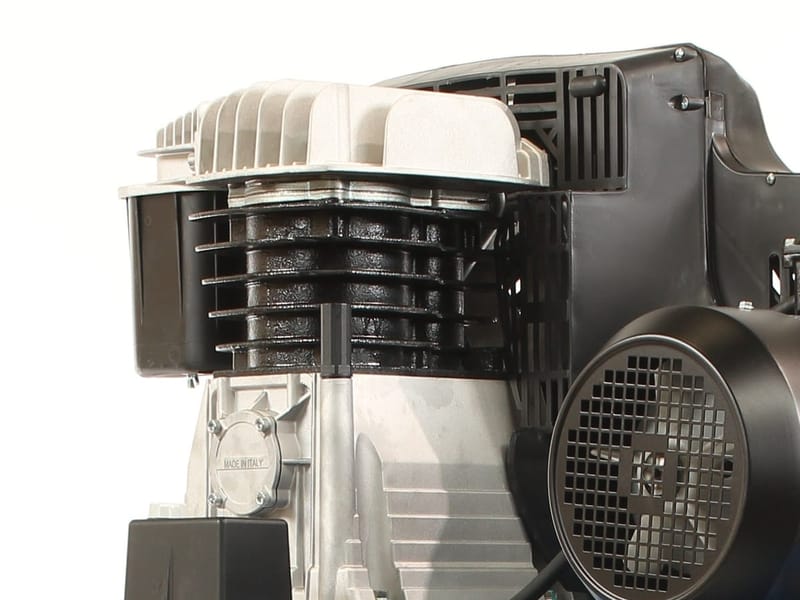
The A39B compresses the air in one stage to 10 bar — a simpler pump for lighter demand. The A49B, B59B and B60 work in two stages: the first cylinder compresses the air to an intermediate pressure, the air passes through the intercooler — a finned tube between the cylinders — and the second, smaller cylinder takes it up to 11 bar. The B59B and B60 have cylinders cast in iron for long runs under load.
A tank on end and three legs
The 150, 200 or 270 l tank stands on three legs with holes for bolting down; the pump and motor sit on a plate on the top end of the tank. The centre of gravity is high, so the machine belongs on a level floor and against a wall or in a corner, not where pallets are being handled around it.
Belts, guard and aftercooler
The motor drives the pump through V-belts geared down to 1,050, 1,300 or 1,400 rpm; the belts run under a belt guard. The compressed air leaves the pump through the finned tube of the aftercooler, cools down, and the first of the condensate drops out in the tank. You replace the belt and the intake filter without opening up the pump.
Switch, outlet and condensate
The pressure switch with a gauge starts and stops the motor according to the pressure in the tank; the motor has thermal overload protection. The air outlet is a ball valve on the side of the tank; the condensate is drained by a valve in the bottom of the tank between the legs; the gauge on the switch shows the pressure in the tank, while the pressure for the tools is set downstream in the pipework.
Oil, filter and service
The pump is lubricated with oil from the crankcase, with an oil sight glass; you check the level by eye and change the oil and clean the intake filter as per the manual. The AirTube QR code on the tank opens service videos. We carry the A39B, A49B, B59B and B60 pumps and the service kits as separate items.
Equipment, operation and maintenance
What you get with every machine
- A39B pump (single-stage), or A49B, B59B or B60 (two-stage with an intercooler; the B59B and B60 with cast-iron cylinders), oil-lubricated, with an oil sight glass; V-belt drive under a belt guard
- 2.2 to 5.5 kW electric motor with thermal overload protection — single-phase 230 V on the VM, three-phase 400 V on the VT; automatic stop/start pressure switch with a gauge
- Aftercooler on the pump outlet
- Vertical 150, 200 or 270 l tank on three legs with holes for bolting down, condensate drain valve in the bottom
- Air outlet through a ball valve on the side of the tank into the pipework or a hose
- AirTube QR code on the tank opens service videos
- 2-year warranty, 10 years on the tank against rusting through; extension to 3 years for a 5% surcharge
Four pumps, three tanks
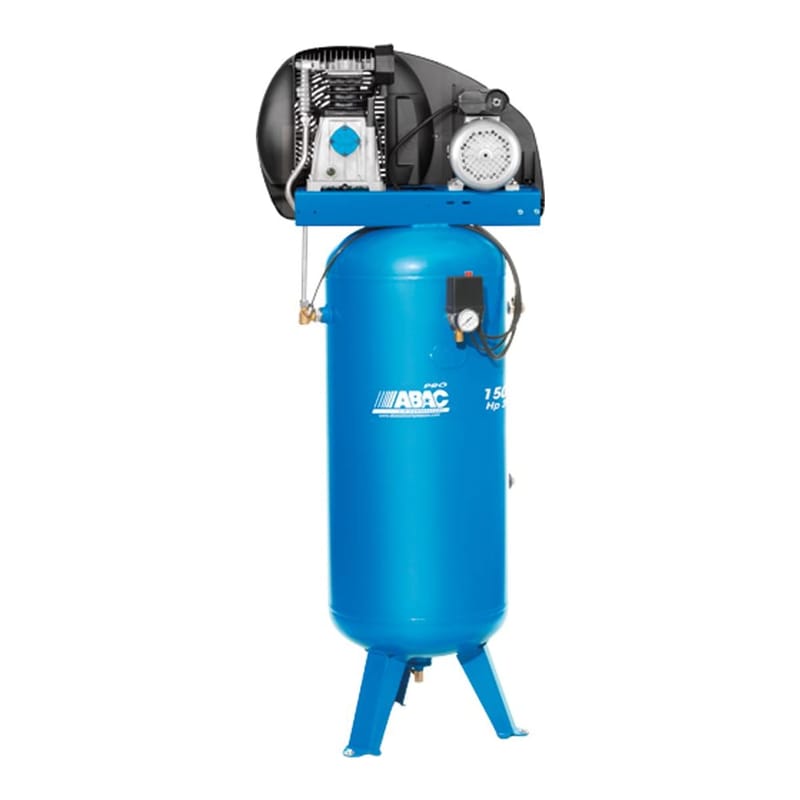
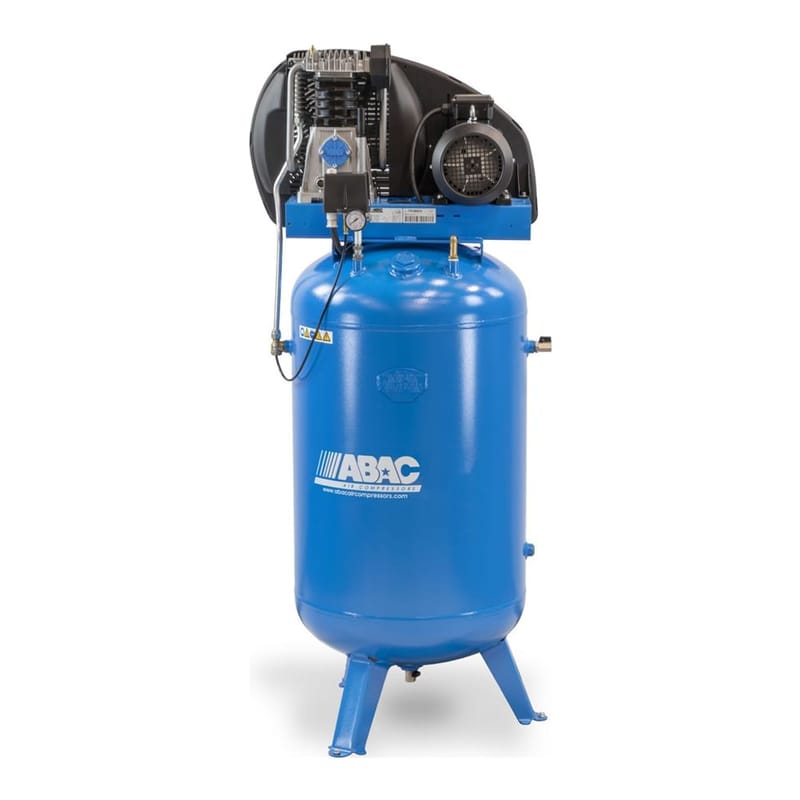
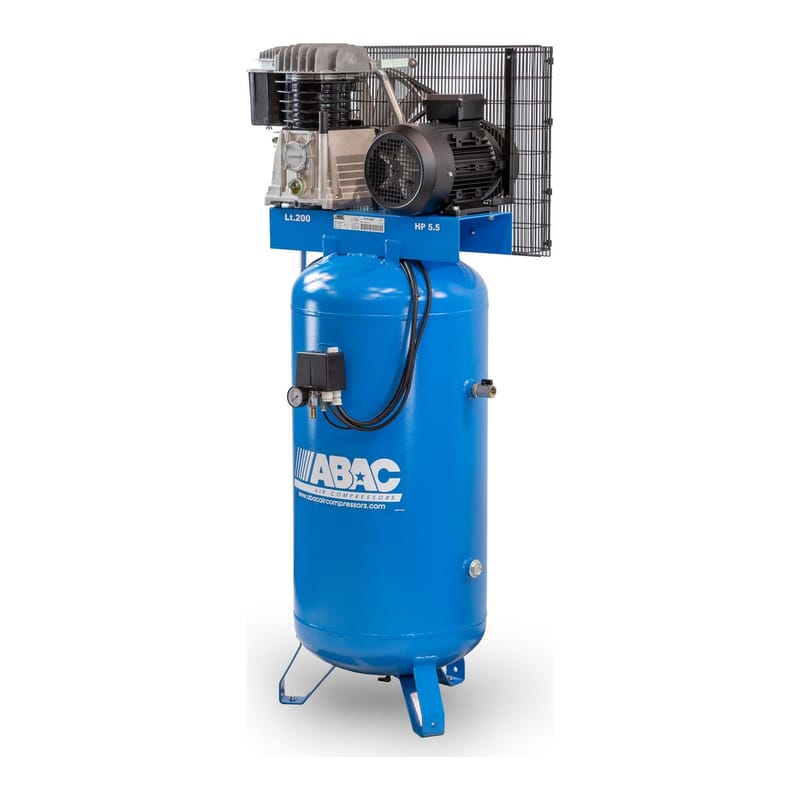
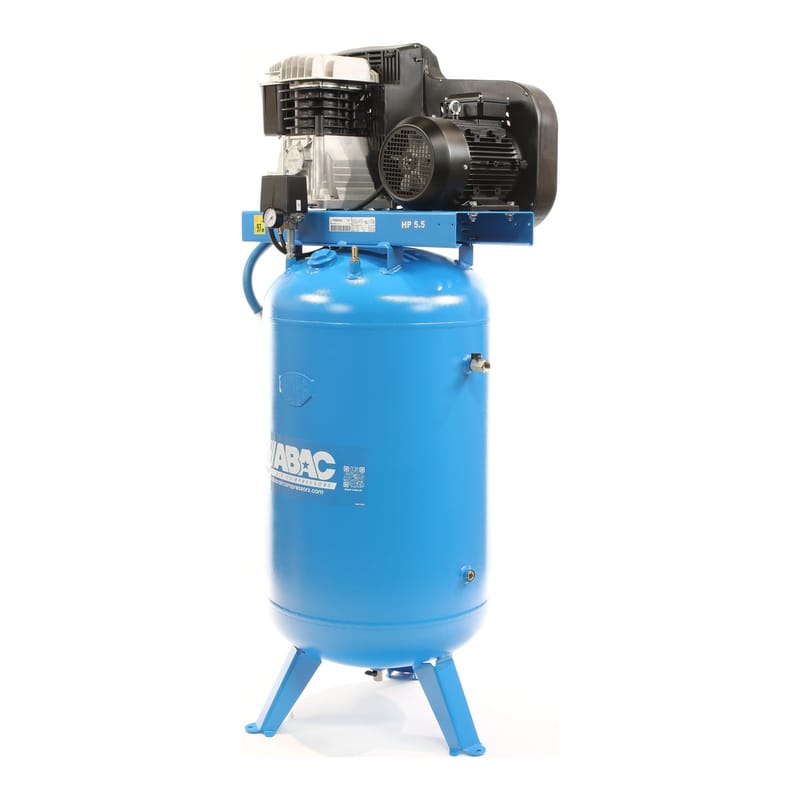
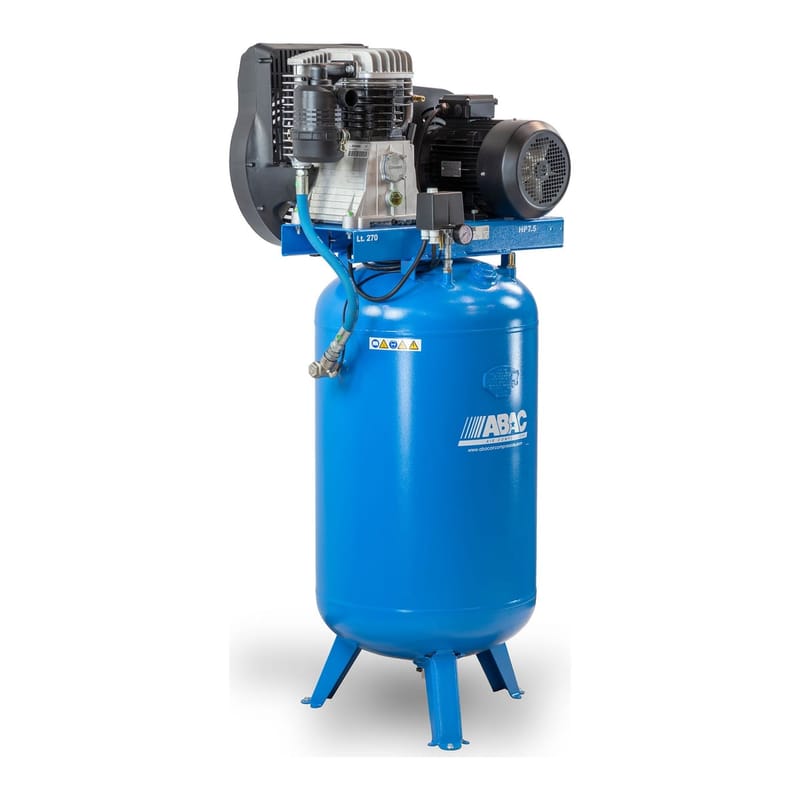
Machine details (B59B-4-270VT)
Where a vertical tank pays off
Tyre shop and garage in the corner of the hall
An impact wrench and tyre inflation at two lifts draw air in bursts: the B59B-4-200VT or B59B-4-270VT with 653 l/min and a vertical tank stands in the corner next to the compressor room and the air goes to the hoses through the pipework. Where there are more lifts and a grinder runs all afternoon, the B60-5.5-270VT gives 827 l/min from the same footprint.
Paint shop and joinery short of space
A spray gun and a sander need a reserve, not pressure: the A49BP-4-270VT with 595 l/min and 270 l at 11 bar fits behind the booth door; a joinery where the sander and the gun take turns is fine with the A49BP-3-270VT and its 553 l/min. Upstream of the gun goes a regulator with a filter, which catches the oil and water from the pipework.
Garage and trade workshop on 230 V
If you have only one phase, take the A39BP-2.2-150VM for blowing off, tyre inflation and smaller spraying jobs, or the A49BP-2.2-270VM when a sander or a gun is added — both for an ordinary socket, both on the footprint of the tank rather than its length.
Accessories and service
A vertical machine has only a ball valve on the tank; the regulator with a filter, the hoses and the quick couplings belong at the workstation. ABAC belongs to the Atlas Copco group and is one of the brands we repair in our own service workshop; we carry the A39B, A49B, B59B and B60 pumps and the service kits as separate items.
- pressure regulator with a filter — A regulator with a filter at every workstation — it sets the pressure and catches oil and water from the pipework.
- spiral hoses — Hoses from the ball valve or the pipework to the tool, with DN 7.2 quick couplings.
- impact wrenches — Impact wrenches for the lift — tools that get by on air in bursts from a vertical tank.
- spray guns — HVLP and LVLP guns for the A49BP and B59B in the paint shop.
- A39B compressor pump — Replacement pump for the A39BP-2.2-150VM.
- A49B compressor pump — Replacement pump for the three A49BP machines in the table.
- B59B compressor pump — Replacement pump for the B59B-4-200VT and B59B-4-270VT.
- B60 compressor pump — Replacement pump for the B60-5.5-270VT.
- A49-PK1 service kit — Valve plate, gaskets and an intake filter for a major service of the A49B pump; the oil is bought separately.
- B59-PK1 service kit — The same set of parts for the B59B pump.
- B60-PK1 service kit — The same set of parts for the B60 pump.
- ABAC compressor service — Warranty and post-warranty repairs of ABAC machines in our workshop; belt, filter and oil replacement.
Where next if a vertical machine is not the right fit
The vertical machines are the A39B, A49B, B59B and B60 pumps on a tank standing on end. If you want the same pump on castors or on feet, a bigger tank, a dryer, 15 bar, lower speed or two pumps, ABAC has the horizontal siblings; vertical machines of other brands are in the parameter categories further down. You will find the whole range, with filters by output, tank and voltage, among all compressors.
- horizontal B59B, B60 and B70 compressors — The same cast-iron B59B and B60 pumps on horizontal 90 to 500 l tanks, plus the B70 with 1,210 l/min.
- horizontal A49BP and A49BT compressors — The A49B pump on horizontal 90 to 270 l tanks, on castors, also on 230 V.
- horizontal A39BP and A39BT compressors — The single-stage A39B pump on horizontal 50 to 270 l tanks.
- vertical compressors of all brands — Machines with a vertical tank across brands — piston and screw.
- stationary compressors — Machines on feet and legs across brands.
- compressors with a 270 l tank — 270-litre machines across brands — the tank of five of the seven vertical machines.
- compressors with a 150 l tank — 150-litre machines across brands — the tank of the A39BP-2.2-150VM.
- 230 V compressors — Single-phase machines of all brands — both VM machines belong here.
- two-stage compressors — Two-stage machines across brands — six of the seven vertical ones.
- low-speed B60-4, B70-5.5 and B79-7.5 compressors — The B60 and B70 pumps with a smaller motor at 1,100 rpm and the B79 at 900 rpm — on horizontal tanks only.
- compressors with a dryer — Horizontal B59B, B60 and B70 with a refrigerant dryer on the tank — ABAC does not offer a vertical one with a dryer.
- B60 and B70 compressors at 15 bar — The B60 and B70 with a horizontal 500 l tank at 15 bar.
- tandem compressors — Two pumps on one horizontal tank for an operation where one pump is not enough.
- sound-insulated ABAC Silent compressors — The A39B, A49B, B59B and B60 pumps in a sound-insulated cabinet for running next to the workstation.
- screw compressors — For a draw without pauses for the whole hall, where the piston machine reaches its limit.
Ventilek advises
You buy a vertical machine for the floor, not for the air — it gives exactly as much air as its horizontal sibling with the same pump. For the corner of a tyre shop I take the B59B-4-270VT, for a paint shop with one booth the A49BP-4-270VT, for a garage on a socket the A39BP-2.2-150VM. If you need to wheel the machine around the workshop, want 500 l, a dryer or 15 bar, go to the horizontal ones.
Frequently asked questions
- How much room does a vertical compressor take up, and does it fit in the corner of the workshop?
- The footprint is 830 × 644 mm on the A49BP-2.2-270VM, A49BP-3-270VT and A49BP-4-270VT, 832 × 472 mm on the A39BP-2.2-150VM and 850 × 970 mm on the B59B and B60 — under a square metre instead of the 1.4 to 1.6 m length of a horizontal machine. It fits in a corner; leave room around it for access to the switch, the intake filter and the outlet valve, and clearance above for its height of 1.7 m (A) to 2.1 m (B). How to set the machine up in the compressor room is described in our article on setting up a compressor.
- Vertical or upright compressor — is it the same thing?
- Yes, both mean a machine with the tank standing on end. But people searching for an “upright compressor” are often after small machines with a 24 to 100 l tank for the garage; those are not here — the smallest vertical machine of the Pro Line range has 150 l. A smaller upright machine on 230 V with a 50 l tank is what we carry as the V30-2.2-50VM.
- Is a 230 V socket enough?
- On two machines, yes: the A39BP-2.2-150VM and A49BP-2.2-270VM have a single-phase 2.2 kW motor for an ordinary socket (the letter M in the code). The other five have a three-phase 400 V motor (the letter T) and need a 400 V socket with a breaker rated for the 3, 4 or 5.5 kW motor. We carry the B range with a vertical tank on 400 V only.
- Single-stage A39B pump, or two-stage A49B, B59B and B60?
- The single-stage A39B fills to 10 bar and draws in 393 l/min — for blowing off, tyre inflation and smaller spraying jobs. The two-stage pumps compress the air in two cylinders with an intercooler, fill to 11 bar and give 444 to 827 l/min; they suit places where the tools draw air for long stretches and where you want a bigger reserve in the tank. Ten-bar machines of all brands are grouped together among 10 bar compressors.
- Why buy a vertical one when it has the same pump as the horizontal one?
- For the floor, not for the air: the displacement, the pressure and the tank volume are the same, but the vertical version takes up only the footprint of the tank, not its length. A horizontal machine makes sense if you want to wheel it around the workshop (castors, a handle, a regulator with quick couplings), or if you need 500 l, a dryer, 15 bar or a low-speed pump.
- How much air does the machine deliver?
- We quote the air displacement of the pump: 393 (A39B), 444, 553 or 595 (A49B with a 2.2, 3 and 4 kW motor), 653 (B59B) and 827 l/min (B60). How much air the tool gets depends on the pressure, on the tank and on how long it draws air at a stretch; a piston machine works in cycles of topping up and pausing, not continuously.
- Is it right for a tyre shop, a paint shop, a garage?
- For a tyre shop with impact wrenches and tyre inflation the B59B-4-200VT or B59B-4-270VT, with more lifts the B60-5.5-270VT. For a paint shop with one booth the A49BP-4-270VT or B59B-4-270VT with a regulator and filter upstream of the gun. For a trade workshop with 400 V, where sanding and spraying take turns, the A49BP-3-270VT; for a garage or workshop on a single phase the A39BP-2.2-150VM or A49BP-2.2-270VM.
- How loud are they?
- The A49BP-2.2-270VM 93 dB Lwa and 73 dB at 4 m, the A39BP-2.2-150VM 95 / 75 dB, the A49BP-3-270VT 96 / 76 dB, the A49BP-4-270VT, B59B-4-200VT and B59B-4-270VT 97 / 77 dB, the B60-5.5-270VT 102 / 82 dB. The vertical tank makes no difference to the noise — it is the noise of the pump and the motor; the machine belongs in the compressor room or in a corner, not next to the bench. If you need fewer decibels next to the workstation, ABAC has the same pumps in a sound-insulated cabinet in the Silent range.
- Can a vertical machine be moved?
- It is not built for it: it has no castors or handle, and with its high centre of gravity it is moved with a pallet truck or a forklift with the forks between the legs. The legs have holes for bolting down; stand the machine on anti-vibration pads rather than bolting it rigidly to the floor. If you need the machine at the tools here one day and there the next, take the horizontal version on castors.
- Is there a vertical machine with a dryer?
- Not in the Pro Line range — only the horizontal B59B, B60 and B70 (FTD, FTXD) have a refrigerant dryer on the tank. With a vertical machine the dryer is bought separately and plumbed into the pipework downstream of the tank; the dry air then goes to the workstations just as it does from a machine with a factory-fitted dryer.
- What does the code A49BP-4-270VT or B59B-4-200VT mean?
- The pump, the motor power in kW, the tank volume in litres and the version: V is a vertical tank, M a single-phase 230 V motor, T a three-phase 400 V motor. The letter P after A39B and A49B marks the Expert generation, just as on the horizontal siblings. So the B59B-4-200VT is the cast-iron B59B pump with 4 kW on a vertical 200 l tank on 400 V. An overview of all the ranges is in the ABAC PRO Line guide.
- What is the warranty and what does maintenance involve?
- Two years on the machine, an extension to three years for a 5% surcharge, and ten years on the tank against rusting through. Maintenance as per the manual: draining the condensate through the valve in the bottom of the tank, checking the oil level in the sight glass, changing the oil and cleaning the intake filter, checking the belt tension; for a major service we carry the A49-PK1, B59-PK1 and B60-PK1 service kits.
- Where do I find the service videos, and who does the servicing?
- On the tank there is an AirTube sticker with a QR code — scanned with a phone, it opens instructional and service videos for the pump. Repairs, belts, filters and oil are handled by our workshop; the other ranges, from the suitcase models to the screw compressors, are in the ABAC brand guide.
All values apply to a 50 Hz supply. Air displacement is the amount of air the pump draws in; how much of it reaches the tool depends on the pressure and the tank. Noise is given as the sound power level Lwa and the sound pressure at 4 m from the machine. The dimensions given are those of the machine without packaging. A piston compressor works in cycles (topping up the tank and pausing), not continuously.


