
Pro Line B59B, B60 and B70 compressors with a dryer — dry air from one machine
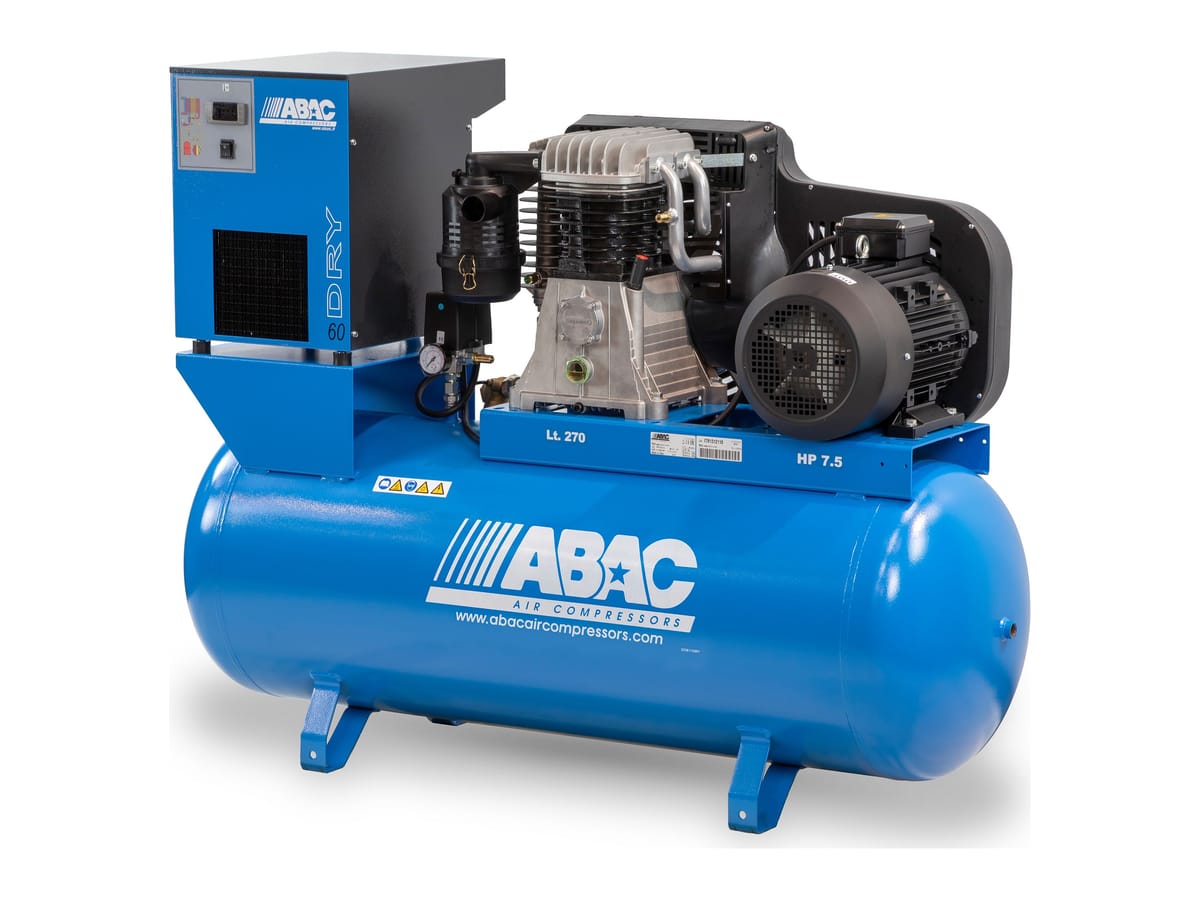 B59B, B60 and B70 · with a dryer · 11 bar · 270 and 500 l
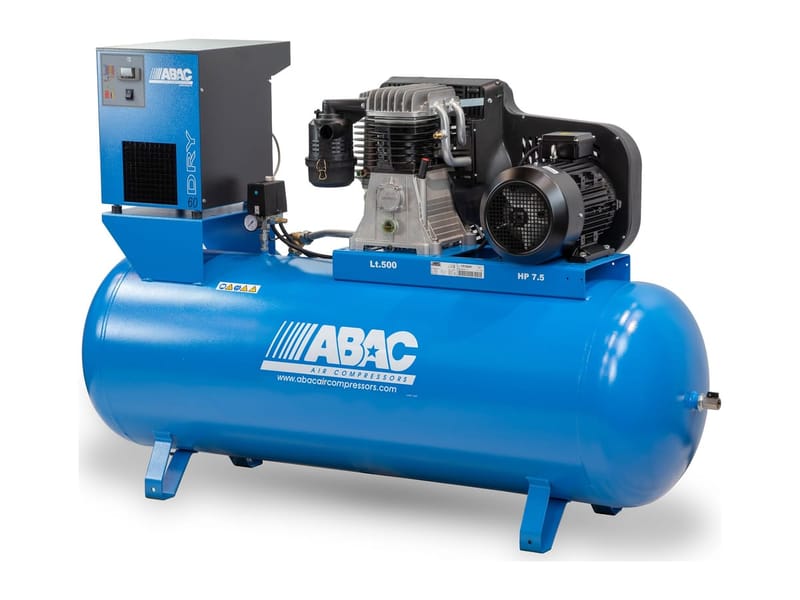
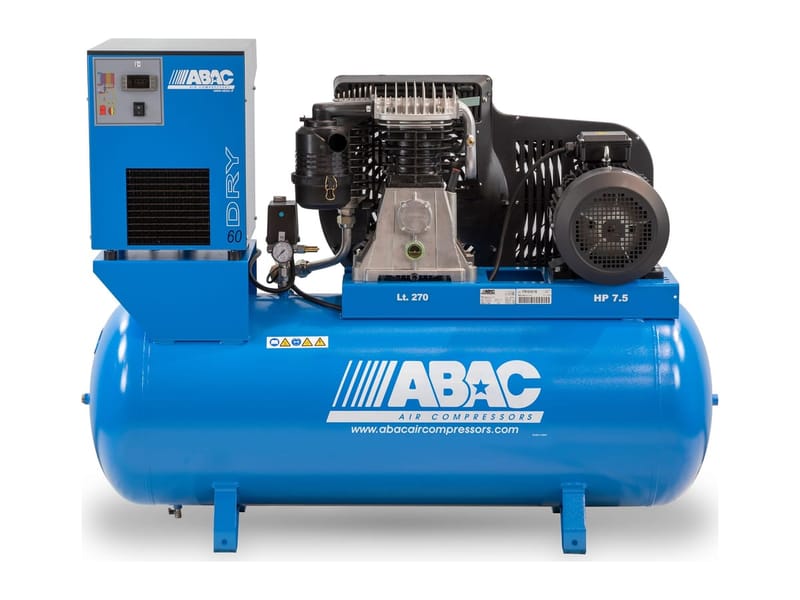
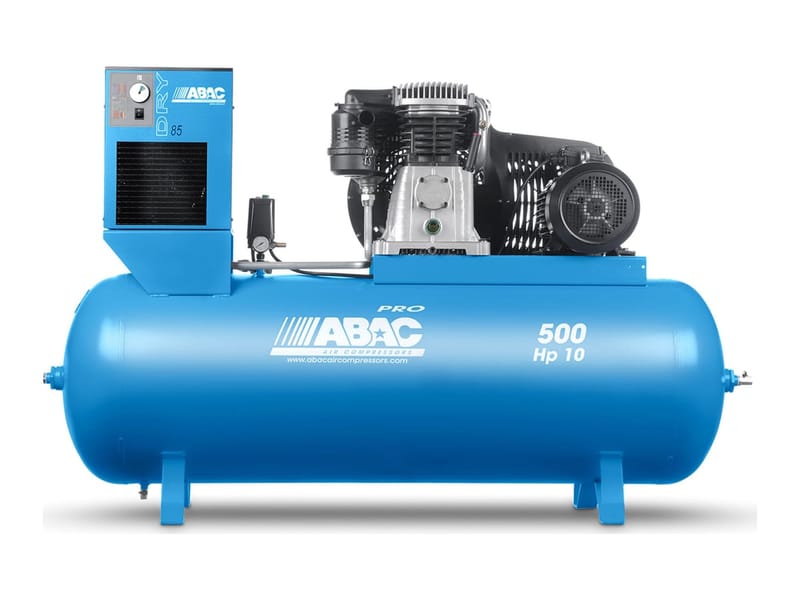
Five stationary ABAC compressors that come with a refrigerant dryer already fitted to the tank at the factory: a cast-iron two-stage B59B, B60 or B70 pump, a horizontal 270 or 500 l tank at 11 bar and, downstream of it, a dryer with a pressure dew point of +3 °C. The air goes into the pipework free of condensate, so no water condenses in the pipes or in the gun — without a separate dryer, connecting hoses or extra floor space in the compressor room. Displacement of 653, 827 or 1,210 l/min, a three-phase 400 V motor; the FTD version has a direct-on-line start, the FTXD version a starter panel with a star-delta switch. We service the ABAC brand.
Which machine with a dryer — pump, tank and start
The dryer has the same job on all five: dry the air to a pressure dew point of +3 °C and drain the condensate. You choose by how much air the pump has to put out, how big a reserve the tank should hold and how the motor should start.
B59B: 653, B60: 827, or B70: 1,210 l/min
Three cast-iron two-stage pumps of the same build as in the basic range. The B59B with a 4 kW (5.5 hp) motor draws in 653 l/min at 1,400 rpm; the B60 with 5.5 kW (7.5 hp) 827 l/min at 1,400 rpm; the B70 with 7.5 kW (10 hp) 1,210 l/min at 1,300 rpm. All of them fill the tank to 11 bar. Noise 97 dB Lwa (77 dB at 4 m) on the B59B, 102 dB Lwa (82 dB at 4 m) on the B60 and B70 — the machine belongs in the compressor room, not next to the workstation.
A 270 or 500 l tank
The tank does not add displacement, it only extends the time the pipework draws air before the motor cuts in. 270 l with the B59B for a tyre shop or a smaller paint shop, where the air is drawn in bursts, with the B60 for a body shop with a grinder and a riveter; 500 l where a gun in the spray booth or sandblasting draws air for long stretches — a bigger reserve and fewer motor starts per hour. We carry the B70 with a dryer only on 500 l.
FTD with a direct-on-line start, or FTXD with a star-delta start
The FTD starts the motor directly from the pressure switch. The FTXD adds a starter panel with a star-delta switch: the motor starts in star connection with a lower starting current and, once up to speed, switches over to delta — the choice for a supply with less headroom on the breaker or for a machine that starts often. We carry the B70 with a dryer only as an FTXD, the B59B only as an FTD, the B60 with a direct-on-line start on 500 l and with the starter panel on 270 l.
Five machines side by side
| Pro Line B59B, B60 and B70 with a dryer — stationary two-stage ABAC compressors, 11 bar, dew point +3 °C | ||||||||
|---|---|---|---|---|---|---|---|---|
| Model | Start | Tank | Pressure | Motor power | Air intake | Speed | Noise Lwa / at 4 m | Weight |
| B59B-4-270FTD | direct-on-line start | 270 l | 11 bar | 4 kW (5.5 hp) | 653 l/min | 1,400 rpm | 97 / 77 dB | 197 kg |
| B59B-4-500FTD | direct-on-line start | 500 l | 11 bar | 4 kW (5.5 hp) | 653 l/min | 1,400 rpm | 97 / 77 dB | 249 kg |
| B60-5,5-500FTD | direct-on-line start | 500 l | 11 bar | 5.5 kW (7.5 hp) | 827 l/min | 1,400 rpm | 102 / 82 dB | 290 kg |
| B60-5,5-270FTXD | star-delta start | 270 l | 11 bar | 5.5 kW (7.5 hp) | 827 l/min | 1,400 rpm | 102 / 82 dB | 207 kg |
| B70-7,5-500FTXD | star-delta start | 500 l | 11 bar | 7.5 kW (10 hp) | 1,210 l/min | 1,300 rpm | 102 / 82 dB | 314 kg |
All of them: a two-stage twin-cylinder pump with cast-iron cylinders and an intercooler, oil-lubricated, with an oil sight glass, V-belt drive under a belt guard, an aftercooler on the pump outlet, a three-phase 400 V / 50 Hz electric motor with thermal overload protection, a pressure switch with a gauge, a horizontal tank on feet with a condensate drain valve, a refrigerant dryer on the tank with a pressure dew point of +3 °C and an electronic condensate drain, the outlet to the pipework downstream of the dryer. The FTXD adds a starter panel with a star-delta switch. Noise: the first figure is the sound power level Lwa, the second the sound pressure at 4 m from the machine. The same pumps without a dryer, on castors, upright, at 15 bar, with lower speed and as a tandem have their own categories — the links are further down.
#showmore#
FTD, or FTXD — and when a separate dryer or a screw compressor
The pump, the tank and the dryer are the same on the FTD and the FTXD; the difference is in how the motor starts. If you already have a stationary machine or pipework, you can buy the dryer on its own; if you draw air without pauses for the whole hall, you are looking for a screw compressor with a dryer.
FTD: direct-on-line start
The 4 or 5.5 kW motor starts directly — the B59B-4-270FTD, B59B-4-500FTD and B60-5,5-500FTD. Simpler wiring, no extra starter panel; the supply has to cope with the starting current of the motor. For a workshop with an ordinary breaker and a machine that starts a few times an hour.
FTXD: star-delta start
The 5.5 or 7.5 kW motor starts in star connection and switches over to delta once up to speed — the B60-5,5-270FTXD and B70-7,5-500FTXD. The starting current is roughly a third of that of a direct-on-line start — for a supply with less headroom on the breaker or for a machine that starts often. We carry the B70 with a dryer only this way.
When a separate dryer, when a screw compressor
If you already have a stationary B59B, B60 or B70 without a dryer — say the B59B-4-270FT — you buy the dryer separately and plumb it into the pipework downstream of the tank; the same applies if the dryer is to stand somewhere other than by the machine. The FTD and FTXD machines make sense where the compressor room is being built from scratch and is to be complete with a single unit. Where the whole hall draws air without pauses, the piston machine reaches its limit and the screw compressor with a dryer takes over.
Dryer, two stages, cast iron and belts — what is inside
Refrigerant dryer on the tank
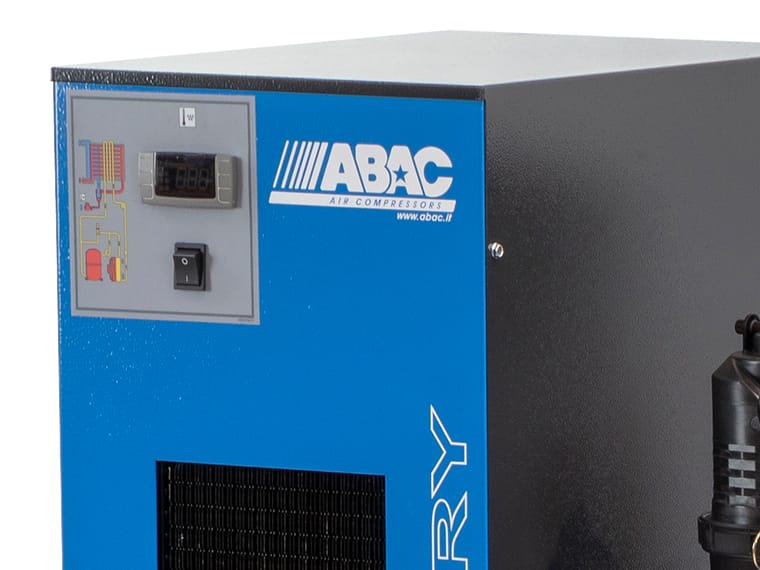
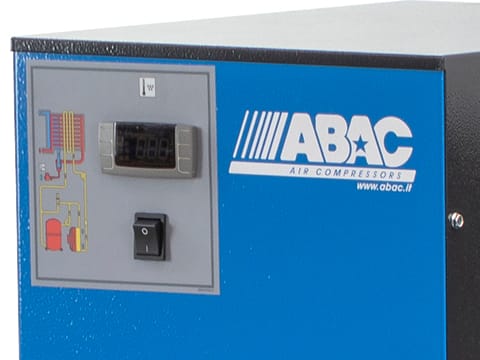
The air from the tank passes through the heat exchanger of the dryer, the refrigeration circuit cools it to +3 °C and the water vapour that the air can no longer hold at this temperature condenses; the condensate is discharged by the electronic drain, the air warms back up and goes into the pipework dry. The dryer sits on a bracket on the tank, piped up and wired at the factory; the bypass line lets you route the air around the dryer when it is shut down or being serviced.
Two stages and an intercooler
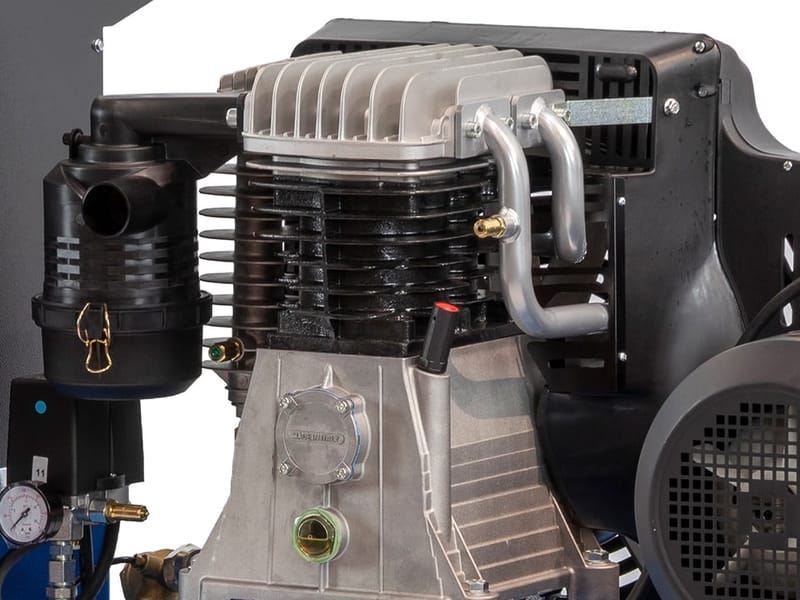
Two cast-iron cylinders work one after the other: the first compresses the intake air to an intermediate pressure, the air passes through the intercooler — a finned tube between the cylinders — and the second, smaller cylinder takes it up to 11 bar. Each stage does only part of the work, and a tank at 11 bar holds more air than a tank of the same size on a single-stage machine at 10 bar.
Cast-iron cylinders and the oil in the pump
The cylinders are cast iron — for long runs under load with tools that draw air for long stretches: a spray gun, sandblasting, sanding. The pump is lubricated with oil from the crankcase, with an oil sight glass; you check the level by eye and change the oil and clean the intake filter as per the manual.
Belts, an aftercooler and 1,400 or 1,300 rpm
The motor drives the pump through V-belts with a reduction ratio: the B59B and B60 run at 1,400 rpm, the B70 at 1,300. The compressed air leaves the second stage through the finned tube of the aftercooler into the tank, where the first part of the condensate drops out; the rest of the moisture is dealt with by the dryer downstream of the tank. The belt and the intake filter are parts you replace without opening up the pump.
Tank, switch and the outlet downstream of the dryer
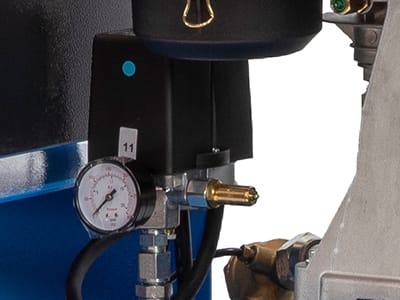
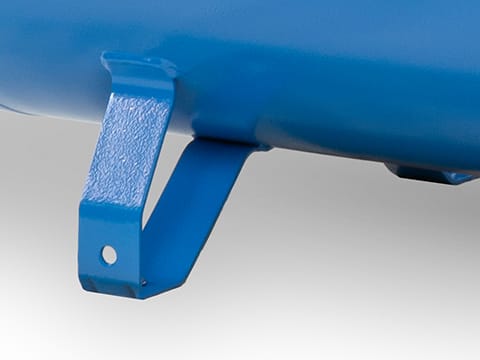
A horizontal 270 or 500 l tank at 11 bar on feet. The pressure switch with a gauge starts and stops the motor according to pressure, the three-phase 400 V motor has thermal overload protection; on the FTXD the signal from the switch goes through the starter panel with the star-delta switch. The condensate from the tank is drained by a valve under the tank, the condensate from the dryer leaves through the drain — both should be run into a collection container or a separator. The outlet to the pipework is downstream of the dryer; the regulators and filters belong at the workstations.
Equipment, operation and maintenance
What you get with every machine
- Two-stage twin-cylinder B59B, B60 or B70 pump with cast-iron cylinders and an intercooler, oil-lubricated, with an oil sight glass; V-belt drive under a belt guard
- Refrigerant dryer on the tank: pressure dew point +3 °C, electronic condensate drain, bypass line; piped up and wired at the factory
- Aftercooler on the pump outlet
- Three-phase 400 V / 50 Hz electric motor with thermal overload protection, automatic stop/start pressure switch with a gauge
- FTXD: starter panel with a star-delta switch for a lower starting current
- Horizontal 270 or 500 l tank at 11 bar, on feet, with a valve for draining condensate; outlet to the pipework downstream of the dryer
- AirTube QR code on the tank opens service videos
- 2-year warranty, 10 years on the tank against rusting through; extension to 3 years for a 5% surcharge
Three pumps and two tanks
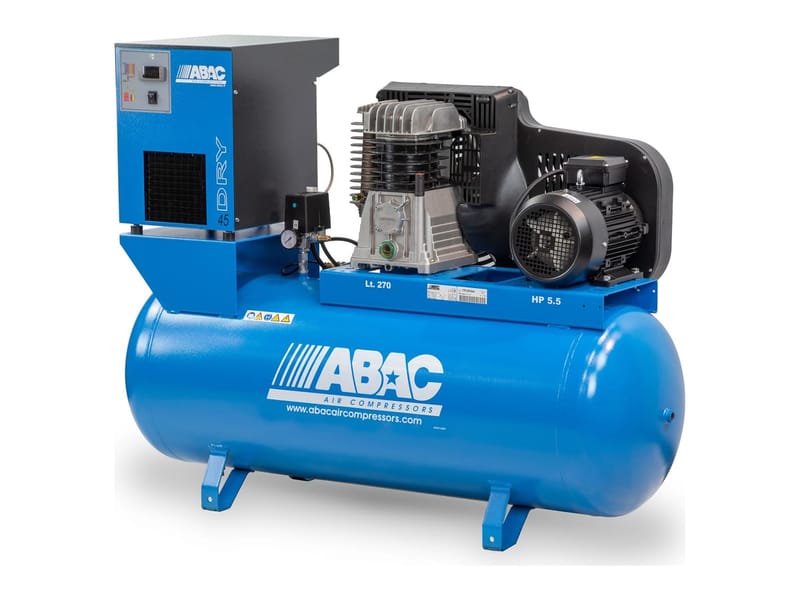
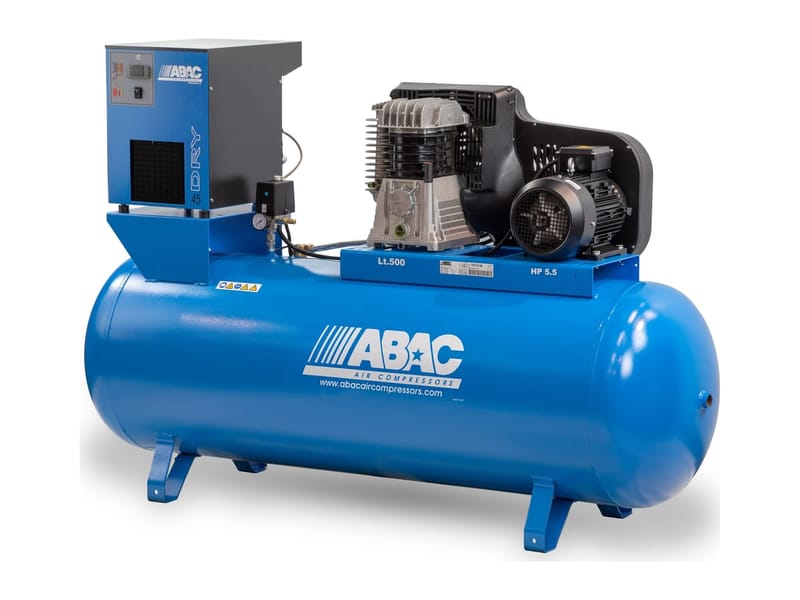
Machine details
Where dry air makes the difference
Paint shop and spray booth
A drop of water in the gun shows on the paintwork. The B60-5,5-500FTD puts 827 l/min into 500 l at 11 bar and downstream of the tank dries the air to +3 °C — the gun gets dry air without a separate dryer between the machine and the booth. You still need a regulator with a filter at the workstation upstream of the gun, to catch oil and the last of the dirt.
Sandblasting and body shop
A sandblasting gun draws air for long stretches and damp air makes the grit clump inside it: the B70-7,5-500FTXD with 1,210 l/min and a star-delta start is the machine for a blast cabinet where whole parts are blasted, the B60-5,5-270FTXD for a body shop with a grinder, a riveter and the occasional sandblasting job.
Tyre shop and pipework to several workstations
Where the air runs through pipes to three or more workstations, condensate in the pipework corrodes the pipes and fills the tools with water. The B59B-4-270FTD or B59B-4-500FTD in the compressor room sends air into the pipework that is dry from the machine onwards; the impact wrenches and tyre inflation at the lifts get air without water.
Accessories and service
The dryer on the machine deals with the water; oil and dust from the pipework are caught by a regulator with a filter at the workstation, for spraying by a filter system upstream of the gun. ABAC belongs to the Atlas Copco group and is one of the brands we repair in our own service workshop; we carry the B59B, B60 and B70 pumps and the service kits as separate items.
- pressure regulator with a filter — A regulator with a filter at every workstation — it sets the pressure and catches oil and dust from the pipework.
- filter system for spraying — Multi-stage filtration upstream of the spray gun — downstream of the dryer only oil and particles are left to catch.
- spray guns — HVLP and LVLP guns; dry air from a machine with a dryer gives them a finish without drops.
- spiral hoses — Hoses from the pipework to the tool with DN 7.2 quick couplings.
- pneumatic tools — Grinders, riveters and impact wrenches that last longer on dry air.
- B59B compressor pump — Replacement pump for the B59B-4-270FTD and B59B-4-500FTD.
- B60 compressor pump — Replacement pump for the B60 machines in the table.
- B70 compressor pump — Replacement pump for the B70-7,5-500FTXD.
- B59-PK1 service kit — Valve plate, gaskets and an intake filter for a major service of the B59B; the oil is bought separately.
- B60-PK1 service kit — Valve plate, gaskets and an intake filter for the B60 pump.
- B70-PK1 service kit — The same set of parts for the B70 pump.
- ABAC compressor service — Warranty and post-warranty repairs of ABAC machines, dryer included, in our workshop; belt, filter and oil replacement.
Where next if a machine with a dryer is not the right fit
The FTD and FTXD machines are stationary B59B, B60 and B70 pumps with a refrigerant dryer on a horizontal tank. If you want the same pump without a dryer, on castors, on an upright tank, at 15 bar, with lower speed or with two pumps, ABAC has sister machines; if you want a separate dryer or a screw compressor, you will find them further down. You will find the whole range, with filters by output, tank and voltage, among all compressors.
- basic B59B, B60 and B70 compressors — The same pumps without a dryer — the CT on castors and the stationary FT, 200 to 500 l, plus the ninety at 15 bar.
- air dryers with a dew point of +3 °C — A separate refrigerant dryer for a machine that is already in place, or for the pipework further away from the machine.
- all compressors with a dryer — Piston and screw machines with a dryer across brands — for a draw without pauses, the screw ones.
- how a refrigerant dryer works — The cooling principle, the dew point and how to size a dryer to the flow of the machine.
- cyclone separators — A separator catches water drops and oil downstream of the tank — a stage upstream of the dryer, not a substitute for it.
- slow-running B60-4, B70-5,5 and B79-7,5 compressors — The B60 and B70 pumps with a smaller motor at 1,100 rpm and the B79 pump at 900 rpm — without a dryer.
- upright VT compressors — The B59B and B60 pumps on an upright 200 or 270 l tank — where floor space is short.
- B60 and B70 compressors at 15 bar — The B60 and B70 with a 500 l tank at 15 bar for tools that 11 bar is not enough for.
- tandem compressors — Two pumps on one tank for an operation where one pump is not enough.
- sound-insulated ABAC Silent compressors — The B59B, B60 and B70 pumps in a sound-insulated cabinet — also in a version with a dryer, for running next to the workstation.
- two-stage A49B compressors — The smaller two-stage A49B pump with 2.2 to 4 kW motors, 444 to 595 l/min, 90 to 270 l tanks, also on 230 V.
- screw compressors — For a draw without pauses for the whole hall, where the piston machine reaches its limit.
- stationary compressors — Machines on feet across brands.
- compressors with a 500 l tank — Five-hundred-litre machines across brands — the tank of three of the five machines with a dryer.
Ventilek advises
A dryer on the machine is not for everyone — it is for whoever is building the compressor room in one go and wants the water dealt with before the air enters the pipes. For a paint shop with one booth I take the B60-5,5-500FTD, for a body shop with sandblasting the B70-7,5-500FTXD, for a tyre shop with pipework to the lifts the B59B-4-270FTD. If you already have a stationary machine, do not buy a second one — add a separate dryer. And if you draw air without pauses for the whole hall, look at the screw compressors with a dryer.
Frequently asked questions
- When a machine with a dryer, and when the basic FT plus a separate dryer?
- You buy an FTD or FTXD machine where the compressor room is being built from scratch and is to be complete with a single unit: the dryer sits on the tank, piped up and wired at the factory, and the air goes into the pipework dry. You choose a separate dryer when you already have a stationary B59B, B60 or B70, when the dryer is to stand somewhere other than by the machine, or when you want a different flow or dew point from the one the dryer on the machine gives. The difference is in the installation and the location, not in the drying principle.
- What does a pressure dew point of +3 °C mean, and is it enough for spraying?
- It is the temperature at which water starts to condense out of the compressed air at working pressure. The dryer cools the air to +3 °C, so the water that would condense at this temperature and pressure condenses out in the dryer itself and runs off through the drain. In the pipework, water then no longer condenses unless the pipe temperature drops below +3 °C — in a workshop, practically never. For spraying, sandblasting and pneumatic tools that is the usual standard; a lower dew point is needed by, say, laboratories, food processing, pharmaceuticals or pipework that runs through freezing conditions.
- Where does the condensate go, and what do I do with it?
- From two places: from the tank through the valve under the tank (which you drain by hand as per the manual) and from the dryer through the electronic drain, which opens only for as long as there is something to discharge. The condensate contains oil from the pump, so run both outlets into a collection container or an oil-water separator — it does not belong in the sewer.
- Is a water separator enough, or do I need a dryer?
- A separator catches the drops that have already condensed in the tank and the pipes; it does not catch the water vapour that condenses only in the gun or the tool. A dryer removes most of the vapour by cooling the air and condensing the water out of it before the pipework. If drops downstream of the tank are your only problem, a separator will do; if you spray or sandblast, you need a dryer.
- FTD, or FTXD — what does a star-delta start mean?
- The FTXD motor starts in star connection, drawing roughly a third of the starting current, and once up to speed the starter panel switches it over to delta for full power. That way the breaker on the supply never sees the current surge of a direct-on-line start. Choose the FTXD where the supply is on the limit of its breaker or where the machine starts often; the FTD with a direct-on-line start is enough for an ordinary workshop supply. We carry the B70 with a dryer only as an FTXD.
- Is it right for a paint shop, for sandblasting, for a tyre shop?
- For a paint shop, yes — dry air without drops is a precondition for a good finish. For sandblasting, yes — damp air makes the grit clump in the gun; go for 500 l, for the occasional sandblasting job the B59B is enough, for whole parts the B60 or B70 pump. For a tyre shop — where the air runs through pipework to several lifts and condensate collects in the pipes. You still need a regulator with a filter upstream of the gun, and a filter system for spraying.
- Piston with a dryer, or screw with a dryer?
- A piston machine works in cycles — it tops up the tank, stops and cuts in again when the pressure drops — and needs pauses; it suits a workshop where the air is drawn in bursts and the machine starts a few times an hour. Where the air is to flow without a break for the whole hall, a screw compressor with a dryer is the one.
- How do the B59B, B60 and B70 with a dryer differ?
- In the pump and the motor: the B59B with 4 kW (5.5 hp) draws in 653 l/min at 1,400 rpm, the B60 with 5.5 kW (7.5 hp) 827 l/min at 1,400 rpm, the B70 with 7.5 kW (10 hp) 1,210 l/min at 1,300 rpm. All of them fill the tank to 11 bar, all are three-phase on 400 V and all have a refrigerant dryer on the tank with the same pressure dew point of +3 °C. The manufacturer marks the pumps B5900B, B6000 and B7000 — on the rating plate you will find, say, “B5900B 270 FT5.5 FFO”, where FFO marks the version with a dryer; on the FTXD the manufacturer adds YD to the designation.
- How loud are they?
- The B59B has 97 dB Lwa and 77 dB at 4 m, the B60 and B70 102 dB Lwa and 82 dB at 4 m — machines for the compressor room, not for next to the bench. If you need fewer decibels next to the workstation, ABAC has the B59B, B60 and B70 pumps in a sound-insulated cabinet in the Silent range, also with a dryer.
- Is a 230 V socket enough?
- No. All five machines have a three-phase 400 V / 50 Hz motor and this range has no single-phase version with a dryer; you need a 400 V socket with a breaker rated for the 4, 5.5 or 7.5 kW motor; the dryer is wired up on the machine at the factory. Three-phase machines of all brands are grouped together among 400 V compressors.
- How much room does the machine need?
- The horizontal 270 or 500 l tank sets the length, the dryer sits on a bracket over one end of the tank next to the pump. Allow room for access to the switch and the dryer from the side, for the airflow to the condenser of the dryer and for a condensate collection container under the machine. The exact dimensions and weight of each machine are in its parameters.
- What is the warranty and what does maintenance involve?
- Two years on the machine, an extension to three years for a 5% surcharge, and ten years on the tank against rusting through. Maintenance as per the manual: draining the condensate from the tank, checking the dryer drain, cleaning the condenser grille of the dryer, checking the oil level in the sight glass, changing the oil and cleaning the intake filter, checking the belt tension; for a major service we carry the B59-PK1, B60-PK1 and B70-PK1 service kits with a valve plate and gaskets.
- What does the code B60-5,5-270FTXD mean?
- The pump, the motor power in kW, the tank volume in litres and the version: F is a stationary machine on feet, T a three-phase 400 V motor, X a star-delta start, D a dryer. So the B59B-4-270FTD is the B59B pump with 4 kW on a 270 l tank with a direct-on-line start and a dryer, the B70-7,5-500FTXD the B70 pump with 7.5 kW on 500 l with a star-delta start and a dryer. An overview of all the ranges is in the ABAC PRO Line guide.
- Where do I find the service videos, and who does the servicing?
- On the tank there is an AirTube sticker with a QR code — scanned with a phone, it opens instructional and service videos for the pump. Servicing the whole machine, dryer included, plus belts, filters and oil, is handled by our workshop; the other ranges, from the suitcase models to the screw compressors, are in the ABAC brand guide.
All values apply to a 50 Hz supply. Air intake is the amount of air the pump draws in; how much of it reaches the pipework depends on the pressure and the tank. Noise is given as the sound power level Lwa and the sound pressure at 4 m from the machine. The pressure dew point of +3 °C applies at the working pressure of the machine. A piston compressor works in cycles (topping up the tank and pausing), not continuously.


