
Pro Line B59B, B60 and B70 compressors — two-stage, 11 bar
 B59B, B60 and B70 · two-stage · 11 bar · 200 to 500 l
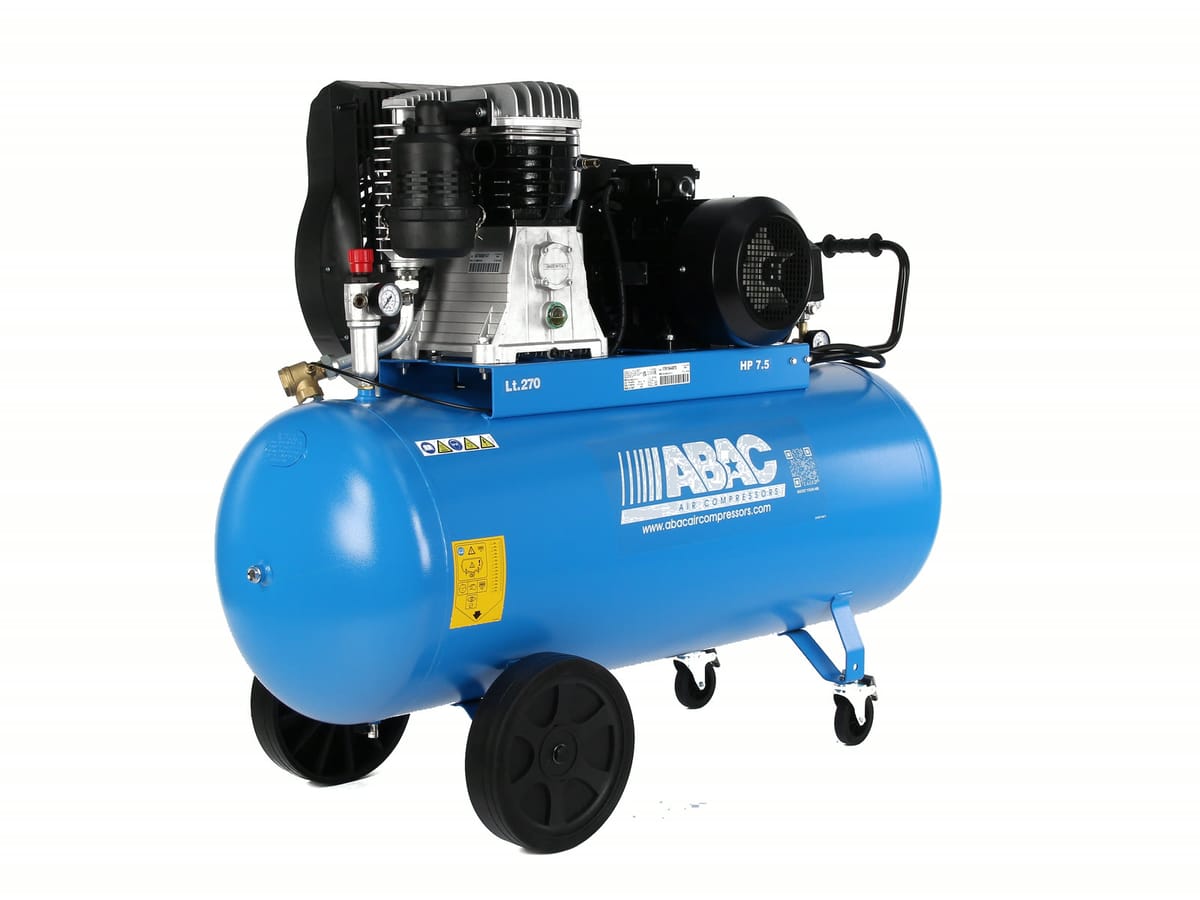
Fourteen belt-driven ABAC compressors with the cast-iron two-stage B59B, B60 and B70 pumps, a working pressure of 11 bar and a three-phase 4, 5.5 or 7.5 kW motor. The CT version has two front swivel castors with brakes, two rear wheels, a handle and a regulator with two quick couplings; the FT version stands on feet without castors or a regulator and connects to the pipework through a ball valve. Displacement of 653, 827 or 1,210 l/min, a horizontal 200, 270 or 500 l tank; the B59B-4-90CTH with a 90 l tank fills to 15 bar. Machines for the tyre shop, the paint shop and the workshop with several people on the tools, where the A49B pump is no longer enough; we service the ABAC brand.
Which B59B, B60 or B70 — pump, tank and castors
Three choices, in this order: how much air the pump should deliver, how big a reserve the tank should hold, and whether the machine is to travel around the workshop or stand in one place connected to the pipework.
B59B: 653, B60: 827, or B70: 1,210 l/min
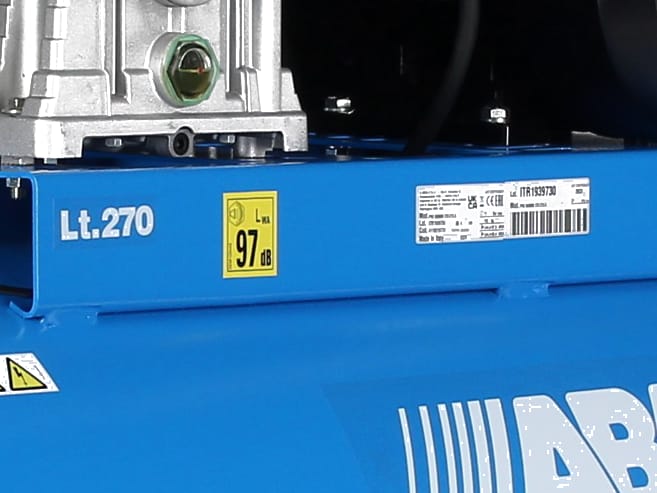
Three cast-iron two-stage pumps of the same build. The B59B with a 4 kW (5.5 hp) motor draws in 653 l/min at 1,400 rpm; the B60 with 5.5 kW (7.5 hp) 827 l/min at 1,400 rpm; the B70 with 7.5 kW (10 hp) 1,210 l/min at 1,300 rpm. All of them fill the tank to 11 bar. Noise 97 dB Lwa (77 dB at 4 m) on the B59B, 102 dB Lwa (82 dB at 4 m) on the B60 and B70. The special case is the B59B-4-90CTH: the same pump geared down to 928 rpm draws in 442 l/min and fills the ninety to 15 bar.
A 200, 270 or 500 l tank
The tank does not add displacement, it only extends the time the tools draw air before the motor cuts in. 200 l with the B59B for a garage with one lift; 270 l with all three pumps for a paint shop or a workshop with two people; 500 l where several tools run at once or where a sandblasting gun draws air for long stretches. The ninety at 15 bar is for tools that 11 bar is not enough for.
CT on castors, or FT stationary
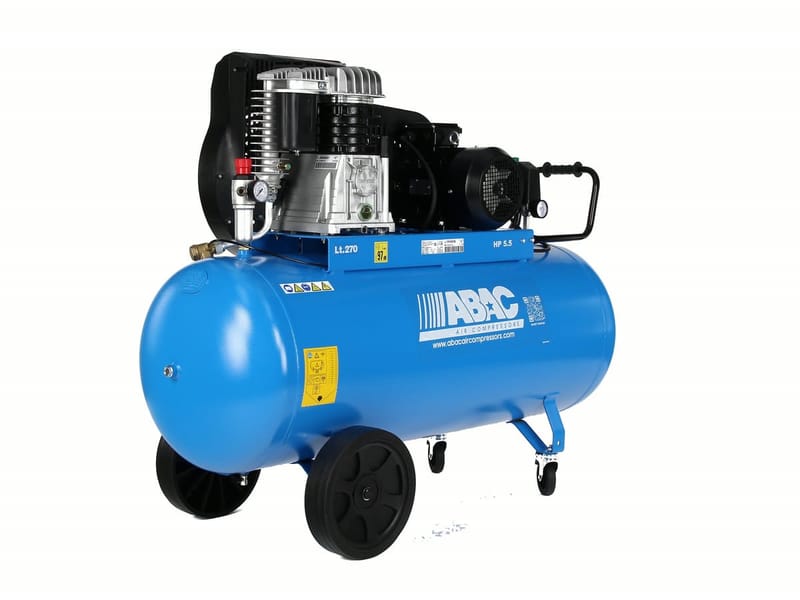
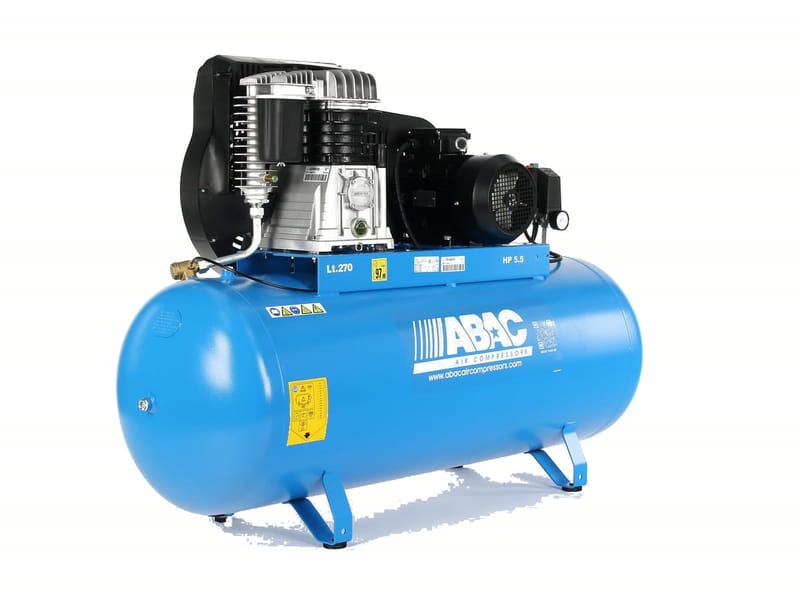
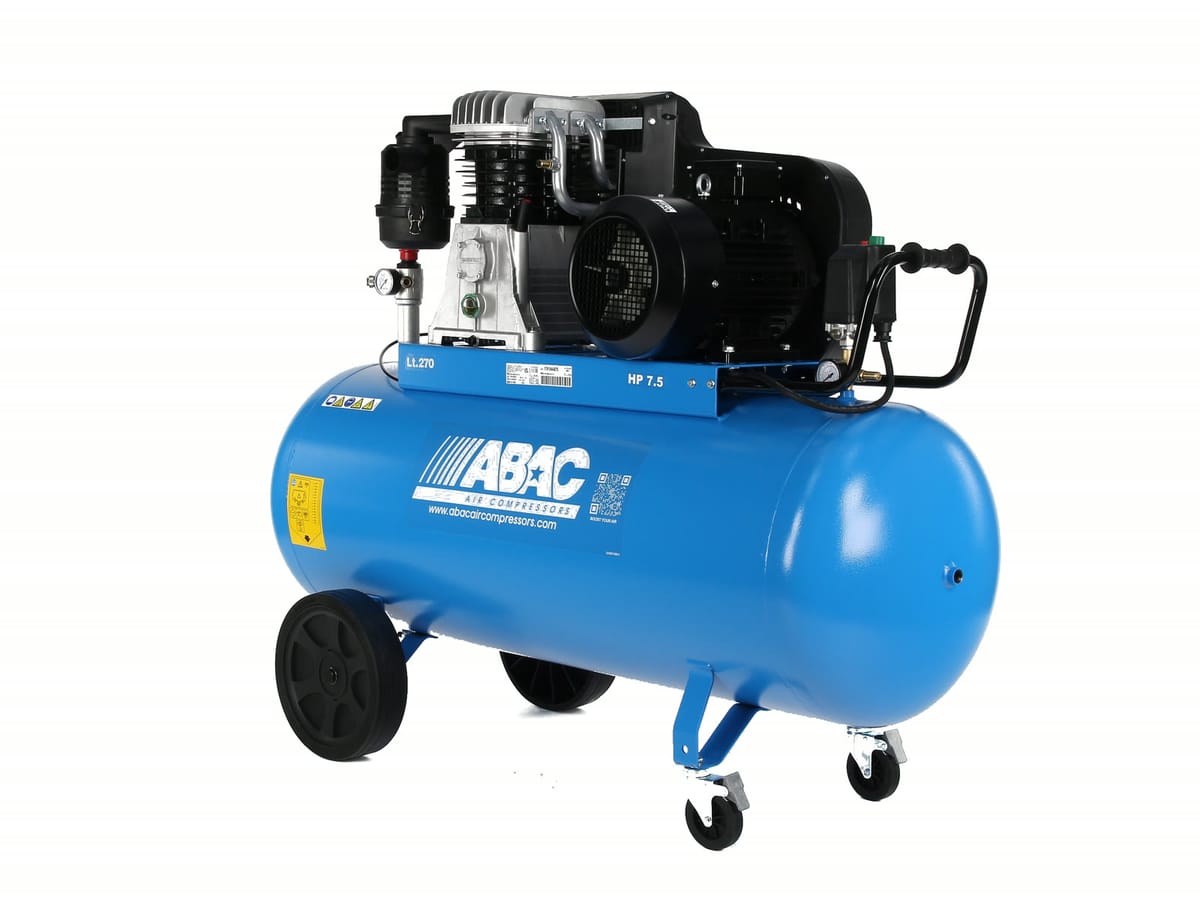
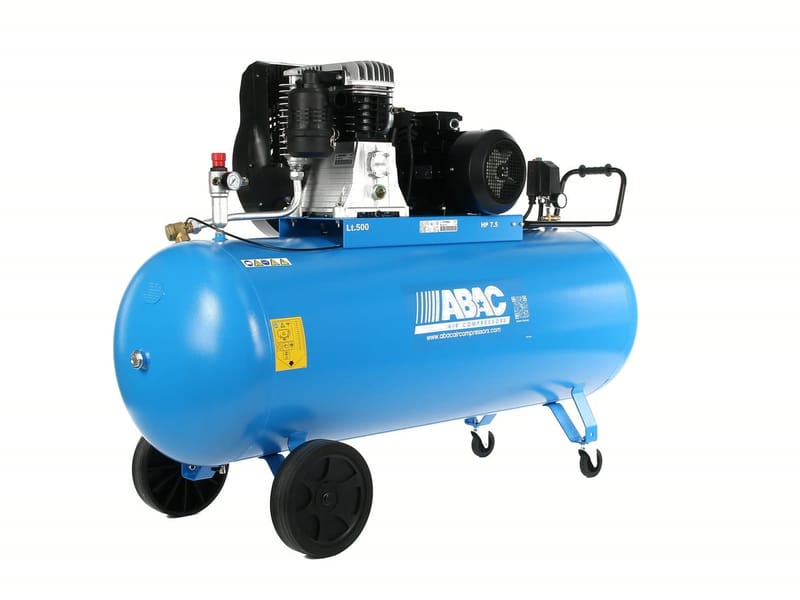
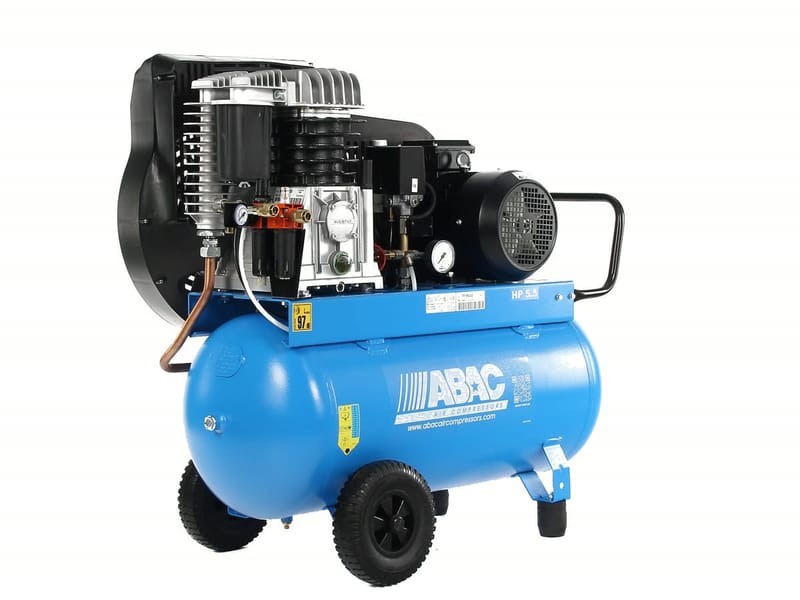
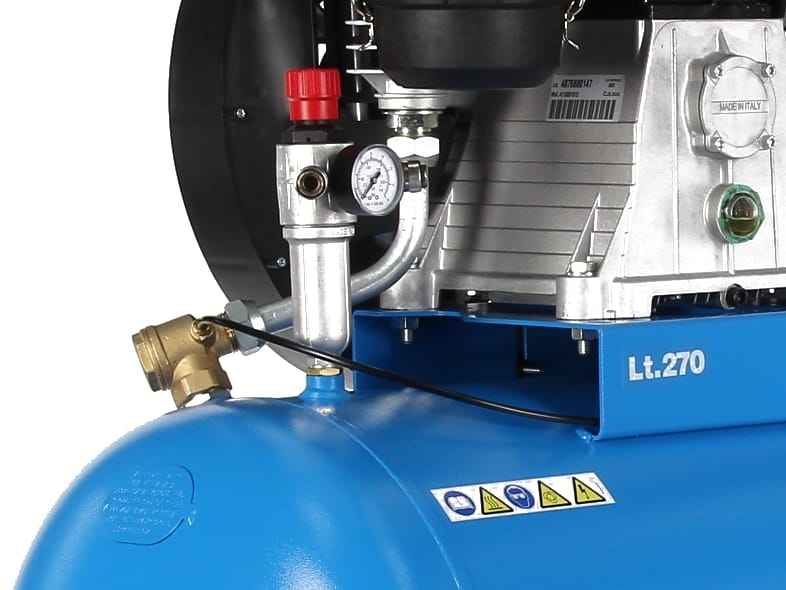
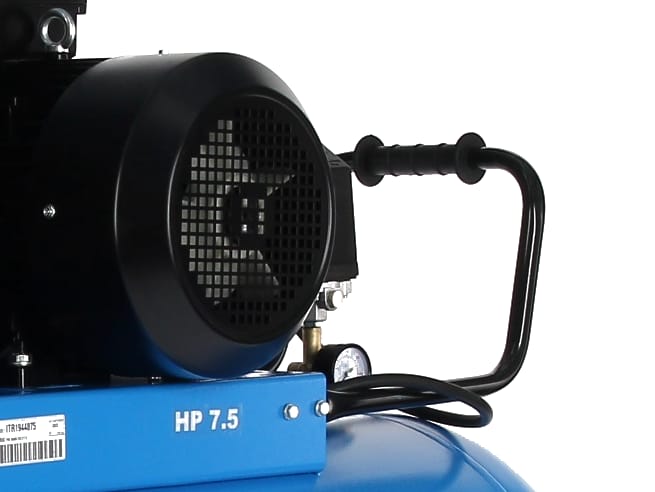
The CT has two front swivel castors with brakes, two rear wheels, a tubular handle with a rubber grip, on the tank a pressure regulator with two DN 7.2 quick couplings and two gauges (tank and outlet) — the hoses plug straight into the machine. The FT stands on feet, has a pressure switch with a gauge and a 1/2" ball valve outlet: the regulator, filter and quick couplings belong in the pipework at the workstation. Eight machines are CT, six FT; with the B59B, B60 and B70 you get 270 and 500 l in both versions. The exception as far as the chassis goes is the B59B-4-90CTH: a smaller machine with two wheels and a handle.
Fourteen machines side by side
| Pro Line B59B, B60 and B70 — two-stage belt-driven ABAC compressors, 11 bar (B59B-4-90CTH 15 bar) | ||||||||
|---|---|---|---|---|---|---|---|---|
| Model | Version | Tank | Pressure | Motor power | Air displacement | Speed | Noise Lwa / at 4 m | Weight |
| B59B-4-90CTH | on castors | 90 l | 15 bar | 4 kW (5.5 hp) | 442 l/min | 928 rpm | 97 / 77 dB | 97 kg |
| B59B-4-200CT | on castors | 200 l | 11 bar | 4 kW (5.5 hp) | 653 l/min | 1,400 rpm | 97 / 77 dB | 164 kg |
| B59B-4-270CT | on castors | 270 l | 11 bar | 4 kW (5.5 hp) | 653 l/min | 1,400 rpm | 97 / 77 dB | 170 kg |
| B59B-4-270FT | stationary | 270 l | 11 bar | 4 kW (5.5 hp) | 653 l/min | 1,400 rpm | 97 / 77 dB | 167 kg |
| B59B-4-500CT | on castors | 500 l | 11 bar | 4 kW (5.5 hp) | 653 l/min | 1,400 rpm | 97 / 77 dB | 222 kg |
| B59B-4-500FT | stationary | 500 l | 11 bar | 4 kW (5.5 hp) | 653 l/min | 1,400 rpm | 97 / 77 dB | 219 kg |
| B60-5.5-270CT | on castors | 270 l | 11 bar | 5.5 kW (7.5 hp) | 827 l/min | 1,400 rpm | 102 / 82 dB | 180 kg |
| B60-5.5-270FT | stationary | 270 l | 11 bar | 5.5 kW (7.5 hp) | 827 l/min | 1,400 rpm | 102 / 82 dB | 177 kg |
| B60-5.5-500CT | on castors | 500 l | 11 bar | 5.5 kW (7.5 hp) | 827 l/min | 1,400 rpm | 102 / 82 dB | 263 kg |
| B60-5.5-500FT | stationary | 500 l | 11 bar | 5.5 kW (7.5 hp) | 827 l/min | 1,400 rpm | 102 / 82 dB | 260 kg |
| B70-7.5-270CT | on castors | 270 l | 11 bar | 7.5 kW (10 hp) | 1,210 l/min | 1,300 rpm | 102 / 82 dB | 199 kg |
| B70-7.5-270FT | stationary | 270 l | 11 bar | 7.5 kW (10 hp) | 1,210 l/min | 1,300 rpm | 102 / 82 dB | 196 kg |
| B70-7.5-500CT | on castors | 500 l | 11 bar | 7.5 kW (10 hp) | 1,210 l/min | 1,300 rpm | 102 / 82 dB | 282 kg |
| B70-7.5-500FT | stationary | 500 l | 11 bar | 7.5 kW (10 hp) | 1,210 l/min | 1,300 rpm | 102 / 82 dB | 279 kg |
All of them: a two-stage twin-cylinder pump with cast-iron cylinders and an intercooler, oil-lubricated, with an oil sight glass, V-belt drive under a guard, an aftercooler on the pump outlet, a three-phase 400 V / 50 Hz electric motor with thermal overload protection, a pressure switch, a horizontal tank with a condensate drain, an AirTube QR code. The CT adds a pressure regulator with two DN 7.2 quick couplings, a second gauge, castors and a handle; the FT has a 1/2" ball valve outlet. Noise: the first figure is the sound power level Lwa, the second the sound pressure at 4 m from the machine. The upright VT versions of the B59B and B60 pumps, the 15 bar B60 and B70 machines with a 500 l tank, the B60 and B70 versions with lower speed and the versions with a dryer have their own categories — the links are further down.
#showmore#
CT, or FT — and when to reach for the A49B, the upright version or a screw compressor
The pump is the same on the CT and the FT: the difference is whether the machine travels around the workshop with the hoses plugged straight into it, or stands in the compressor room with the air leaving through the pipework. The siblings: the smaller two-stage A49B range, the upright VT versions and the 15 bar machines; for a draw without pauses there is the screw compressor.
CT: two front castors, a handle and two quick couplings
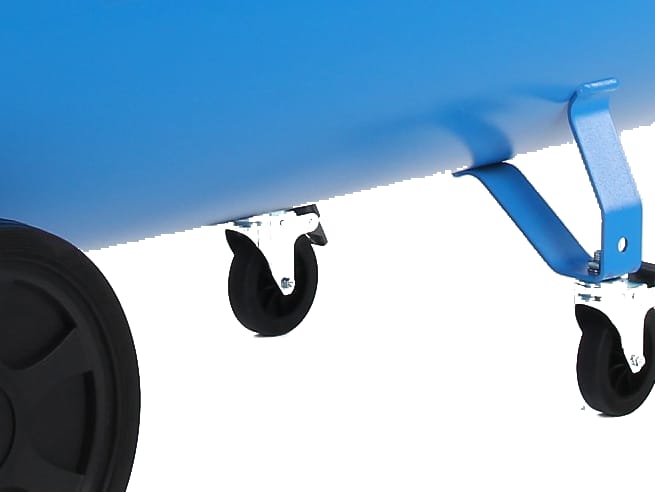
Two front swivel castors with brakes, two rear wheels and a tubular handle with a rubber grip — on a level floor that is enough to move even the B70-7.5-500CT with its 282 kg. On the tank a pressure regulator with two DN 7.2 quick couplings and two gauges (tank pressure and tool pressure), under the tank a ball valve for the condensate. Eight machines: the B59B with 200, 270 and 500 l; the B60 with 270 and 500 l; the B70 with 270 and 500 l — and the ninety B59B-4-90CTH at 15 bar, which has a smaller chassis with two wheels and a handle.
FT: feet, a switch with a gauge and a ball valve
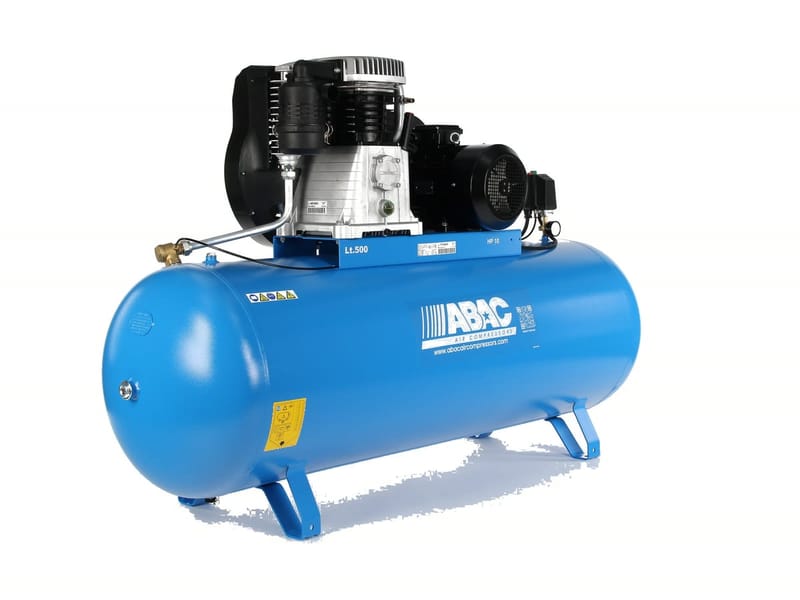
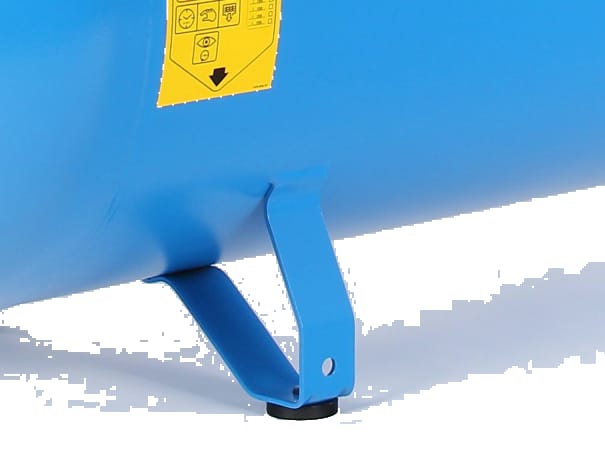
The same pump, motor and tank on feet, without castors or a handle; the air leaves through a 1/2" ball valve into the pipework, the pressure is shown by one gauge on the switch and the condensate is drained by a valve under the tank. The regulator, filter and quick couplings go at the workstation, not on the machine — so the machine stands in the compressor room and the noise stays behind the door. Six machines: the B59B, B60 and B70 with 270 or 500 l.
When the A49B, the VT, 15 bar or a screw compressor
If 444 to 595 l/min and a tank up to 270 l are enough, you pay less for the smaller two-stage A49B range with 2.2 to 4 kW motors. If you have no room for a horizontal tank, take the B59B and B60 pumps on the upright VT tank. If you need 15 bar with a bigger tank than 90 l, there are the B60 and B70 with 500 l at 15 bar. If you draw air for several people without pauses, you move on to a screw compressor — a piston machine works in cycles.
Two stages, cast iron, 11 bar and V-belts — what is inside
Two stages and an intercooler
The B59B, B60 and B70 pumps have two cast-iron cylinders that do not work side by side but one after the other: the first cylinder compresses the intake air to an intermediate pressure, the air passes through the intercooler — a finned tube between the cylinders — and the second, smaller cylinder takes it up to 11 bar. Each stage does only part of the work, the pump heats up less and a tank at 11 bar holds more air than a tank of the same size on a single-stage machine at 10 bar.
Cast-iron cylinders and the oil in the pump
The cylinders are cast iron, not aluminium — for a longer pump life during long runs under load, with tools that draw air for long stretches: sandblasting, sanding, an impact wrench by the lift. The pump is lubricated with oil from the crankcase, with an oil sight glass; the oil capacity is 1.5 l on the B59B, 2.3 l on the B60 and 2.2 l on the B70. You check the level by eye and change the oil as per the manual.
Belts and 1,400 or 1,300 rpm
The motor drives the pump through V-belts with a reduction ratio: the B59B and B60 run at 1,400 rpm, the B70 at 1,300 — slower than direct-drive pumps, which turn with the motor. The belts sit under a moulded belt guard; the belt is a part you replace without opening up the pump.
Aftercooler on the outlet
The compressed air leaves the second stage through the finned tube of the aftercooler, where it cools down before it enters the tank. Most of the moisture drops out as condensate in the tank, not in the hose at the tool; on the CT you drain it through the ball valve under the tank, on the FT through a valve. If you need dry air for spraying, put a filter at the workstation or reach for the version with a dryer.
Tank, switch and outlet
A horizontal 200, 270 or 500 l tank at 11 bar, on the B59B-4-90CTH 90 l at 15 bar. The pressure switch starts and stops the motor according to pressure; the three-phase 400 V motor has thermal overload protection. The CT has a pressure regulator with two DN 7.2 quick couplings and two gauges on the tank, the FT one gauge on the switch and a 1/2" ball valve outlet. The AirTube QR code on the tank opens service videos.
Equipment, operation and maintenance
What you get with every machine
- Two-stage twin-cylinder B59B, B60 or B70 pump with cast-iron cylinders and an intercooler, oil-lubricated, with an oil sight glass; V-belt drive under a belt guard
- Aftercooler on the pump outlet
- Three-phase 400 V / 50 Hz electric motor with thermal overload protection, automatic stop/start pressure switch with a gauge
- Horizontal 200, 270 or 500 l tank at 11 bar (90 l at 15 bar) with a condensate drain
- CT: two front swivel castors with brakes, two rear wheels, a tubular handle with a rubber grip (B59B-4-90CTH: two wheels and a handle), a pressure regulator with two DN 7.2 quick couplings and a second gauge for the outlet pressure
- FT: feet for a fixed spot, 1/2" ball valve outlet into the pipework
- AirTube QR code on the tank opens service videos
- 2-year warranty, 10 years on the tank against rusting through; extension to 3 years for a 5% surcharge
Three pumps, three tanks, two versions
Machine details
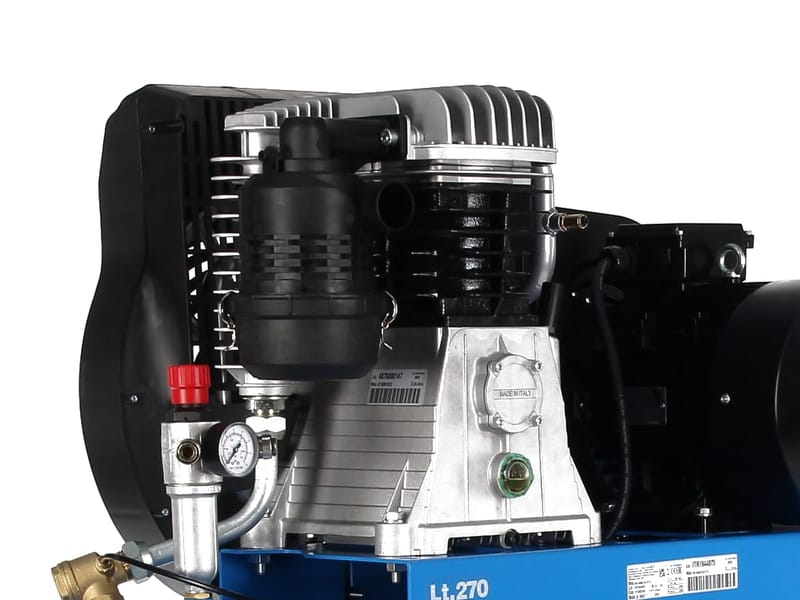
Where the B59B, B60 and B70 work
Tyre shop and garage
Two lifts, an impact wrench, a ratchet, tyre inflation and blowing off at once: the B59B-4-270CT puts 653 l/min into a 270 l tank at 11 bar and with its handle and castors you wheel it between the lifts. Where truck tyres or tools for a higher pressure are involved, the ninety B59B-4-90CTH at 15 bar is the one; if you put the machine in the next room and run the air through pipework, take the stationary B59B-4-270FT.
Paint shop, sandblasting and sanding
A spray gun, a sandblasting gun and a random orbital sander draw air for long stretches: the B60-5.5-500CT pumps 827 l/min into 500 l at 11 bar, the B70-7.5-500FT 1,210 l/min for two people sandblasting. Upstream of the gun goes a regulator with a filter at the workstation — on the FT it is the only way, on the CT you plug it into one of the two quick couplings.
Metalwork, body and assembly shops
A grinder, a riveter, an air chisel and blowing off for three to four people: the B60-5.5-270CT or the B70-7.5-270CT hold 270 l at 11 bar and the pump keeps topping the tank up. Where the whole hall draws air without pauses, the piston machine reaches its limit and the screw compressor takes over.
Accessories and service
The DN 7.2 quick coupling on the CT is the same standard as on the hoses, guns and tools across our whole range; with the FT the regulator, filter and quick couplings go into the pipework at the workstation. ABAC belongs to the Atlas Copco group and is one of the brands we repair in our own service workshop; we carry the B59B, B60 and B70 pumps and the service kits as separate items.
- pressure regulator with a filter — A regulator with a filter at the workstation for a spray gun — on the FT the only way, on the CT into one of the quick couplings.
- spray guns — HVLP and LVLP guns; with 827 or 1,210 l/min and a 500 l tank at 11 bar the machine keeps up with them for long spraying.
- impact wrenches — An impact wrench running non-stop for the tyre shop — 11 bar in the tank keeps a reserve, 15 bar on the B59B-4-90CTH even more.
- tyre inflators — Tyre inflation from a tank at 11 or 15 bar.
- spiral hoses — Hoses with DN 7.2 quick couplings from the machine to the tool — the CT has outlets for two.
- B59B compressor pump — Replacement pump for the B59B machines; our workshop supplies the parts.
- B60 compressor pump — Replacement pump for the four B60 machines in the table.
- B70 compressor pump — Replacement pump for the B70 machines in the table and their siblings.
- B59-PK1 service kit — Valve plate, gaskets and an intake filter for a major service of the B59B; the oil is bought separately.
- B60-PK1 service kit — Valve plate, gaskets and an intake filter for the B60 pump.
- B70-PK1 service kit — The same set of parts for the B70 pump.
- ABAC compressor service — Warranty and post-warranty repairs of ABAC machines in our workshop; belt, filter and oil replacement.
Where next if neither the B59B, the B60 nor the B70 is the right fit
The B59B, B60 and B70 are the two-stage pumps of the Pro Line B range on a horizontal tank in the basic CT and FT versions. If you need less air, an upright tank, 15 bar with a bigger tank, a dryer, two pumps or a machine running next to the workstation, ABAC has sister machines. You will find the whole range, with filters by output, tank and voltage, among all compressors.
- two-stage A49B compressors — The smaller two-stage A49B pump with 2.2 to 4 kW motors, 444 to 595 l/min, 90 to 270 l tanks, also on 230 V.
- upright VT compressors — The same B59B and B60 pumps on an upright 200 or 270 l tank — where floor space is short.
- B60 and B70 compressors at 15 bar — The B60 and B70 with a 500 l tank at 15 bar for tools that 11 bar is not enough for.
- slow-running B60 and B70 compressors — The B60 and B70 pumps with a smaller motor and lower speed — a lower running temperature and less noise.
- compressors with a dryer — FT machines with a built-in refrigerant dryer — dry air into the pipework straight from the machine.
- tandem compressors — Two pumps on one tank for an operation where one pump is not enough.
- sound-insulated ABAC Silent compressors — The B59B, B60 and B70 pumps in a sound-insulated cabinet for running next to the workstation.
- cast-iron ATMOS Perfect compressors — Cast-iron twin-cylinder ATMOS pumps with an aftercooler, 10 or 12.5 bar, 90 to 500 l tanks.
- screw compressors — For a draw without pauses for the whole hall, where the piston machine reaches its limit.
- two-stage piston compressors — All two-stage machines with filters by output and tank.
- stationary compressors — Machines on feet across brands.
- compressors with a 500 l tank — Five-hundred-litre machines across brands — the biggest tank this range offers.
- compressors with a 7.5 kW motor — Machines with 7.5 kW across brands.
Ventilek advises
A two-stage cast-iron pump is not about motor power: it is for tools that draw air for long stretches and want 11 bar in the tank. There are three pumps, so I choose by how many people are on the tools. For a tyre shop with two lifts I take the B59B-4-270CT, for a paint shop with sandblasting the B60-5.5-500CT with a regulator and filter at the workstation, for a compressor room with pipework the B70-7.5-500FT. If 595 l/min is enough, look at the A49B; if floor space is short, at the upright VT; if you draw air without pauses for the whole hall, at a screw compressor.
Frequently asked questions
- How do the B59B, B60 and B70 differ?
- They are three sizes of the same cast-iron two-stage pump. The B59B with a 4 kW (5.5 hp) motor draws in 653 l/min at 1,400 rpm, the B60 with 5.5 kW (7.5 hp) 827 l/min at 1,400 rpm, the B70 with 7.5 kW (10 hp) 1,210 l/min at 1,300 rpm. All of them fill the tank to 11 bar, all are three-phase on 400 V. The manufacturer marks the pumps B5900B, B6000 and B7000 — on the label of the machine you will find, say, “PRO B6000 270 CT7.5”.
- What do CT and FT mean in the designation?
- C is a machine on castors, F a stationary one on feet, T a three-phase 400 V motor; the number after the pump is the motor power in kW and the next number the tank volume in litres. So the B59B-4-270CT is the B59B pump, 4 kW, 270 l, on castors; the B70-7.5-500FT the B70 pump, 7.5 kW, 500 l, stationary. H at the end means 15 bar (B59B-4-90CTH). The upright versions have V instead of C or F and have their own category of upright VT compressors.
- What does the CT have that the FT does not, and what do I have to buy extra for the FT?
- The CT has two front swivel castors with brakes, two rear wheels, a tubular handle with a rubber grip, a pressure regulator with two DN 7.2 quick couplings, a second gauge for the outlet pressure and a ball valve for the condensate — you plug the hoses straight into the machine (the ninety B59B-4-90CTH has a smaller chassis with two wheels and a handle). The FT has a switch with a gauge and a 1/2" ball valve outlet; the regulator, filter and quick couplings for it belong in the pipework at the workstation, and the condensate is drained by a valve under the tank. The FT is for a machine that stands in the compressor room and feeds the air through pipes.
- Which tank size should I choose?
- The tank does not add displacement, it only extends the time the tools draw air before the motor cuts in — and at 11 bar it holds more than the same tank at 10 bar. The 200 goes with the B59B for a garage with one lift, 270 l is the tank all three pumps share, for a paint shop or a workshop with two people, and 500 l is for where several tools run at once or a sandblasting gun draws for long stretches. Parameter categories compare machines of all brands by tank volume, for example compressors with a 270 l tank.
- Why 11 bar, and what is 15 bar on the B59B-4-90CTH for?
- Two stages of compression allow the tank to be filled to 11 bar, whereas single-stage machines stop at 10 bar; the tank holds more air and the tools draw for longer between top-ups. The B59B-4-90CTH has the same pump geared down to 928 rpm: it draws in 442 l/min and fills the ninety to 15 bar — for a truck tyre shop and tools that 11 bar is not enough for. Eleven-bar machines of other brands are among 11 bar compressors; if you want 15 bar with a 500 l tank, you will find the B60 and B70 among 15 bar compressors.
- How much air do the pumps actually deliver?
- The displacement of 653, 827 and 1,210 l/min is the amount of air the pump draws in per minute; how much of it reaches the tool depends on the pressure it works at and on the tank. How to work out the consumption of your tools and choose a machine for it is explained in our article on choosing a compressor.
- How loud are they?
- The B59B has 97 dB Lwa and 77 dB at 4 m, the B60 and B70 102 dB Lwa and 82 dB at 4 m — these are machines for the workshop or the compressor room, not for next to the bench. If you need fewer decibels next to the workstation, ABAC has the B59B, B60 and B70 pumps in a sound-insulated cabinet in the Silent range; if you can, put the FT in the next room and run the air through pipework.
- Is a 230 V socket enough?
- No. All fourteen machines have a three-phase 400 V / 50 Hz motor and there is no single-phase version in this range; you need a 400 V socket with a breaker rated for the 4, 5.5 or 7.5 kW motor. Two-stage machines for an ordinary 230 V socket come from ABAC in the smaller A49B range with a 2.2 kW motor; three-phase machines of all brands are grouped together among 400 V compressors.
- Why V-belts, cast iron and an aftercooler?
- The belts let the pump run slower than the motor — 1,400 or 1,300 rpm; the pistons do fewer cycles per shift and the pump heats up less. Cast-iron cylinders are the choice for long runs under load and a longer pump life. The aftercooler cools the compressed air before it enters the tank, so most of the condensate stays in the tank, not in the hose. The belt and the intake filter are parts you replace without opening up the pump.
- What is the warranty and what does maintenance involve?
- Two years on the machine, an extension to three years for a 5% surcharge, and ten years on the tank against rusting through. Maintenance as per the manual: draining the condensate, checking the oil level in the sight glass, changing the oil and cleaning the intake filter, checking the belt tension; for a major service we carry the B59-PK1, B60-PK1 and B70-PK1 service kits with a valve plate and gaskets.
- Who is the range for?
- For the tyre shop, the paint shop and the workshop where two to four people are on the tools and the A49B pump with 595 l/min is no longer enough: impact wrenches at two lifts, a spray gun, sandblasting, sanding. The CT for a machine that is wheeled around the workshop; the FT for a compressor room with pipework. A piston machine works in cycles and needs pauses; for a draw without pauses for the whole hall choose a screw compressor. Machines for workshops and trade operations of all brands with parameter filters are among compressors for professional use.
- How do the B59B, B60 and B70 differ from the A49B and from the ATMOS Perfect?
- The A49B is the smaller two-stage pump of the same Pro Line range — 2.2 to 4 kW, 444 to 595 l/min, 90 to 270 l tanks, also on 230 V. The ATMOS Perfect are cast-iron twin-cylinder pumps at 10 or 12.5 bar from another brand, which we also service in our workshop. The B59B, B60 and B70 are cast-iron two-stage pumps at 11 bar with tanks up to 500 l. An overview of all the ranges is in the ABAC PRO Line guide.
- When does the version with lower speed, with a dryer or the tandem make sense?
- The B60-4 and B70-5.5 versions have the B60 and B70 pumps with a smaller motor and 1,100 rpm (660 and 1,023 l/min), the B79-7.5 a bigger pump at 900 rpm (1,130 l/min): lower speed and fewer piston cycles per shift, but also less displacement. The FTD/FTXD dryer goes with the FT machine where the air needs to be dry already in the pipework — a paint shop or sandblasting. The tandem with two pumps on one tank is for an operation where one pump is not enough. The links to all three categories are in the Where next section.
- Where do I find the service videos, and who does the servicing?
- On the tank there is an AirTube sticker with a QR code — scanned with a phone, it opens instructional and service videos for the pump. Service, belts, filters and oil are handled by our workshop; the other ranges, from the suitcase models to the screw compressors, are in the ABAC brand guide.
All values apply to a 50 Hz supply. Air displacement is the amount of air the pump draws in; how much of it reaches the tool depends on the pressure and the tank. Noise is given as the sound power level Lwa and the sound pressure at 4 m from the machine. A piston compressor works in cycles (topping up the tank and pausing), not continuously.


