
Soundproofed ABAC Silent piston compressors: cabinet or output
 ABAC Silent · 6 branches
The ABAC Silent range is not one shelf of machines but six branches that differ in a single thing — whether the pump is shut inside a sound cabinet or not. With a cabinet you get 81 to 89 dB; without one, 89 to 94 dB, which is roughly where an ordinary compressor sits. The word Silent in a machine code is the name of the pump, not a promise about noise — and that is exactly why it pays to know which branch is which. Altogether there are 56 machines from 1.5 to 7.5 kW.
Four questions that decide the choice
Every machine in the range is a piston compressor, belt-driven or direct-driven, and oil-lubricated. Before you look at litres per minute, work through these four things — they narrow the choice from six branches to one.
1. Will the machine stand where you work?
This is the main question. If the compressor stands in the workshop beside you, a sound cabinet is worth it — the difference between 94 and 82 dB is heard as a quarter of the noise. If it stands in a boiler room, a lean-to or behind a wall, you would be paying for the cabinet for nothing and a machine without one is the better buy.
2. How much air do you need?
The range runs from 255 l/min on the smallest machines to 1,070 l/min on the largest cabinets. The line around five hundred litres separates one station from a workshop where several people draw air at once. What counts is the average draw per hour, not the peak.
3. Where will the air live?
The receiver is the reserve you draw from until the motor cuts in again. The range holds machines with 27, 90, 150, 200, 270 and 500 l tanks and machines with no tank at all, which connect to the pipework or to a separate pressure vessel standing elsewhere.
4. Does moisture in the air matter?
Compressed air carries water with it, and that water comes out in the pipework. For blowing off and inflating it does no harm; for spray finishing or air tools with fine mechanisms it does. One branch of the range therefore has a refrigeration dryer built right into the cabinet.
Four branches with a sound cabinet — 35 machines
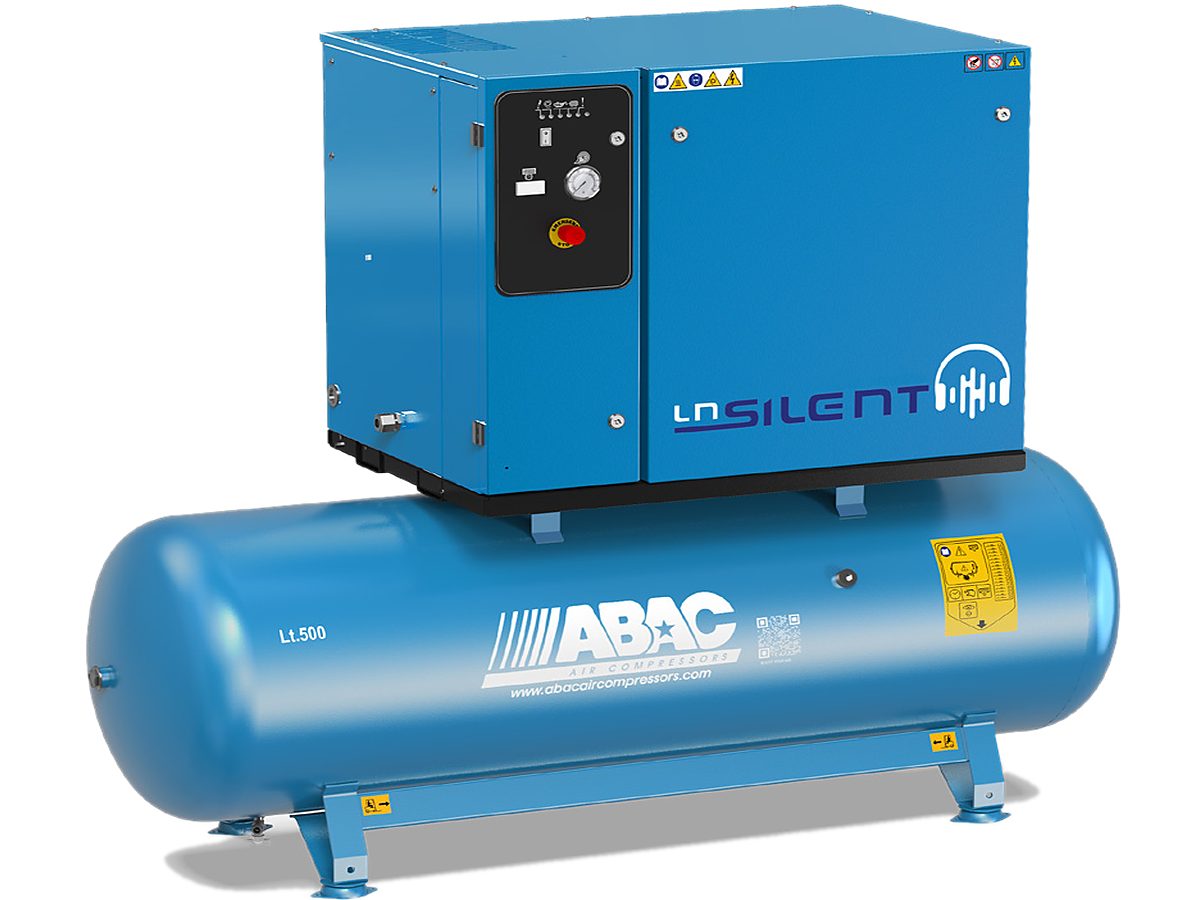
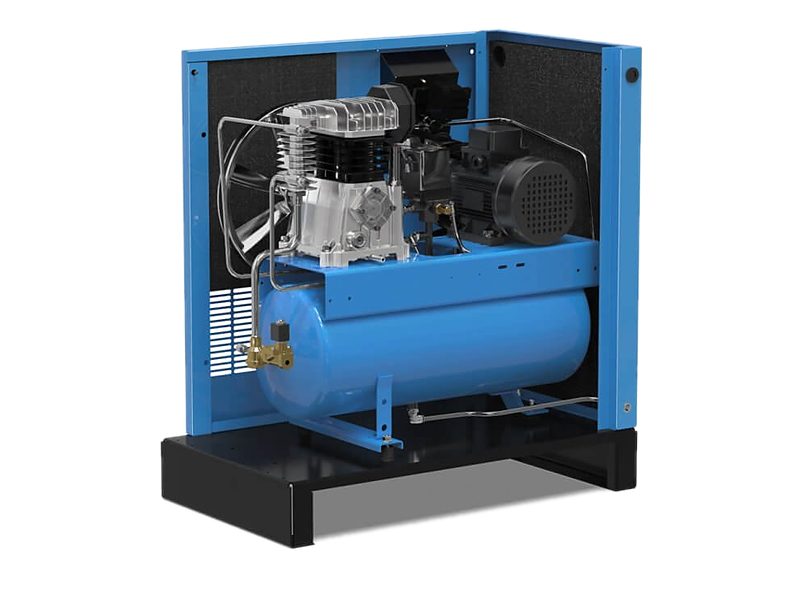
The cabinet is a sheet-metal box lined with sound-absorbing foam, with the whole machine shut inside it: pump, motor and belt drive. They differ in what sits under it and in it.
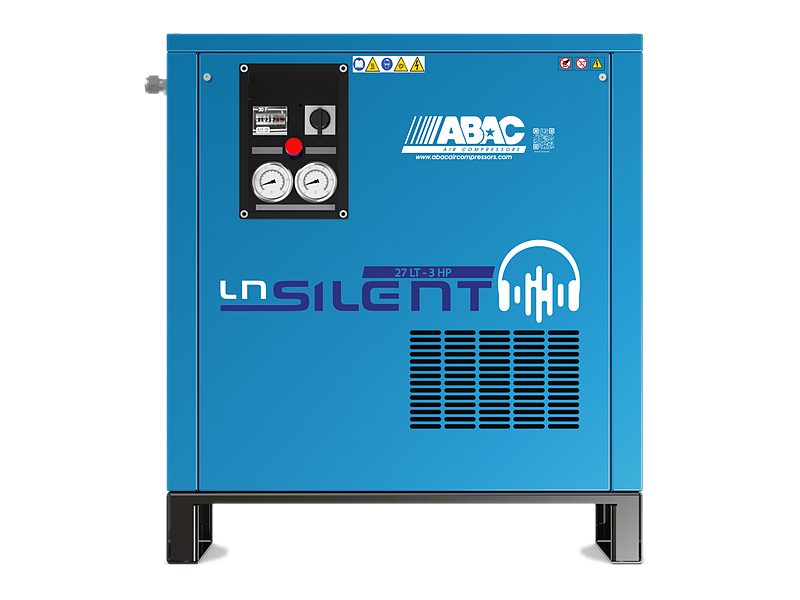
Cabinet with a 27 l receiver — 81 to 82 dB
Four machines, 1.5 and 2.2 kW. The lowest noise in the whole range and the smallest footprint. The small tank works as a buffer, not as a store — the machine belongs on pipework or at a station with short draws.
Cabinet on a 270 or 500 l receiver — 85 to 89 dB
Fifteen machines, 2.2 to 7.5 kW. The widest branch of the range. The cabinet stands on a horizontal receiver, so what sits on the floor is a single unit you connect to power and to the pipework. The usual choice for a workshop with no air main.
Cabinet with a dryer on 500 l — 87 to 88 dB
Six machines, 4 to 7.5 kW. The same as the previous branch, but the cabinet also holds a refrigeration dryer. Dry air comes straight out of the outlet, with no hoses and no extra floor space.
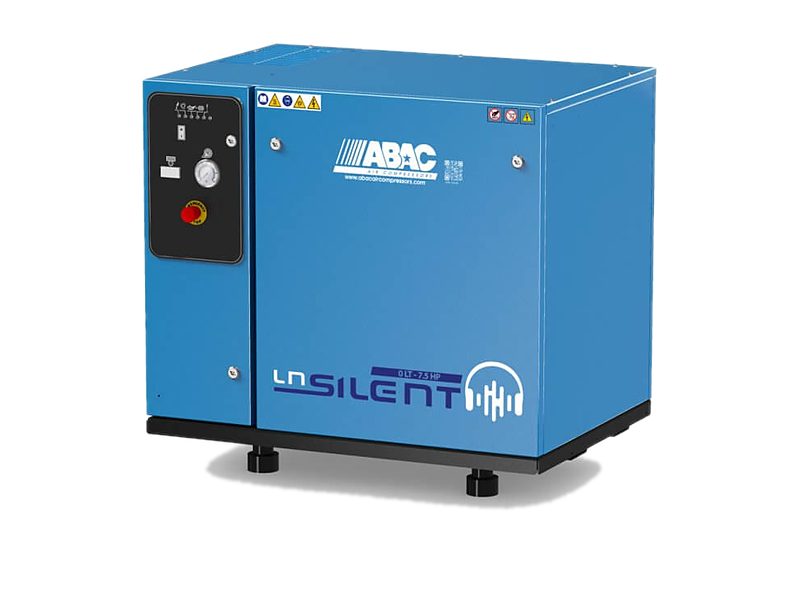
Cabinet with no tank — 87 to 89 dB
Ten machines, 3 to 7.5 kW. Just the cabinet, no tank. The air goes straight into the pipework or into a separate pressure vessel you stand where the air is actually drawn — and the compressor goes in a corner.
What the cabinet does to the noise
An ordinary piston compressor in an open frame runs at 95 to 102 dB of sound power. A sound cabinet pulls that down to 81 to 89 dB — and since every three decibels mean roughly twice the noise load for the human ear, a difference of thirteen decibels is heard as a workshop several times calmer.
The cabinet is not paid for in money alone. On the larger machines the pump inside is deliberately slowed, so it delivers less air than the same pump in an open frame — 1,070 instead of 1,210 l/min, for instance. The smaller machines of the range are not slowed and the cabinet takes only decibels from them. The second price is access: a panel comes off when you want to reach the machine, though they are made so that it is a minute of work.
Two branches without a cabinet — 21 machines
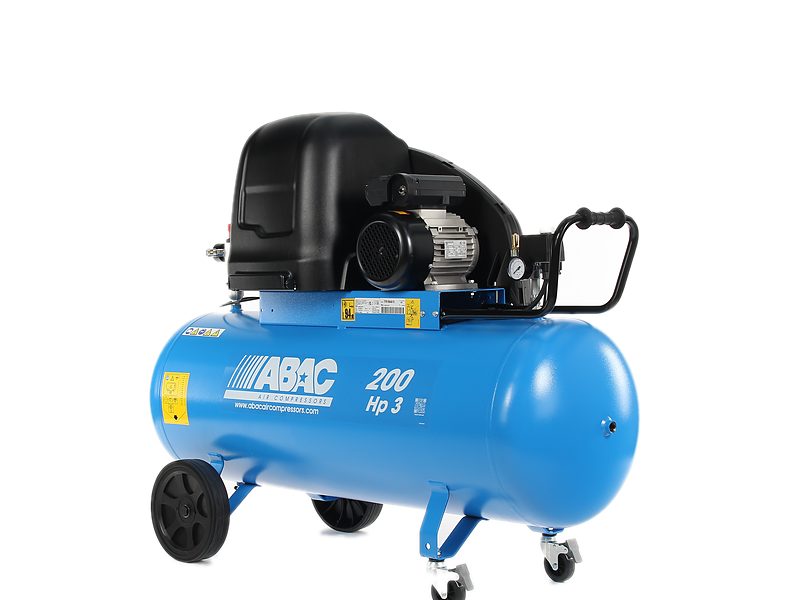
The A29B and A39B pumps have only a plastic cover with a fan grille above them. They are honest working machines, but 89 to 94 dB is the figure of an ordinary compressor — if you need quiet in the workshop, look a little higher up this page.
On wheels — 12 machines
1.5 to 3 kW, 90 to 270 l receiver. A large rear wheel, a front swivel castor with a brake and a handle. The machine can be pulled to the work and wheeled away again. The smallest run off an ordinary 230 V socket.
On feet — 9 machines
1.5 to 3 kW, 90 to 270 l receiver. The same pumps set down firmly on four feet. The choice where the compressor stays in one place and is connected to the pipework.
All six branches side by side
Soundproofed ABAC Silent piston compressors — 6 branches, 56 machines, 1.5 to 7.5 kW, 81 to 94 dB | ||||||
|---|---|---|---|---|---|---|
| Branch | Machines | Cabinet | Receiver | Motor | Intake | Lwa |
| Cabinet with a 27 l receiver | 4 | yes | 27 l | 1.5–2.2 kW | 255–320 l/min | 81–82 dB(A) |
| Cabinet on a 270 or 500 l receiver | 15 | yes | 270 a 500 l | 2.2–7.5 kW | 393–1,070 l/min | 85–89 dB(A) |
| Cabinet with a dryer on 500 l | 6 | yes | 500 l | 4–7.5 kW | 570–1,070 l/min | 87–88 dB(A) |
| Cabinet with no tank | 10 | yes | none | 3–7.5 kW | 490–1,070 l/min | 87–89 dB(A) |
| No cabinet, on feet | 9 | no | 90 až 270 l | 1.5–3 kW | 255–486 l/min | 89–94 dB(A) |
| No cabinet, on wheels | 12 | no | 90 až 270 l | 1.5–3 kW | 255–486 l/min | 89–94 dB(A) |
Lwa is the sound power level stated on the machine plate. Intake is the volume of air the pump draws in. The machine counts match what is currently offered. All figures are manufacturer data.
#showmore#
How noise is measured and where someone can mislead you
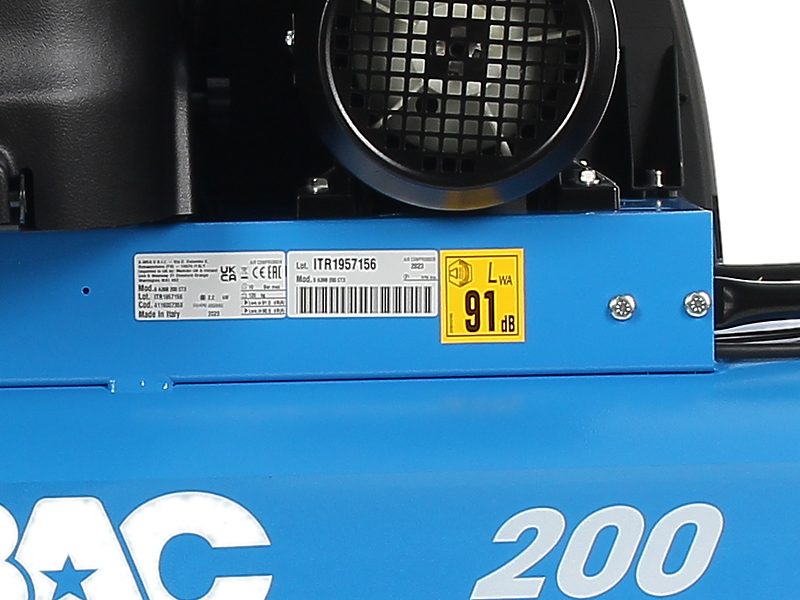
Under the European machinery directive the sound power level Lwa must be stated on the machine plate — the total power of the sound waves leaving the machine. It is an absolute figure and does not depend on where you stand. The second quantity is the sound pressure level Lwp: what actually reaches your ear. It falls with distance, and on our machines we state it measured at four metres, where it is roughly 20 dB(A) lower than Lwa.
🔴 And that is where the trap lies. When you read somewhere that a compressor is "only 70 dB", check which quantity that is. 70 dB Lwp at four metres is the same as 90 dB Lwa on the plate — a machine that ranks among the loudest in this overview. On every machine we offer you will find both figures side by side, so that apples can be compared with apples.
For comparison: everyday noise levels | |
|---|---|
| Threshold of hearing | 0 dB(A) |
| Birdsong | 40 dB(A) |
| A passing car | 75 dB(A) |
| The calmest machine in this range | 81 dB(A) |
| A kitchen blender | 88 dB(A) |
| A piston compressor in an open frame | 95 to 102 dB(A) |
Three versions side by side
This trio shows the whole axis of the range: a cabinet with its own tank, the cabinet alone, and a machine with no cabinet at all.
What the machines in the range share
Cast-iron cylinders
The pumps have cast-iron cylinders that take the working temperature and long running periods. It is the reason these machines can be repaired years later instead of thrown away.
Oil lubrication
The whole range is oil-lubricated. You check the oil level from outside — through a sight glass on the cabinet versions, or after taking off one panel.
Hour counter
The machine counts the hours it has worked, so servicing is planned by actual running time rather than by the calendar.
Branded pressure switch
A pressure switch runs the machine and thermal protection watches the motor, so it works unattended in automatic mode.
Plate with the Lwa level
Under the European directive every machine carries a plate with its sound power. It is the one figure that can be compared honestly between machines.
Two-year warranty
The machines carry a two-year warranty; on selected ranges an extension to three years can be bought with the machine.
V-belts
On most machines in the range the power goes from the motor to the pump through V-belts. They turn the pump more slowly than the motor runs, which means a lower temperature and less noise than a direct drive.
Ventilek recommends
Do not buy "Silent" by the name, buy it by the plate. The word Silent sits in the code of a machine that runs at 94 dB too — it marks the pump, it does not promise low noise. The cabinet is what brings quiet, and even with it we are at 81 to 89 dB, not at sixty. Start from where the machine will stand: in the workshop beside you a cabinet pays for itself on the first day, in a boiler room behind a wall it is money thrown away. And when you compare figures with another offer, watch whether it is Lwa from the plate or Lwp from four metres — there are twenty decibels in it.
Frequently asked questions
- Is a machine marked Silent always quieter?
- No. Silent is the name of the pump, and machines without a sound cabinet carry it too — those run at 89 to 94 dB, roughly what an ordinary compressor does. The cabinet is what decides: with one we are at 81 to 89 dB. Every machine plate states the Lwa figure that tells you which is which.
- What is 81 dB in practice?
- About seven decibels below a kitchen blender and fourteen below a piston compressor in an open frame. Every three decibels mean twice the noise load for the ear, so the difference between 95 and 81 dB is heard as a room several times calmer. It does not mean you can talk beside the machine without raising your voice.
- Why does a machine in a cabinet give less air?
- On the larger pumps it is deliberate: inside the cabinet they turn more slowly, so they run calmer and heat up less. The same pump that draws 1,210 l/min in an open frame gives 1,070 l/min in a cabinet. It is a trade of litres for decibels. On the smaller machines the speed is not reduced and the cabinet takes only noise.
- Do I need a receiver?
- The receiver is a reserve for peaks in demand. If you have an air main or a separate pressure vessel, a machine without a tank can stand where it is out of the way. If you have no pipework, pick a version that carries the tank underneath it — otherwise the motor will cut in far more often.
- Can a dryer be added later?
- Not to the machines that have one built into the cabinet — it is part of them. To all the others, yes: a separate refrigeration dryer goes into the pipework after the compressor and can be sized exactly to the flow. Anyone building from scratch usually does better with the package.
- Will a soundproofed compressor handle continuous duty?
- A piston compressor works in cycles, not without a break — that holds for the whole range, with a cabinet and without. The machines are built for partly continuous duty; if you need air truly without interruption, that is a job for a screw compressor.
Where to go next
If the Silent range does not fit, the road leads on like this: You will find an overview of every range in the Compressors category.
- The ABAC Pro Line range — the open version without a cabinet, more air for less money, but 95 to 102 dB
- Separate air dryers — refrigeration and adsorption dryers to fit into the pipework after any compressor
- Everything from ABAC — piston and screw compressors, spare parts and accessories from one manufacturer
- Compressor noise — how to read Lwa and Lwp and why figures in offers cannot be compared blindly
- How to choose a compressor — the path from what your tools use through output to receiver volume
Under the European machinery directive the sound power level Lwa is stated on the machine plate; the sound pressure level Lwp is measured at a distance of four metres over a hemispherical surface and is roughly 20 dB(A) lower. Machine counts and parameter ranges match the current offer. All figures are manufacturer data.
-
 Single stage A29B-A39B
-
Single-stage A29B-A39B
-
Soundproof compressors A29B
-
SLN reciprocating compressors
-
Compressors soundproofed
-
Compressors soundproof

Bestsellers


Product sorting
List of products

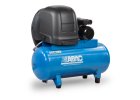
Extremely quiet piston compressor with an output pressure of 8 bar, designed primarily as a small compressed air source popular in Airbrush applications. Portable,...

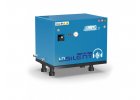
A compressor for a room where people work and talk: the whole machine, receiver included, sits under sheet steel. The A29 pump is enough for a tyre inflator, a blow gun, a...


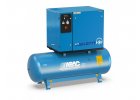
A compressor for a room where people work and talk: the whole machine, receiver included, sits under sheet steel. The A29 pump is enough for a tyre inflator, a blow gun, a...


