
Mobile ABAC Silent A29B and A39B compressors on 90 to 270 l receivers
 ABAC Silent
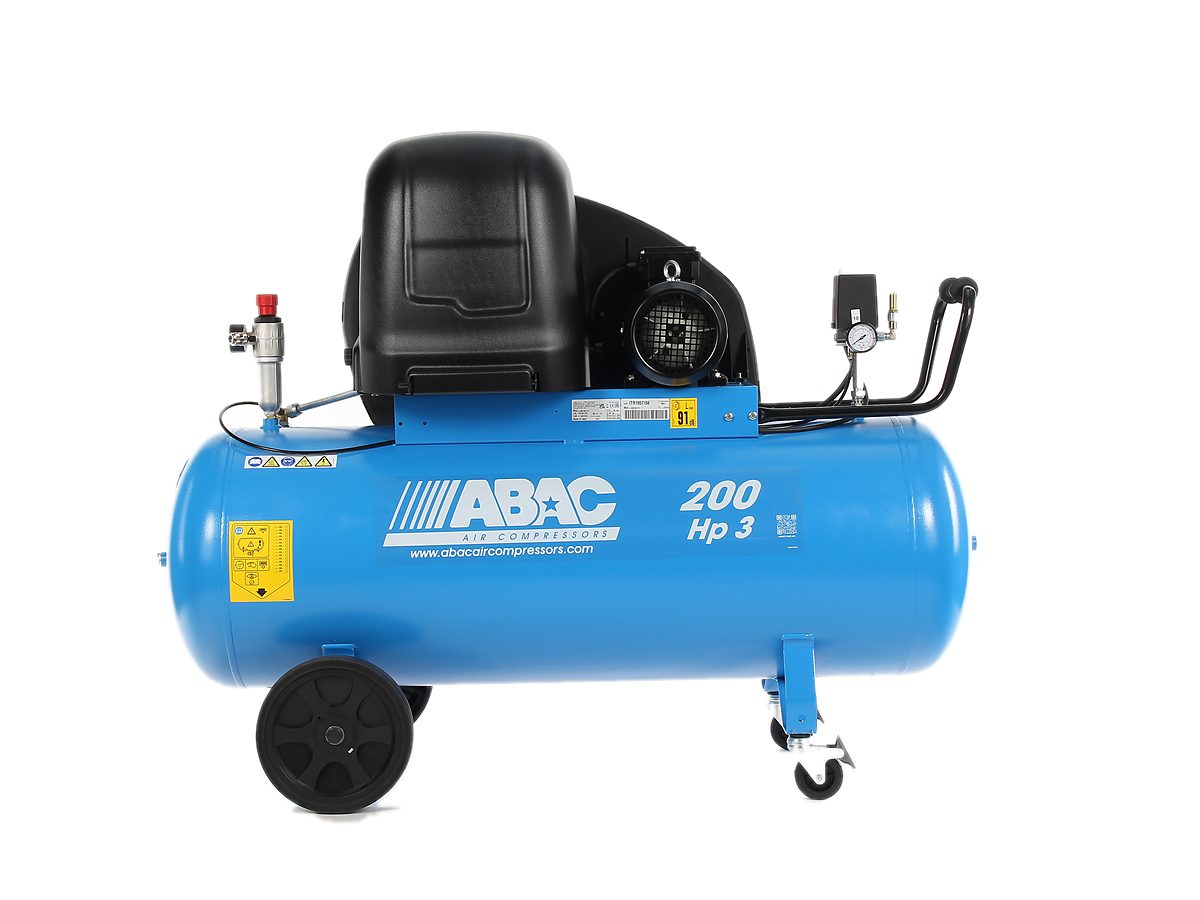
Twelve mobile ABAC compressors of the Silent range are built on two pump units you know from the Pro Line range — A29B rated at 1.5 kW and A39B with 2.2 or 3 kW. On top of that they carry a plastic hood over the pump unit: against the same unit without a hood the machine sits 2 to 4 dB(A) lower on the sound power level. The receiver comes in sizes from 90 to 270 litres and every machine runs at 10 bar. Four machines plug into a standard socket at 230 V, eight need a three-phase 400 V supply — and all twelve roll on their own wheels to wherever the work is.
Four questions that decide the choice
All twelve machines are oil-lubricated twin-cylinder units with V-belts and a hood over the pump unit. They differ in four things — and it pays to go through them in this order.
1. How much air will you use?
The A29B unit takes in 255 l/min, the A39B with 2.2 kW 393 l/min and with 3 kW 486 l/min. What matters is the sum of the tools running at the same time, not how many sit in the workshop.
2. How large a receiver?
You can choose 90, 150, 200 and 270 litres. A bigger receiver does not mean more air per minute — it means a longer uninterrupted draw and fewer motor starts.
3. Socket, or three-phase supply?
A code ending in M means 230 V, a code with T means 400 V. Four machines up to 2.2 kW run on 230 V, the remaining eight need a three-phase supply.
4. Will it stay put, or travel?
This category is mobile — large rear wheels, front swivel castors with a brake and a handle. If the machine is to stay in one place, go for the stationary version of the same units.
Three pump units, twelve machines
Read the machine code from the left: pump unit, motor rating, receiver volume and finally voltage and version. A39B-2,2-200CMS is therefore an A39B unit with 2.2 kW on a 200-litre receiver, at 230 V, in the silenced mobile version.
A29B — 1.5 kW
The smallest of the three. Takes in 255 l/min at 1,075 rpm. Enough for pneumatic tools that work in short bursts — a blow gun, a stapler, a tyre inflator, a smaller impact wrench. It is also the lightest and narrowest machine in the category.
A29B-1,5-90CMS · A29B-1,5-90CTS · A29B-1,5-150CMS · A29B-1,5-150CTS
4 machines · 255 l/min · 90 and 150 l receiver · 230 and 400 V · 89 to 90 dB(A) Lwa
A39B — 2.2 kW
The most popular six. Takes in 393 l/min at 1,050 rpm. It will carry longer sanding and spraying, and it is the only unit you can have on all three large receivers and in both voltages. At 230 V it is the strongest machine in the category.
A39B-2,2-150CMS · A39B-2,2-150CTS · A39B-2,2-200CMS · A39B-2,2-200CTS · A39B-2,2-270CMS · A39B-2,2-270CTS
6 machines · 393 l/min · 150, 200 and 270 l receiver · 230 and 400 V · 91 dB(A) Lwa
A39B — 3 kW
The highest output in the category. The same A39B unit, but spun up to 1,300 rpm — which is why it takes in 486 l/min. It exists only in the 400 V version and only on the 200 and 270 litre receiver. The output is paid for in noise: it is 3 dB(A) higher than the 2.2 kW version.
A39B-3-200CTS · A39B-3-270CTS
2 machines · 486 l/min · 200 and 270 l receiver · 400 V only · 94 dB(A) Lwa
What the hood over the pump unit does
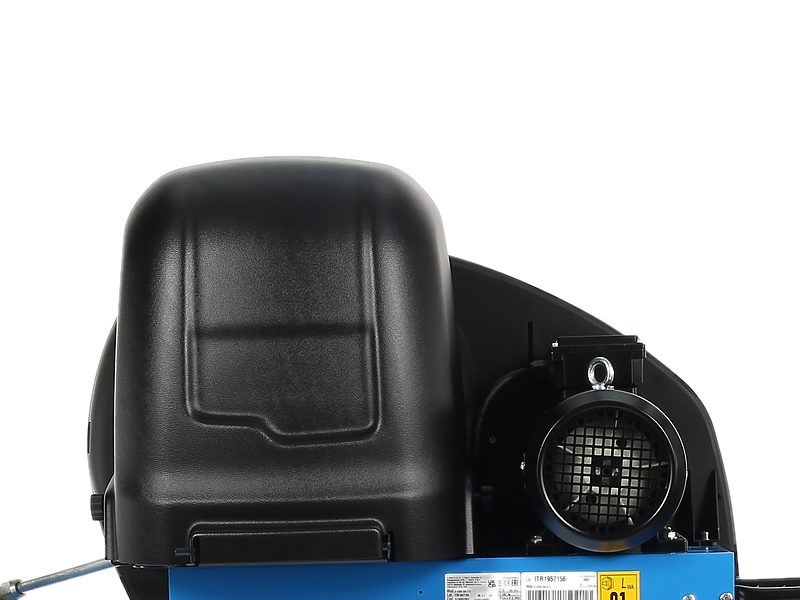
The plastic hood sits over the pump unit and the belt drive, not over the whole machine. Against the same unit in the uncovered Pro Line version the difference is 2 dB(A) for the A39B unit and 3 to 4 dB(A) for the A29B — the table below gives each machine its own figure. The hood also keeps dust away from the heads and the belt pulley.
Maintenance does not get longer because of it: the hood opens on a locating peg and a hinge, so you reach the filter, the oil sight glass and the belts without tools. Cooling is handled by a channelled air flow — under the hood the air has its own path from the fan to the heads, so the pump unit does not choke.
All twelve machines side by side
Silenced mobile ABAC Silent A29B and A39B compressors — 12 machines, 10 bar, 90 to 270 l receiver, 230 and 400 V | |||||||||
|---|---|---|---|---|---|---|---|---|---|
| Model | Pump unit | Motor | Suction | Speed | Receiver | Voltage | Lwa / Lwp | Weight | Dimensions L × W × H |
| A29B-1,5-90CMS | A29B | 1.5 kW | 255 l/min | 1 075 rpm | 90 l | 230 V | 89 / 69 dB(A) | 59 kg | 1 010 × 415 × 980 mm |
| A29B-1,5-90CTS | A29B | 1.5 kW | 255 l/min | 1 075 rpm | 90 l | 400 V | 89 / 69 dB(A) | 59 kg | 1 010 × 415 × 980 mm |
| A29B-1,5-150CMS | A29B | 1.5 kW | 255 l/min | 1 075 rpm | 150 l | 230 V | 89 / 69 dB(A) | 90 kg | 1 375 × 420 × 1 030 mm |
| A29B-1,5-150CTS | A29B | 1.5 kW | 255 l/min | 1 075 rpm | 150 l | 400 V | 90 / 70 dB(A) | 90 kg | 1 375 × 420 × 1 030 mm |
| A39B-2,2-150CMS | A39B | 2.2 kW | 393 l/min | 1 050 rpm | 150 l | 230 V | 91 / 71 dB(A) | 90 kg | 1 375 × 420 × 1 030 mm |
| A39B-2,2-150CTS | A39B | 2.2 kW | 393 l/min | 1 050 rpm | 150 l | 400 V | 91 / 71 dB(A) | 90 kg | 1 375 × 420 × 1 030 mm |
| A39B-2,2-200CMS | A39B | 2.2 kW | 393 l/min | 1 050 rpm | 200 l | 230 V | 91 / 71 dB(A) | 94 kg | 1 500 × 470 × 1 190 mm |
| A39B-2,2-200CTS | A39B | 2.2 kW | 393 l/min | 1 050 rpm | 200 l | 400 V | 91 / 71 dB(A) | 94 kg | 1 500 × 470 × 1 190 mm |
| A39B-2,2-270CMS | A39B | 2.2 kW | 393 l/min | 1 050 rpm | 270 l | 230 V | 91 / 71 dB(A) | 141 kg | 1 530 × 595 × 1 140 mm |
| A39B-2,2-270CTS | A39B | 2.2 kW | 393 l/min | 1 050 rpm | 270 l | 400 V | 91 / 71 dB(A) | 141 kg | 1 530 × 595 × 1 140 mm |
| A39B-3-200CTS | A39B | 3 kW | 486 l/min | 1 300 rpm | 200 l | 400 V | 94 / 74 dB(A) | 94 kg | 1 500 × 470 × 1 190 mm |
| A39B-3-270CTS | A39B | 3 kW | 486 l/min | 1 300 rpm | 270 l | 400 V | 94 / 74 dB(A) | 141 kg | 1 530 × 595 × 1 140 mm |
Lwa is the sound power level of the machine, Lwp the sound pressure level at a distance of four metres. Suction is the amount of air the pump unit draws in. All figures are the manufacturer’s data.
#showmore#
Four receiver sizes and three details that matter
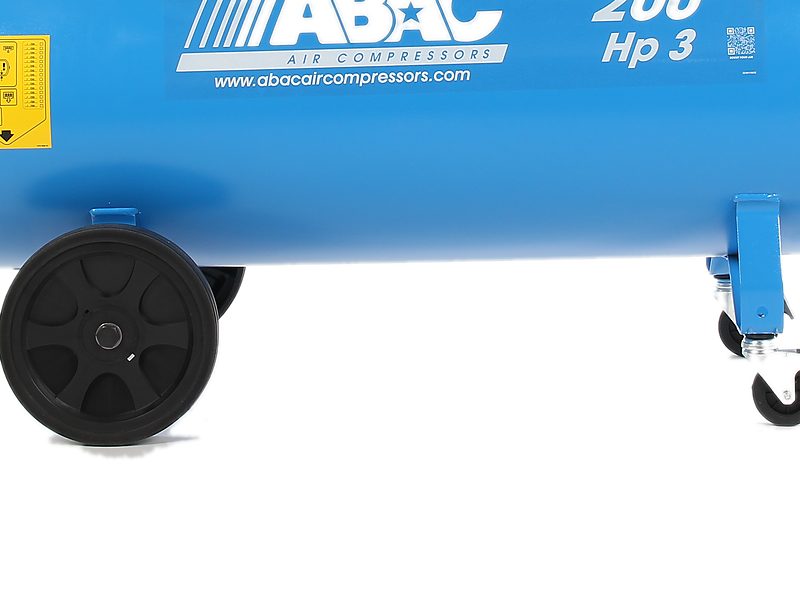
From the outside the machines differ mainly in the receiver: from the ninety, which fits through a workshop door and next to a bench, to the two hundred and seventy on two large wheels.
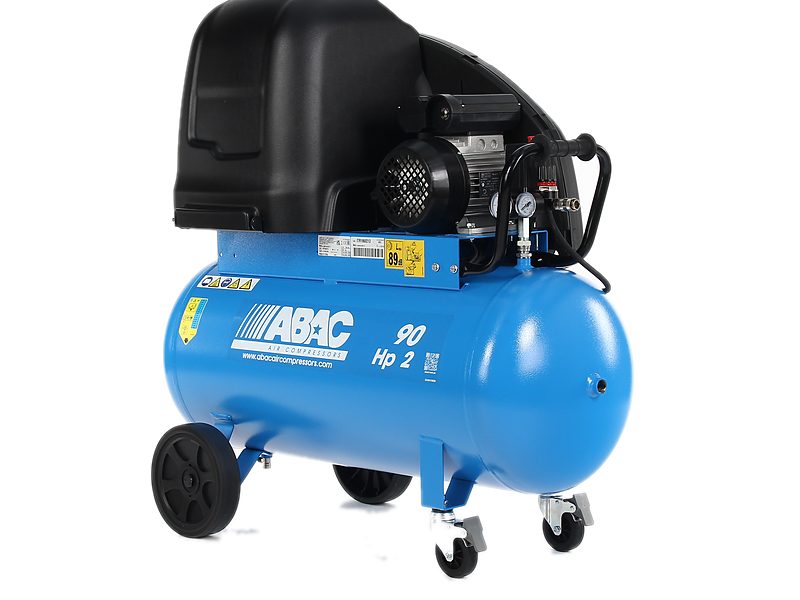
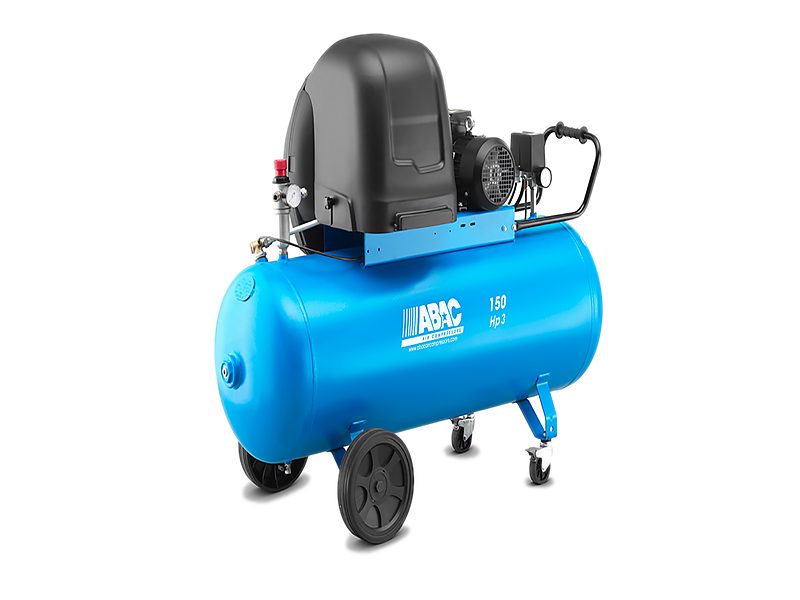
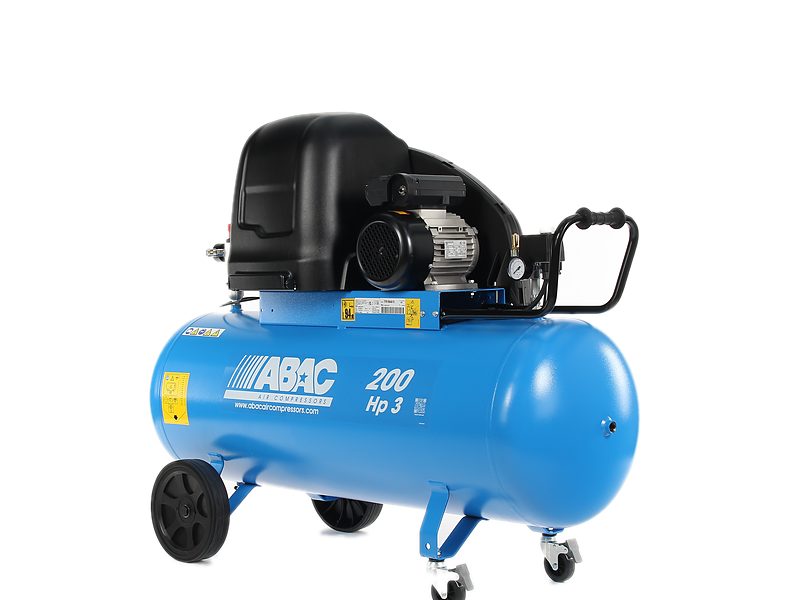
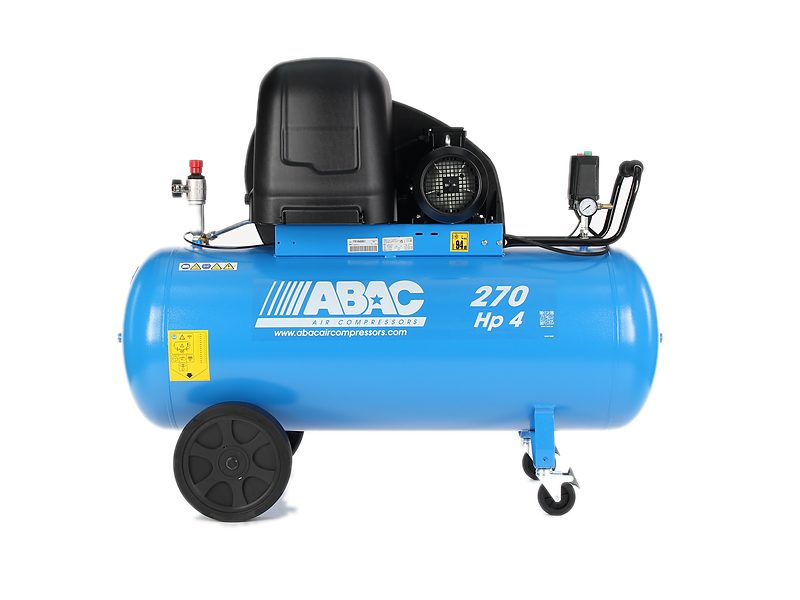
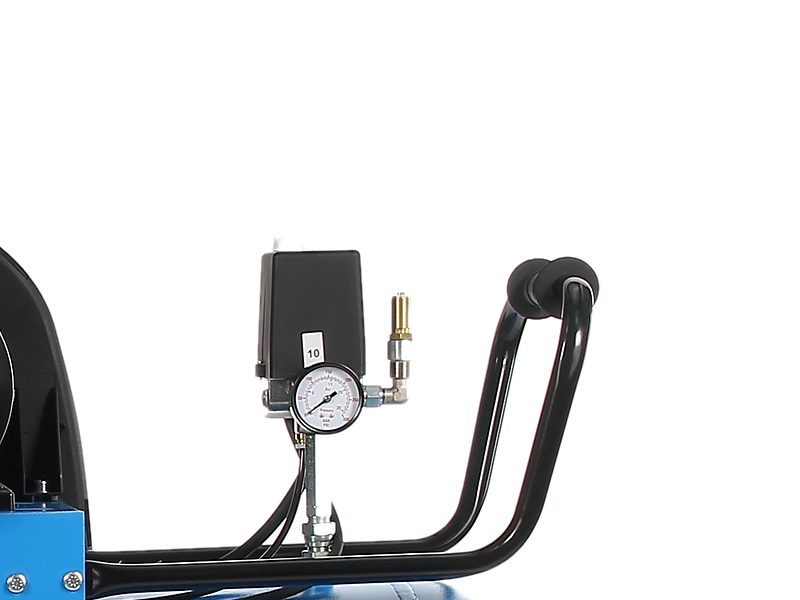
And three details that listing photos rarely show:
What all the machines share
Twin-cylinder oil-lubricated unit
One stage, two cylinders, oil lubrication and an oil sight glass on the side. The fill is 0.7 l on the A29B and 0.8 l on the A39B.
V-belts
Motor and pump unit are joined by a V-belt drive with a pulley guard. The pump unit turns more slowly than the motor, which is why these machines run calmer than direct-drive compressors.
Hood over the pump unit
Plastic, opens on a peg and a hinge. Takes off 2 to 4 dB(A) and protects the pump unit from dust.
Running gear
Large rear wheels, front swivel castors with a brake and a rubberised handle. All twelve machines are mobile.
Controls and outlet
A pressure switch with unloading, a gauge and a multi-profile quick coupling at the outlet.
Motor protection
A thermal cut-out switches the motor off when overloaded. The machines are built for occasional to partly sustained duty, not for running without a break.
Horizontal receiver
The receiver lies along the machine, so the centre of gravity stays low. A safety valve sits on top, a condensate drain cock at the bottom.
Ventilek advises
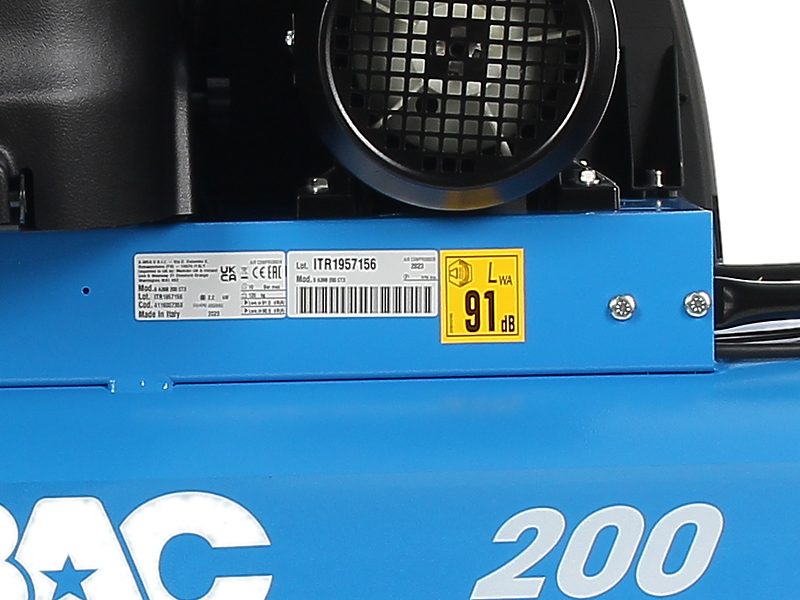
Noise is measured in two ways and the figures look completely different. The label on the machine carries Lwa — the sound power, that is what the machine puts out in total. What you hear is the sound pressure Lwp, and the manufacturer calculates it for four metres from the machine: it is 20 dB lower. A machine with 91 dB(A) Lwa therefore gives 71 dB(A) at four metres. When choosing by noise, always compare the same quantity — figures from different columns cannot be put side by side.
Frequently asked questions
- How much calmer is a machine with a hood than the same unit without one?
- For the A39B unit the difference is 2 dB(A) on the sound power level, for the A29B 3 to 4 dB(A). Each machine has its own Lwa and Lwp figure in the table above — across the twelve machines of this category that means 89 to 94 dB(A) Lwa.
- What do Lwa and Lwp mean?
- Lwa is the sound power, that is the total sound the machine radiates; it is the figure from the yellow label on the frame. Lwp is the sound pressure four metres from the machine — the value that matches what the operator hears. The difference between them is 20 dB on these machines. Our guide to compressor noise goes through it in detail.
- What is the difference between the M and T codes?
- M is the single-phase version at 230 V, T the three-phase one at 400 V. Four machines run on 230 V — two with 1.5 kW and two with 2.2 kW; all the others, including both 3 kW machines, need a three-phase supply. The output of the pump unit does not change with the voltage, only the way it is connected.
- Which receiver should I choose — 90, 150, 200 or 270 litres?
- The receiver does not decide how much air the machine makes, but how long it can be drawn on before the motor starts. For short bursts (a tyre inflator, a blow gun, a stapler) 90 or 150 l is enough. For sanding and spraying, where air flows continuously, choose 200 or 270 l. A larger volume also means a longer machine and more weight — from 59 kg for the ninety to 141 kg for the two hundred and seventy.
- Mobile, or stationary version?
- These are the same A29B and A39B units, they differ only in the undercarriage. Here the machines are on wheels; in the stationary version the receiver stands on feet. If the compressor is to serve one workplace and the air line is in place, the stationary version is worth considering; if the work is in the hall one day and outside the next, the running gear wins.
- How does it differ from the oil-free Super Silent OS range?
- These machines are oil-lubricated and draw in 255 to 486 l/min. The Super Silent OS range is oil-free, delivers air without residual oil and suits surgeries, laboratories and plants where oil in the air is a problem. It pays for that with lower output and a higher price per litre of air. If oil in the line is no issue for you and output is what counts, stay with this category.
- What work are these compressors built for?
- The manufacturer intends them for sanding, spraying and impact wrenches — workshop work where tools take turns and there is a pause between jobs. We do not recommend them for sandblasting: a blast gun draws air continuously and its consumption is higher than this class of machine can keep up with. Write to us what you will be running and we will pick a machine to match the real consumption of your tools.
- What about oil and maintenance?
- The fill is 0.7 l on the A29B unit and 0.8 l on the A39B; you check the level through the oil sight glass on the side of the pump unit. The hood opens on a peg and a hinge, so the filter and the belts are within reach without tools. Oil and filter change intervals are in the machine manual; we service these machines.
Where to go next
If these twelve are not the right fit, the path continues within the same family: You will find an overview of every range in the Compressors category.
- The whole ABAC Silent range — a hub of every silenced version, including machines without a receiver
- Stationary A29B and A39B — the same units, but on feet instead of castors
- The SLN range — a hood over the whole machine, when the compressor should be as far from your ears as possible
- Pro Line — the same units without a hood, with a wider choice of outputs and receivers
- Super Silent OS — the oil-free version for surgeries and laboratories
- How to choose a compressor — the route from tool consumption to output and receiver
The figures given are ABAC manufacturer data for the individual machines. Suction is the amount of air drawn in, Lwa the sound power level, Lwp the sound pressure level at four metres. Dimensions and weights apply to the machine without accessories.


