
ABAC Silent Line LN piston compressors in a cabinet, 3 to 7.5 kW
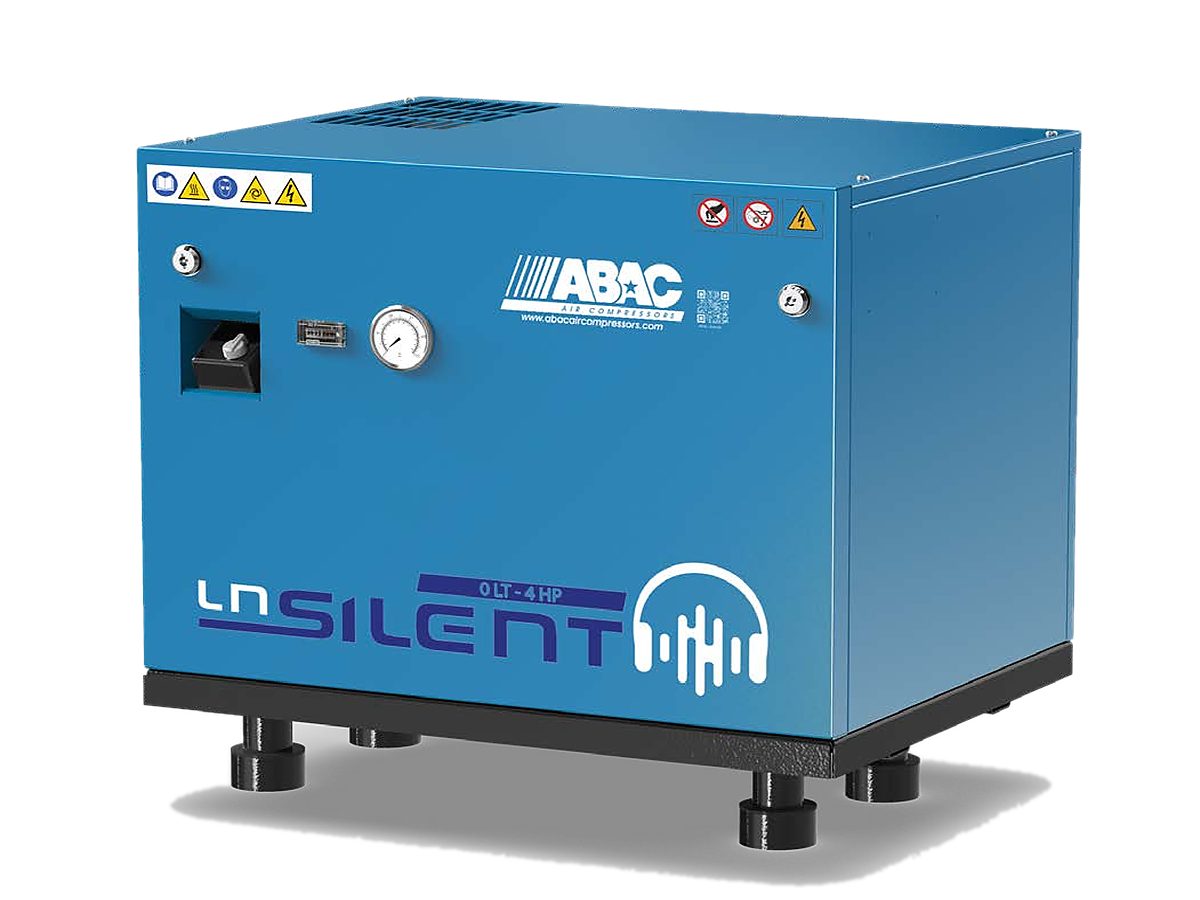 ABAC Silent Line LN
Ten machines with the whole compressor shut inside a steel cabinet lined with acoustic foam — and no receiver of their own. Their air goes straight into pipework or into a separate pressure vessel, so the machine stands where it is out of the way rather than where the work happens. The result is 87 to 89 dB Lwa at ratings that read 96 to 102 dB in an open frame. There are two cabinet sizes, L1 and L2, and pumps from 3 to 7.5 kW.
Four questions that decide the choice
All ten machines are oil-lubricated, V-belt driven, with an aftercooler, and run on a 400 V three-phase supply. They differ in four things.
1. How much air do you need?
The range runs from 490 l/min at the smallest to 1,070 l/min at the 7.5 kW B70. Because the machine carries no store of its own, what counts is the demand that runs continuously — not the peak a receiver would cover elsewhere.
2. Where does the air go next?
These compressors have no receiver. They belong beside an air main or a separate pressure vessel you put next to them. If you have no pipework and do not intend to build any, look for a machine that carries its vessel underneath.
3. Cabinet L1 or L2?
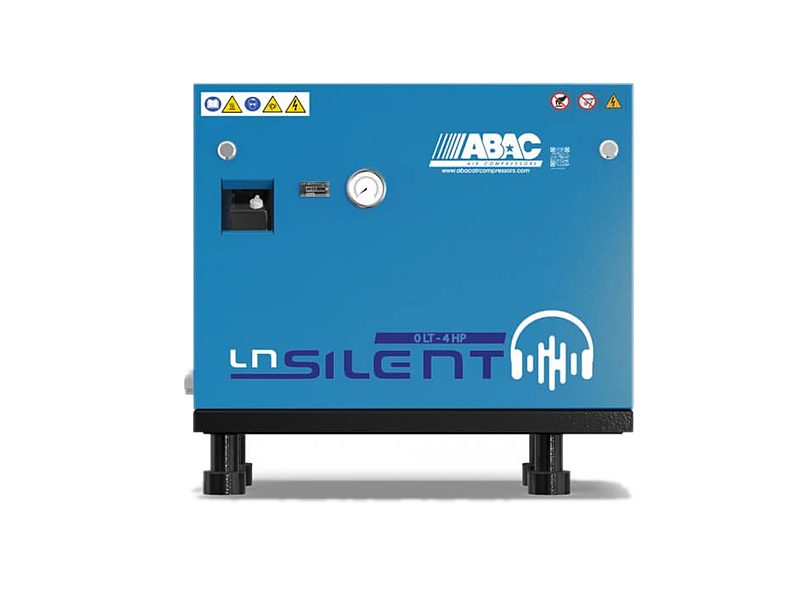
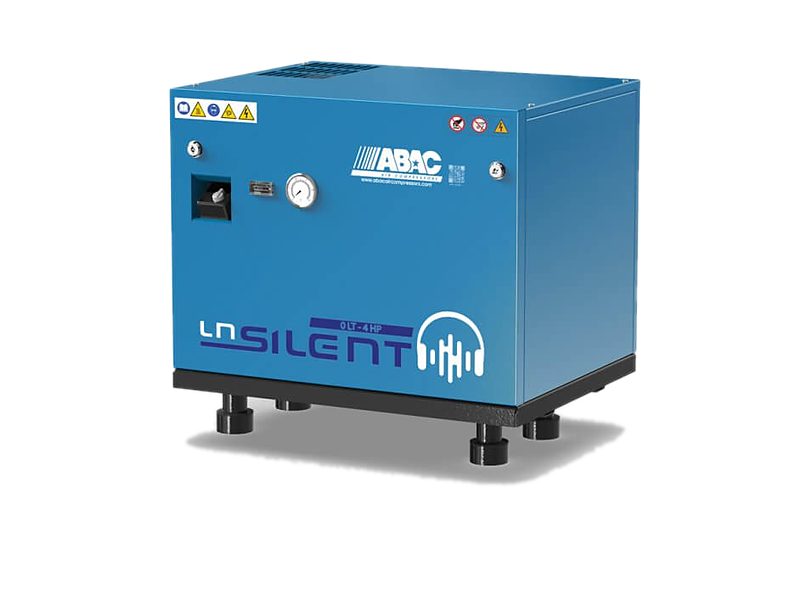
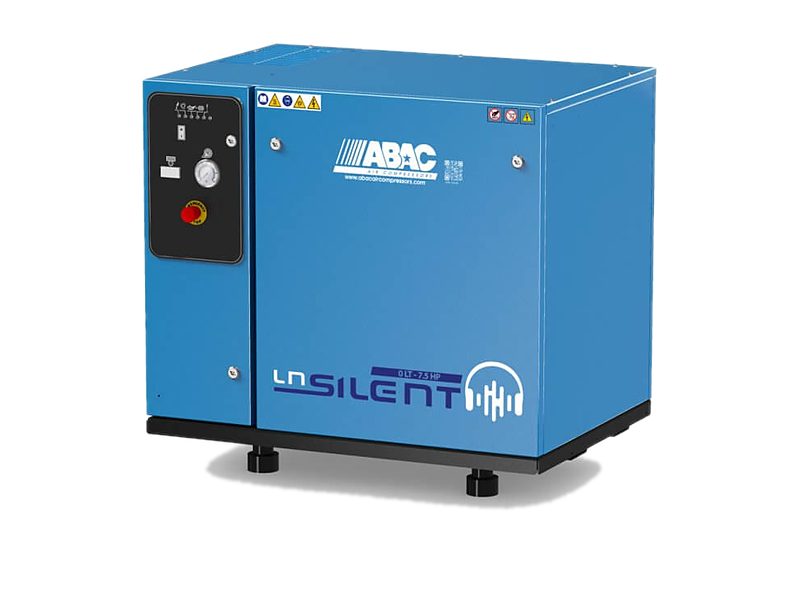
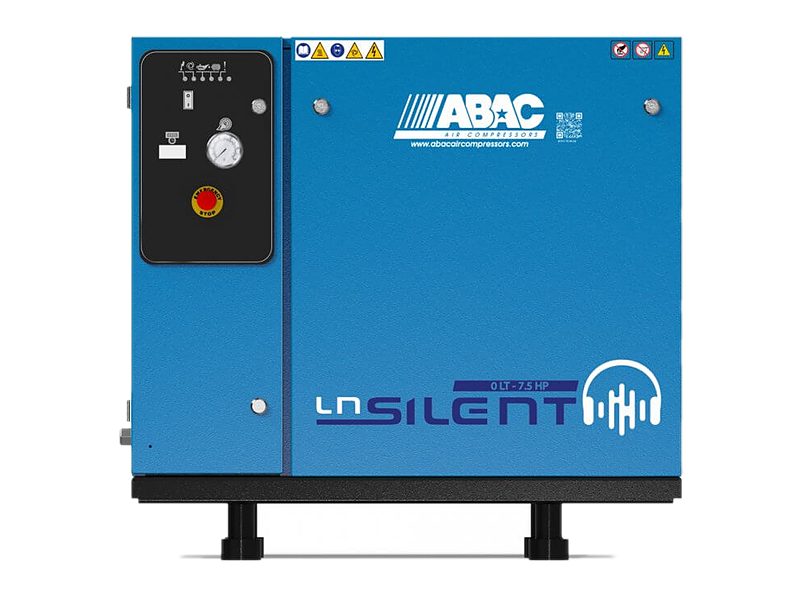
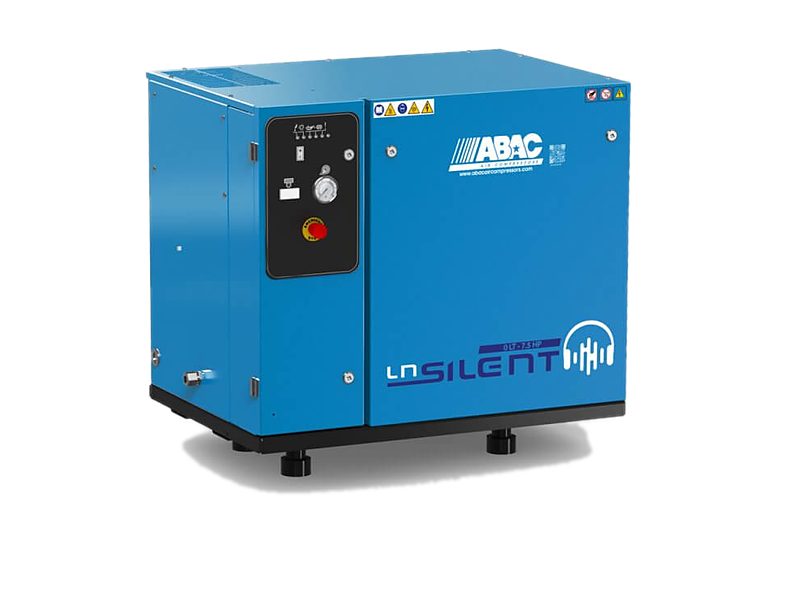
L1 measures 750 × 580 mm and weighs 170 kg; L2 measures 1,000 × 738 mm and weighs 170 to 253 kg. L2 is not merely a bigger box — a stronger pump fits inside it and it adds a control panel with LED fault indication.
4. One stage or two?
Nine of the ten machines are two-stage at 11 bar. The only single-stage one is the A39B-3-L1T at 10 bar — it is here for the lower entry price, not for the output.
Two cabinet sizes
Read the code from the left: pump, motor rating, cabinet size and voltage. B70-7,5-L2T is a B70 pump at 7.5 kW in an L2 cabinet on 400 V. A final X means a star-delta start.
L1 — 750 × 580 × 761 mm
Four machines from 490 to 598 l/min, all 170 kg. The smallest footprint that exists in this power class — the cabinet takes up roughly half a square metre. The panel carries a main switch, a gauge and an hour counter.
L2 — 1,000 × 738 × 955 mm
Six machines from 553 to 1,070 l/min, 170 to 253 kg. The larger cabinet takes pumps up to 7.5 kW and carries a control panel with LED fault indication. Three of them have a star-delta start.
What the cabinet does to the noise
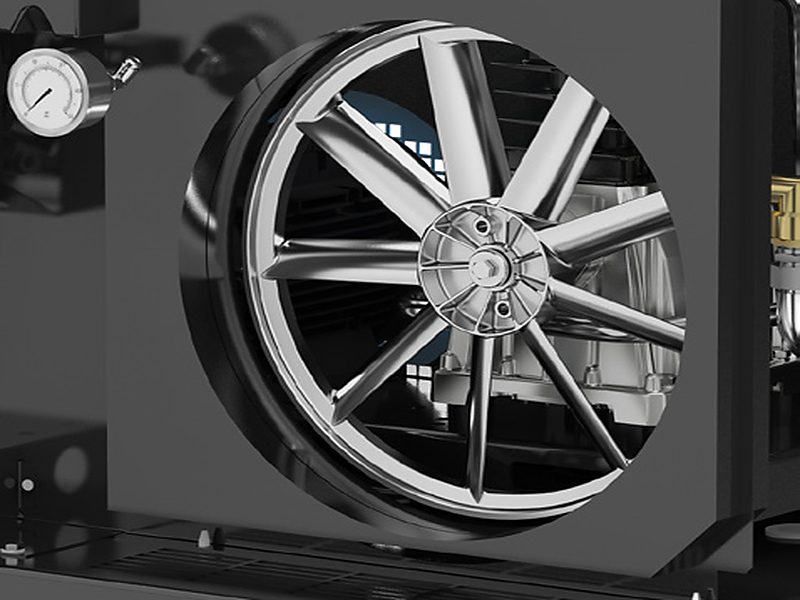
The panels are sheet steel lined with acoustic foam; the whole machine is inside, and all that leaves it is the power lead and the air outlet. Cooling is handled by a pulley whose spokes are shaped like fan blades — it turns with the pump and drives air onto the cylinders, so the closed cabinet does not overheat. The panels come off, so the filter, the oil and the belts are reachable without dismantling the machine.
In figures: a 4 kW machine reads 97 dB Lwa in the open Pro Line frame and 87 dB here inside the cabinet. At 7.5 kW the gap is wider still — 102 dB against 88 dB. Not all of that is the sheet metal: the pump in the largest cabinets turns more slowly (1,150 instead of 1,300 to 1,400 rpm), which is also why it delivers slightly less air than the same rating in an open version.
All ten machines side by side
Soundproofed ABAC Silent Line LN compressors in a cabinet — 10 machines, 3 to 7.5 kW, 490 to 1,070 l/min, 400 V | |||||||||
|---|---|---|---|---|---|---|---|---|---|
| Model | Pump | Cabinet | Motor | Intake | Speed | Pressure | Lwa / Lwp | Weight | Dimensions l × w × h |
| A39B-3-L1T | A39B | L1 | 3 kW | 490 l/min | 1 300 rpm | 10 bar | 88 / 68 dB(A) | 170 kg | 750 × 580 × 761 mm |
| A49B-3-L1T | A49B | L1 | 3 kW | 553 l/min | 1 300 rpm | 11 bar | 89 / 69 dB(A) | 170 kg | 750 × 580 × 761 mm |
| A49B-4-L1T | A49B | L1 | 4 kW | 598 l/min | 1 400 rpm | 11 bar | 89 / 69 dB(A) | 170 kg | 750 × 580 × 761 mm |
| B59-4-L1T | B59 | L1 | 4 kW | 570 l/min | 1 200 rpm | 11 bar | 87 / 67 dB(A) | 170 kg | 750 × 580 × 761 mm |
| A49B-3-L2T | A49B | L2 | 3 kW | 553 l/min | 1 300 rpm | 11 bar | 89 / 69 dB(A) | 170 kg | 1 000 × 738 × 955 mm |
| B59-4-L2T | B59 | L2 | 4 kW | 570 l/min | 1 200 rpm | 11 bar | 87 / 67 dB(A) | 177 kg | 1 000 × 738 × 955 mm |
| B59-4-L2TX | B59 | L2 | 4 kW | 570 l/min | 1 200 rpm | 11 bar | 87 / 67 dB(A) | 181 kg | 1 000 × 738 × 955 mm |
| B60-5,5-L2TX | B60 | L2 | 5.5 kW | 660 l/min | 1 150 rpm | 11 bar | 88 / 68 dB(A) | 240 kg | 1 000 × 738 × 955 mm |
| B70-7,5-L2T | B70 | L2 | 7.5 kW | 1 070 l/min | 1 150 rpm | 11 bar | 88 / 68 dB(A) | 253 kg | 1 000 × 738 × 955 mm |
| B70-7,5-L2TX | B70 | L2 | 7.5 kW | 1 070 l/min | 1 150 rpm | 11 bar | 88 / 68 dB(A) | 253 kg | 1 000 × 738 × 955 mm |
Lwa is the sound power level of the machine, Lwp the sound pressure level at a distance of four metres. Intake is the volume of air the pump draws in. The figures are the manufacturer’s data.
#showmore#
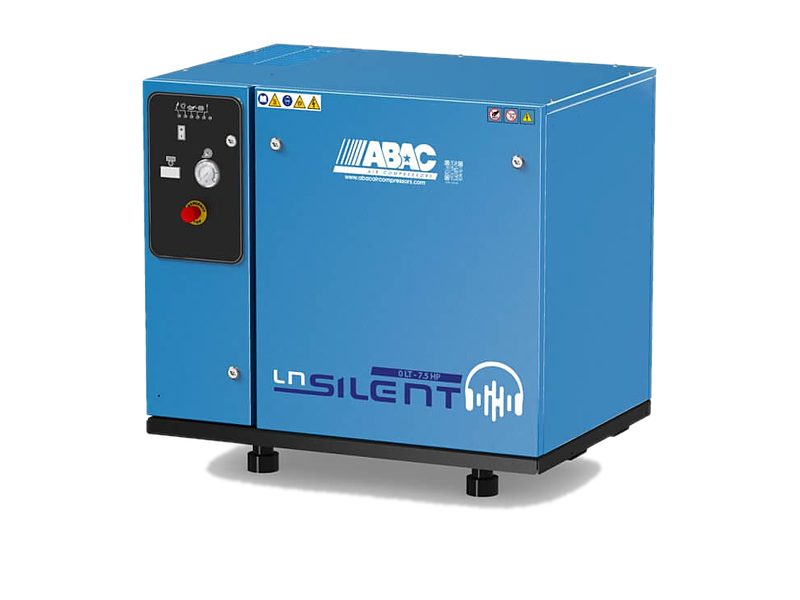
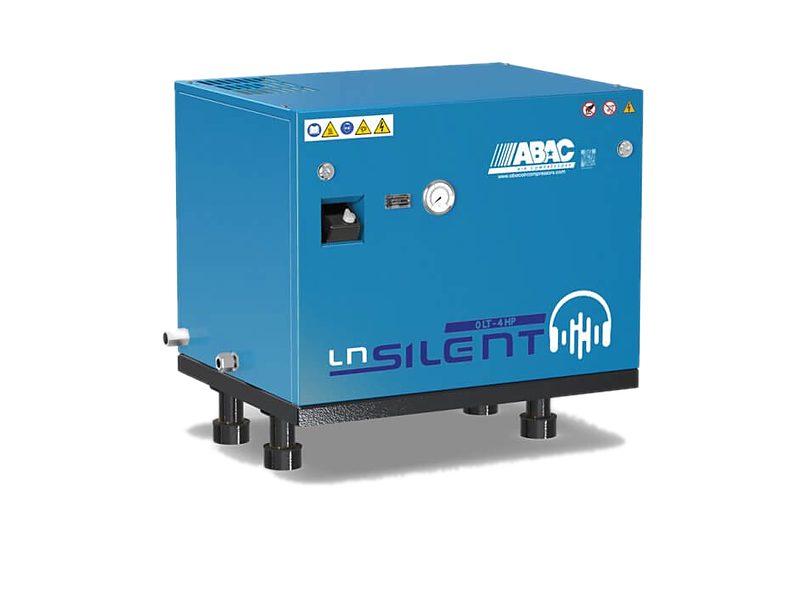
Both cabinets from three sides
The difference between L1 and L2 shows better in photographs than in millimetres: the smaller cabinet is a box with the panel at the top, the larger one has its controls on a separate column at the left.
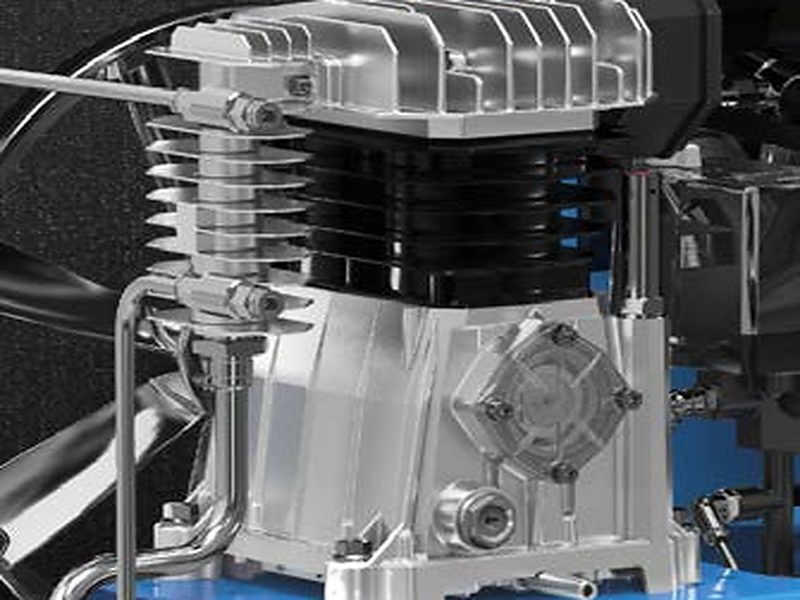
And two looks inside, at what sits under the sheet metal:
What all the machines share
Oil-lubricated pump with aftercooler
An oil-lubricated unit with V-belts and an aftercooler on the outlet — the air leaves cooler and with less condensed water in it.
Cabinet lined with acoustic foam
Sheet-steel panels lined with foam, each removable on its own. The whole machine is inside — pump, motor and belt drive.
Cooling by the pulley
The spokes of the pulley are shaped like fan blades and drive air onto the cylinders of the pump.
Central control panel
Main switch, gauge, pressure regulator and hour counter. The L2 cabinets add LED fault indication.
No receiver of its own
The machine connects to pipework or to a separate pressure vessel. The size of that vessel then follows the peak demand, not the output of the compressor.
Motor protection
A thermal cut-out stops the motor on overload and a pressure switch controls running. These machines are built for partly continuous duty, not for running without a break.
Three-phase supply
All ten machines run on 400 V. The three strongest have a star-delta start, which softens the current surge at the moment of starting.
Ventilek advises
A compressor without a receiver is not unfinished. It is a different way of distributing compressed air. A receiver under the compressor has one drawback: it ties the machine to wherever the vessel stands. Separate the vessel and you can put the compressor in a corner or in the next room and the vessel where the air is actually drawn. With these ten machines that is the whole point — which is why they are chosen by how much air they make per minute, not by litres. The size of the separate vessel then follows the peak demand: the shorter and sharper the draw, the bigger the vessel. If you have no pipework and do not intend to build any, choose a version that carries its vessel underneath.
Frequently asked questions
- Why a compressor without a receiver?
- Because the vessel need not stand where the machine stands. The compressor can be tucked into a corner or behind a wall and the pressure vessel put at the workplace — or left out entirely if the air flows into pipework long enough to act as a store in itself. If you have no pipework, you want the version with its own receiver.
- How big a vessel should I buy for it?
- That follows how sharply you draw air, not the output of the compressor. Tools with short heavy draws (an impact wrench, a sandblaster) want a bigger vessel; a steady draw (a spray gun, machining) manages with a smaller one. The vessel is connected downstream of the compressor outlet.
- What is the difference between the L1 and L2 cabinet?
- L1 measures 750 × 580 × 761 mm, L2 measures 1,000 × 738 × 955 mm. Pumps up to 4 kW fit into L1, up to 7.5 kW into L2. L2 also carries a control panel with LED fault indication. Weight runs from 170 kg for L1 to 253 kg for the strongest L2.
- What does the X at the end of the code mean?
- A star-delta start. The motor runs up in two steps, so the current surge at starting is gentler — worth having where the compressor cuts in often or where the supply is near its limit. The B59-4-L2TX, B60-5,5-L2TX and B70-7,5-L2TX have it.
- Will the machine overheat in a closed cabinet?
- Cooling is handled by the pulley, whose spokes are shaped like fan blades and drive air onto the cylinders of the pump; the air passes through the cabinet and leaves it. The condition is that the grilles stay clear and the machine is not pushed hard against a wall.
- Why does the strongest machine turn more slowly than a weaker one?
- Because that is how the noise is kept down. The B60 and B70 in a cabinet turn at 1,150 rpm, while the same ratings in an open version run at 1,300 to 1,400. The price of the quieter running is that the machine delivers slightly less air than it would at higher speed.
- How does the A39B-3-L1T differ from the rest?
- It is the only single-stage machine in the category and works at 10 bar, while the other nine are two-stage at 11 bar. It delivers 490 l/min. The other single-stage ABAC machines are in the Pro Line range.
- How loud is it against an open compressor?
- A 4 kW machine reads 97 dB Lwa in the open Pro Line frame and 87 dB here in the cabinet. At 7.5 kW it is 102 dB against 88 dB. Four metres from the machine, 87 dB Lwa corresponds to 67 dB of sound pressure.
Where to go next
If these ten do not fit, the path continues within the same family: You will find an overview of every range in the Compressors category.
- The same cabinets on a receiver — when you have no air main and the vessel should sit right under the machine
- The same cabinets with a dryer — cabinet, five-hundred-litre receiver and refrigeration dryer in one unit
- The smaller A29 and A29B cabinets — the same idea two classes down — 1.5 and 2.2 kW, 81 dB, from an ordinary socket
- The same ratings without a cabinet — the open version on a 200 to 500 l receiver, louder and cheaper to buy
- Compressors without a vessel — every machine without a receiver across brands and ratings
- The whole ABAC Silent range — the hub for every soundproofed version
- How to choose a compressor — from what your tools use to output and receiver size
The values given are the ABAC manufacturer data for the individual machines. Intake is the volume of air drawn in, Lwa the sound power level, Lwp the sound pressure level at four metres. Dimensions and weights are for the machine without accessories.


