
ABAC Silent Line LN piston compressors with a dryer on a 500 l receiver
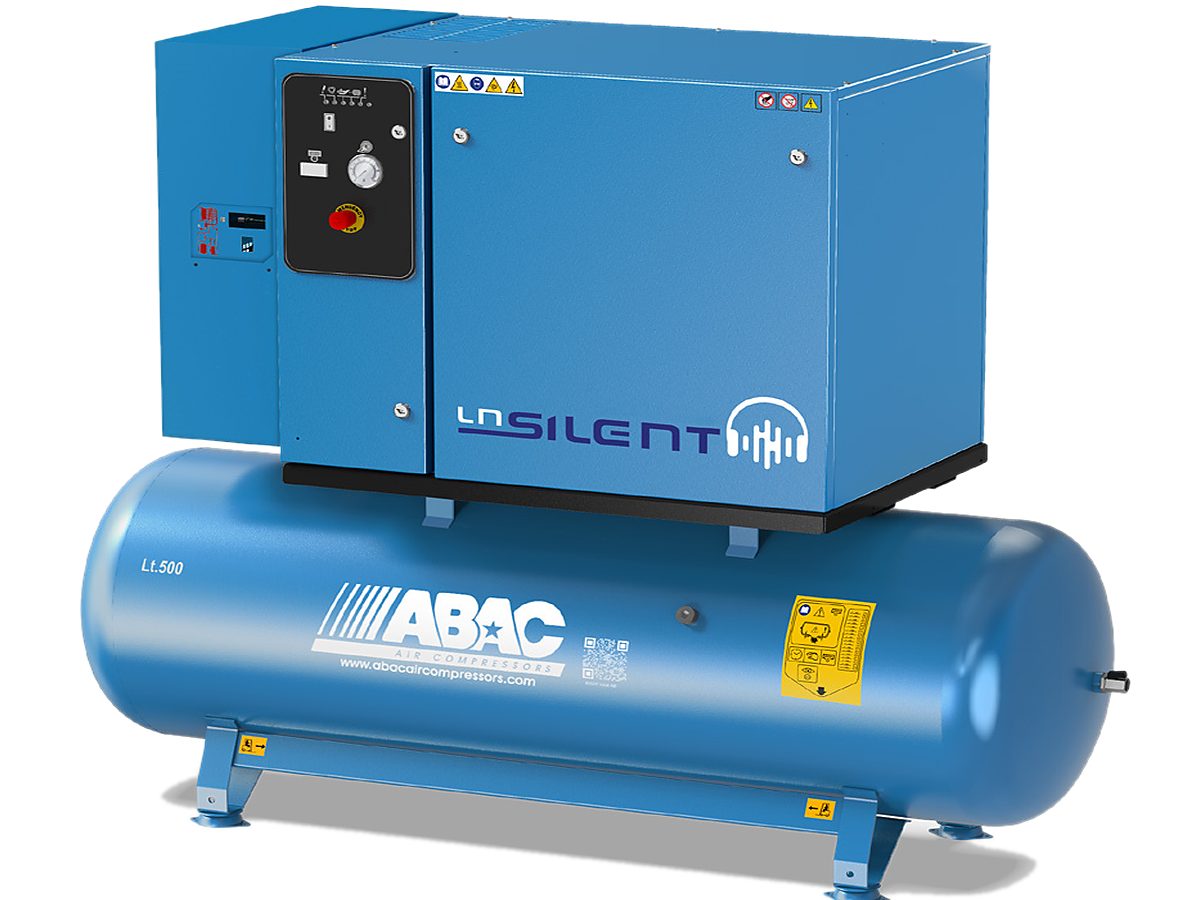 ABAC Silent Line LN with a dryer
Six machines where the foam-lined cabinet holds not only the compressor but also a refrigeration dryer — and the whole cabinet stands on a horizontal 500 litre receiver. What sits on the floor is a single unit: connect it to power and to the pipework and it delivers dry compressed air straight away. Noise comes out at 87 and 88 dB Lwa for pumps that run at 97 to 102 dB in the open. Motors range from 4 to 7.5 kW.
Four things that decide the choice
All six machines are oil-lubricated, two-stage at 11 bar, belt-driven and run on a three-phase 400 V supply. They stand on the same five-hundred-litre receiver in the same cabinet. They differ in four things.
1. How much air do you need?
Three pumps: B59-4 at 570 l/min, B60-5.5 at 660 l/min and B70-7.5 at 1,070 l/min. The line around a thousand litres a minute is where one compressor can run several stations at once.
2. Do you really need a dryer?
Yes where moisture in the air causes trouble: spray finishing, sandblasting, air tools with fine mechanisms, pipework running through an unheated hall. No where you only blow off and inflate, and condensate does no harm. On these machines the dryer cannot be left out — it is part of the frame.
3. Direct or star-delta starting?
Three machines carry an X at the end of the code — the motor starts in two steps, so the current surge at start-up is gentler. It matters where the supply is weak or where the compressor cuts in often. On a seven-and-a-half-kilowatt motor it is closer to a necessity.
4. A built-in or a separate dryer?
A built-in dryer takes no extra floor space and comes connected from the factory. A separate dryer, on the other hand, can be replaced independently of the compressor and sized exactly to the flow of the pipework. Anyone building from scratch usually does better with the package; anyone who already has a compressor buys the dryer separately.
Three pumps in one assembly
The code reads from the left: pump, motor rating, receiver volume, cabinet size and supply, and the final D means a dryer. B70-7.5-500L2TD is therefore a B70 pump with 7.5 kW on a five-hundred-litre receiver in an L2 cabinet on 400 V with a dryer. An X before it means star-delta starting.
B59-4 — 570 l/min
302 and 306 kg. The calmest of the three at 87 dB Lwa. The four-kilowatt pump turns at 1,200 rpm inside the cabinet. For a workshop where one or two people draw air and quiet matters.
B60-5.5 — 660 l/min
404 kg. Ninety litres more at 88 dB Lwa and a hundred kilos of sturdier build. The pump runs at 1,150 rpm. A sensible middle when one station stops being enough.
B70-7.5 — 1,070 l/min
448 kg. The most air this assembly can do, also at 88 dB Lwa and 1,150 rpm. For a shop where several stations hang on the air at the same time.
What the dryer does to the air
Compressed air carries water with it, and once it cools in the pipework that water comes out — leaving marks in paint, rust in tools and ice in winter. A refrigeration dryer first chills the air, lets the water drop out as condensate and then warms the air again. The catalogue pressure dew point is +7 °C: the air downstream stays dry as long as the pipework does not fall below that line.
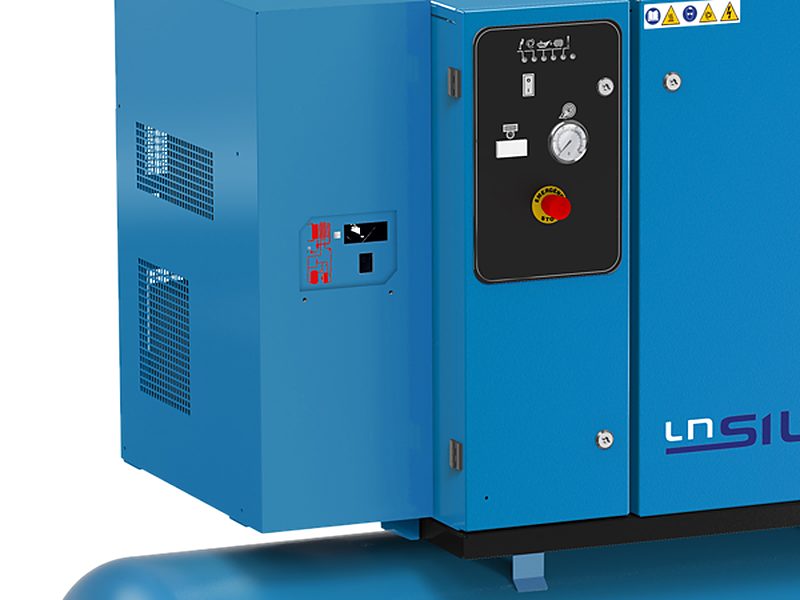
The dryer sits inside the same cabinet as the pump — you can tell it by its own panel with the refrigeration circuit and by the grilles on the side. The refrigerant is R513A, and the condensate drain is electronic, switching on demand rather than at fixed intervals. The dimensions and weight of the assembly stay the same as on the version without a dryer.
What the soundproofing costs
All three pumps are deliberately slowed inside the cabinet — and that, together with the steel and the foam, is why they run so calmly. B59-4 turns at 1,200 rpm instead of 1,400 and draws 570 instead of 653 l/min, but 97 dB becomes 87 dB.
B60-5.5 goes from 1,400 to 1,150 rpm and from 827 to 660 l/min for 88 dB instead of 102. B70-7.5 goes from 1,300 to 1,150 rpm and from 1,210 to 1,070 l/min, also for 88 dB. Fourteen decibels are heard as half the noise — and the slower running also means a lower working temperature, which is no small thing with a dryer in the same cabinet. Anyone who needs the most air and does not care about noise will find the same pumps with a dryer in the open version as well.
All six machines side by side
Soundproofed ABAC Silent Line LN compressors with a dryer — 6 machines, 4 to 7.5 kW, 570 to 1,070 l/min, 500 l receiver | |||||||||
|---|---|---|---|---|---|---|---|---|---|
| Model | Receiver | Cabinet | Starting | Motor | Intake | Speed | Pressure | Lwa / Lwp | Weight |
| B59-4-500L2TD | 500 l | L2 | direct | 4 kW | 570 l/min | 1,200 rpm | 11 bar | 87 / 67 dB(A) | 302 kg |
| B59-4-500L2TXD | 500 l | L2 | star-delta | 4 kW | 570 l/min | 1,200 rpm | 11 bar | 87 / 67 dB(A) | 306 kg |
| B60-5,5-500L2TD | 500 l | L2 | direct | 5.5 kW | 660 l/min | 1,150 rpm | 11 bar | 88 / 68 dB(A) | 404 kg |
| B60-5,5-500L2TXD | 500 l | L2 | star-delta | 5.5 kW | 660 l/min | 1,150 rpm | 11 bar | 88 / 68 dB(A) | 404 kg |
| B70-7,5-500L2TD | 500 l | L2 | direct | 7.5 kW | 1,070 l/min | 1,150 rpm | 11 bar | 88 / 68 dB(A) | 448 kg |
| B70-7,5-500L2TXD | 500 l | L2 | star-delta | 7.5 kW | 1,070 l/min | 1,150 rpm | 11 bar | 88 / 68 dB(A) | 448 kg |
Lwa is the sound power level of the machine, Lwp the sound pressure level at a distance of four metres. Intake is the volume of air the pump draws in. Every assembly measures 1,943 × 738 × 1,593 mm. All figures are manufacturer data.
#showmore#
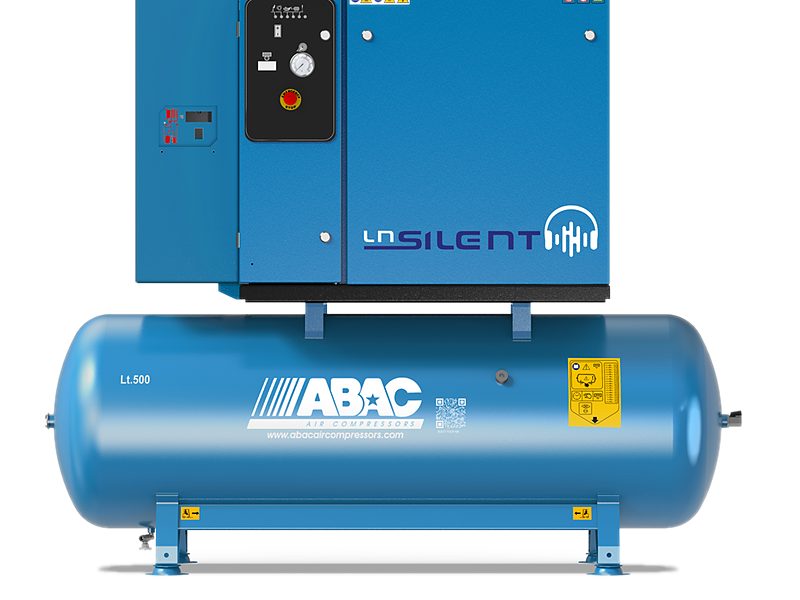
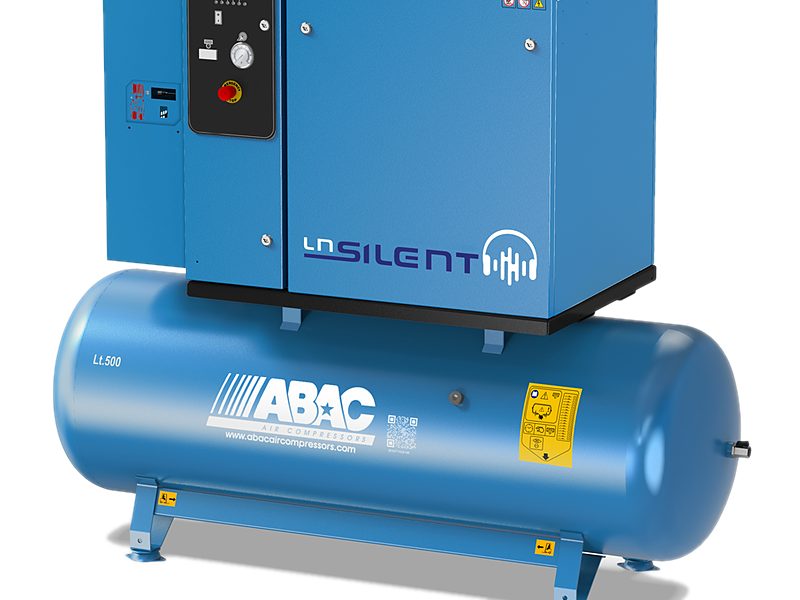
The assembly from three sides
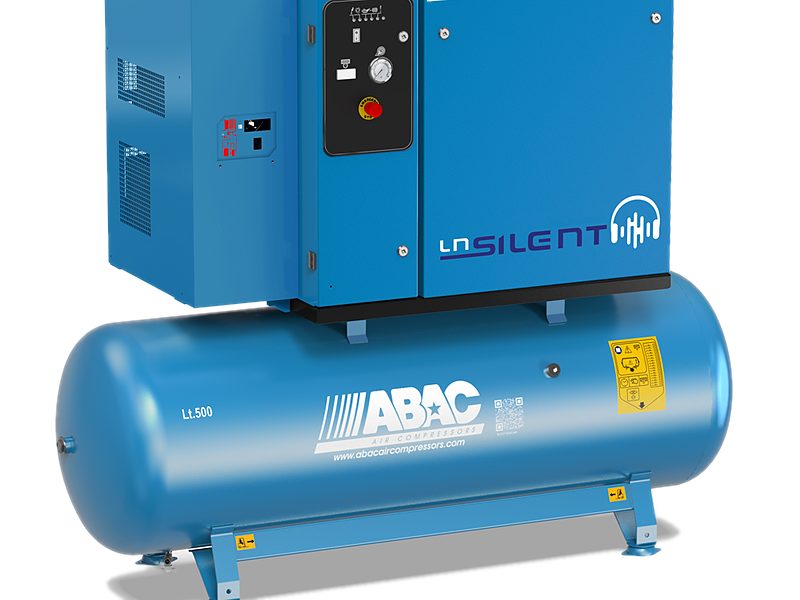
From the outside the dryer shows in two places: the grilles on the left-hand side that carry heat away from the refrigeration circuit, and the second panel next to the main controls.
What all the machines share
Two-stage oil-lubricated pump
An oil-lubricated unit with V-belts and an air aftercooler. Two-stage compression gives 11 bar at a lower temperature and with less strain on the pump.
Cabinet with sound-absorbing foam
Sheet-metal panels lined with foam, each one removable on its own. The whole machine is inside — pump, motor, belt drive and dryer.
Refrigeration dryer in the cabinet
Pressure dew point +7 °C, R513A refrigerant, electronic condensate drain. Connected from the factory, with no hoses and no extra floor space.
Horizontal 500 l receiver
The receiver forms the base of the whole machine and carries it on four feet. The large volume means fewer motor starts per hour.
Central control panel
Main switch, pressure gauge, pressure regulator, hour counter and emergency stop button in one place.
Motor protection
Thermal protection shuts the motor down on overload and a pressure switch runs the machine. These machines are built for partly continuous duty, not for running without a break.
Two-year warranty
All machines carry a two-year warranty; the catalogue extension to three years (ABA-3R) can be bought with the machine.
Ventilek recommends
This is a whole compressor room in one unit. Compressor, five-hundred-litre receiver and dryer sit under one sheet of steel, connected at the factory and soundproofed together. You stand it on the floor, connect it to power and to the pipework — and dry air comes straight out. Start choosing by asking whether you really need the dryer: for blowing off and inflating it is unnecessary, but for spray finishing or for pipework running through a cold hall it is the first thing you buy. Only then look at litres per minute.
Frequently asked questions
- What does a dew point of +7 °C mean?
- It is the temperature at which the air downstream of the dryer would start to condense again. As long as the pipework stays warmer than +7 °C, the air stays dry. For outdoor or unheated runs you therefore have to allow for how low the temperature falls in winter — there only an adsorption dryer with a far lower dew point helps.
- Can the dryer be added later?
- Not on these machines — the dryer is built into the cabinet and forms part of the machine. Anyone who does not need it yet buys the same machine without a dryer and can add a separate dryer to the pipework later.
- How does it differ from the open version with a dryer?
- Cabinet and speed. The same pumps with a dryer also exist in an open frame, where they turn faster, deliver more air and run at 97 to 102 dB Lwa. Here they are slowed to 87 and 88 dB and deliver less air. It is a trade of litres for quiet.
- What does the X at the end of the code mean?
- Star-delta starting. The motor runs up in two steps, so the current surge at start-up is gentler. Three machines in the category have it: B59-4-500L2TXD, B60-5.5-500L2TXD and B70-7.5-500L2TXD.
- How much room does the machine take?
- All six measure 1,943 × 738 × 1,593 mm, so just under two metres long and one metre sixty high. Allow a gap from the walls so the dryer circuit has somewhere to give off its heat.
- Does the condensate have to be drained somewhere?
- Yes. Both the dryer and the receiver release condensed water; on the dryer an electronic drain handles it. The condensate contains oil, so it does not belong in the sewer — it goes to an oil-water separator.
Where to go next
This category is one of four branches of the soundproofed Silent Line LN range. They differ in what sits under the cabinet and inside it. You will find an overview of every range in the Compressors category.
- Silent Line LN without a dryer — the same assemblies without a dryer, plus a smaller 270 l receiver and the narrower L1 cabinet
- Silent Line LN without a receiver — the cabinet alone — for pipework or a separate tank
- Silent Line LN with a 27 l receiver — the smallest machines of the range, 1.5 and 2.2 kW
- The same pumps with a dryer in an open frame — more air for less money, but 97 to 102 dB
- B59 to B70 pumps without a cabinet or a dryer — the basic version with no enclosure
- Separate air dryers — refrigeration and adsorption dryers to fit into the pipework
- The whole soundproofed ABAC Silent range — the hub of every soundproofed ABAC piston compressor
Under the European machinery directive the sound power level Lwa is stated on the machine plate; the sound pressure level Lwp is measured at a distance of four metres over a hemispherical surface and is roughly 20 dB(A) lower. The pressure dew point applies to the rated conditions stated by the manufacturer. All figures are manufacturer data.


