
Soundproofed ABAC A29 and A29B compressors in a cabinet with a 27 l receiver
 ABAC Silent LN
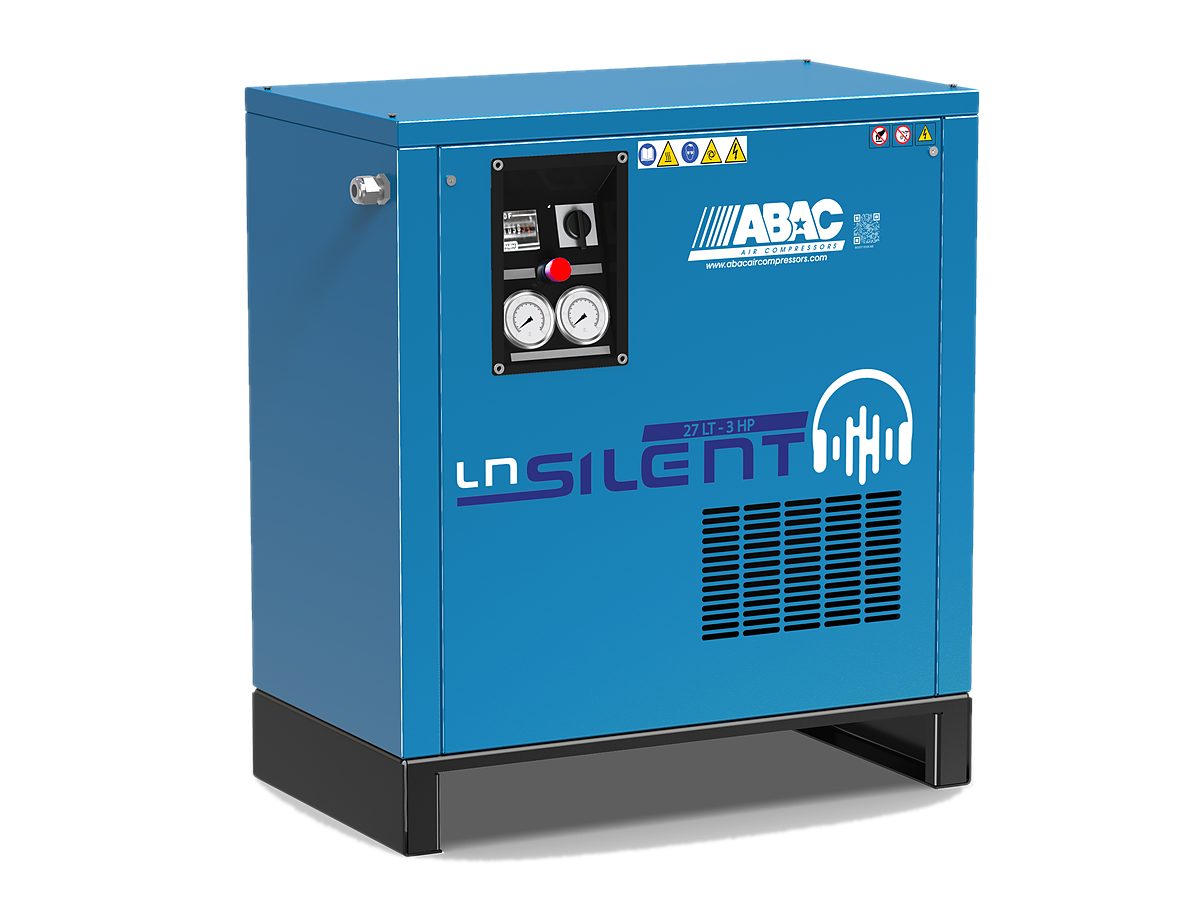
Four ABAC compressors with the whole machine under the sheet metal — pump, motor, belts and receiver. Not a cover over the pump, but a closed cabinet the size of a small bedside table: a 761 × 430 mm footprint and 845 mm tall. All that leaves it is the power lead and a quick coupling. The result is 81 and 82 dB Lwa, twelve to thirteen decibels below the same pumps in an open frame. The receiver holds 27 litres and sits inside the cabinet — it does not build an hour of stored air, it smooths the pulses and lets the machine run steadily.
Four questions that decide the choice
All four machines are oil-lubricated twin-cylinder pumps driven by V-belts, inside a steel cabinet with a twenty-seven-litre receiver. They differ in only two things — but you have four decisions to make.
1. How much air will you use?
The A29 pump draws 255 l/min, the A29B 320 l/min. Add up the tools that will run at the same time. In this category that matters more than elsewhere: a small receiver will not cover the peak for you, the machine has to keep up continuously.
2. Socket, or a three-phase supply?
A code ending in M is 230 V, a code ending in T is 400 V. Both voltages exist at both ratings, so the choice of output and the choice of supply do not restrict each other.
3. Where does the air go next?
Twenty-seven litres is a buffer vessel, not a store. These machines are installed next to an air main or beside a larger separate receiver. If you have no pipework, look for a compressor with its own 90 to 270 litre receiver.
4. How close to people will it stand?
That is the whole point of the cabinet. 81 dB Lwa means the machine can stand in a room where people work and talk — not behind a wall, not in a lean-to.
Two pumps, four machines
Read the code from the left: pump, motor rating, receiver volume, cabinet size and voltage. A29B-2,2-27L0T is an A29B pump at 2.2 kW, a 27 litre receiver, an L0 cabinet and 400 V. The final M means 230 V, T means 400 V.
A29 — 1.5 kW
255 l/min at 1,075 rpm, 81 dB Lwa and 61 dB at four metres, 86 kg. Two machines: 230 V and 400 V. The pump turns slowly, and that is the main reason the whole cabinet stays this calm.
A29B — 2.2 kW
320 l/min at 1,350 rpm, 82 dB Lwa and 62 dB at four metres, 87 kg. Two machines again, 230 V and 400 V. Twenty-five per cent more air costs you a single decibel and one kilogram.
A cabinet, not a cover
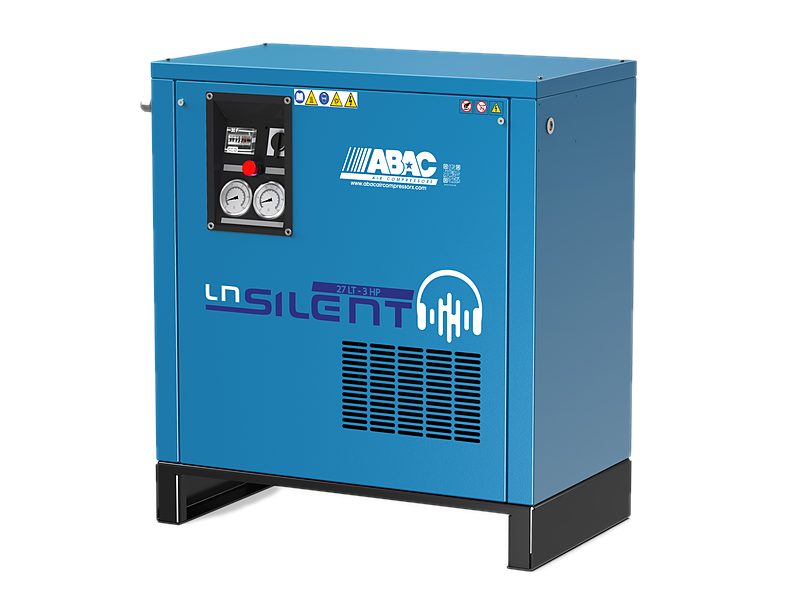
In the other soundproofed ABAC ranges the cover sits over the pump and the rest of the machine — motor, receiver, pulley — stays in the open. Here everything is inside. The cabinet is all sheet steel, held together by removable panels, and it has two grilles: it draws cooling air in at the front and blows it out at the back. The condensate drain cock is at the lower left of the rear panel, so you never have to reach in from the front.
The figures show it best. The same A29B pump at 1.5 kW reads 93 dB Lwa in an open frame, 89 dB under a cover over the pump and 81 dB here inside the cabinet. At 2.2 kW the gap is wider still: 95 dB in the open version against 82 dB in the cabinet. Decibels do not add up linearly — a twelve-decibel difference is heard as roughly half the noise.
All four machines side by side
Soundproofed ABAC A29 and A29B compressors in a cabinet — 4 machines, 10 bar, 27 l receiver, 230 and 400 V, 81 and 82 dB Lwa | |||||||||
|---|---|---|---|---|---|---|---|---|---|
| Model | Pump | Motor | Intake | Speed | Receiver | Voltage | Lwa / Lwp | Weight | Dimensions l × w × h |
| A29-1,5-27L0M | A29 | 1.5 kW | 255 l/min | 1 075 rpm | 27 l | 230 V | 81 / 61 dB(A) | 86 kg | 761 × 430 × 845 mm |
| A29-1,5-27L0T | A29 | 1.5 kW | 255 l/min | 1 075 rpm | 27 l | 400 V | 81 / 61 dB(A) | 86 kg | 761 × 430 × 845 mm |
| A29B-2,2-27L0M | A29B | 2.2 kW | 320 l/min | 1 350 rpm | 27 l | 230 V | 82 / 62 dB(A) | 87 kg | 761 × 430 × 845 mm |
| A29B-2,2-27L0T | A29B | 2.2 kW | 320 l/min | 1 350 rpm | 27 l | 400 V | 82 / 62 dB(A) | 87 kg | 761 × 430 × 845 mm |
Lwa is the sound power level of the machine, Lwp the sound pressure level at a distance of four metres. Intake is the volume of air the pump draws in. The figures are the manufacturer’s data.
Outside the listing, older cabinet versions with larger pumps have also run out (B59 at 4 kW, B60 at 5.5 kW and B70 at 7.5 kW, each with and without an aftercooler). We no longer supply those; at that size the range that continues today is SLN.
#showmore#
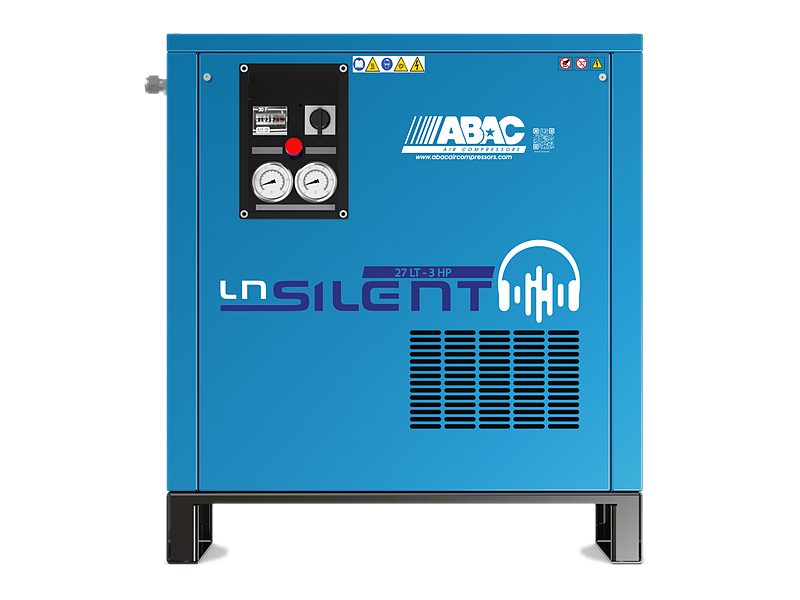
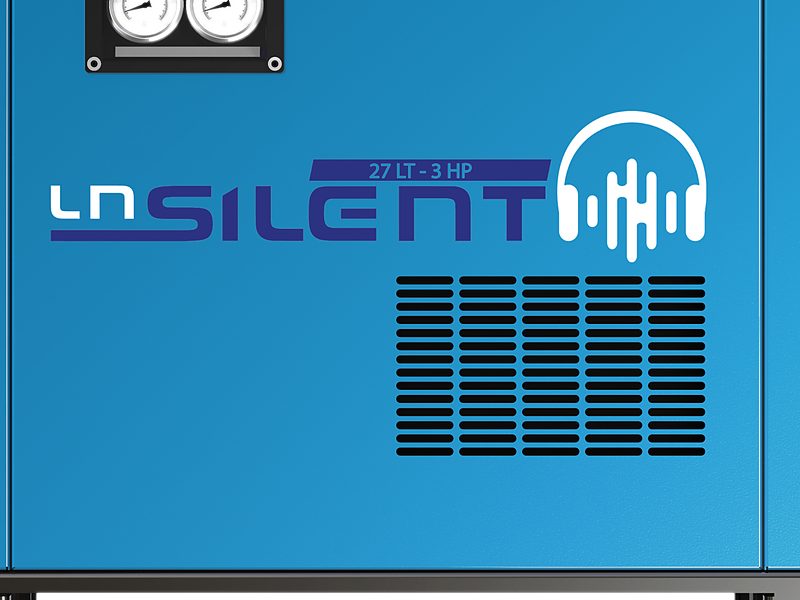
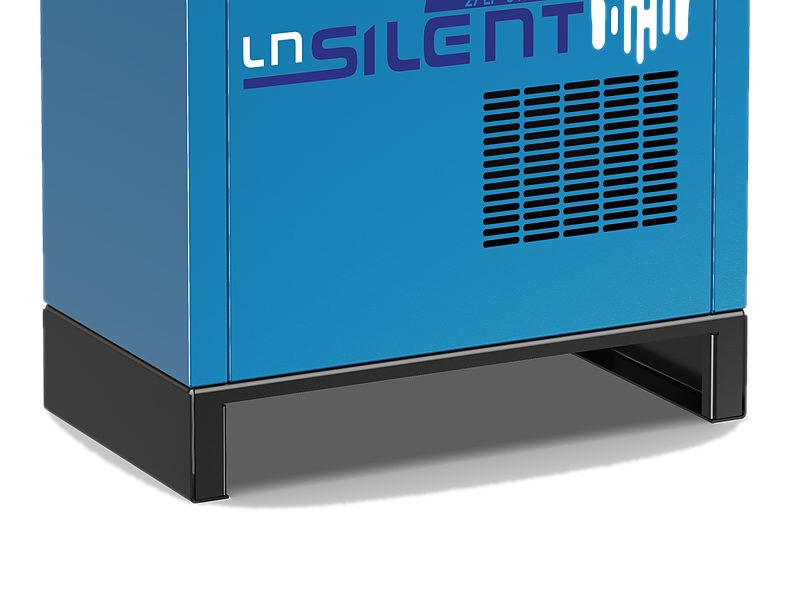
The cabinet from every side, and what is inside it
From the outside it is a smooth blue box. What is interesting is what fitted into it.
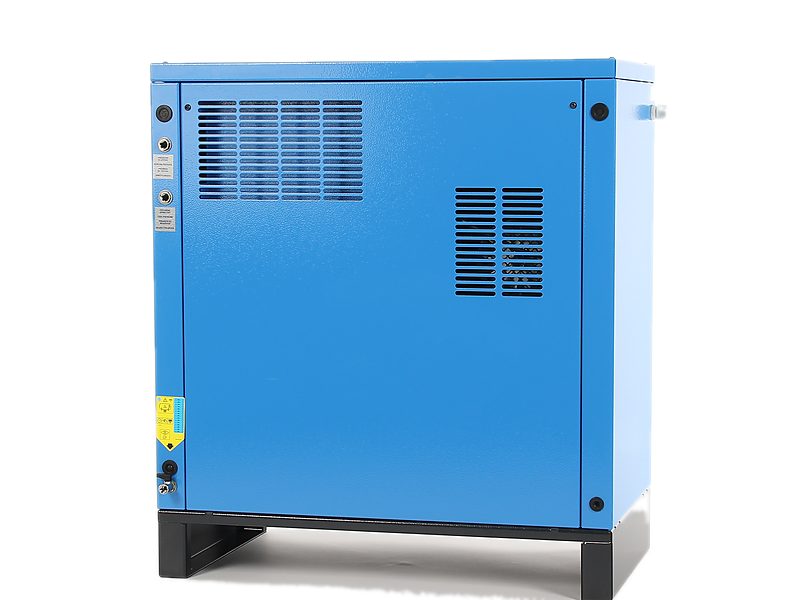
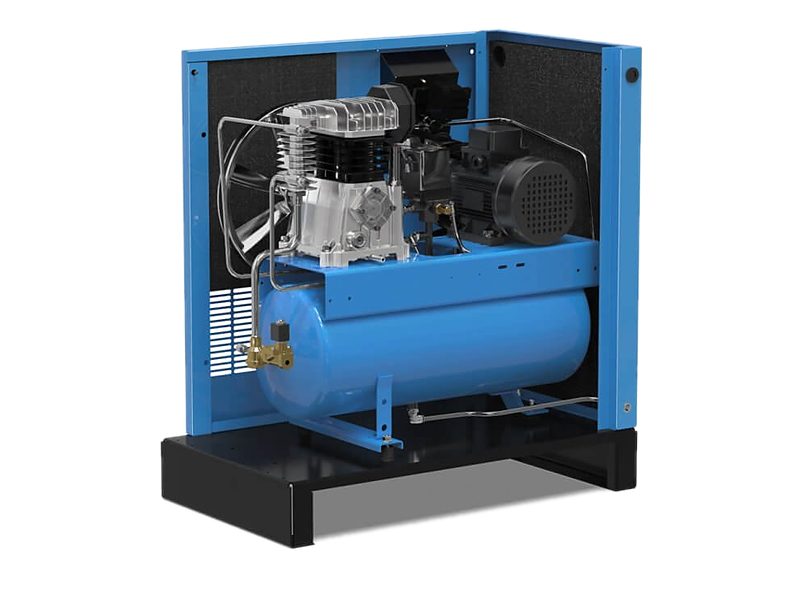
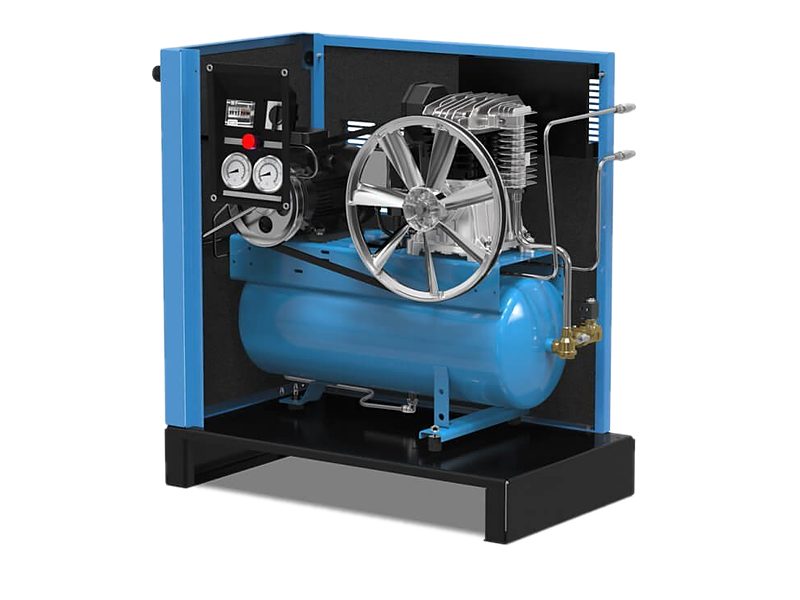
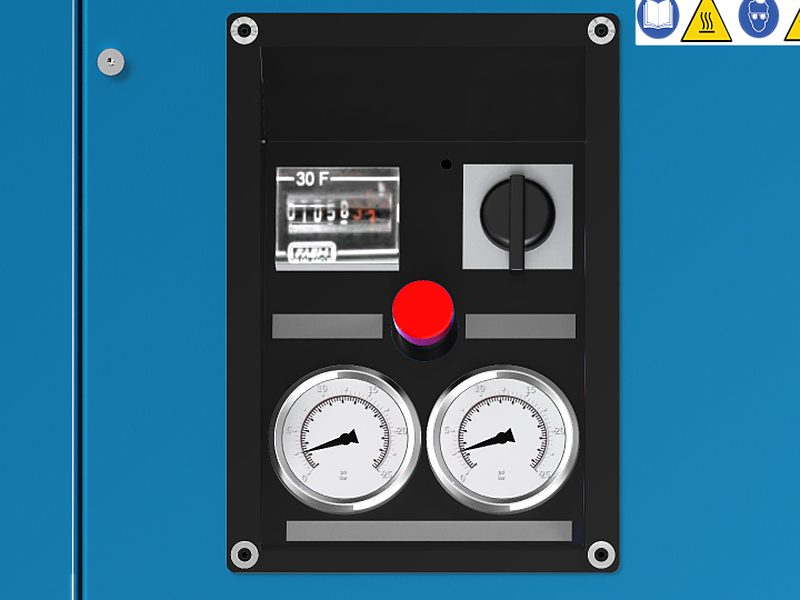
And three details the listing photographs never show:
What all four machines share
Twin-cylinder oil-lubricated pump
One stage, two cylinders, oil lubrication, a 0.7 litre fill and a sight glass reachable once a panel is off.
V-belt drive
A belt drive links the motor and the pump. The pump turns more slowly than the motor — which is why the machine is calmer than a direct-drive compressor.
All-steel cabinet
Removable panels, intake at the front, exhaust at the back. The whole machine including the receiver is inside.
27 l receiver inside
A horizontal 10 bar vessel under the pump, with a safety valve and a condensate cock brought out through the panel.
Panel with an hour counter
Two gauges, a pressure regulator, the main switch and a counter of hours worked — service intervals can be tracked by it rather than by the calendar.
Motor protection
A thermal cut-out stops the motor on overload. These machines are built for occasional to partly continuous duty, not for running without a break.
The same pumps as the rest of the range
A29 and A29B are identical to the open and the covered versions — only what surrounds them changes.
Ventilek advises
Twenty-seven litres is not a store of air. It is a buffer vessel. This is the one thing this category keeps coming back to. A 27 litre receiver will not cover a peak in demand — that is not what it is for. Its job is to smooth the pulses from a twin-cylinder pump and give the pressure switch a sensible gap between cutting in and cutting out. The air you use has to be made as you go: 255 or 320 litres a minute. If you own a tool that occasionally asks for more, put a separate receiver downstream of the compressor — the cabinet expects it and the outlet is ready for it. If you would rather not install one, choose a version that carries its own receiver underneath.
Frequently asked questions
- Why does the compressor have only 27 litres when elsewhere it is 90 or 270?
- Because this range is not built as a standalone air source for one tool, but as a source for pipework. The twenty-seven-litre vessel inside the cabinet smooths the pulses from the twin-cylinder pump and holds the pressure between switch operations. The store of air comes either from the pipework itself or from a separate receiver downstream. If you want that store right under the compressor, you want the stationary version on a 90 to 270 l receiver.
- Can I connect a larger receiver to it?
- Yes, and with this range that is the usual arrangement. The receiver is connected downstream of the compressor outlet — the compressor fills both it and the pipework. The size of the separate vessel follows the peak demand, not the output of the compressor.
- Will it overheat if it is completely enclosed?
- The cabinet has guided cooling: air is drawn in through the grille on the front panel, passes the pump and motor and leaves through two grilles at the back. The condition is that nothing blocks the grilles — so do not push the machine back against a wall and do not put things on top of it.
- How much space does it need around it?
- The footprint is 761 × 430 mm and the height 845 mm. Leave clear space mainly behind the machine for the exhaust and in front of it for the panel and for taking the front cover off. It fits into a corner facing the wall exactly as badly as any other compressor.
- How do I reach the filter and the oil?
- The cabinet panels are removable. With one off, the pump, the sight glass, the air filter and the belts are all in view. The hour counter on the panel tells you when it is time — compressor service intervals are counted in hours worked, not from the date of purchase.
- What is the difference between the A29 and the A29B?
- The volume of air drawn in, and the speed. The A29 at 1.5 kW draws 255 l/min at 1,075 rpm; the A29B at 2.2 kW draws 320 l/min at 1,350 rpm. The difference in noise is a single decibel (81 against 82 dB Lwa) and in weight one kilogram.
- What do M and T at the end of the code mean?
- Voltage. M is 230 V from an ordinary socket, T is 400 V with a three-phase supply. Neither output nor noise changes with it — both variants exist at 1.5 kW and at 2.2 kW.
- How loud is it compared with other ABAC compressors?
- The same A29B pump at 1.5 kW reads 93 dB Lwa in the open Pro Line frame, 89 dB with a cover over the pump in the Silent range, and 81 dB here in the cabinet. At 2.2 kW it is 95 dB against 82 dB. Four metres from the machine you will measure 61 and 62 dB respectively.
Where to go next
If these four do not fit, the path continues within the same family: You will find an overview of every range in the Compressors category.
- Stationary A29B and A39B — the same pumps with their own 90 to 270 l receiver, on feet
- Mobile A29B and A39B — the same pumps on wheels with a handle, twelve machines
- The SLN range — a cabinet at larger ratings too, from 4 kW upwards
- The LN range with a dryer — several classes up: a cabinet with a 500 l receiver and a refrigeration dryer
- The whole ABAC Silent range — the hub for every soundproofed version
- Super Silent OS — the oil-free version for surgeries and laboratories
- How to choose a compressor — from what your tools use to output and receiver size
The values given are the ABAC manufacturer data for the individual machines. Intake is the volume of air drawn in, Lwa the sound power level, Lwp the sound pressure level at four metres. Dimensions and weights are for the machine without accessories.
Bestsellers


Product sorting
List of products

A compressor for a room where people work and talk: the whole machine, receiver included, sits under sheet steel. The A29 pump is enough for a tyre inflator, a blow gun, a...

A compressor for a room where people work and talk: the whole machine, receiver included, sits under sheet steel. The A29 pump is enough for a tyre inflator, a blow gun, a...

