
Stationary ABAC Silent A29B and A39B compressors on 90 to 270 l receivers
 ABAC Silent
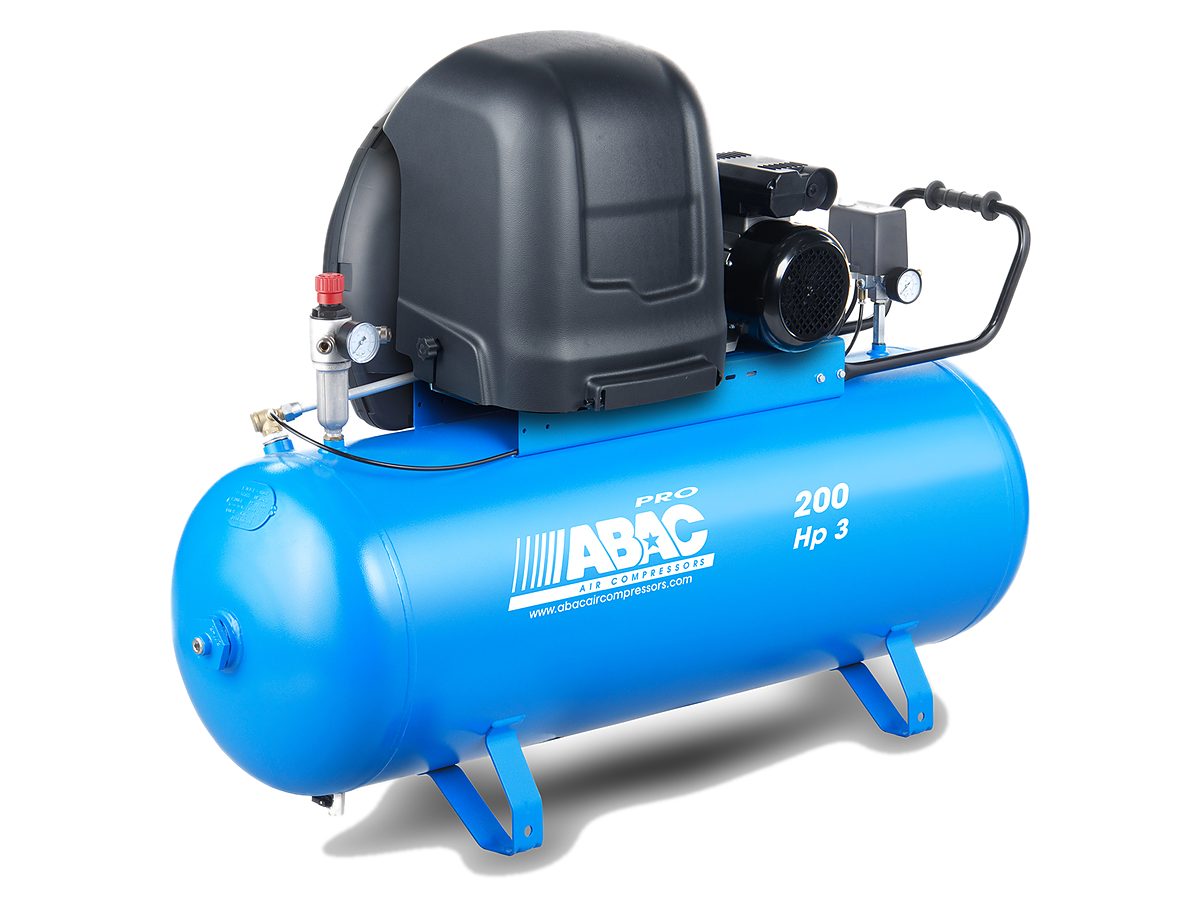
Nine ABAC Silent compressors that never travel. The receiver stands on four feet and the machine has no wheels and no handle — the idea is that it stays in one place and the air reaches the tools through a pipe run. Inside are the same pump units as in the mobile version: A29B with 1.5 kW and A39B with 2.2 or 3 kW, all under a plastic hood that takes 2 to 4 dB(A) off the uncovered unit. Receivers from 90 to 270 litres, 10 bar, seven machines on 400 V and two on a standard socket.
Four questions that decide the choice
All nine machines are oil-lubricated twin-cylinder units with V-belts, a hood over the pump unit and a receiver on feet. They differ in four things.
1. How much air will you use?
The A29B unit takes in 255 l/min, the A39B with 2.2 kW 393 l/min and with 3 kW 486 l/min. What counts is the sum of the tools running at the same time, not everything you own.
2. How large a receiver?
You can choose 90, 150, 200 and 270 litres. Volume does not add air per minute, but it lengthens the uninterrupted draw and cuts the number of motor starts.
3. Socket, or three-phase supply?
A code with M means 230 V, a code with T means 400 V. Two machines with 1.5 kW run on 230 V, the remaining seven need a three-phase supply.
4. Do you have an air line?
The stationary version assumes a fixed place and a pipe run to the workstations. If the machine has to follow the work, take the mobile version of the same units.
Three pump units, nine machines
Read the code from the left: pump unit, motor rating, receiver volume, voltage and version. A39B-2,2-200FTS is an A39B unit with 2.2 kW on a 200-litre receiver, at 400 V, in the silenced stationary version — the letter F means feet instead of castors.
A29B — 1.5 kW
The smallest of the three. Takes in 255 l/min at 1,075 rpm. Enough for tools that work in short bursts — a tyre inflator, a blow gun, a stapler or a smaller impact wrench. It is also the only unit in the category available for a standard socket.
A29B-1,5-90FMS · A29B-1,5-90FTS · A29B-1,5-150FMS · A29B-1,5-150FTS
4 machines · 255 l/min · 90 and 150 l receiver · 230 and 400 V · 89 to 90 dB(A) Lwa
A39B — 2.2 kW
The workshop standard. Takes in 393 l/min at 1,050 rpm. It carries longer sanding and spraying and comes on all three large receivers. In the stationary version only at 400 V.
A39B-2,2-150FTS · A39B-2,2-200FTS · A39B-2,2-270FTS
3 machines · 393 l/min · 150, 200 and 270 l receiver · 400 V · 91 dB(A) Lwa
A39B — 3 kW
The highest output in the category. The same A39B unit spun up to 1,300 rpm — hence 486 l/min. Only at 400 V and only on the 200 and 270 litre receiver. The output is paid for in noise: 3 dB(A) more than the 2.2 kW version.
A39B-3-200FTS · A39B-3-270FTS
2 machines · 486 l/min · 200 and 270 l receiver · 400 V · 94 dB(A) Lwa
What the stationary version means
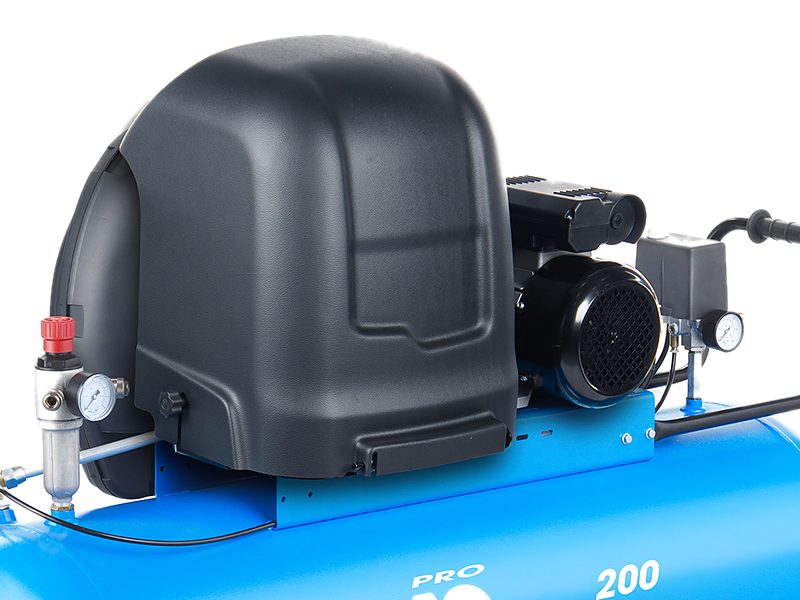
The receiver stands on four feet bolted to its shell. The machine is not pushed around, so nothing wobbles: the feet can be anchored to the floor, vibration stays out of the surroundings and the hose or pipe keeps its place. Against the mobile version there are no castors and no handle — and with them a few centimetres of height.
The rest is the same as on the mobile siblings: a plastic hood over the pump unit and the belt drive that takes 2 dB(A) off on the A39B unit and 3 to 4 dB(A) on the A29B, opening on a locating peg and a hinge, and cooling by a channelled air flow. The filter, the oil sight glass and the belts stay reachable without tools.
All nine machines side by side
Stationary silenced ABAC Silent A29B and A39B compressors — 9 machines, 10 bar, 90 to 270 l receiver, 230 and 400 V | |||||||||
|---|---|---|---|---|---|---|---|---|---|
| Model | Pump unit | Motor | Suction | Speed | Receiver | Voltage | Lwa / Lwp | Weight | Dimensions L × W × H |
| A29B-1,5-90FMS | A29B | 1.5 kW | 255 l/min | 1 075 rpm | 90 l | 230 V | 89 / 69 dB(A) | 59 kg | 1 010 × 415 × 980 mm |
| A29B-1,5-90FTS | A29B | 1.5 kW | 255 l/min | 1 075 rpm | 90 l | 400 V | 89 / 69 dB(A) | 59 kg | 1 010 × 415 × 980 mm |
| A29B-1,5-150FMS | A29B | 1.5 kW | 255 l/min | 1 075 rpm | 150 l | 230 V | 89 / 69 dB(A) | 90 kg | 1 375 × 420 × 1 030 mm |
| A29B-1,5-150FTS | A29B | 1.5 kW | 255 l/min | 1 075 rpm | 150 l | 400 V | 90 / 70 dB(A) | 90 kg | 1 375 × 420 × 950 mm |
| A39B-2,2-150FTS | A39B | 2.2 kW | 393 l/min | 1 050 rpm | 150 l | 400 V | 91 / 71 dB(A) | 90 kg | 1 375 × 420 × 950 mm |
| A39B-2,2-200FTS | A39B | 2.2 kW | 393 l/min | 1 050 rpm | 200 l | 400 V | 91 / 71 dB(A) | 91 kg | 1 500 × 470 × 1 110 mm |
| A39B-2,2-270FTS | A39B | 2.2 kW | 393 l/min | 1 050 rpm | 270 l | 400 V | 91 / 71 dB(A) | 141 kg | 1 530 × 595 × 1 140 mm |
| A39B-3-200FTS | A39B | 3 kW | 486 l/min | 1 300 rpm | 200 l | 400 V | 94 / 74 dB(A) | 91 kg | 1 500 × 470 × 1 110 mm |
| A39B-3-270FTS | A39B | 3 kW | 486 l/min | 1 300 rpm | 270 l | 400 V | 94 / 74 dB(A) | 141 kg | 1 530 × 595 × 1 140 mm |
Lwa is the sound power level of the machine, Lwp the sound pressure level at a distance of four metres. Suction is the amount of air the pump unit draws in. All figures are the manufacturer’s data.
#showmore#
Three receiver sizes and three details that matter
From the outside the machines differ mainly in the receiver — and in standing on feet instead of castors.
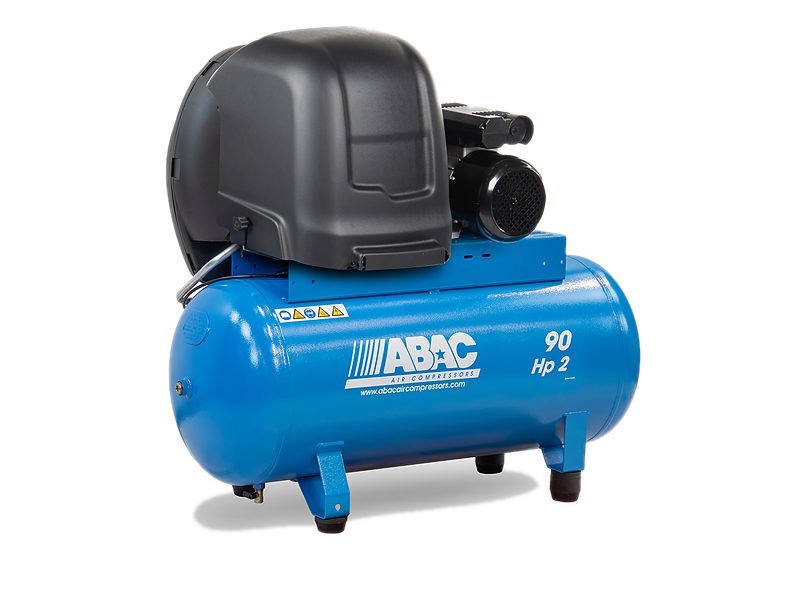
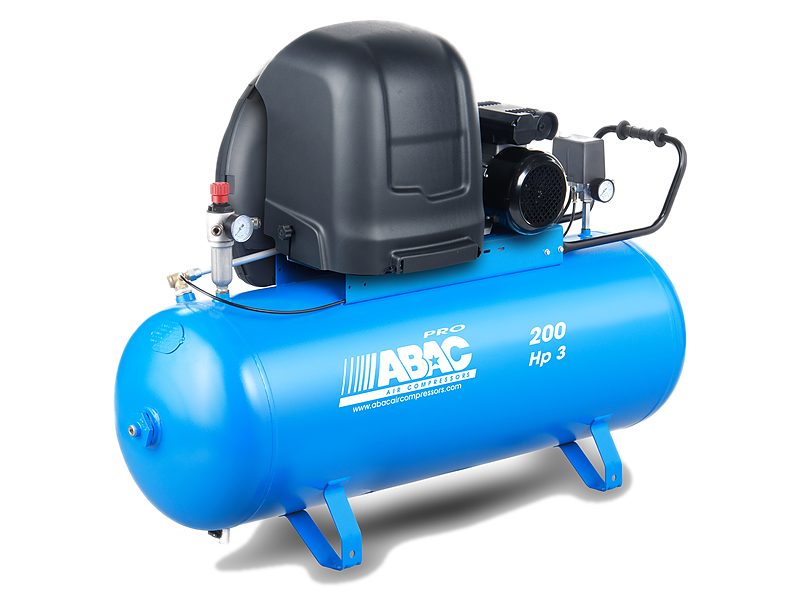
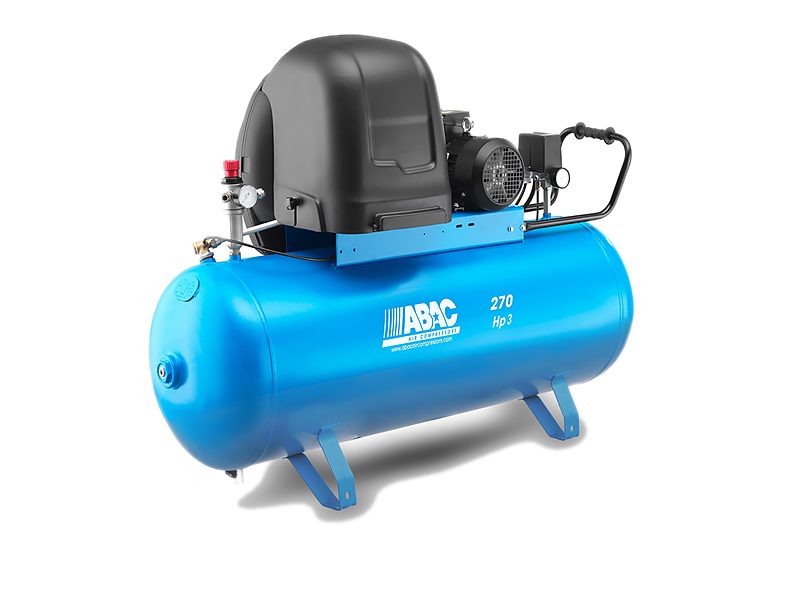
And three details that listing photos rarely show:
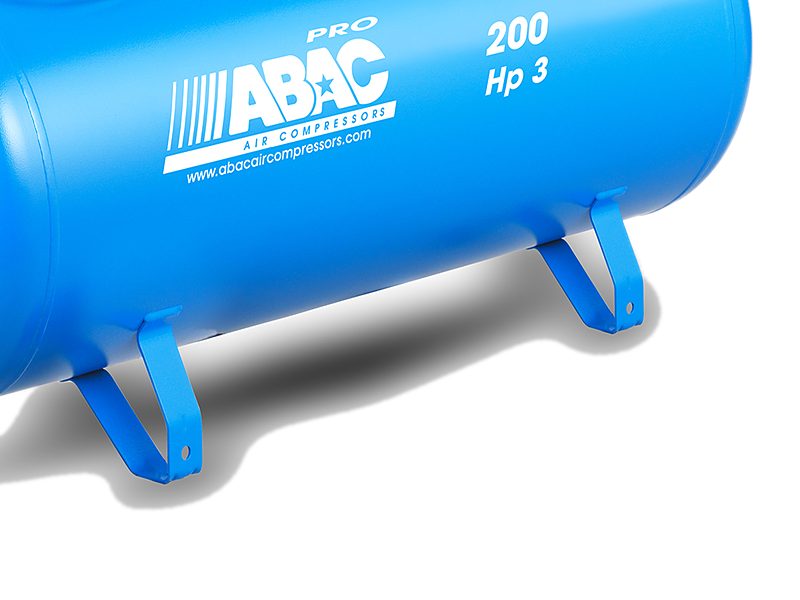
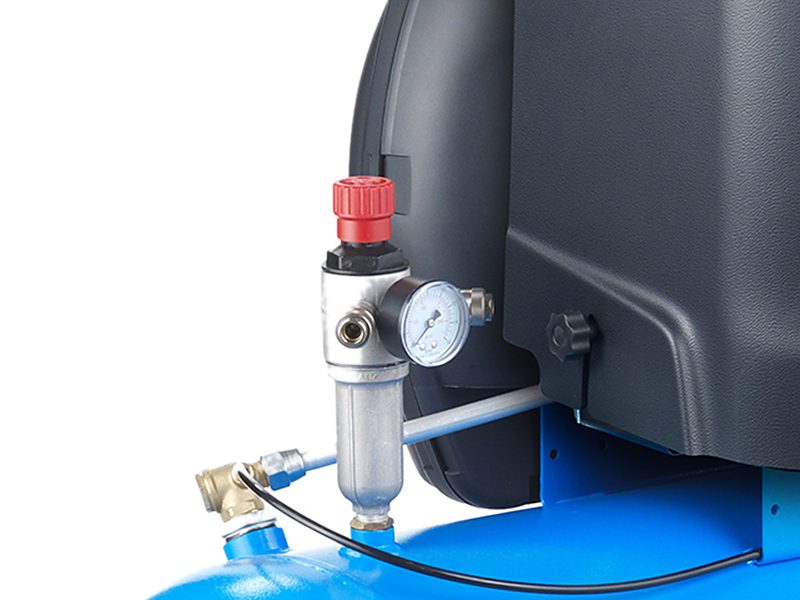
What all the machines share
Twin-cylinder oil-lubricated unit
One stage, two cylinders, oil lubrication and an oil sight glass on the side. The fill is 0.7 l on the A29B and 0.8 l on the A39B.
V-belts
Motor and pump unit are joined by a V-belt drive with a pulley guard. The pump unit turns more slowly than the motor — which is why these machines run calmer than direct-drive compressors.
Hood over the pump unit
Plastic, opens on a peg and a hinge. Takes off 2 to 4 dB(A) and protects the pump unit from dust.
Receiver on feet
A horizontal receiver on four feet, a safety valve on top and a condensate drain cock at the bottom.
Controls and outlet
A pressure switch with unloading, a pressure regulator with a gauge and a quick coupling at the outlet.
Motor protection
A thermal cut-out switches the motor off when overloaded. The machines are built for occasional to partly sustained duty, not for running without a break.
The same units as the mobile version
A29B and A39B are identical to the mobile version — only the undercarriage differs; output and noise stay the same.
Ventilek advises
A stationary machine only makes sense with an air line. A compressor on feet is cheaper to run because it does not have to stand next to the tool — it stands where it bothers nobody and the pipe leads from there to the workstations. If you have no pipe run and plan to push the machine around the workshop, buy the mobile version straight away: a braked castor costs less than an extra line. And if the pipe run comes later, remember that a hose from a stationary machine has its limits — over ten metres the pressure drops noticeably.
Frequently asked questions
- How does the stationary version differ from the mobile one?
- Only in the undercarriage. The A29B and A39B units, the receiver, the hood and the output are identical — here the receiver stands on four feet, in the mobile version on wheels with a handle. The stationary machine is lower by the height of the castors and can be anchored to the floor.
- Do I have to anchor the machine?
- You do not have to, but it pays off. The feet have holes for bolts; an anchored machine does not shift on start-up and passes less vibration into the floor. A rubber pad under the feet helps if the workshop sits above living space.
- What is the difference between the M and T codes?
- M is the single-phase version at 230 V, T the three-phase one at 400 V. In the stationary range two machines with the A29B unit run on 230 V; all the others, including both 3 kW machines, need a three-phase supply. The output of the unit does not change with the voltage.
- Which receiver should I choose — 90, 150, 200 or 270 litres?
- The receiver decides how long you can draw before the motor starts. Short bursts are fine on 90 or 150 l; for sanding and spraying choose 200 or 270 l. On a stationary machine the volume matters more than on a mobile one: nobody walks to the compressor, so you set it once and then simply draw from the line.
- How much calmer is a machine with a hood than the same unit without one?
- On the A39B unit the difference is 2 dB(A) on the sound power level, on the A29B 3 to 4 dB(A). Each machine has its own Lwa and Lwp figure in the table — across these nine that means 89 to 94 dB(A) Lwa.
- What do Lwa and Lwp mean?
- Lwa is the sound power, the total sound the machine radiates — the figure from the yellow label on the frame. Lwp is the sound pressure four metres from the machine, which matches what the operator hears. The difference is 20 dB on these machines; our guide to compressor noise goes through it in detail.
- What work are these compressors built for?
- The manufacturer intends them for sanding, spraying and impact wrenches — workshop work where tools take turns and there is a pause between jobs. We do not recommend them for sandblasting: a blast gun draws air continuously and consumes more than this class of machine can keep up with.
- Where do I find stationary compressors from other brands?
- Every stationary version across brands and types sits in the overview of stationary compressors. This category is a part of it — nine silenced ABAC machines with A29B and A39B units.
Where to go next
If these nine are not the right fit, the path continues within the same family: You will find an overview of every range in the Compressors category.
- Mobile A29B and A39B — the same units on castors with a handle, twelve machines
- The whole ABAC Silent range — a hub of every silenced version, including machines without a receiver
- The SLN range — a hood over the whole machine, when the compressor should be as far from your ears as possible
- Pro Line — the same units without a hood, with a wider choice of outputs and receivers
- Super Silent OS — the oil-free version for surgeries and laboratories
- How to choose a compressor — the route from tool consumption to output and receiver
The figures given are ABAC manufacturer data for the individual machines. Suction is the amount of air drawn in, Lwa the sound power level, Lwp the sound pressure level at four metres. Dimensions and weights apply to the machine without accessories.


