
Two-stage piston air compressors
A two-stage compressor compresses air twice: the first, larger cylinder pre-compresses it, the intercooler removes heat, and the second, smaller cylinder brings it up to the final pressure. As a result it reaches 11 bar or more at a lower temperature and with less wear than a single-stage machine.
#showmore#
Why two stages
Air heats up as it is compressed — the higher the pressure, the more. A single-stage piston compressor therefore stops at ten, at most eleven bar. A two-stage one splits the work between two cylinders and cools the air in between, so the second stage compresses cooler, denser air. The result is higher pressure, lower oil and valve temperatures and a longer service life. There is more on this in our article Two-stage compressors: higher efficiency for industry.
Looking for a compressor with two pistons?
Two-stage and twin-cylinder are not the same thing. Twin-cylinder means two cylinders — they can work as two identical stages side by side, or as two stages in series. All machines with two pistons, single-stage and two-stage, are listed under twin-cylinder air compressors.
Which two-stage machines we offer
11 bar for the workshop
Most of the machines are belt-driven two-stage twin-cylinder units at 11 bar — ABAC Pro Line A49B, B59B, B60 and B70, in a cabinet, with a dryer or as a tandem. They are all grouped together under 11 bar air compressors.
Higher pressures: 15 to 30 bar
ABAC Tech ATH with direct drive and a continuous-duty motor, plus the B59B to B70 and WALTER HWK1200 at 15 bar. Start with 15 bar air compressors, which link on to 20 and 30 bar.
Engine-driven
Eleven Engine Air machines have a petrol or diesel engine and a two-stage pump with 10 to 14 bar — for building sites and work without electricity. The whole range is under Engine Air petrol and diesel compressors.
When a two-stage machine pays off
When the compressor runs for many hours a day, when you need more than ten bar, or when the pipework is long. For a single tool in a home workshop, a single-stage machine is enough: at ten bar it gives a similar amount of air for the same motor power and is simpler. You can compare all types in our overview of air compressors.
Frequently asked questions
- Is a two-stage compressor more economical?
- At higher pressures, yes — cooling between the stages reduces the work needed for compression. For 8 to 10 bar the difference is small and a single-stage machine is enough.
- Can I recognise a two-stage compressor at a glance?
- Usually, yes: the cylinders differ in size and a finned intercooler pipe runs between them.
-
 Black Wind piston compressors
-
ATMOS piston compressors
-
Walter reciprocating compressors
-
Piston compressors ABAC
-
Piston compressors ABAC
-
Expert Zero compressors
-
ABAC reciprocating compressors
-
Quiet compressors Super Silent OS
-
INDUSTRIAL TECH compressors
-
CLR reciprocating compressors
-
Combustion compressors
-
Screw compressors
-
Pressure vessels
-
Compressor accessories

Product sorting
List of products


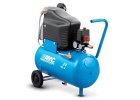
A two-stage pump on the A-series pulley — the step between workshop and industrial duty. Higher pressure than the single-stage pumps and more efficient compression.


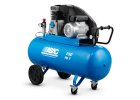
The entry-level two-stage pump of the B series. For duty where the compressor runs most of the shift and consumption is steady.


Two-stage A49B pump with 2.2 kW on 400 V: 444 l/min at 1,050 rpm, 11 bar, 150 l tank on castors, 114 kg. Intercooler, aftercooler, regulator, DN 7.2 quick coupling; 91 dB Lwa /...


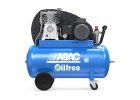
A two-stage pump for higher draws — several workstations at once, or one more demanding tool.

The strongest machine of the category: fifteen kilowatts and over a thousand litres of air per minute at thirty bar. Twice what the eleven-kilowatt machine gives.


The strongest machine of the category: fifteen kilowatts and over a thousand litres of air per minute at twenty bar. On a base frame, with star-delta starting.

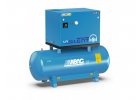
Eleven kilowatts on a base frame. Against the 7.5 kW machine it adds only nine per cent of air, but runs more easily and is 39 kg heavier.


The most powerful unit in the range, without a tank, for a compressor room with its own air receiver or a central air network. Four cylinders in two V pairs run at 768 rpm and...

A high-pressure four-cylinder unit for operations where the process calls for more than 10 bar and plenty of air as well: pressure testing, presses, filling. It delivers 960...

The top of the range for pressure: a four-cylinder unit with the lowest speed of them all, 688 rpm, for test facilities and processes with a specified pressure above 13 bar. It...


Central air supply for the workshop: sandblasting, three points of use at once, an air network across the hall. The four-cylinder unit at 768 rpm delivers 1,100 l/min, the most...
