
11 bar air compressors
At eleven bar, our range consists solely of two-stage piston compressors. They compress air in two steps and cool it in between, so they reach the higher pressure at a lower temperature than a single-stage machine. All are belt-driven and oil-lubricated, from 2.2 to 15 kW.
#showmore#
What the extra bar is for
Eleven bar in the tank means a larger air reserve in the same volume and more margin for pipework that must still provide 6.3 bar for tools at its end. It suits garages with several workstations running at once, and plants with longer pipework. For a shorter hose and a single tool, you can manage with 10 bar air compressors.
The two-stage design is made for this: a large low-pressure cylinder pre-compresses the air, an intercooler cools it, and a smaller high-pressure cylinder takes it to final pressure. We explain why this works under two-stage air compressors.
Which ranges you will find at 11 bar
ABAC A49B on smaller tanks
The two-stage A49B pump with 2.2 to 4 kW on tanks of 90 to 270 l, including versions for a 230 V socket. This is the smallest way into two-stage machines — see the ABAC Pro Line A49B.
ABAC B59B, B60 and B70
Larger two-stage pumps on 270 and 500 l tanks for workshops with several workstations. Alongside the basic version of the B59B to B70, there are low-speed versions, versions with a dryer and versions with a vertical tank.
Tandems and cabinet machines
A tandem carries two pumps on one tank that alternate and stand in for each other, with an output of up to 1,864 l/min. Twenty-seven machines come in a cabinet and can stand in the workshop where people work — these are the ABAC Silent Line LN.
Which tanks they come on
Machines for 11 bar most often sit on a 500 l tank, closely followed by 270 l. Smaller two-stage pumps are on 90 to 200 l tanks, and the largest tandems with 11 and 15 kW on a 900 l tank. A large tank and higher pressure add up — a five-hundred-litre tank at 11 bar holds more air than the same tank at 10 bar, so the machine starts less often.
Above that: high-pressure machines
If you need more than 11 bar, two-stage machines for higher pressures start with 15 bar air compressors. Other pressures and sizes are in our overview of air compressors.
Frequently asked questions
- Is an 11 bar compressor better than a 10 bar one?
- For longer pipework and more workstations, yes — it has a bigger margin. For one tool on a short hose you will not notice the difference, and a single-stage 10 bar machine is enough.
- Does an 11 bar compressor need a special tank?
- The tank must be built for this pressure; on complete machines with a tank this is taken care of. Choose any additional air tank with a working pressure of at least 11 bar.
- Are there 11 bar compressors for 230 V?
- Five machines with the A49B pump and 2.2 kW plug into a standard socket. The rest have 3 to 15 kW and need a three-phase 400 V supply.
- Why are 11 bar compressors belt-driven?
- The belt slows the two-stage pump to a lower speed, so it heats up less and copes with long running. Direct drive only appears on the high-pressure ABAC Tech machines with a low-speed motor.
-
 Black Wind piston compressors
-
ATMOS piston compressors
-
Walter reciprocating compressors
-
Piston compressors ABAC
-
Piston compressors ABAC
-
Expert Zero compressors
-
ABAC reciprocating compressors
-
Quiet compressors Super Silent OS
-
INDUSTRIAL TECH compressors
-
CLR reciprocating compressors
-
Combustion compressors
-
Screw compressors
-
Pressure vessels
-
Compressor accessories

Product sorting
List of products

Protection for the receiver in case the pressure switch fails to cut out. Once the set pressure is passed it lets the air out and keeps the tank from being overpressured. It...

The largest of the small horizontal air receivers, with two top connections, so you can fit both the safety valve and the pressure gauge without branch fittings. It suits a...

An air receiver for built-in use where length is limited: it holds 50% more air than the 10-litre version and is less than two centimetres longer. Without feet, it fits into a...


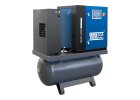
Two-stage A49B pump with 2.2 kW on 400 V: 444 l/min at 1,050 rpm, 11 bar, 150 l tank on castors, 114 kg. Intercooler, aftercooler, regulator, DN 7.2 quick coupling; 91 dB Lwa /...

A small horizontal air receiver that already has a top connection for a pressure gauge or safety valve. It stands on two feet with bolt holes and fits under a workbench or on a...

A horizontal vessel on two feet, made of unpainted steel and sold as a clearance item. It suits applications where you finish the surface yourself, for example in the same...


A 10-litre cylinder without feet for a machine frame or cabinet where feet would get in the way. It has a top connection for a pressure gauge or safety valve and a bottom one...

The smallest air receiver with feet, both with bolt holes. It fits on a shelf, in a crate or under a workbench and serves as a small air reserve or a buffer volume.

A vertical air receiver with twice the air reserve of the 24-litre version, while still needing little floor space. The taller legs leave room under the bottom end for a...

The smallest air receiver for built-in use, a smooth cylinder without feet. You mount it with clamps in a frame, a cabinet or a small pneumatic device.

A horizontal air receiver for places where length is limited but a slightly wider vessel is no problem. Compared with the 10-litre version, it holds 50% more air at almost the...

The largest air receiver for built-in use in this category, with two top connections of the same size. It suits a machine frame or assembly that needs a large air reserve...


A vertical air receiver that fits even into a narrow corner of the workshop. It stands on legs, and you can feed air into it from above, from below or from the side.


An air receiver without feet, with the volume typical of small compressor tanks. It suits a custom assembly where the vessel is to lie in a frame, or serves as a built-in air...


A horizontal air receiver with the volume typical of small compressor tanks. Placed next to the compressor, it doubles the air reserve, so the machine starts less often.

A two-stage pump on the A-series pulley — the step between workshop and industrial duty. Higher pressure than the single-stage pumps and more efficient compression.


