
Engine Air combustion-engine compressors: petrol and diesel
 Engine Air
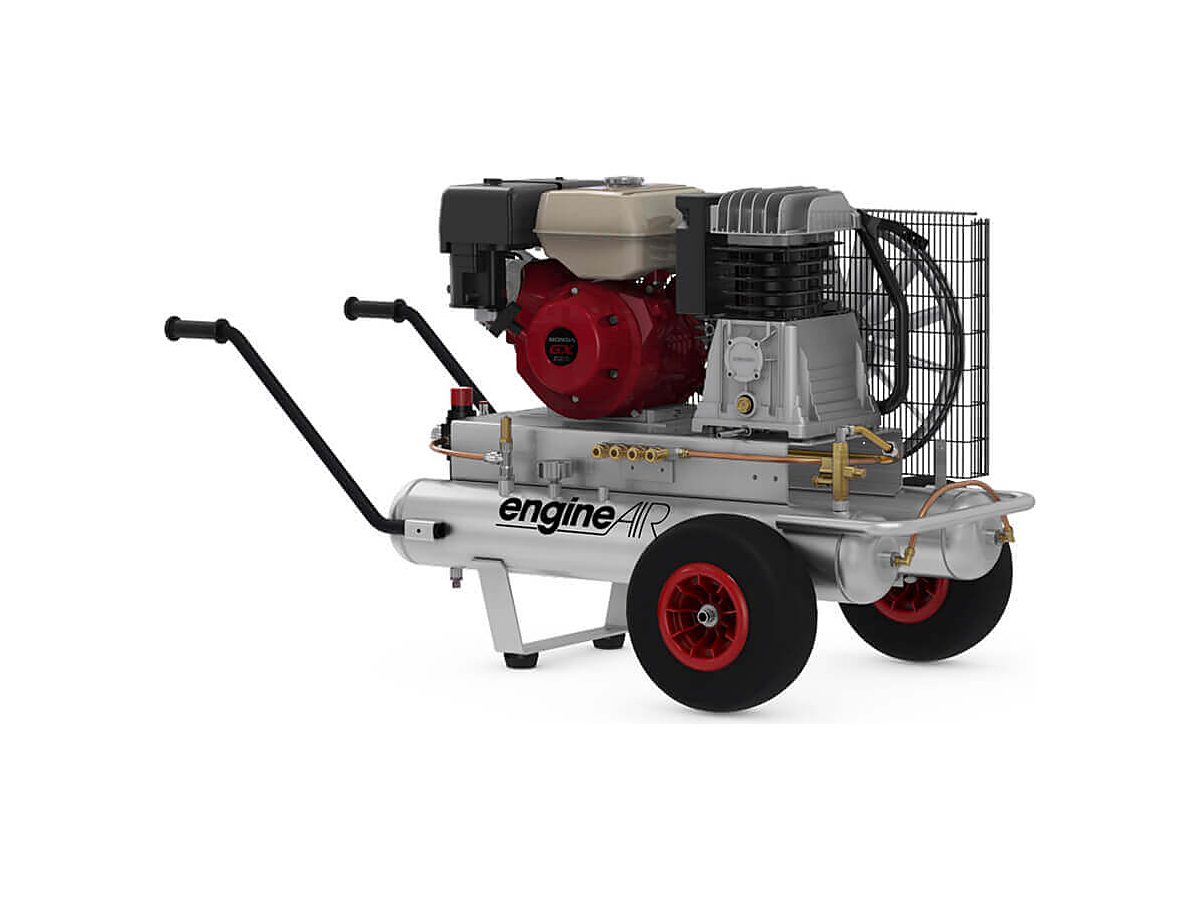
You cannot run a cable onto a motorway, a field or a forest. The Engine Air range is the answer: a piston compressor driven by a petrol or diesel engine instead of an electric motor — one that asks nobody for power. There are twenty-two machines, from a 28 kg box you carry by hand to a stationary 378 kg unit that also generates electricity. One thing unites them: where there is fuel, there is compressed air.
Three questions before you choose
The range is deliberately wide — a machine for a nail gun in a roof and a machine for breakers in a quarry have nothing in common but fuel. Work through these three questions and only a few models will be left.
How often will you move it?
A different site every day, often onto a pickup bed? Take the portable version in a protective frame, or a light wheeled machine under 60 kg. If the machine stands in one yard all season, take the stationary version on feet — it has the biggest tank and the highest output.
How many tools will run at once?
A single stapler or tyre inflator is happy with the smallest machines at 275 l/min intake. Two breakers or a sandblaster need 550 l/min and above. The more tools, the bigger the tank — it evens out the peaks so the engine need not run flat out all the time.
Petrol or diesel?
Petrol means a cheaper purchase, lower weight and a start on one pull — which is why eighteen of the twenty-two run on it. Choose diesel where the machine works long hours every day and where you already keep diesel on site anyway.
How to read the model designations
A designation such as EA9-6,2-50CPH looks complicated, but it is an instruction for reading the whole machine. EA9 is the size within the range, 6,2 the engine power in kilowatts, 50 the tank volume in litres, and the letters at the end tell you what the machine looks like and what it runs on.
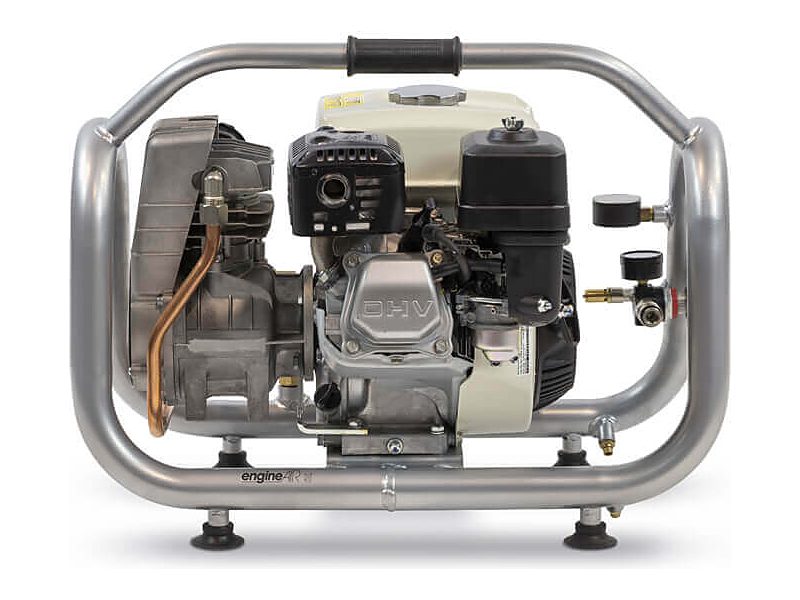
R — portable in a frame
The pump unit sits in a tubular protective frame; two people carry it, or you drop it onto a pickup bed. The smallest machine in the range weighs 28 kg.
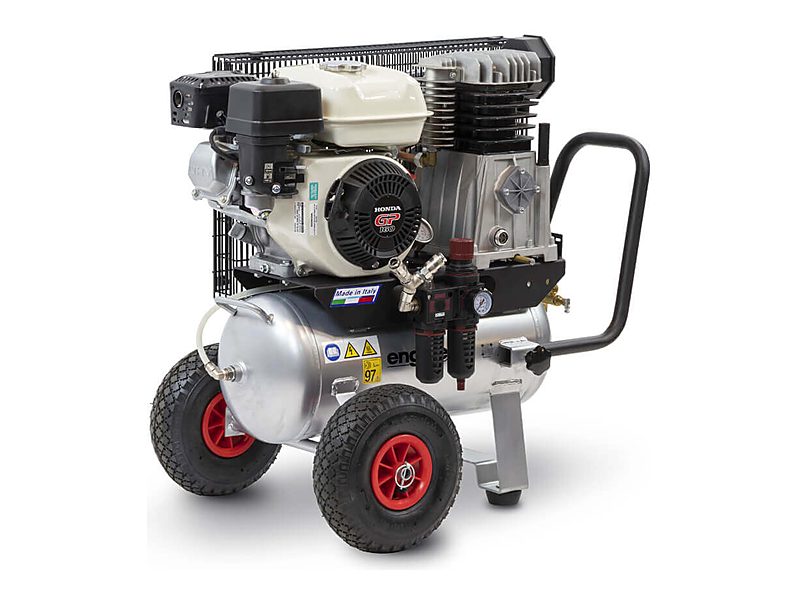
C — on wheels
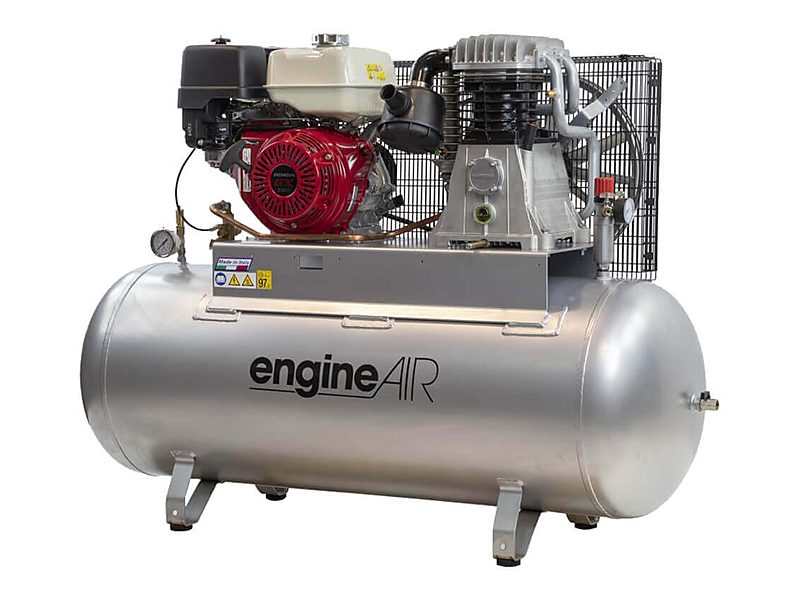
The site classic: a horizontal tank, pneumatic wheels and a handle. The most common version in the range — fifteen machines out of twenty-two.
F — stationary on feet
Heavy machines with a 270 l tank, set down in a yard or bolted onto a pickup bed. All of them have an electric starter.
P, D, H and S at the end
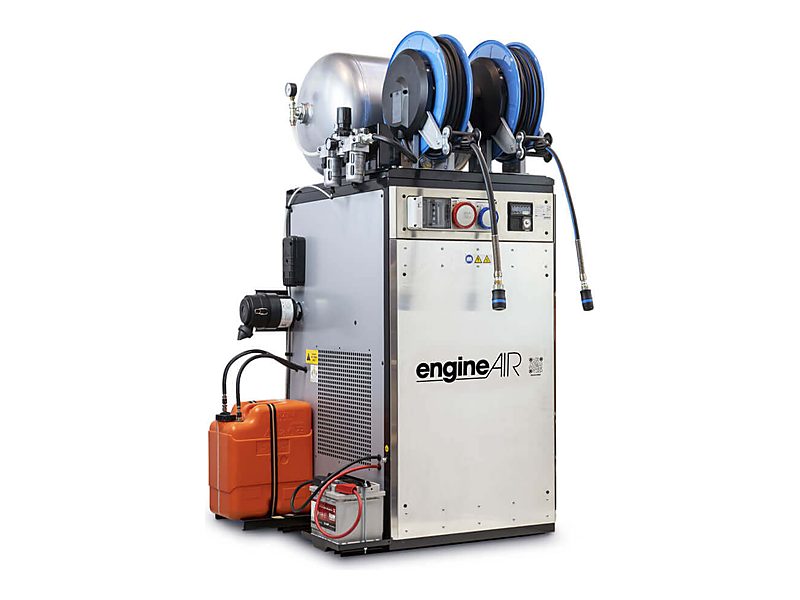
P for Petrol, D for diesel. H marks the 14 bar high-pressure version where a pair exists — for instance EA12-8,7-270FP and EA12-8,7-270FPH. S means the machine supplies electricity as well as air; only one machine, the largest in the range, has it.
All twenty-two machines in one table
Engine Air combustion-engine compressors — technical data | ||||||||||
|---|---|---|---|---|---|---|---|---|---|---|
| Model | Fuel | Version | Intake | Tank | Pressure | Power | Engine | Starter | Noise | Weight |
| EA5-3,5-2-5RP | petrol | portable | 275 l/min | 2.5 l | 10 bar | 3.5 kW | Honda | manual | 96 dB(A) | 28 kg |
| EA5-3,5-4RP | petrol | mobile | 275 l/min | 4 l | 10 bar | 3.5 kW | Honda | manual | 96 dB(A) | 29 kg |
| EA5-3,5-20RP | petrol | mobile | 275 l/min | 20 l | 10 bar | 3.5 kW | Honda | manual | 96 dB(A) | 40 kg |
| EA4-3,5-22RP | petrol | mobile | 320 l/min | 22 l | 10 bar | 3.5 kW | Honda | manual | 95 dB(A) | 54 kg |
| EA5-3,5-2x11CP | petrol | mobile | 411 l/min | 22 l | 10 bar | 3.5 kW | Honda | manual | 96 dB(A) | 70 kg |
| EA5-3,5-2x11RP | petrol | mobile | 411 l/min | 22 l | 10 bar | 3.5 kW | Honda | manual | 96 dB(A) | 78 kg |
| EA5-3,5-24CP | petrol | mobile | 411 l/min | 24 l | 10 bar | 3.5 kW | Honda | manual | 96 dB(A) | 60 kg |
| EA9-6,2-2x17CP | petrol | mobile | 552 l/min | 34 l | 10 bar | 6.2 kW | Honda | manual | 97 dB(A) | 107 kg |
| EA5-3,5-50CP | petrol | mobile | 411 l/min | 50 l | 10 bar | 3.5 kW | Honda | manual | 96 dB(A) | 66 kg |
| EA9-6,2-50CPH | petrol | mobile | 524 l/min | 50 l | 14 bar | 6.2 kW | Honda | manual | 97 dB(A) | 100 kg |
| EA9-6,2-50CP | petrol | mobile | 552 l/min | 50 l | 10 bar | 6.2 kW | Honda | manual | 97 dB(A) | 100 kg |
| EA4-3,5-100CP | petrol | mobile | 320 l/min | 100 l | 10 bar | 3.5 kW | Honda | manual | 95 dB(A) | 70 kg |
| EA5-3,5-100CP | petrol | mobile | 411 l/min | 100 l | 10 bar | 3.5 kW | Honda | manual | 96 dB(A) | 72 kg |
| EA5-3,5-200CP | petrol | mobile | 411 l/min | 200 l | 10 bar | 3.5 kW | Honda | manual | 96 dB(A) | 98 kg |
| EA9-6,2-270CP | petrol | mobile | 552 l/min | 270 l | 10 bar | 6.2 kW | Honda | manual | 97 dB(A) | 170 kg |
| EA12-8,7-270FP | petrol | stationary | 676 l/min | 270 l | 10 bar | 8.7 kW | Honda | electric | 97 dB(A) | 185 kg |
| EA12-8,7-270FPH | petrol | stationary | 633 l/min | 270 l | 14 bar | 8.7 kW | Honda | electric | 97 dB(A) | 185 kg |
| EA13-8,7-270FPH | petrol | stationary | 972 l/min | 270 l | 14 bar | 8.7 kW | Honda | electric | 98 dB(A) | 195 kg |
| EA17-12,6-90FBDS | diesel | stationary | 765 l/min | 90 l | 12 bar | 12.6 kW | Kohler | electric | 96 dB(A) | 378 kg |
| EA7-5,2-270CD | diesel | mobile | 541 l/min | 270 l | 10 bar | 5.2 kW | Kohler | manual | 97 dB(A) | 184 kg |
| EA10-7,5-270FD | diesel | stationary | 727 l/min | 270 l | 14 bar | 7.5 kW | Kohler | electric | 98 dB(A) | 198 kg |
| EA11-7,5-270FD | diesel | stationary | 1,038 l/min | 270 l | 14 bar | 7.5 kW | Kohler | electric | 98 dB(A) | 208 kg |
Intake is the volume drawn in according to the manufacturer — the machine delivers less to the tool, and the gap widens with pressure. Noise is the sound power level Lwa, the figure from the rating plate required by the European directive for machinery; the noise you hear a few metres away is markedly lower. All data come from the manufacturer catalogue ABAC 2025 (pages 94 to 98), dimensions from the importer.
#showmore#
Four versions, four ways of working
The letter in the model designation is not cosmetic — it changes the whole shape of the machine. This is what all four versions look like.
Petrol or diesel — how they differ
The eighteen petrol machines are built around Honda GP and GX series engines. You start them with a cord, the machine is lighter and cheaper, and it fires up even after a week standing in frost. It is the choice for a tradesman who carries the compressor from site to site and runs it for a few hours a day.
The four diesel machines use Kohler engines. Diesel makes sense where the machine runs long shifts and where a fuel bowser stands on site anyway — consumption per cubic metre of air is lower and the engine takes more running hours. Diesel machines are noticeably heavier, though: the lightest weighs 184 kg.
From 7.5 kW you no longer pull a cord
Sixteen machines in the range start manually, by pulling a cord. On large engines that would be hard work, so the six most powerful machines have an electric key start — every stationary version with a 270 l tank, plus the large machine with a generator.
The drive follows the same logic. The three smallest machines have the pump mounted directly on the engine shaft; the other nineteen are driven by V-belts, which lower the pump speed and extend its life. Eleven machines compress in one stage, eleven in two.
What all the machines share
Oil-lubricated piston pump
The same pumps ABAC fits to its workshop compressors — from the small S15 unit to the twin-cylinder B7000. Service and spare parts are readily available.
An engine every workshop knows
Honda on petrol, Kohler on diesel. Nothing exotic: oil, filter and spark plug can be changed anywhere, far from our workshop too.
Pressure regulator and quick coupling
The machine is ready to work straight away — set the pressure on the regulator and click the tool into the DN 7.2 quick coupling.
Working pressure 10 to 14 bar
Sixteen machines work up to 10 bar, five up to 14 and one up to 12. Higher pressure means headroom for tools that run at their limit.
Ventilek recommends
Do not buy more litres than you can move. The commonest mistake with engine-driven compressors is taking the biggest machine „just in case". The 270-litre version on feet weighs over 180 kg and will not move itself around a site. Choose by how many tools will run at once, then by how often the machine will be moved. And one thing people forget: a combustion engine does not belong in a closed hall or a cellar — the exhaust has to go outside.
Frequently asked questions
- Can a combustion-engine compressor run inside a hall?
- It cannot. The engine releases exhaust gases including carbon monoxide, so the machine belongs outdoors or in a space with fume extraction. That is exactly why an engine-driven compressor is worth buying only where there really is no power — in a workshop an electric compressor is cheaper, cleaner and quieter.
- How many tools will the smallest machine run?
- Machines with 275 l/min intake handle one air tool with intermittent use — a stapler, nail gun, tyre inflator or blow gun. For a breaker or a sandblaster, which draw air continuously, you need a machine from 550 l/min upwards and a large tank.
- What does an intake of 411 l/min mean?
- It is the volume of air the pump draws in per minute with free intake. Less reaches the tool — part of the output is consumed by compression itself, and the gap widens with the pressure you set. It is a manufacturer figure, used to compare machines with one another.
- Why is the noise figure almost 100 dB(A)?
- Because it is the sound power level (Lwa) required by the European directive for outdoor machinery and stated on the rating plate. It is not the noise you hear standing nearby — that is tens of decibels lower. The figures in the table are comparable with one another: 95 dB(A) is noticeably less than 98.
- Can the machine with a generator replace a generator set?
- Yes. The EA17-12,6-90FBDS supplies compressed air and electric power at the same time, and that is precisely its purpose — in remote terrain it saves you one machine. It is the heaviest item in the range, though, at 378 kg.
- How often does the oil need changing?
- Both the engine and the pump have oil, and each is changed separately. The interval is in the manual for the specific machine; on a new compressor the first change comes considerably sooner than the later ones, as with any new engine. Our service department will prepare and maintain the machine for you.
Where to go next
If mains power is available on site, a workshop compressor will be cheaper to buy and will run far more quietly. Have a look at the Compressors category.
- Piston compressors — the same pump, but with an electric motor — for the workshop
- Screw compressors — when air has to flow all shift without a break
- Air tools — what you will run off the compressor
- Compressor noise — what the decibels on the plate mean and what you will hear
Technical data follow the manufacturer catalogue ABAC General Catalogue 2025, pages 94 to 98; dimensions are taken from the importer. Intake is the volume drawn in, not the volume delivered to the tool. Noise is the sound power level Lwa under the European directive for equipment used outdoors.


Product sorting
List of products

A fifty-litre tank with the smallest engine in the range. The lightest fifty-litre machine on offer.

A hundred-litre tank with the fast-running A39B unit. A higher intake than the slow-running version.

A stationary diesel machine at fourteen bar with an electric starter and the two-stage B6000B pump.

The highest-output machine in the whole range. A Kohler diesel engine, the largest B7000 pump, working up to fourteen bar.

A hundred-litre tank with the slow-running A29B unit. The calmest machine in the large class.

A twenty-litre tank on wheels. The smallest machine in the range you can reasonably work with all day.

The smallest and lightest machine in the whole range. Pump unit in a protective frame, 28 kg, a tank of just 2.5 litres.

A twenty-two-litre tank and the slow-running A29B unit at 1,350 rpm. A heavier but calmer machine.

A two-hundred-litre tank on wheels. The largest reserve of air among the wheeled machines.

A twenty-four-litre tank and the fast-running A39B unit. The site classic under sixty kilograms.

Two eleven-litre tanks either side instead of one big one. A long, low machine that travels well.

The same pair of eleven-litre tanks as the CP version, but entirely in a protective frame. Eight kilograms heavier.

The same pump unit as the smallest model, but with a four-litre tank and one kilogram heavier.

The only machine on offer with a built-in generator. It supplies compressed air and electric power at the same time.

A stationary machine on feet with an electric starter. The largest petrol engine in the range, ten bar.

The high-pressure version of the stationary machine: fourteen bar instead of ten, otherwise identical.

The highest intake among the petrol machines. The largest B7000 pump, working up to fourteen bar.

The only diesel machine you can still push around a site. A 270-litre tank and manual start.

The largest wheeled machine in the range: a 270-litre tank and a petrol engine.

The most powerful machine with a split tank: two times seventeen litres and a Honda GX270 engine.

A fifty-litre tank and a Honda GX270 engine. The highest output you can still push around a site.

The only fifty-litre machine at fourteen bar. The same machine as the 50CP, but with a higher working pressure.