
Dental compressors for dentists and laboratories: Clean Air CLR
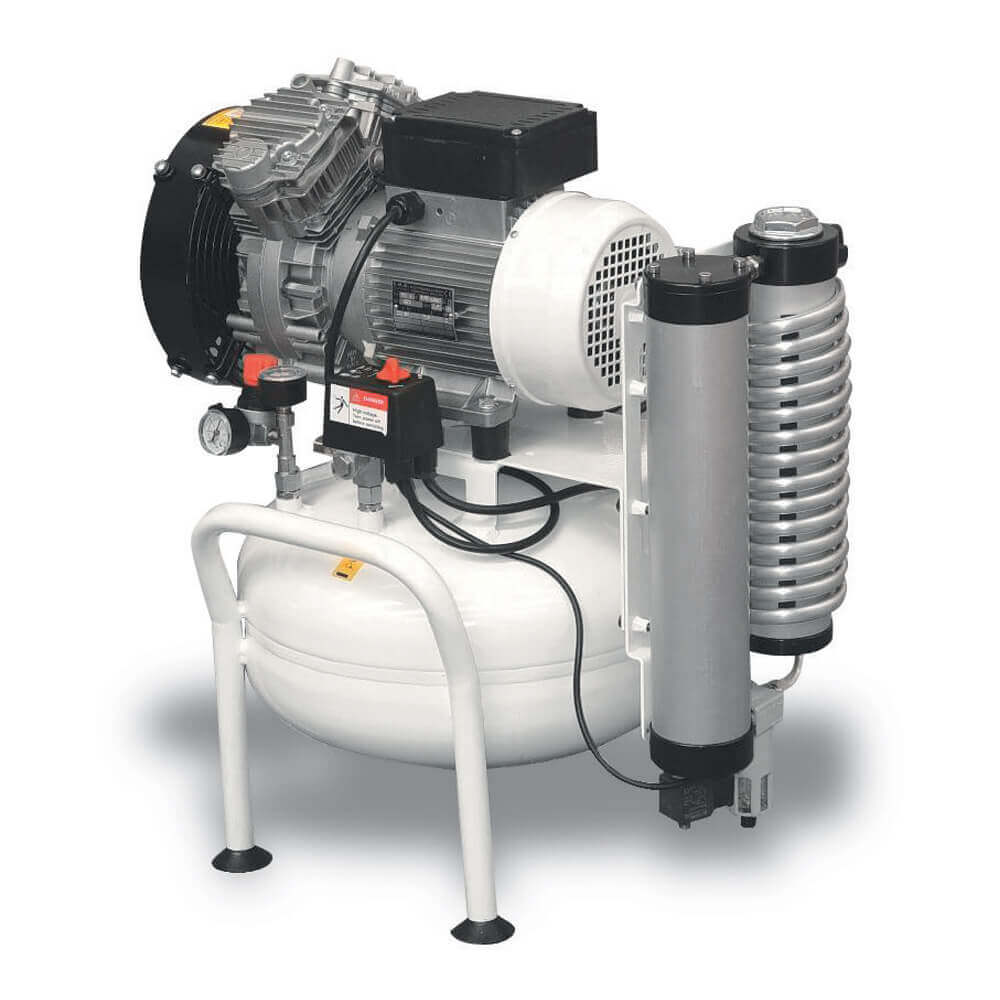 Clean Air CLR · oil-free · 8 bar
In a dental surgery one thing decides the compressor — the purity of the air. The Clean Air CLR range solves it at the source: it compresses completely without oil, the inside of the receiver is protected against corrosion by an epoxy coating, and half the machines carry an adsorption dryer that dries the air down to a −40 °C dew point. There are fourteen machines in three sizes — the manufacturer sorts them by the number of dental chairs they serve: 1–2, 2–3 or 4–5.
Three questions that decide the choice
All fourteen machines are oil-free, single-stage at 8 bar, directly driven, running at 1,400 rpm on ordinary 230 V. They differ in three things.
1. How many chairs will you serve?
The manufacturer calculates 50 l/min at 5 bar per chair. The smallest machines at 1.1 kW serve 1 to 2 chairs (delivery 125 l/min), 1.5 kW handles 2 to 3 (155 l/min) and 2.0 kW covers 4 to 5 chairs (240 l/min).
2. Do you need a dryer?
An oil-free compressor gives air without oil, but not without moisture — that condenses in every machine. Versions with the letter D have an adsorption dryer with silica gel that dries the air to a −40 °C dew point. Seven machines have it, seven do not.
3. Does the machine stand in the surgery or in a plant room?
The open version runs at 71 to 77 dB(A) at one metre. The S version in a sound canopy is at 64 dB(A) — a difference you hear in a surgery. You pay for it in weight: the canopy adds roughly thirty kilos.
How to read the machine code
The code CLR-1,1-30MDS has four parts: CLR is the oil-free dental range, the first number is the motor power in kilowatts, the second the receiver volume in litres, and the letters at the end give the equipment.
M — the basic version
All fourteen machines. A pump unit without a drop of oil on a vertical receiver with epoxy protection, the motor on four anti-vibration mounts, a handle and a DN 7.2 quick coupling.
D — with an adsorption dryer
Seven machines. Two silica-gel towers, a cyclone separator and automatic regeneration. The air enters the receiver at a −40 °C dew point, so it does not condense in the pipework.
S — in a sound canopy
Four machines. The pump is enclosed in an acoustic canopy with a 30 l receiver inside. The noise drops from 71–74 to 64 dB(A), while the weight rises to 68 to 79 kg.
All fourteen machines side by side
Clean Air CLR dental compressors — 14 machines, 1 to 5 chairs, 1.1 to 2.0 kW, 8 bar, 25 to 50 l receiver | |||||||||
|---|---|---|---|---|---|---|---|---|---|
| Model | Chairs | Receiver | Dryer | Canopy | Motor power | Intake | Delivery at 5 bar | Noise at 1 m | Weight |
| CLR-1,1-25M | 1–2 | 25 l | — | — | 1.1 kW | 240 l/min | 125 l/min | 71 dB(A) | 31 kg |
| CLR-1,1-25MD | 1–2 | 25 l | yes | — | 1.1 kW | 240 l/min | 125 l/min | 71 dB(A) | 43 kg |
| CLR-1,1-50M | 1–2 | 50 l | — | — | 1.1 kW | 240 l/min | 125 l/min | 71 dB(A) | 36 kg |
| CLR-1,1-50MD | 1–2 | 50 l | yes | — | 1.1 kW | 240 l/min | 125 l/min | 71 dB(A) | 47 kg |
| CLR-1,1-30MS | 1–2 | 30 l | — | yes | 1.1 kW | 240 l/min | 125 l/min | 64 dB(A) | 68 kg |
| CLR-1,1-30MDS | 1–2 | 30 l | yes | yes | 1.1 kW | 240 l/min | 125 l/min | 64 dB(A) | 75 kg |
| CLR-1,5-25M | 2–3 | 25 l | — | — | 1.5 kW | 350 l/min | 155 l/min | 74 dB(A) | 36 kg |
| CLR-1,5-25MD | 2–3 | 25 l | yes | — | 1.5 kW | 350 l/min | 155 l/min | 74 dB(A) | 50 kg |
| CLR-1,5-50M | 2–3 | 50 l | — | — | 1.5 kW | 350 l/min | 155 l/min | 74 dB(A) | 40 kg |
| CLR-1,5-50MD | 2–3 | 50 l | yes | — | 1.5 kW | 350 l/min | 155 l/min | 74 dB(A) | 54 kg |
| CLR-1,5-30MS | 2–3 | 30 l | — | yes | 1.5 kW | 350 l/min | 155 l/min | 64 dB(A) | 72 kg |
| CLR-1,5-30MDS | 2–3 | 30 l | yes | yes | 1.5 kW | 350 l/min | 155 l/min | 64 dB(A) | 79 kg |
| CLR-2,0-50M | 4–5 | 50 l | — | — | 2 kW | 480 l/min | 240 l/min | 77 dB(A) | 52 kg |
| CLR-2,0-50MD | 4–5 | 50 l | yes | — | 2 kW | 480 l/min | 240 l/min | 77 dB(A) | 60 kg |
The capacity in chairs is manufacturer data calculated on a consumption of 50 l/min at 5 bar per chair. Delivery is the amount of air the machine supplies at 5 bar; intake is the volume drawn in by the pump unit. The noise figure is the sound pressure at one metre per the manufacturer leaflet; the sound power level Lwa is in the parameters of each machine. All values are manufacturer data.
#showmore#
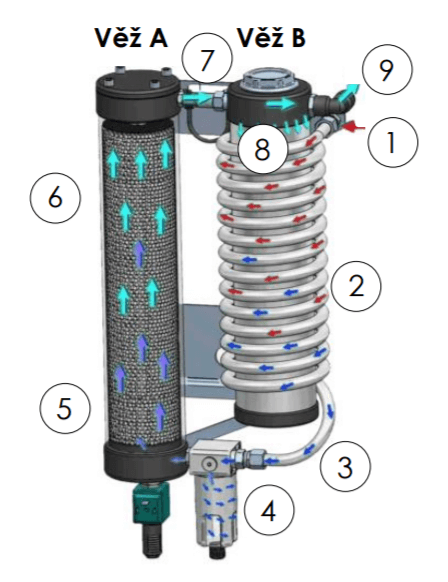
How the adsorption dryer works
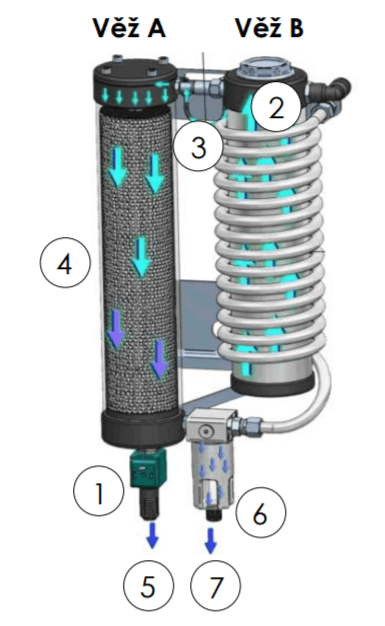
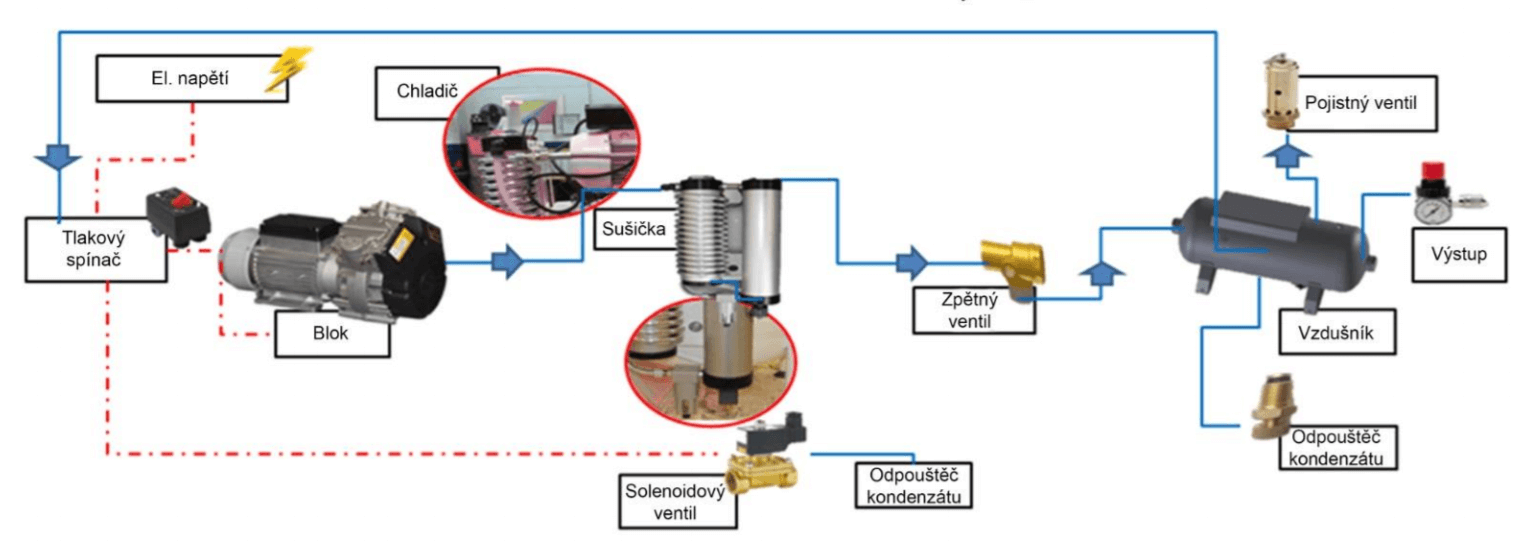
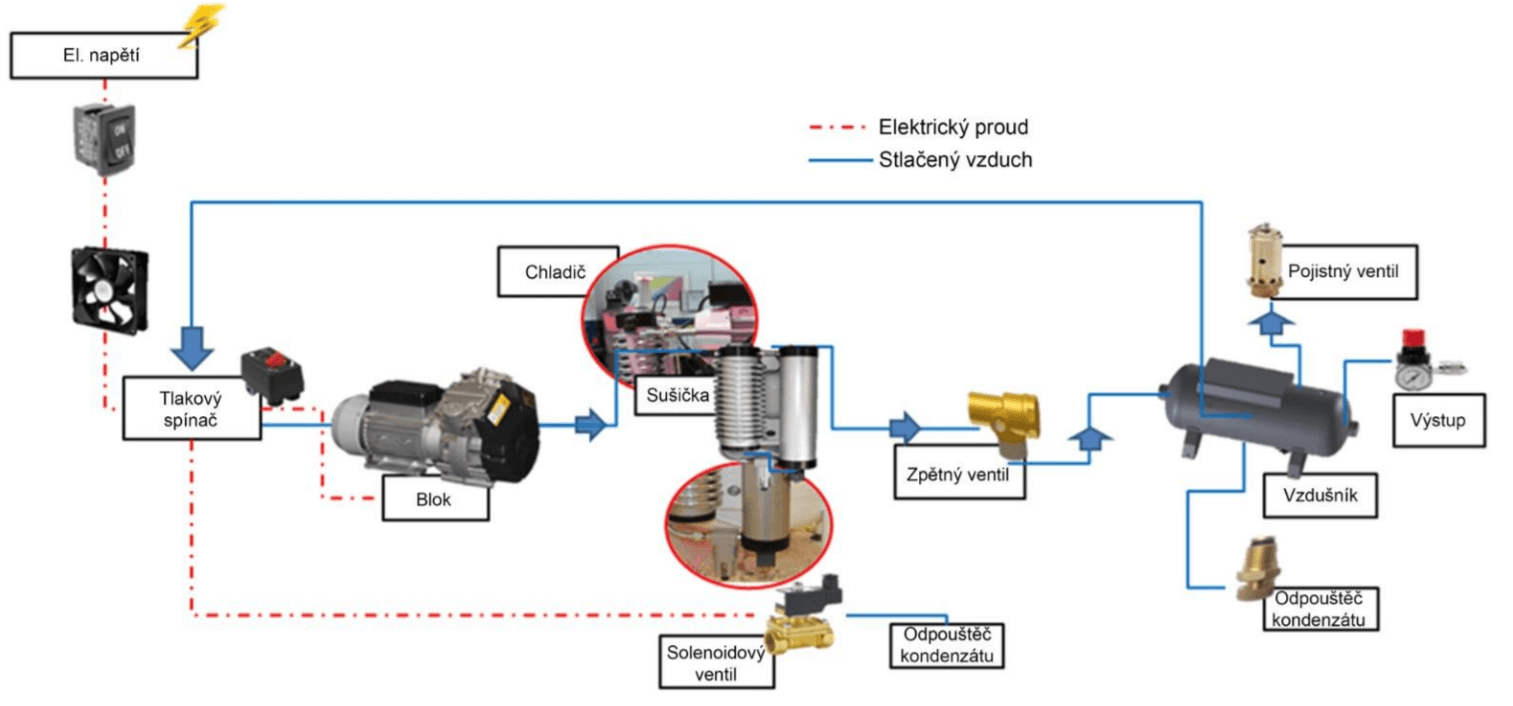
Hot compressed air leaves the pump unit and first passes through a finned cooler, where it cools sharply — which precipitates most of the water out of it. A cyclone separator catches that. The remaining moisture is then absorbed by the silica gel in tower A, and only this dried air passes through a check valve into the receiver. Meanwhile the second tower B fills with dry air as a reserve.
When the compressor finishes building pressure and switches off, a solenoid valve opens and dry air from tower B flows back at a regulated rate into tower A — drying the saturated silica gel. Regeneration takes about a minute and happens automatically after every cycle, so the dryer has no service interval in the usual sense. The residual water leaves through a drain valve into a collecting bottle.
Noise: open machine or canopy
The manufacturer states the sound pressure at one metre: the open version is at 71 dB(A) for the smallest machine, 74 for the middle one and 77 for the largest. In the sound canopy both smaller classes are at 64 dB(A) regardless of output — the canopy levels out the difference between 1.1 and 1.5 kW.
🔴 Be careful when comparing offers. For the same machines figures of around 84 to 97 dB also appear — that is the sound power level Lwa from the rating plate, roughly twenty decibels above the sound pressure. Both numbers are correct, each simply measures something else. You will find both in the parameters of every machine.
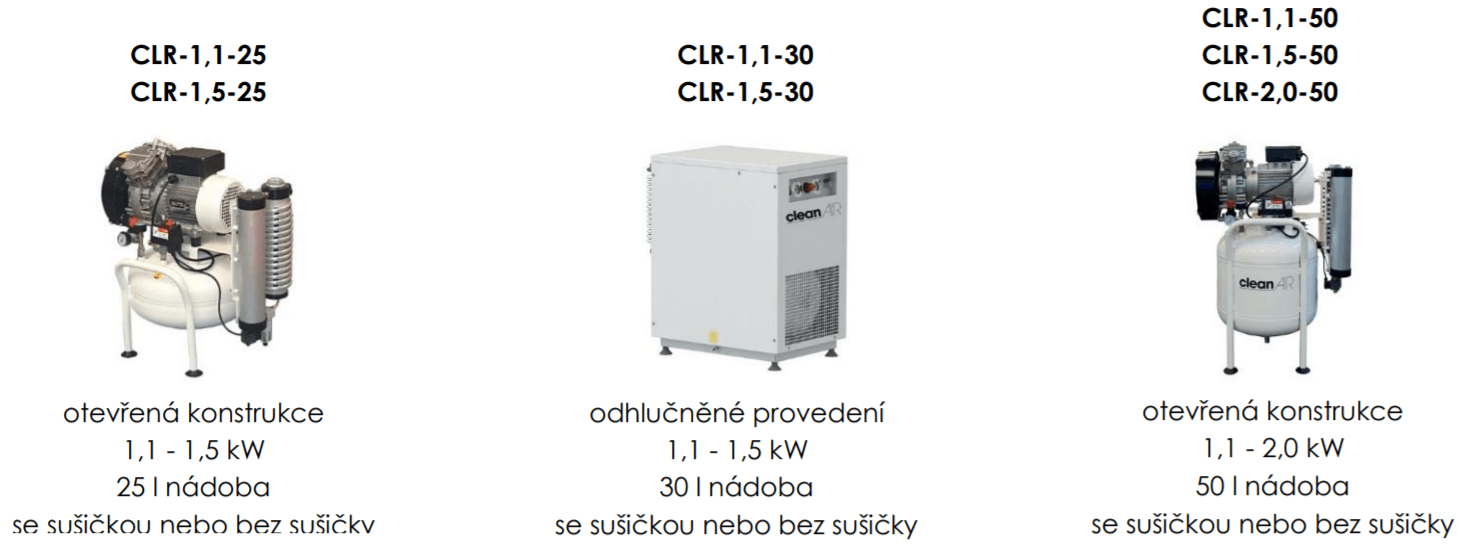
Open and silenced versions
On the left the basic open design, on the right a machine enclosed in an acoustic canopy with the receiver inside.
What all Clean Air machines share
Compression entirely without oil
No oil can reach the air, so no filter is needed downstream to remove it.
Epoxy inside the receiver
The inside of the receiver is protected against corrosion — essential with moist air.
Direct drive without belts
The motor is coupled to the pump directly. No belt tensioning and no replacement.
Slow running at 1,400 rpm
Lower speed means less noise and less wear than on workshop machines.
Four anti-vibration mounts
The motor stands on anti-vibration blocks, so the vibration does not reach the floor.
An ordinary 230 V socket
All fourteen machines run on a single-phase supply — you can plug them in anywhere in the surgery.
Two-year warranty
A two-year warranty applies to every machine in the range.
Ventilek advises
Oil-free does not yet mean water-free. In this range oil really will not reach the air, but moisture will — it condenses in every compressor regardless of lubrication. In a surgery that is a problem: water in the pipework ruins instruments and fillings. That is why there are versions with the letter D and an adsorption dryer at −40 °C. If you take a machine without a dryer, expect to drain the receiver regularly and to fit at least a water separator downstream.
Frequently asked questions
- How many chairs will one compressor serve?
- The manufacturer calculates 50 l/min at 5 bar per chair. On that basis a 1.1 kW machine serves one to two chairs, 1.5 kW two to three and 2.0 kW four to five. It is a guide figure — if your surgery is unusually busy or your instruments consume more, choose a class higher.
- Does really no oil reach the air from these machines?
- Correct. The pump units have no oil charge at all, so there is no way for oil to get into the air and no filter is needed downstream to remove it. Moisture, however, does not disappear — that is handled by the dryer or by draining the receiver.
- What is the dryer for and do I need it?
- An adsorption dryer with silica gel dries the air to a −40 °C dew point, so no water condenses in the pipework or the instruments. For dentistry you can hardly do without it; if the surgery has a central dryer downstream of the compressor, a version without D will do.
- How loud is the compressor in the canopy?
- The manufacturer states 64 dB(A) at one metre against 71 to 77 dB(A) for the open version. The canopy also levels out the difference between 1.1 and 1.5 kW — both classes are equally loud inside it. A machine in a canopy is, however, about thirty kilos heavier.
- What is the difference between 25, 30 and 50 litres?
- The receiver volume does not determine how much air the machine makes — delivery does. A larger receiver means fewer motor starts and calmer running under intermittent draw. The thirty-litre receiver belongs to the canopy machines because it has to fit inside.
- Does the dryer need maintenance?
- The silica gel regenerates itself after every cycle using dry air from the reserve tower, so it does not have to be replaced like a filter element. Check only the condensate drain and the collecting bottle regularly.
- Are these machines suitable outside dentistry?
- Yes. The manufacturer builds them for every field where the air has to be hygienically clean — dental laboratories, medical surgeries, laboratories, food and drink packaging. The principle is the same everywhere: no oil, dry air, a receiver protected against corrosion.
Where to go next
This category is the Clean Air CLR oil-free dental range. If you are looking for something else: An overview of all ranges is in the Compressors category.
- Oil-free compressors — all oil-free machines, dentistry and beyond
- Air dryers — when you want to dry the air with a separate unit
- Article on surgeries — a fuller account of air in the surgery and of drying
- How to choose a compressor — from instrument consumption through output to receiver size
- Compressor noise — why the figures in offers differ by twenty decibels
The data follow the manufacturer leaflet for the cleanAIR CLR range. The capacity in dental chairs is calculated on a consumption of 50 l/min at 5 bar per chair. The sound pressure is measured at one metre from the machine; under the European machinery directive the sound power level Lwa is stated on the rating plate and is roughly 20 dB(A) higher. All values are manufacturer data.
Bestsellers


Product sorting
List of products

The smallest pump in a sound canopy. 64 dB(A) instead of 71, a 30 l receiver inside, 68 kilos.

The strongest machine of the range with a dryer. 240 l/min and a −40 °C dew point for four to five chairs, 60 kilos.

The lightest machine of the range for one to two chairs. A twenty-five-litre receiver, 31 kilos and an oil-free pump without a dryer.

The middle class in a canopy and with a dryer. 64 dB(A), a −40 °C dew point, 79 kilos — the heaviest machine of the range.

A fifty-litre receiver and an adsorption dryer in one. For one to two chairs, 47 kilos.

The middle class with the fifty-litre receiver and a dryer. Dry air for two to three chairs, 54 kilos.

The same machine as the 25M but with an adsorption dryer. A −40 °C dew point, 43 kilos, for one to two chairs.

The quietest version of the smallest class, with a dryer. 64 dB(A), a −40 °C dew point, 75 kilos.

A fifty-litre receiver on the smallest pump. Fewer motor starts under intermittent draw, 36 kilos.

The middle class on a small receiver. 155 l/min for two to three chairs, 36 kilos, no dryer.

The middle class with a dryer on the small receiver. A −40 °C dew point for two to three chairs, 50 kilos.

The middle class in a sound canopy. 64 dB(A) for two to three chairs, a 30 l receiver inside, 72 kilos.

The middle class on the fifty-litre receiver. 155 l/min for two to three chairs, 40 kilos, no dryer.

The strongest machine of the range. 240 l/min for four to five chairs, a fifty-litre receiver, 52 kilos.