
WALTER cast-iron piston compressors
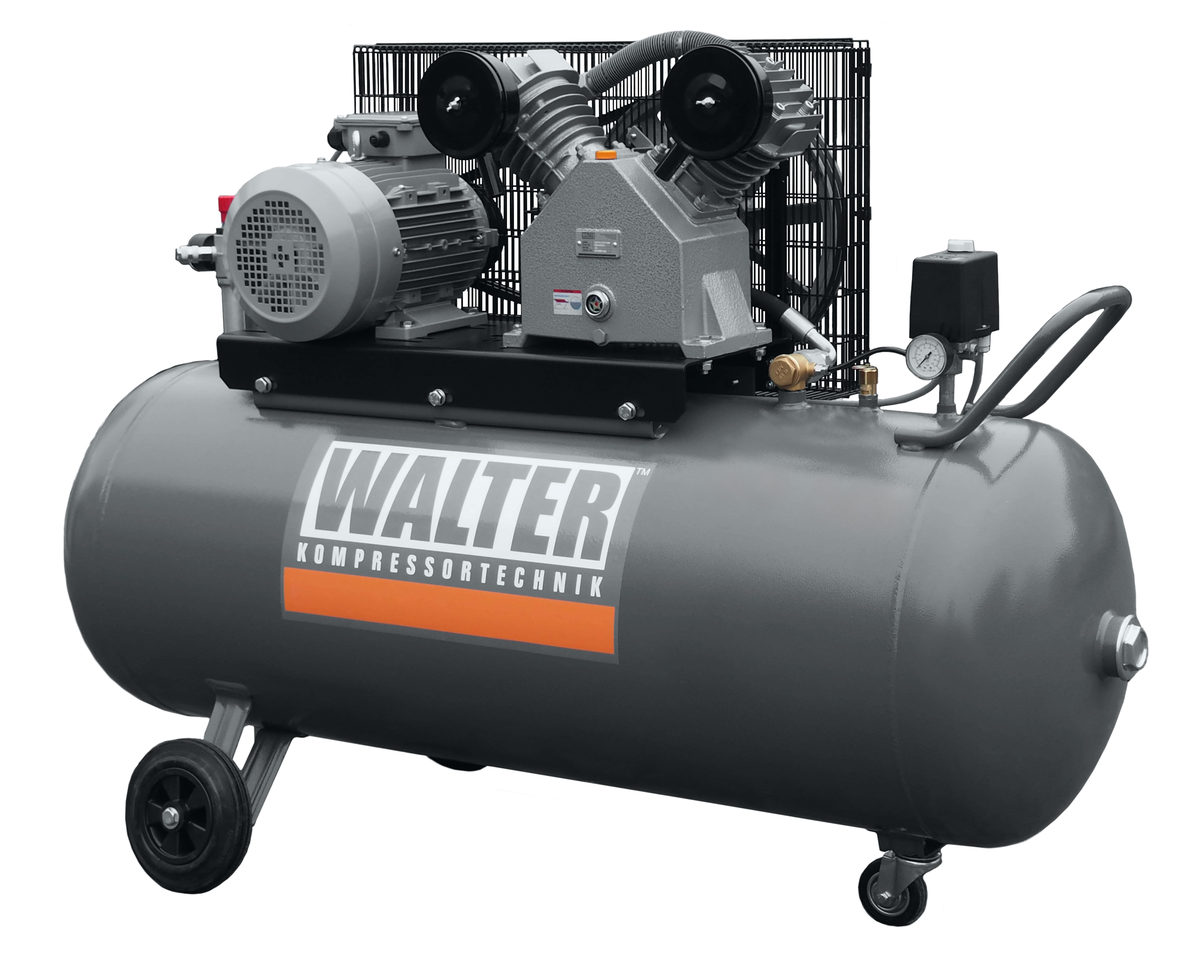
Low-speed cast-iron compressor units, 2.2–7.5 kW
Built for a long service life, not for impressive catalogue figures. The all-cast-iron unit and low-speed running at 688–1,276 rpm are the reason these machines can take continuous duty in metalworking, tyre services and paint shops. The range has 5 power classes and 28 electric variants: horizontal and vertical versions, air receivers of 50–500 l, units on a base frame and high-pressure HWK models for 13 and 15 bar. Where there is no electricity, the petrol WKM 700-7/38 with a Honda engine steps in. The importer and warranty provider is Walter Kompressortechnik Česko of Ostrava.
All 29 WALTER models
Sorted by power class. Air delivery is the air that actually reaches your workshop — choose by that figure. The intake number in the model name is only there to identify the machine.
| WALTER cast-iron piston compressors — all 29 versions | |||||||
|---|---|---|---|---|---|---|---|
| Model | Power | Intake | Delivery | Pressure | Tank | Dimensions L × W × H | Weight |
| WK430P-PLATE unit on a base frame | 2.2 kW | 420 l/min | 340 l/min | 10 bar | no tank | 610 × 380 × 380 mm | 41 kg |
| WK430AP-PLATE unit on a base frame · 230 V | 2.2 kW | 420 l/min | 340 l/min | 10 bar | no tank | 610 × 380 × 380 mm | 42 kg |
| WK430-3,0/50P | 2.2 kW | 420 l/min | 340 l/min | 10 bar | 50 l | 850 × 400 × 770 mm | 75 kg |
| WK430-3,0/50AP 230 V | 2.2 kW | 420 l/min | 340 l/min | 10 bar | 50 l | 850 × 400 × 770 mm | 75 kg |
| WK430-3,0/100P | 2.2 kW | 420 l/min | 340 l/min | 10 bar | 100 l | 1,150 × 490 × 850 mm | 86 kg |
| WK430-3,0/100AP 230 V | 2.2 kW | 420 l/min | 340 l/min | 10 bar | 100 l | 1,150 × 490 × 850 mm | 86 kg |
| WK430-3,0/200P | 2.2 kW | 420 l/min | 340 l/min | 10 bar | 200 l | 1,550 × 560 × 1,000 mm | 129 kg |
| WK430-3,0/200AP 230 V | 2.2 kW | 420 l/min | 340 l/min | 10 bar | 200 l | 1,550 × 560 × 1,000 mm | 129 kg |
| VWK430-3,0/90P vertical | 2.2 kW | 420 l/min | 340 l/min | 10 bar | 90 l | 630 × 540 × 1,240 mm | 100 kg |
| VWK430-3,0/90AP vertical · 230 V | 2.2 kW | 420 l/min | 340 l/min | 10 bar | 90 l | 630 × 540 × 1,240 mm | 100 kg |
| WK550P-PLATE unit on a base frame | 3.0 kW | 530 l/min | 440 l/min | 10 bar | no tank | 720 × 420 × 430 mm | 54 kg |
| WK550-4,0/100P | 3.0 kW | 530 l/min | 440 l/min | 10 bar | 100 l | 1,460 × 640 × 1,150 mm | 115 kg |
| WK550-4,0/200P | 3.0 kW | 530 l/min | 440 l/min | 10 bar | 200 l | 1,460 × 640 × 1,150 mm | 129 kg |
| WK550-4,0/270P | 3.0 kW | 530 l/min | 440 l/min | 10 bar | 270 l | 1,650 × 660 × 1,120 mm | 156 kg |
| VWK550-4,0/90P vertical | 3.0 kW | 530 l/min | 440 l/min | 10 bar | 90 l | 630 × 560 × 1,300 mm | 110 kg |
| WK650P-PLATE unit on a base frame | 4.0 kW | 630 l/min | 550 l/min | 10 bar | no tank | 800 × 450 × 450 mm | 71 kg |
| WK650-5,5/270P | 4.0 kW | 630 l/min | 550 l/min | 10 bar | 270 l | 1,650 × 660 × 1,150 mm | 163 kg |
| VWK650-5,5/270P vertical | 4.0 kW | 630 l/min | 550 l/min | 10 bar | 270 l | 650 × 700 × 1,750 mm | 180 kg |
| HWK700-5,5/270P 13 bar | 4.0 kW | 600 l/min | 500 l/min | 13 bar | 270 l | 1,650 × 660 × 1,150 mm | 205 kg |
| HWK700-5,5/270P-15P 15 bar | 4.0 kW | 560 l/min | 470 l/min | 15 bar | 270 l | 1,650 × 660 × 1,150 mm | 205 kg |
| WK900P-PLATE unit on a base frame | 5.5 kW | 880 l/min | 740 l/min | 10 bar | no tank | 870 × 480 × 500 mm | 85 kg |
| WK900-7,5/270P | 5.5 kW | 880 l/min | 740 l/min | 10 bar | 270 l | 1,650 × 510 × 1,150 mm | 178 kg |
| WK900-7,5/500P | 5.5 kW | 880 l/min | 740 l/min | 10 bar | 500 l | 2,000 × 610 × 1,250 mm | 253 kg |
| VWK900-7,5/270P vertical | 5.5 kW | 880 l/min | 740 l/min | 10 bar | 270 l | 650 × 700 × 1,800 mm | 195 kg |
| WK1500P-PLATE unit on a base frame | 7.5 kW | 1,400 l/min | 1,100 l/min | 10 bar | no tank | 1,010 × 510 × 600 mm | 172 kg |
| WK1500-10/500P | 7.5 kW | 1,400 l/min | 1,100 l/min | 10 bar | 500 l | 2,000 × 610 × 1,250 mm | 320 kg |
| HWK1200-10/500P 13 bar | 7.5 kW | 1,120 l/min | 960 l/min | 13 bar | 500 l | 2,000 × 610 × 1,250 mm | 390 kg |
| HWK1200-10/500P-15P 15 bar | 7.5 kW | 1,060 l/min | 900 l/min | 15 bar | 500 l | 2,000 × 610 × 1,250 mm | 390 kg |
| WKM 700-7/38 petrol · Honda GX200 | 4.3 kW | — | 316 l/min | 10 bar | 2 × 19 l | 1,250 × 510 × 690 mm | 82 kg |
Units on a base frame are supplied without a pressure tank. For the petrol WKM 700-7/38, the Power column shows the output of the Honda engine, and no intake figure is given.
#showmore#
The fastest way: find your situation
Workshop without a three-phase supply
WK430-3,0/100AP
The only class that also comes in a 230 V version. A hundred litres of stored air covers a blow gun, a ratchet and a stapler.
2.2 kW · delivery 340 l/min · 100 l · 230 V
Tyre service, one bay
WK550-4,0/270P
A three-cylinder unit and a 270 l air receiver. Impact wrench and tyre changer with no waiting for the pressure to build back up.
3.0 kW · delivery 440 l/min · 270 l · 1,202 rpm
Car workshop and paint shop
WK650-5,5/270P
The sweet spot of the range. The first class to run below a thousand rpm, with a steady air flow even when painting and with two people working at once.
4.0 kW · delivery 550 l/min · 270 l · 993 rpm
Central workshop air supply, sandblasting
WK1500-10/500P
A four-cylinder unit at 768 rpm — the most powerful machine in the range and also the slowest-running of the 10 bar models.
7.5 kW · delivery 1,100 l/min · 500 l · 768 rpm
Nowhere to put it
VWK650-5,5/270P
The same unit as the WK650, just on an upright tank: roughly half the floor space, the same output.
4.0 kW · delivery 550 l/min · 270 l · vertical
Building site or field without electricity
WKM 700-7/38
A Honda GX200 petrol engine and two 19-litre tanks on a transport wheel. Air where no cable can reach — outdoor use only.
4.3 kW · delivery 316 l/min · 2 × 19 l · petrol
Need more than 10 bar, or just a unit without a tank? You will find both in the section on versions further down the page.
Choose in two steps
The first question is your power supply, the second is how much air will be drawn at the same time.
I only have a standard 230 V socket
The whole range has 5 machines for 230 V, and all of them are built on the same 2.2 kW unit: intake 420 l/min, air delivery 340 l/min, 1,276 rpm, two cylinders. So you are not choosing the output, only the size of the tank.
- WK430-3,0/50AP — 50 l · 230 V · 340 l/min
- VWK430-3,0/90AP — 90 l · vertical · 230 V · 340 l/min
- WK430-3,0/100AP — 100 l · 230 V · 340 l/min
- WK430-3,0/200AP — 200 l · 230 V · 340 l/min
- WK430AP-PLATE — unit on a base frame · 230 V · 340 l/min
A word of caution on the wiring: 2.2 kW on 230 V means a high starting current. The machine will usually need its own circuit, a circuit breaker with a slow tripping characteristic (typically 16 A, type C) and a supply cable sized for its length. Take the exact value from the machine's manual, leave the installation to an electrician and do not use an extension cable on a reel. What to do when the breaker keeps tripping is explained in the article Compressor trips the circuit breaker.
I have a three-phase 400 V supply
That opens up 23 of the 29 models. The second question: how much air do you need at the same time? What counts is the free air delivery, not the intake in the model name. You can work it out from your tools in the section on air consumption below.
Up to 440 l/min — one tool, blow gun, stapler, ratchet
The 2.2 kW class (340 l/min, 1,276 rpm) or the 3.0 kW class (440 l/min, 1,202 rpm).
- WK430-3,0/100P — 100 l · 340 l/min
- WK550-4,0/270P — 270 l · 440 l/min
- VWK550-4,0/90P — 90 l · vertical · 440 l/min
- WK550P-PLATE — unit on a base frame · 440 l/min
440–550 l/min — an impact wrench or spray gun in continuous use
The 4.0 kW class: 550 l/min of air delivery at 993 rpm. The most requested class in the whole range. If you need 13 or 15 bar, go for the high-pressure HWK700.
- WK650-5,5/270P — 270 l · 550 l/min
- VWK650-5,5/270P — 270 l · vertical · 550 l/min
- WK650P-PLATE — unit on a base frame · 550 l/min
550–740 l/min — a grinder alongside other tools, two workstations
The 5.5 kW class: 740 l/min at 902 rpm, three-cylinder 3W unit.
- WK900-7,5/270P — 270 l · 740 l/min
- WK900-7,5/500P — 500 l · 740 l/min
- VWK900-7,5/270P — 270 l · vertical · 740 l/min
- WK900P-PLATE — unit on a base frame · 740 l/min
Over 740 l/min — sandblasting, three points of use, central air network
The 7.5 kW class: 1,100 l/min at 768 rpm, four-cylinder 4V unit. There is no vertical version in this class — either a horizontal machine, or a unit on a base frame with the tank placed separately. For 13 or 15 bar, there is the high-pressure HWK1200.
- WK1500-10/500P — 500 l · 1,100 l/min
- WK1500P-PLATE — unit on a base frame · 1,100 l/min
I have no electricity at all
For building sites with no power supply, orchards or repairs out in the field, the range has a single machine with its own engine: the WKM 700-7/38 with a Honda GX200 petrol engine, an air delivery of 316 l/min and two 19 l tanks. It may only be run outdoors — exhaust fumes have no place in a hall or garage.
Still not sure? Give us a call — we will recommend a model based on the tools you actually use.
How much air you really need
The number in the model name (430, 550, 650, 900, 1500) is the approximate intake, i.e. the volume the unit draws in — the actual intake is 420 / 530 / 630 / 880 / 1,400 l/min. What flows into the workshop, however, is the air delivery, which after losses is 79–87% of the intake: 340 / 440 / 550 / 740 / 1,100 l/min. Choose by air delivery.
| Approximate compressed air consumption by tool type | ||
|---|---|---|
| Tool | Consumption | Duty |
| Air stapler | 20–60 l/min | intermittent |
| Blow gun, 3/8" ratchet, drill | 150–250 l/min | short bursts |
| 1/2" impact wrench | 300–400 l/min | short bursts |
| Air hammer, random orbital sander | 300–450 l/min | continuous |
| HVLP spray gun | 250–400 l/min | continuous |
| Pneumatic angle grinder | 400–600 l/min | continuous |
| Sandblasting gun, 3 mm nozzle | 500–1,000 l/min | continuous |
The values are approximate ranges depending on the type and condition of the tool, not figures from tool manufacturers.
The simultaneous-use rule in three steps
- Add up only the tools that will run at the same time and continuously. Anything used briefly and in turns does not belong in the sum — the air receiver takes care of that.
- Add 30% for leaks in the air network and its future expansion.
- Choose a machine whose air delivery is higher than your result.
Example A: impact wrench and blow gun in a tyre service, never at the same time → 300 × 1.3 = 390 l/min → WK550-4,0/270P with 440 l/min.
Example B: grinder in continuous use plus a second person with an impact wrench → 600 × 1.3 = 780 l/min → WK1500-10/500P, because the WK900 gives 740 l/min and would be borderline.
And how many litres of air receiver?
The tank does not increase output, but it reduces the number of motor starts — and it is the starts that wear a piston compressor out. As a guide, 0.3–0.5 l of tank per 1 l/min of intake: 100–200 l for the WK430, 200–270 l for the WK550, 270 l for the WK650, 270–500 l for the WK900, 500 l for the WK1500. More about tanks in the article Pressure vessels and air receivers.
Worked out: with a 2 bar difference between the cut-in and cut-out pressure, a 270 l receiver releases 540 l of free air per cycle, a 100 l one only 200 l. For a machine delivering 550 l/min with a continuous demand of 200 l/min, that means roughly 14 motor cycles per hour versus 38 — i.e. 2.7× fewer starts. That is why the receiver is chosen one size larger, not exactly to match the output.
How to read the model designation (and why the 5,5 is not kilowatts)
Example: VWK650-5,5/270P.
| What the parts of a WALTER designation mean | |
|---|---|
| Part | Meaning |
| WK | WALTER compressor, horizontal version on an air receiver — 13 models |
| V | vertical air receiver, same output, roughly half the floor space — 5 models |
| H | high-pressure version for 13 bar, with the suffix -15P for 15 bar — 4 models |
| 650 | approximate intake in l/min (actual 420 / 530 / 630 / 880 / 1,400) |
| 5,5 | motor power in horsepower, not in kilowatts |
| /270 | air receiver volume in litres (50 / 90 / 100 / 200 / 270 / 500) |
| A | 230 V / 50 Hz version; without the A, the machine is three-phase 400 V — 5 models |
| P-PLATE | standalone unit on a base frame, without a tank — 6 models |
The most important sentence on this whole page: the number after the hyphen is horsepower. 3.0 HP = 2.2 kW · 4.0 HP = 3.0 kW · 5.5 HP = 4.0 kW · 7.5 HP = 5.5 kW · 10 HP = 7.5 kW. On the high-pressure HWK models the number is a nominal designation, not a specification: the HWK700 draws in 600 l/min, the HWK1200 1,120 l/min.
The range used to be sold as GK and VGK: the WK430 is the former GK420, WK550 = GK530, WK650 = GK630, WK900 = GK880 and WK1500 = GK1400. Older tanks still carry the original stickers, and the product web addresses have been kept unchanged so that customers can find spare parts for the machines they already own. Mechanically it is the same platform in a new generation. In the e-shop the names are written with a hyphen (WK650-5-5/270P), while the manufacturer uses a decimal comma (WK650-5,5/270P) — it is the same machine.
Five versions
The unit is the same in every electric class. What differs is what it stands on and what pressure it is built for. The fifth version is petrol-powered, for work without electricity.
Horizontal compressors on an air receiver — 13 models
The version with the most models: a horizontal pressure tank on wheels with the unit on top under a V-belt guard — the machine can be moved to the job, not just parked in a corner. The range covers 2.2 to 7.5 kW, receivers of 50 / 100 / 200 / 270 / 500 l and air delivery of 340–1,100 l/min. Three horizontal variants also run on 230 V (suffix A, WK430 class only) — the other two 230 V machines are the vertical VWK430-3,0/90AP and the WK430AP-PLATE unit. If you are choosing by voltage, there is also an overview of 230 V compressors across all brands.
Short of space? Five vertical models
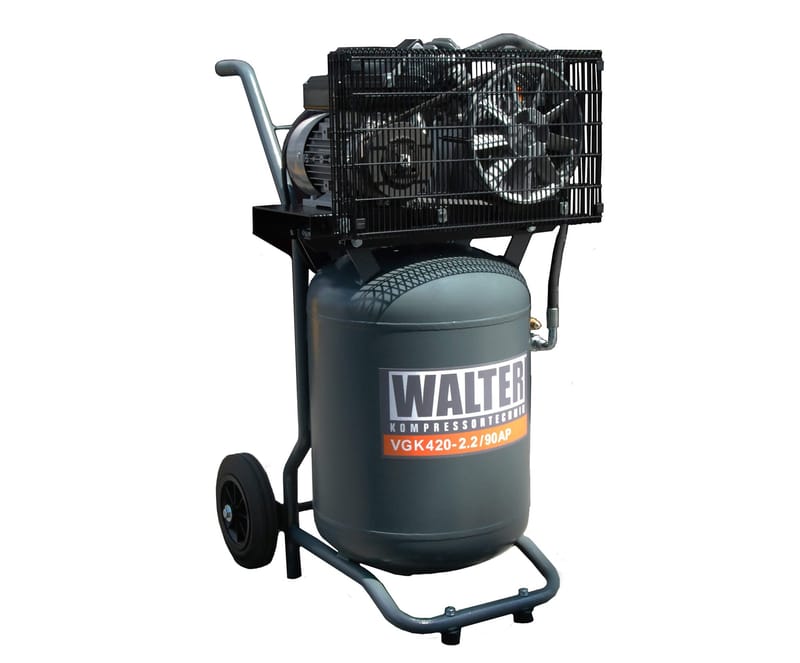
It is the same unit, the same motor and the same speed — only the orientation of the tank changes. The vertical version has neither lower output nor a different service life; it takes up roughly half the floor space and can stand against a wall.
There is no vertical version in the 7.5 kW class (WK1500). If you need more than 740 l/min, you will have to go for a horizontal machine, or choose a unit on a base frame and place the tank separately.
The photo shows the older VGK 420-2.2/90 AP sticker — it is the same machine, now designated VWK430-3,0/90AP.
When 10 bar is not enough: high-pressure HWK for 13 and 15 bar
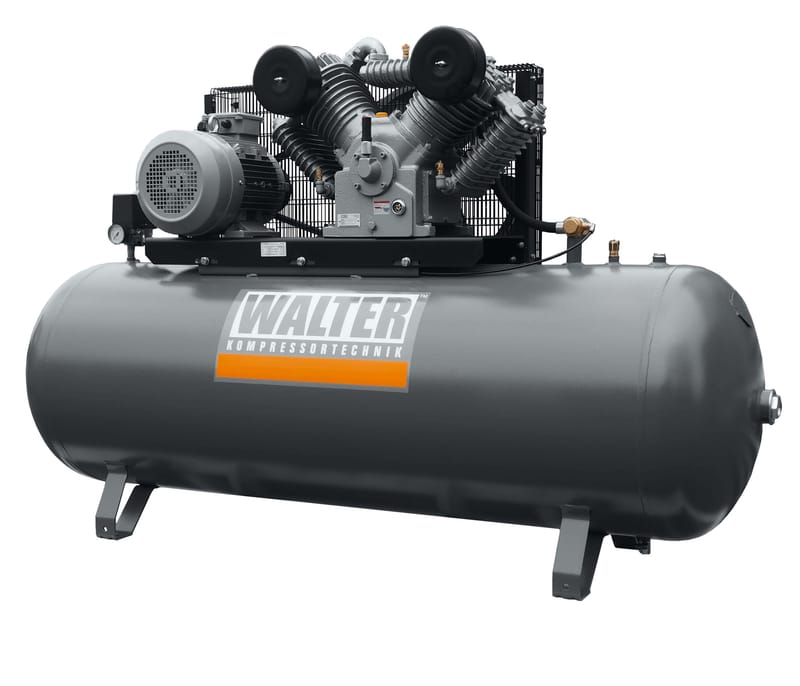
It is bought for the process, not for the output. It makes sense for pressing and forming, pressure testing, some sandblasting and testing applications, and machines with a specified minimum pressure above 10 bar. It makes no sense for an ordinary workshop, impact wrenches or painting: there a high-pressure version would only give you less air.
Illustrative photo — the high-pressure version differs in its cylinder head and valves.
| WALTER HWK high-pressure compressors — 4 models for 13 and 15 bar | ||||||
|---|---|---|---|---|---|---|
| Model | Pressure | Intake | Delivery | Speed | Tank | Power |
| HWK700-5,5/270P | 13 bar | 600 l/min | 500 l/min | 817 rpm | 270 l | 4.0 kW |
| HWK700-5,5/270P-15P | 15 bar | 560 l/min | 470 l/min | 776 rpm | 270 l | 4.0 kW |
| HWK1200-10/500P | 13 bar | 1,120 l/min | 960 l/min | 725 rpm | 500 l | 7.5 kW |
| HWK1200-10/500P-15P | 15 bar | 1,060 l/min | 900 l/min | 688 rpm | 500 l | 7.5 kW |
What you give up for higher pressure: at 4.0 kW you get 550 l/min at 10 bar, 500 l/min at 13 bar (−9%) and 470 l/min at 15 bar (−15%). At 7.5 kW it is 1,100 → 960 (−13%) → 900 l/min (−18%). Always compare the air delivery at your own pressure, not the machine's maximum.
Filling a 270 l tank to 13 bar takes roughly 7.0 minutes, to 15 bar 8.6 minutes. Paradoxically, the lowest speed in the whole range comes with the highest pressure: the HWK1200-10/500P-15P runs at 688 rpm. The web addresses of the high-pressure products contain the numbers of other series (HWK700 → hwk650, HWK1200 → hwk1500) — this is just historical naming.
Already have a tank? Six units on a base frame
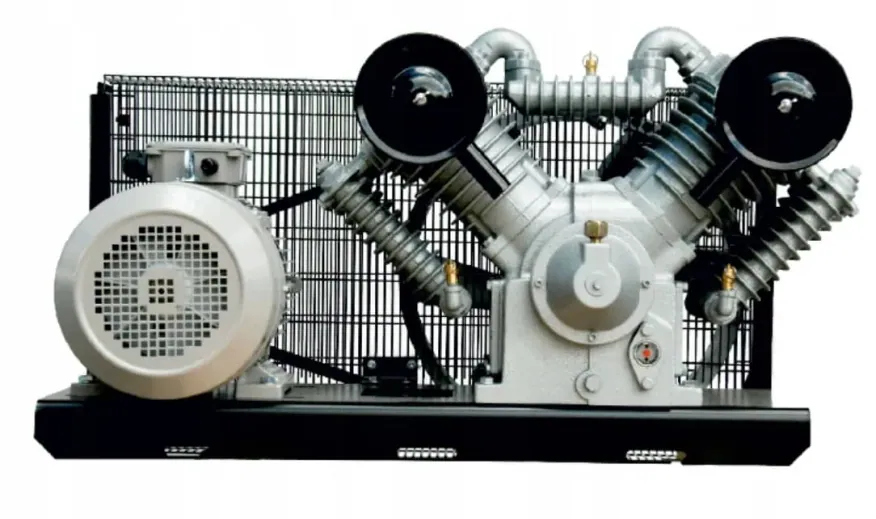
P-PLATE is a cast-iron compressor unit with a motor on a base frame, without a pressure tank. We will gladly confirm the exact scope of supply (pressure switch, fittings) by phone — connecting it to an existing tank always has to be assessed individually. In the e-shop these items are called "Cast iron WK… aggregate on base frame".
When to choose it: the unit on a working tank with a valid inspection has reached the end of its life, you need a second compressor for an existing air network, or you are building your own assembly or a mobile unit. What to bear in mind: the inspection and certification of the pressure tank remain your responsibility, and the unit has no air storage of its own. Standalone tanks can be found in the category Pressure vessels and air tanks.
Without electricity: the petrol WKM 700-7/38
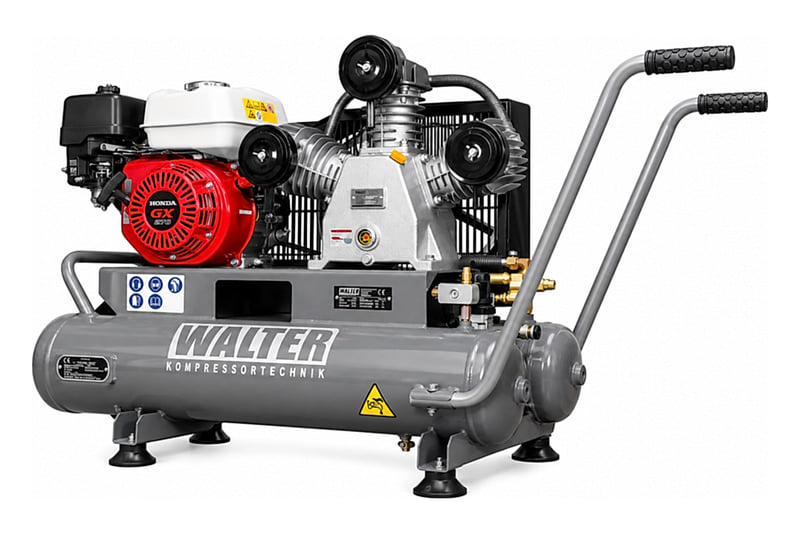
The three-cylinder piston unit is driven by a 4.3 kW Honda GX200 petrol engine, and the air is stored in two 19 l tanks. Its air delivery of 316 l/min corresponds to the smallest electric class, but the machine needs no power supply: on a building site, in an orchard or out in the field, it is moved on its front wheel like a wheelbarrow.
Because of the exhaust fumes, it may only be run outdoors. Maintenance also covers the engine — besides the compressor oil, the engine oil is changed, the engine air filter cleaned and the spark plug checked. You will find the details on the WKM 700-7/38 product page.
Derived data — what the catalogue sheet does not tell you
We calculated the following values from the machines' parameters so that you can compare the machines with each other and with other designs.
| Calculated values for comparing the models | |||
|---|---|---|---|
| Platform | Delivery per 1 kW | Volumetric efficiency | Filling an empty tank to 10 bar |
| WK430 · 2.2 kW | 154.5 l/min | 81 % | 50 l = 1.5 min · 90 l = 2.6 min · 100 l = 2.9 min · 200 l = 5.9 min |
| WK550 · 3.0 kW | 146.7 l/min | 83 % | 90 l = 2.0 min · 100 l = 2.3 min · 200 l = 4.5 min · 270 l = 6.1 min |
| WK650 · 4.0 kW | 137.5 l/min | 87 % | 270 l = 4.9 min |
| WK900 · 5.5 kW | 134.5 l/min | 84 % | 270 l = 3.6 min · 500 l = 6.8 min |
| WK1500 · 7.5 kW | 146.7 l/min | 79 % | 500 l = 4.5 min |
How we calculated it: volumetric efficiency is the air delivery divided by the intake. Filling time = receiver volume × pressure ÷ air delivery — an isothermal estimate of filling from zero with no air being drawn; real values are somewhat higher. The high-pressure HWK models take longer to fill: the HWK700 7.0 min to 13 bar and 8.6 min to 15 bar; the HWK1200 6.8 and 8.3 min. With a comparable piston stroke, the ratio of speeds also corresponds to the ratio of the ring sliding distance — so in one hour of operation the WK1500 (768 rpm) covers about 40% less distance than the WK430 (1,276 rpm).
Cylinders 2V / 3W / 4V: two cylinders in a V, three in a W, four in two V pairs. That the larger WK650 (4.0 kW) is a twin-cylinder and the smaller WK550 a three-cylinder unit is not a mistake — the WK650 makes up for it with a larger bore and lower speed (993 versus 1,202 rpm).
Why a cast-iron WALTER
All-cast-iron unit
Cast-iron blocks and heads have a heat capacity many times greater than thin-walled aluminium castings. They absorb heat and dissipate it through a large finned surface, so the unit's temperature does not shoot up during long running.
Low-speed running at 688–1,276 rpm
A lower piston speed means less wear on the rings and cylinders and less heat. Paradoxically, the highest classes have the lowest speeds.
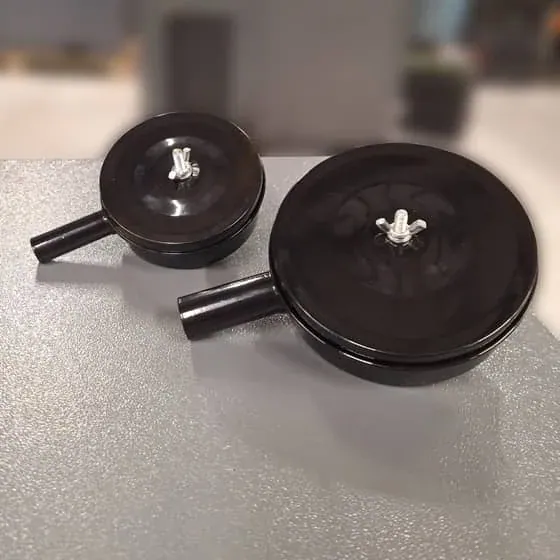
New-generation steel intake filters
An all-metal body with a mesh withstands heat and knocks in the workshop, unlike a plastic cover. The intake is the first place where abrasive dust can get into the compression chamber.
Repairability
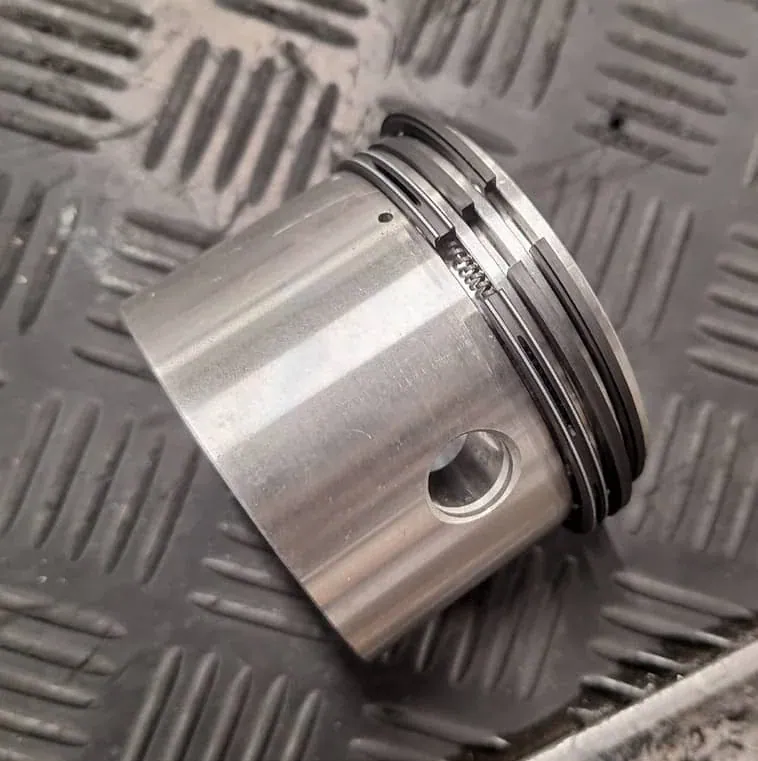
The cast-iron liner can be re-machined and the rings replaced — the unit is a serviceable part, not a throwaway product. We supply spare parts through the importer in the Czech Republic.
28 electric variants on 5 platforms
Horizontal, vertical, units on a base frame, 230 and 400 V, 10 / 13 / 15 bar. The same mechanics also mean shared spare parts.
Compared with common high-speed aluminium units running at 2,000–3,400 rpm, this range has — depending on the class — a 1.6 to 5× shorter ring sliding distance per hour of operation, a machinable cast-iron liner and parts from the importer in the Czech Republic. A light high-speed machine is the right choice for occasional use and carrying around — this range is the answer to continuous duty. You will find more machines of the brand on the WALTER page.
What's new in the 2025 generation
A 3-year warranty and the maintenance that keeps it valid
What the warranty includes
The warranty is provided by Walter Kompressortechnik Česko s.r.o. (Ostrava). Registering the machine at waltercesko.cz extends the warranty to 36 months from the date of purchase; to make a claim, you need the proof of purchase.
- Claims are assessed within 14 working days; an accepted repair is carried out free of charge within 30 days, and the warranty is extended by the time the repair takes.
- After 4 repairs and a further defect, you are entitled to have the machine replaced with a fault-free one.
- You may carry out the prescribed inspections I–V (month 6 / 12 / 18 / 24 / 30) yourself — provided you use original parts and fluids and keep the proof of purchase for them.
The full terms are described in the article 3-year warranty on WALTER piston compressors.
Maintenance schedule
| Maintenance of WALTER cast-iron compressors according to the manual | |
|---|---|
| When | What to do |
| after 8 h | Tighten the cylinder head bolts to 25 Nm and check the other connections |
| daily | Check the hose connections and the oil level, wipe off dust with a cotton cloth |
| 1× a week | Drain the condensate from the tank |
| 1× a month | Blow out the air filters; the new-generation metal element can take this repeatedly |
| after 100 h | First oil change, then at least 1× every 6 months; do not mix oil types |
| month 6 / 12 / 18 / 24 / 30 | Inspections I–V: filters, oil, general check; in months 12 and 24 also the V-belts and the safety valve |
Diagnostic tip: oil that is lighter than when it was filled means water in the oil; darker oil means overheating. In both cases change the oil immediately and look for the cause — condensate not drained from the tank, a clogged filter, insufficient cooling of the room. An automatic condensate drain can drain the condensate on its own.
Ventilek’s tip
Don't go by the number in the name.
The six hundred and fifty in the name is the approximate intake — what actually reaches your workshop is five hundred and fifty. Add up only the tools that will really run at the same time, add 30% for leaks and choose accordingly. Then look at the speed: the seven-and-a-half-kilowatt WK1500 turns at just 768 revolutions per minute — that is why these machines keep going long after a high-speed unit has had its day. And take the tank one size bigger: a machine wears out from its starts, not from its running hours.
Shipping, commissioning and spare parts
Shipping. The machines are sent by pallet freight. For the larger models (270 and 500 l, weights over 150 kg), allow for a forklift, a loading ramp or three people to unload. Check the consignment before you sign for it.
Installation. A level surface and a supply cable sized for the power input; for the 230 V versions, a dedicated circuit and a slow-tripping circuit breaker as specified in the machine's manual. Before the first start, check the oil level, and after the first 8 hours retighten the heads to 25 Nm. We can take care of commissioning and later servicing — see our services.
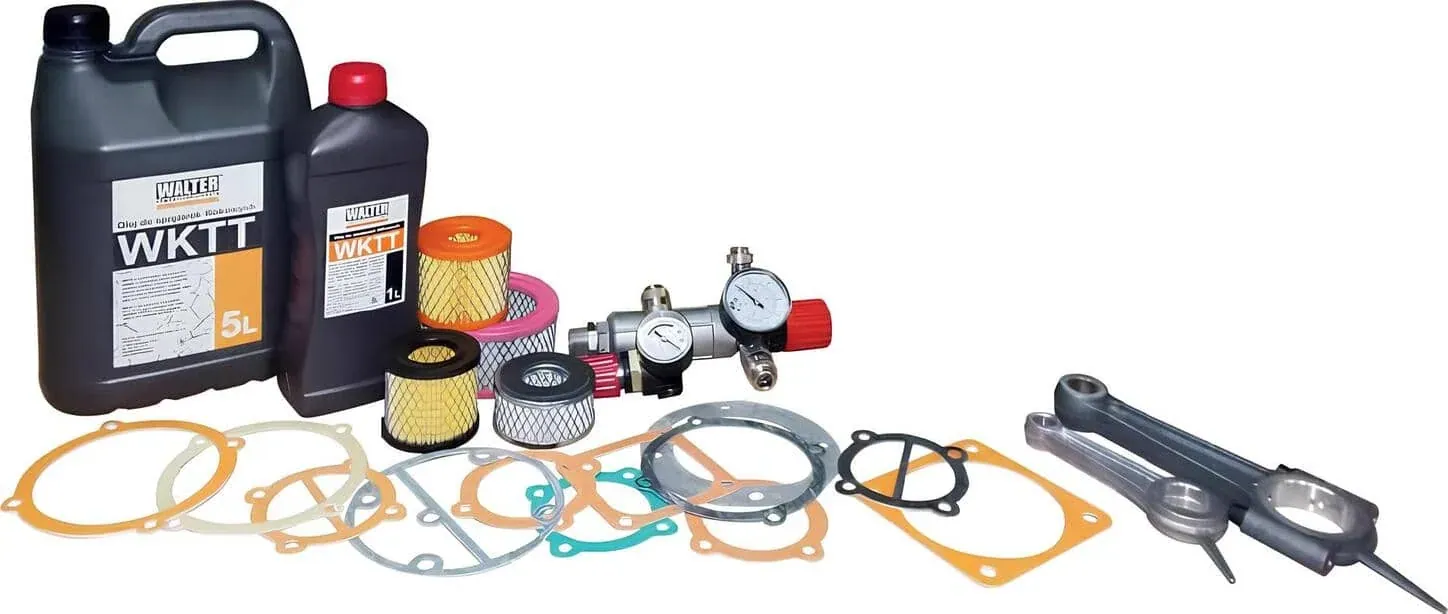
Service and parts. The unit is designed to be repaired, not replaced as a whole. Typical items: WKTT oil in 1 l and 5 l, intake filter and filter element, head gaskets, valve plates, V-belts, rings and connecting rods — the parts are largely shared between the classes. We supply spare parts through the importer in the Czech Republic; when ordering, please also quote the old GK designation from the sticker. Compressor oils can be found in the category Compressor oils.
Frequently asked questions
- Should I go by intake or by air delivery?
- Intake is the volume the unit draws in; air delivery is what you actually get in the workshop. In this range it is 79 to 87% of the intake, specifically 340 / 440 / 550 / 740 / 1,100 l/min depending on the class. Always size for air delivery — the number in the name only serves to identify the machine.
- What does the 5,5 in the designation mean — is it kilowatts?
- No. It is the motor power in horsepower: 3.0 HP = 2.2 kW, 4.0 HP = 3.0 kW, 5.5 HP = 4.0 kW, 7.5 HP = 5.5 kW and 10 HP = 7.5 kW. So the designation WK430-3,0 does not mean 3 kW, but 2.2 kW.
- Which air receiver for which output?
- As a guide, 0.3 to 0.5 litres of tank per 1 l/min of intake: 100 to 200 l for the WK430, 200 to 270 l for the WK550, 270 l for the WK650, 270 to 500 l for the WK900, 500 l for the WK1500. The tank does not increase output but reduces the number of starts: on a machine delivering 550 l/min with a demand of 200 l/min, the motor switches on about 14 times an hour with a 270 l tank and 38 times with a 100 l tank.
- Can a standard socket handle the 230 V version?
- The motor is 2.2 kW with a high starting current, so it needs its own circuit, a slow-tripping circuit breaker (typically 16 A, type C; you will find the exact value in the manual) and a supply cable sized for its length. Do not use an extension cable on a reel, and leave the installation to an electrician. There are 5 models for 230 V in the range, all of them 2.2 kW.
- How do I get the 3-year warranty?
- By registering the machine at waltercesko.cz. The warranty then runs for 36 months from purchase, claims are assessed within 14 working days, and after 4 repairs and a further defect you are entitled to have the machine replaced. You may carry out the inspections yourself, provided you use original parts and keep the receipt.
- What is the difference between WK and GK?
- There is no mechanical difference. WK is the importer's new designation, GK the original one: WK430 = GK420, WK550 = GK530, WK650 = GK630, WK900 = GK880, WK1500 = GK1400. The number in GK corresponds to the actual intake, the number in WK is approximate.
- Do you have a compressor that does not need electricity?
- Yes, the petrol WKM 700-7/38 with a Honda GX200 engine: 316 l/min air delivery, 10 bar pressure, two 19 l tanks and 82 kg on a wheel. It may only be run outdoors — on building sites, in orchards or out in the field.
Bestsellers


Product sorting
List of products

The most common choice for workshops without a three-phase supply. Its 340 l/min air delivery covers a blow gun, a ratchet and a stapler, and the tank holds pressure for short...

The three-cylinder class with the largest reserve, for operations that draw air in heavy bursts: sandblasting smaller parts, filling, blowing down a line. The 740 l/min air...

A three-cylinder unit with a large tank for a workshop where two people work in turns. The 440 l/min air delivery keeps the reserve topped up, so the motor switches on less...

The same unit and tank as the horizontal WK650, just standing upright: a footprint of 65 × 70 cm instead of 165 cm of length. Its 550 l/min air delivery covers painting plus a...

The smallest cast-iron WALTER with a tank: for short jobs, as a second compressor alongside a larger machine, or for workstations you wheel it to. Its 340 l/min air delivery...

A small unit with a large tank for a workshop with intermittent but heavy air demand: the reserve holds the pressure for longer than the 340 l/min air delivery alone could keep...

A well-balanced entry-level combination for a single workstation in a smaller workshop: a cast-iron twin with twice the air reserve of the smallest machine, so the motor...

A three-cylinder unit on a compact tank for a workshop where several tools take turns and none of them runs for long. Its 440 l/min air delivery handles an impact wrench, a blow...

A cast-iron compressor for a garage or a smaller workshop without a three-phase socket. The twin-cylinder unit at 1,276 rpm delivers 340 l/min for a blow gun, a tyre inflator...

A vertical version for a workshop short of floor space: the upright tank takes up a footprint of 63 × 54 cm and can stand against a wall. The cast-iron twin delivers 340 l/min...

The sweet spot of the range for car workshops, paint shops and metalworking: one person works continuously while a second occasionally picks up an impact wrench. The speed drops...

For two people working at the same time and continuously: a grinder plus a spray gun, or two tyre-service bays. The three-cylinder unit at 902 rpm delivers 740 l/min, and the...

The only vertical WALTER for a standard socket: the upright tank stands against a wall and occupies a footprint of 63 × 54 cm. Its 340 l/min air delivery is enough for blowing,...

Three-cylinder performance on a footprint of 63 × 56 cm: a vertical version for a workshop that needs more air than the smallest class but has nowhere to put a horizontal...

Central air supply for the workshop: sandblasting, three points of use at once, an air network across the hall. The four-cylinder unit at 768 rpm delivers 1,100 l/min, the most...

The top of the range for pressure: a four-cylinder unit with the lowest speed of them all, 688 rpm, for test facilities and processes with a specified pressure above 13 bar. It...

A high-pressure four-cylinder unit for operations where the process calls for more than 10 bar and plenty of air as well: pressure testing, presses, filling. It delivers 960...

The highest pressure of the twin-cylinder platform, for test facilities and processes with a specified minimum above 13 bar. The unit runs at 776 rpm, the slowest in its class,...

A machine for a single tyre-service bay: impact wrench and tyre changer with no waiting for the pressure to build back up. Three cylinders in a W and a large tank keep the...

A high-pressure version for processes where 10 bar is not enough: pressure testing, pressing, machines with a specified pressure. The unit runs at just 817 rpm and delivers 500...

A unit on a base frame for a workshop without a three-phase supply: it replaces a worn-out compressor on a tank that is still in good working order. The cast-iron twin delivers...

A compressor for work where no cable reaches — on building sites, in orchards, on farmland or for repairs out on site. It handles staplers, blow guns, tyre inflation and short...

The unit from the most requested class of the range, without a tank: for a compressor room or your own assembly on a working tank. The large-bore twin runs at 993 rpm and...

The largest tank the range offers for a standard socket: for a workshop without three-phase power where air is drawn in bursts, but in large amounts. The 340 l/min air delivery...

The most powerful vertical WALTER: a three-cylinder unit delivering 740 l/min on a footprint of 65 × 70 cm. For a workshop with two workstations that has no room for a two-metre...

The most powerful unit in the range, without a tank, for a compressor room with its own air receiver or a central air network. Four cylinders in two V pairs run at 768 rpm and...

A cast-iron unit for a workshop that already has a working pressure tank and needs a new air supply. The twin-cylinder unit runs at 1,276 rpm and delivers 340 l/min for blowing,...

A three-cylinder unit on a base frame for a working tank with a valid inspection whose motor or compressor pump has reached the end of its life. The W layout spreads the...

A three-cylinder unit for two workstations running at the same time, without a tank: for a compressor room or an existing air receiver with a valid inspection. The W layout at...