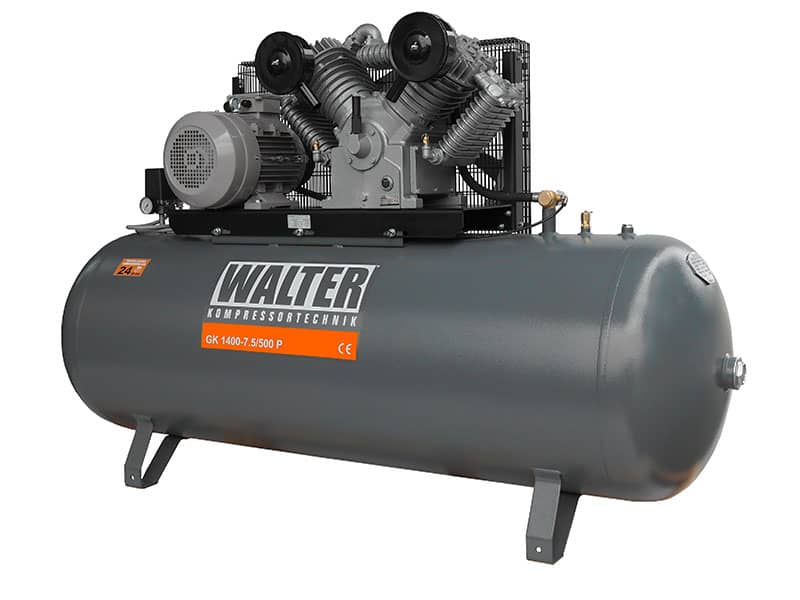

Cast iron piston compressor WK1500-10/500P input power 7.5 kW, intake 1,400 l/min, pressure 10 bar, air receiver 500 l, voltage 400/50 V/Hz
Code: WK1500-10/500P


Related products


Product detailed description
WALTER Cast-Iron Piston Compressor - WK1500-10/500P
The WK1500-10/500P is the machine with the highest delivery in the entire WALTER range: a 4V four-cylinder cast-iron unit with a power input of 7.5 kW, intake of 1,400 l/min, effective delivery of 1,100 l/min at 10 bar and a 500 l horizontal tank. At the same time, it has the lowest RPM among the 10 bar models – the unit runs at 768 rpm, which is 134 rpm less than the 5.5 kW class (902 rpm) and 508 less than the entry-level 2.2 kW class (1,276 rpm).
This is no longer just a workshop compressor, but a compressed air source for the entire operation. A delivery rate of 1,100 l/min can handle continuous sandblasting, three simultaneous draw-offs, or a fixed distribution system across the entire hall. Power supply 400 V / 50 Hz, open design with full service access, noise level approx. 80 dB(A), 3-year warranty after registration at waltercesko.cz.
Configuration of this machine
- Cast-iron unit — 4V · 768 rpm · single-stage compression
- Pressure vessel — 500 l · horizontal
- Horizontal design
- Three-phase 400/50 V/Hz
- Standard pressure of 10 bar for common pneumatic tools
Why choose this model
Four cylinders in two V-pairs – what it does for the operation
The 4V design means four cylinders arranged in two V-pairs. The intake of 1,400 l/min is divided into four compression chambers, so approximately one quarter of the volume is allocated per stroke. The result is the smoothest compression process in the entire range: four smaller pulses per revolution instead of two large ones, a crank mechanism with opposing pairs that balance inertial forces, and uniform loading of the V-belts. This is precisely what allows the reduction of RPM without the machine starting to vibrate.
768 rpm – lowest RPM among 10 bar models
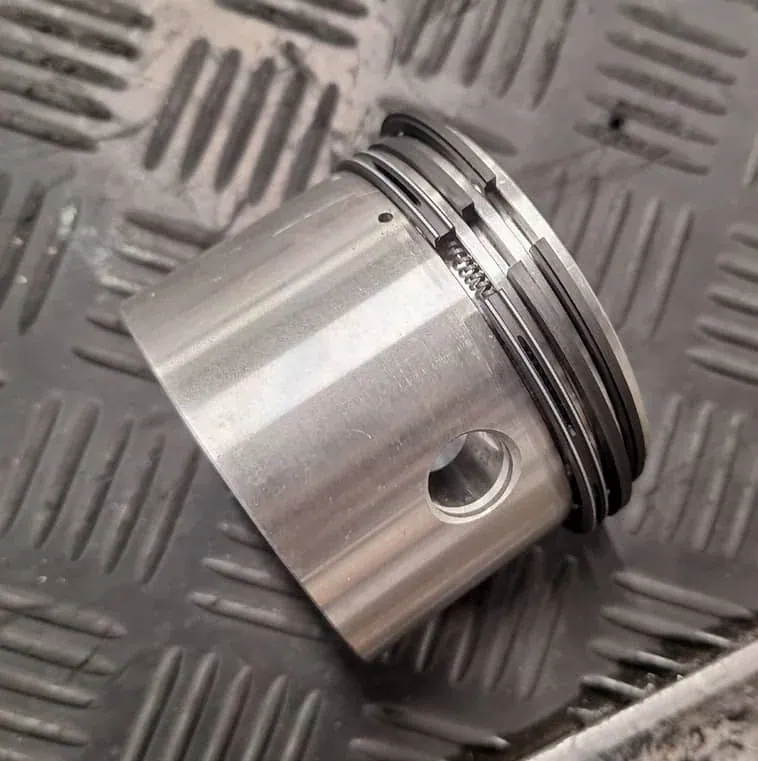
Compared to the 902 rpm of the 5.5 kW class, it is approximately 15% less, and compared to the 1,276 rpm of the entry-level 2.2 kW class, it is 40% less. With a comparable piston stroke, the RPM ratio corresponds to the sliding path ratio of the piston ring: this unit therefore travels an approximately two-fifths shorter distance within the cylinder per hour of operation than the smallest compressor in the range with a pressure vessel. The machine with the highest delivery thus simultaneously travels the shortest path of all ten-bar models in the range.
1,100 l/min handles what smaller machines cannot
A sandblasting gun with a 3 mm nozzle takes 500 to 1,000 l/min continuously, and it is a tool that smaller classes can only cover from the tank and only for a few minutes. Here, we are talking about continuous operation with a reserve. Similarly, two pneumatic angle grinders simultaneously – 800 to 1,200 l/min – are a realistic scenario for this class, not theory.
146.7 l/min per kilowatt – the best ratio among large machines
From every kilowatt of power input, you get approximately 147 litres per minute into the distribution system. Together with the 3.0 kW platform, it is the second-best ratio on offer – the highest specific performance is found in the entry-level 2.2 kW class with 154.5 l/min per kilowatt, but that only provides 340 l/min in absolute terms. For a machine of this size, the specific energy consumption directly impacts the electricity bill, as the compressor consumes energy in proportion to its operating time. The half-cubic-metre tank also adds approximately 1,000 litres of free air per cycle: with a continuous draw of 500 l/min, this results in roughly 16 motor starts per hour.
Who is it for
It is purchased by operations where compressed air is not just an aid, but part of the production process: continuous-duty sandblasting or blasting booths, assembly stations with multiple pneumatic tools running simultaneously, or metal fabrication with a fixed distribution system across the entire hall and multiple people per shift. Typically, it is a machine installed in a separate plant room or compressor room, hard-wired, where the operator only knows it is running by the sound behind the wall. For a workshop with two people and irregular demand, it is an unnecessarily large investment in a machine that will never be fully utilised.
Typical applications
- Continuous sandblasting and blasting with a 3 mm nozzle
- Two pneumatic angle grinders simultaneously (800 to 1,200 l/min)
- Central source for a fixed distribution system in a hall with multiple take-off points
- Assembly stations with pneumatic clamping and tools in shift operation
- Metal fabrication with the concurrent use of three or more tools whose operation cannot be staggered in time
- Operations with long working cycles where the machine runs for hours at a time
Where to choose a different model
Your equipment requires more than 10 bar
The same four-cylinder platform is also available in a high-pressure version at 13 bar with a delivery of 960 l/min at 725 rpm, or alternatively at 15 bar. Higher pressure always comes at the cost of a lower volume of air – compare the delivery rate at your required pressure, not the machine's maximum.
You do not have space in the hall for a horizontal half-cubic-metre tank
A vertical design does not exist in this power class – vertical models end at the 5.5 kW class. The solution is a standalone four-cylinder unit on a base frame, allowing you to place the tank separately, for example, in an adjacent room.
You have a continuous draw of up to 740 l/min and peaks are only occasional
A 7.5 kW machine would merely be heating your plant room. The three-cylinder 5.5 kW class with the same 500 l tank provides 740 l/min and represents a significantly smaller investment in both purchase and electrical installation.
What the figures tell you — calculated values
The values are calculated and are meant for comparing the models with each other, not as guaranteed figures.
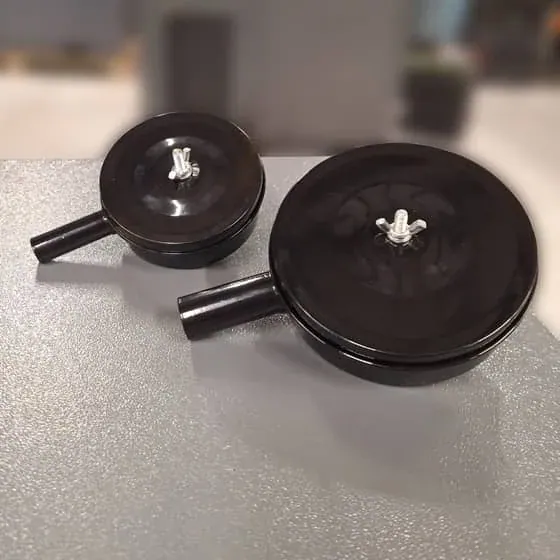
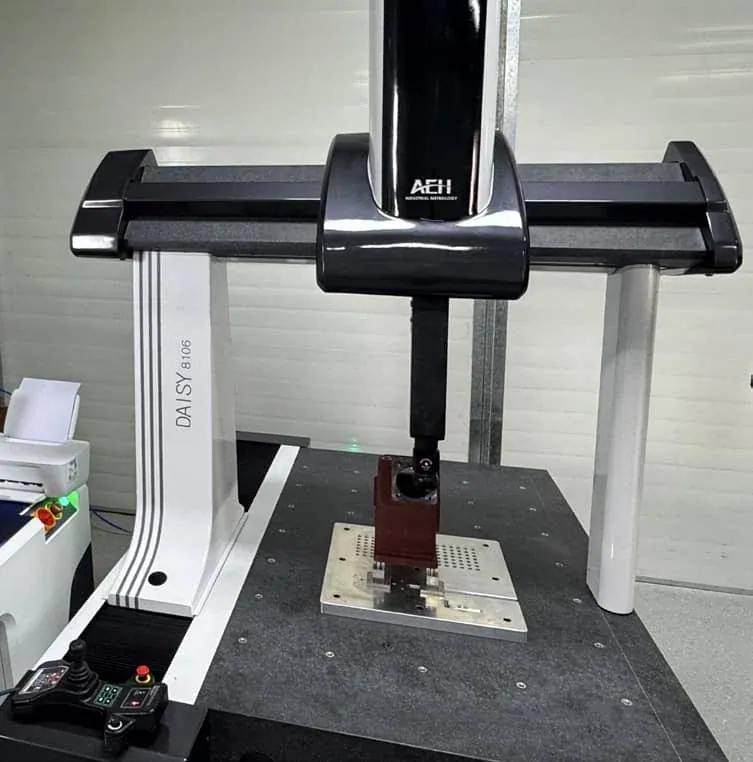
Design and technology

Related models and alternatives
WK900-7,5/500P
One class lower with the same 500 l tank: a three-cylinder 5.5 kW model with 740 l/min at 902 rpm – if 740 l/min is enough for you.
HWK1200-10/500P
The same four-cylinder platform at 13 bar: 960 l/min at 725 rpm, designed for applications with higher pressure requirements.
HWK1200-10/500P-15P
The range maximum: 15 bar, 900 l/min and the lowest speed in the entire range – 688 rpm.
WK1500P-PLATE
The 7.5 kW four-cylinder unit alone on a base frame, without a tank – for custom assemblies or replacing a worn-out unit.
Frequently asked questions
- What does the 4V designation mean and why does this machine have four cylinders?
- Four cylinders arranged in two V-pairs. Smaller models have two cylinders in a V (2V designation) or three in a W (3W). The more cylinders, the smaller the volume per stroke and the smoother the compression – four smaller pulses per revolution instead of two large ones. Opposing pairs further balance the inertial forces. This allows the speed to be reduced to 768 rpm without the risk of harsh operation.
- Does 768 rpm mean this machine is less noisy than smaller models?
- All models in the series have the same figure of approximately 80 dB(A), so not on paper. In reality, however, the lower speed affects the sound character – it is deeper and more consistent than that of high-speed units operating in the thousand-rpm range. The machine is an open design without a noise enclosure, so expect to use hearing protection if placed next to a workstation. A separate compressor room is ideal.
- Can it handle continuous sandblasting?
- Yes, that is one of the primary reasons this class is purchased. A sandblasting gun with a 3 mm nozzle consumes 500 to 1,000 l/min in continuous operation depending on settings, and the 1,100 l/min delivery provides a reserve even after accounting for distribution losses. The half-cubic metre tank further dampens pressure fluctuations when opening and closing the gun. In smaller classes of the series, sandblasting is only possible in short bursts from the tank.
- Why is the delivery-to-intake ratio lower for this model than for smaller machines?
- The difference is smaller than it may seem: 1,100 out of 1,400 l/min is about 79%, while the other 10-bar platforms in the range sit between 81 and 87%. When sizing tools, always go by the delivery of 1,100 l/min; the intake of 1,400 l/min only identifies the model.
- How long does it take to fill the 500 l air tank and how often does the motor switch on?
- The calculation gives approximately 4.5 minutes from zero to 10 bar with no air being drawn – the fastest of all models with a half-cubic-metre tank. In operation, however, the machine only repressurises by 2 bar between the cut-in and cut-out pressure, which is about 1,000 litres of free air per cycle. With a continuous draw of 500 l/min, this results in roughly 16 motor starts per hour. The values given are our own calculation, not a figure from the data sheet.
The machine comes with a 3-year warranty after registration with the importer. Warranty terms, the maintenance schedule and a comparison of all 28 models are in the category WALTER cast-iron piston compressors.
Ventilek’s tip
This is no corner compressor any more — it's an air supply for the whole shop floor. Get hold of a forklift for unloading.
Additional parameters
| Category: | Air compressors |
|---|---|
| Warranty: | 3 years |
| EAN: | 5905122000165 |
| Compressor type: | Piston compressor |
| Pressure: | 10 bars |
| Suction power: | 1 400 l/min |
| Air delivery: | 1,100 l/min |
| Pressure vessel volume: | 500 L |
| Design of pressure vessel: | Lying down |
| Connecting: | Quick coupling DN 7.2, Ball valve 1/2" |
| Motor power: | 7.5 kW |
| Mains voltage: | 400/50 V/Hz |
| Speeds: | 768 rpm |
| Number of cylinders: | 4 |
| Number of grades: | 2 – two-stage compressor |
| Lubrication: | Oleic |
| Noise: | 80dB(A) |
| Dimensions: | 2000 × 610 × 1250 mm |
| Weight: | 320 kg |
| Accessories: | Pressure regulator, Wheels, Handle, Quick coupler, Ball cock |
| Engine: | Electric |
| Soundproofed: | No |
| Drive: | V-belts |
| Air dryer: | No |
| Retrieved from: | Professional |
| Development: | Stationary |


Demonstrace výkonu litinového pístového kompresoru GK1400-75-500 🏭🔧
Product rating
Be the first who will post an article to this item!
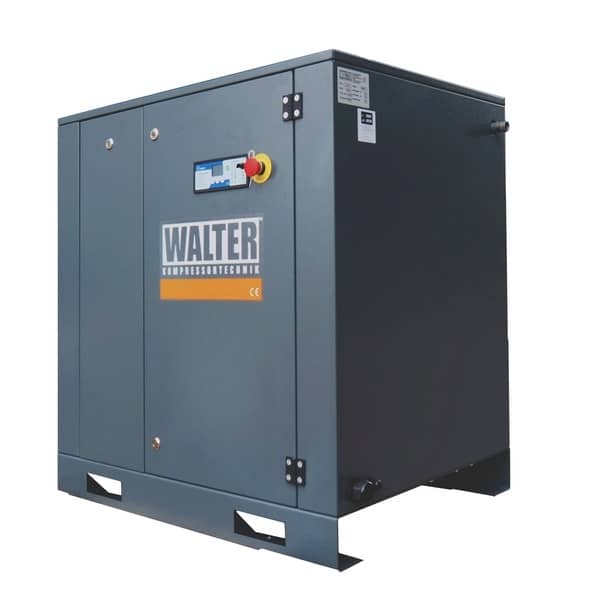
WALTER Kompressortechnik - Innovative Solutions for Compressors
- About the company WALTER: WALTER Kompressortechnik is a renowned manufacturer of air compressors and accessories, known for its quality, reliability and innovative technologies. The company focuses on providing highly efficient solutions for various industries.
- Product portfolio:
- Screw compressors: we offer a wide range of screw compressors that are designed for maximum energy efficiency and long life. Ideal for high demanding industrial applications.
- Reciprocating compressors: these compressors are robust and reliable, suitable for smaller applications and workshops where high flexibility and low running costs are required.
- Mobile compressors: lightweight and easily portable compressors that allow easy use in a variety of locations, ideal for construction and field work.
- Scroll and special compressors: provide quiet operation and are suitable for specific applications requiring minimal vibration and noise.
- Innovation and quality: WALTER emphasizes continuous development and improvement of its products to ensure maximum customer satisfaction. Their compressors are equipped with advanced technologies to optimise performance and save energy.
- Customer support and service: the company offers comprehensive service, including installation, maintenance and diagnostics, ensuring the long-term reliability and efficiency of their equipment.