
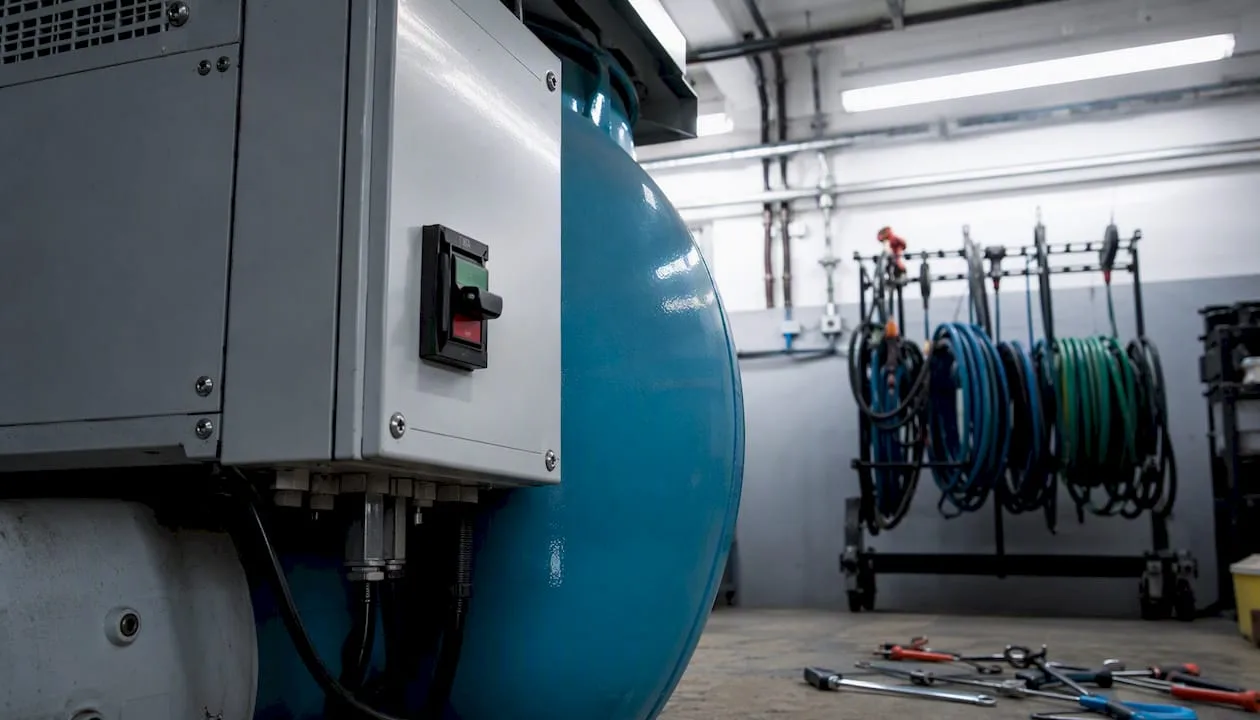
The most common cause is motor startup under pressure, when a malfunctioning pressure relief valve forces the motor to draw many times higher current than the circuit breaker is rated for. The second most common cause is an incorrectly selected circuit breaker characteristic. Type B is often unsuitable for compressors because it trips already at a short current surge, which is common with these motors.
Before you start disassembling anything, check these three things:
- Pressure relief valve – releases pressure from the cylinder head after stopping, so the next start isn't "under load".
- Circuit breaker type – check the letter on the circuit breaker in the distribution panel (B, C, or D).
- Motor mechanics – listen for unusual sounds during startup, difficult piston or bearing movement.
The first step is always to safely disconnect from power supply and visually inspect the pressure relief valve, as this is where the cheapest and fastest fix is usually found.
Key findings
The compressor most often trips the circuit breaker due to startup under pressure caused by a malfunctioning pressure relief valve combined with an unsuitable circuit breaker characteristic.
| Point | Details |
|---|---|
| Check the valve first | The pressure relief valve on the pressure switch is the most common and cheapest cause of a hard start. |
| Starting current is key | A motor can draw 10 to 12 times its rated current at startup under pressure. |
| Choose the correct characteristic | A type C or D circuit breaker withstands a compressor's current surge better than a standard type B. |
| Measure before replacing parts | An ammeter and megohmmeter distinguish an electrical fault from mechanical seizing. |
| Service for persistent faults | Kompresory-vzduchotechnika offers diagnostics, valve repair, and softstarter installation with an on-site technician. |
Useful resources and further reading
For a deeper understanding of the topic, we recommend:
- How a piston compressor works – where the unloading and check valve are located in the design.
- Compressor bleeding procedure – a step-by-step guide for technicians.
- Safety rules for working with a compressor – before you start the diagnostics yourself.
Contents
- Quick checks you can do right away without tools
- Main technical causes of the circuit breaker tripping the compressor
- Diagnostics: what to measure and how to read the results
- Practical solutions: from quick fixes to permanent remedies
- Prevention: how to avoid repeated tripping
- When it's time to call service or an electrician
- Service, parts, and advice from Kompresory-vzduchotechnika
- Frequently Asked Questions
Quick checks you can do right away without tools
Before reaching for a multimeter, switch off the main power supply and make sure the compressor is de-energized. Working in a live electrical panel without professional qualification is an unnecessary risk that is easy to avoid.
Follow this simple sequence:
- Listen to the start: a sharp “braking” sound of the motor during start-up indicates a hard start under pressure.
- Check whether air escapes from the unloader valve at the pressure switch after the compressor switches off (it should take a few seconds).
- Look at the letter on the circuit breaker in the distribution board. Type B is unsuitable for most compressors.
- Note whether the circuit breaker trips every time or only occasionally, and at what time of day.
Professional tip: If the circuit breaker doesn't trip on the first morning start but trips on a subsequent start later in the day, the problem is almost certainly not in the electric motor. It is a typical sign of a malfunctioning unloader valve or a leaking check valve, which leaves pressure in the cylinder between individual starts.
Repeated “circuit breaker tripping” is actually often a mechanical problem disguised as an electrical fault. Users focus on the circuit breaker, when in fact all that's needed is to clean or replace the small valve in the pressure switch.
For a more detailed understanding of how the internal mechanics of the machine work, it is worth reading through the working principle of a piston compressor, which shows exactly where the unloader valve and check valve are located.
The main technical causes of the circuit breaker tripping the compressor
The most likely cause is back pressure during start-up. When the unloader valve fails to release pressure from the cylinder head, the motor has to start against full compression. This dramatically increases both the starting torque and the current needed to turn the shaft at all.
Starting current is the key figure in the whole equation. A typical electric motor draws approximately 5 to 8 times its rated current during start-up. However, if the compressor starts under pressure, the current can briefly spike up to 10 to 12 times the rated draw. A circuit breaker with a type B characteristic is designed to trip at just 3 to 5 times the rated current, so with a compressor, a fault is practically guaranteed at every start.
Other common electrical causes include:
- Loss of one phase in three-phase motors, where the remaining two phases overload the winding.
- Faulty starting capacitor in single-phase motors, which extends the start-up time and increases current draw.
- Voltage asymmetry between phases, which loads the motor unevenly.
Mechanical faults form the second group. A seized piston, worn bearings, or a damaged connecting rod increase mechanical resistance, which is immediately reflected in electrical current draw. Diagnosing a faulty compressor often relies precisely on a combination of sound, temperature, and measured current, because the fault is rarely purely structural in nature. Frequent cyclic switching also contributes to this, where the motor starts and stops at short intervals and does not have time to reach thermal stabilization.
Diagnostics: what to measure and how to read the results
Reliable diagnostics requires three basic tools: a clamp ammeter, a megohmmeter (megger), and a multimeter. A thermal camera is a useful addition, but it is not necessary.
- Measure the starting current with a clamp ammeter directly at start-up. A value above 10 times the rated current confirms a start under pressure.
- Check the insulation condition of the winding with a megohmmeter and compare the resistances between the individual phases. A significant difference between phases indicates damaged winding.
- Verify the voltage and phase symmetry with a multimeter on all three conductors, if it is a three-phase motor.
- Observe the behavior under pressure relief – if manually opening the relief valve at start-up visibly reduces the current, you have confirmed the cause.
Where to look for warning signs:
- High current draw without an apparent short circuit often indicates mechanical seizure, not an electrical fault.
- To confirm a mechanical problem, it is advisable to measure the current with the mechanical load disconnected, if the design allows it, and compare it with a normal start.
- Differing resistances between phases in the winding indicate an impending motor fault, even if it still “works”.
Always perform live measurements with insulated tools and in a dry environment. If you are not confident working with electrical equipment, leave this step to a technician.
Practical solutions: from a quick fix to a permanent remedy
The cheapest and most frequently effective repair is cleaning or replacing the unloader valve on the pressure switch. For single-phase motors, replacing the start capacitor is often just as effective, as it wears out even without visible symptoms.
How to approach the repair:
- First check and repair the pressure components – the unloader valve and the check valve.
- If the problem persists, check and, if necessary, replace the start capacitor on single-phase motors.
- Only after that should you address the protection, and possibly install a soft starter or variable speed drive (VSD).
- For larger motors with accessible winding terminals, consider switching to star/delta starting.
More permanent solutions include:
- Replacing the circuit breaker with a C characteristic, which can handle the short current surge typical of compressors; for heavier machines or very frequent starting, type D is more suitable.
- Installation of a soft starter or VSD, which controls the starting current gradually and protects both the motor and the electrical grid.
- Converting the start-up to star/delta, if the motor design allows it.
As a rough guide: replacing a capacitor costs a few hundred CZK and can be done within an hour. A soft starter or VSD represents an investment in the range of thousands to tens of thousands of CZK depending on motor power, including labor.
Professional tip: Always address the mechanics and pressure components before replacing the circuit breaker. A stronger circuit breaker without repairing the unloading valve only hides the problem and risks damaging the motor.

Prevention: how to avoid repeated tripping
Regular maintenance of the unloading valve and check valve is the cheapest safeguard against repeated circuit breaker tripping. Most manufacturers recommend inspection with every oil and filter change.
It also helps to:
- Choose the circuit breaker characteristic based on the motor's actual starting current, not on the rated power input.
- For compressors with frequent starting, consider soft start already at installation, not just as a reaction to a problem.
- Let the pressure drop gradually before shutdown and avoid repeated starts shortly after one another.
Professional tip: Monitor how long the compressor runs between individual cycles. If it switches on more often than the manufacturer specifies, this is cyclic operation, which shortens the lifespan of both the motor and the unloading valve.
When it's time to call a service technician or an electrician
If the breaker trips even after cleaning the unloader valve and checking the capacitor, it is likely an internal fault in the motor or compressor unit. A burning smell, smoke, or unusual mechanical noises are a signal to shut down the machine immediately.
- Persistent tripping even after basic checks.
- Suspected damage to the windings or bearings inside the compressor.
- An unclear electrical fault that you cannot measure safely.
Modifying the main circuit breaker in the distribution board without the consent of the grid operator or a revision technician is a risk that is not worth taking. Always entrust work on the motor under voltage to an electrician with the appropriate qualification.
Brief recommendation from a technician
On site, I always start by checking the unloader valve, as this is the most common culprit and the repair takes minutes. Only then do I measure the starting current and the insulation condition of the windings. This procedure saves the customer time and money on an unnecessary breaker replacement.
Service, parts and advice from Kompresory-vzduchotechnika
Kompresory-vzduchotechnika is an alternative to arranging a service call through a random electrician without knowledge of pneumatics. We handle compressors comprehensively, from pressure components to electrical protection, so you don't need to contact two different companies for one problem.
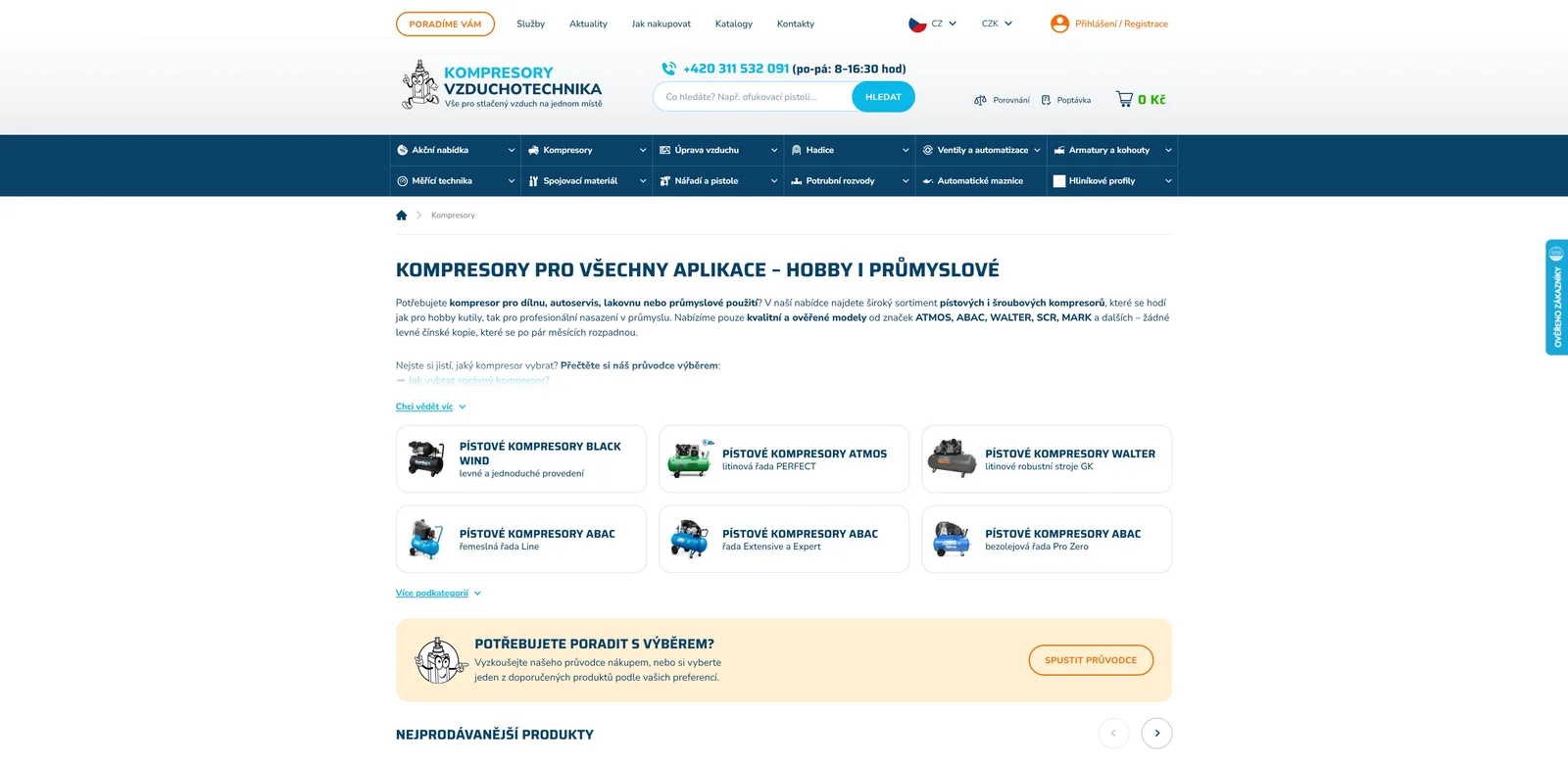
We offer on-site diagnostics, repair and cleaning of unloader valves, installation of softstarters, and supply of spare parts, including capacitors and components for air distribution systems. The exact diagnosis and price quote will always be prepared by a technician after measuring the actual values directly on your machine, not estimated over the phone. If you need to replace piping or supplement your compressed air distribution system, check out pipes for compressed air distribution or the entire range of pneumatics and hydraulics and order a service call directly through the website.
Frequently asked questions
How does a faulty circuit breaker manifest itself?
A faulty circuit breaker trips even without an apparent load, or conversely, does not react at all to a current surge that should disconnect it. If the breaker trips regularly only with the compressor while other appliances on the same circuit work without problems, the fault usually lies in the compressor itself, not in the breaker.
How to recognise a faulty compressor?
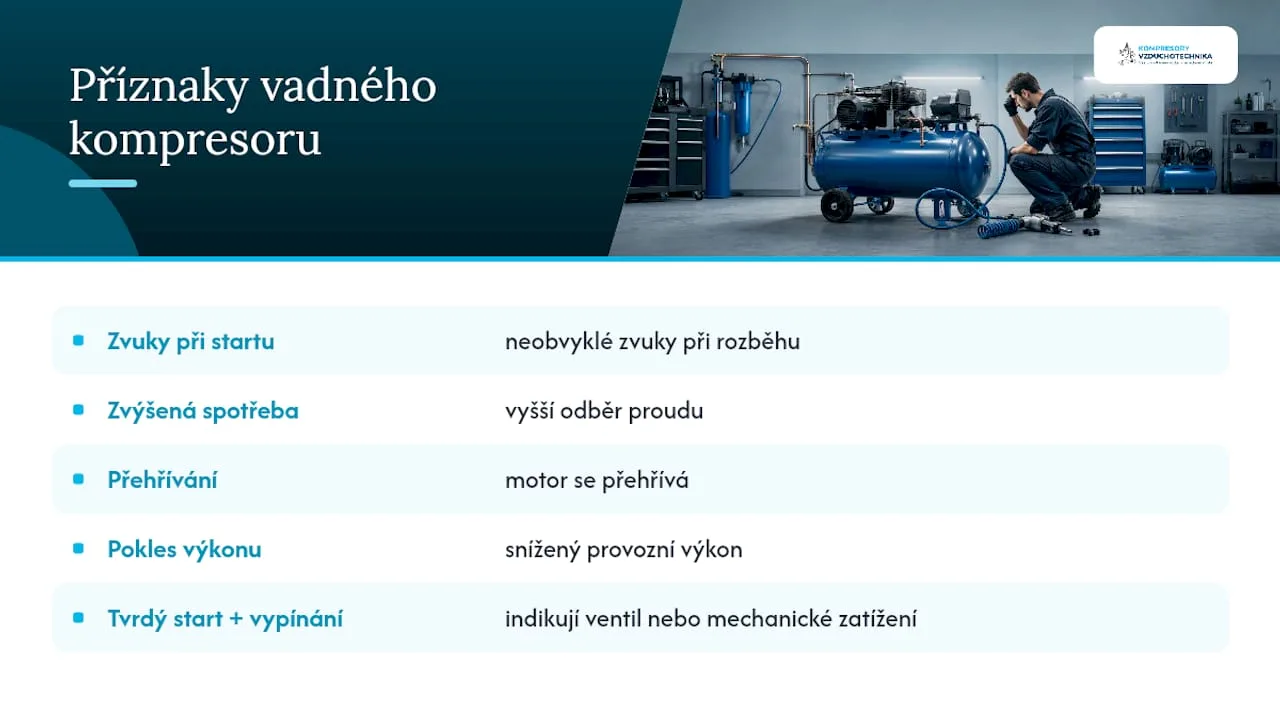
A faulty compressor shows itself through unusual noises on startup, increased current draw, overheating, or a drop in performance. A combination of hard starting and repeated circuit breaker tripping almost always points to a problem with the unloader valve or mechanical load on the motor.
How to recognise a faulty air conditioning compressor?
In an air conditioning compressor, a fault is signalled by shaft leakage, mechanical noise, or contamination of the refrigeration circuit. In case of serious internal damage, it is usually necessary to flush the circuit or replace the compressor entirely.
How to reduce noise from a noisy compressor?
Noise can be reduced by placing the unit on rubber pads, acoustic insulation of the space, and regular inspection of loose parts and bearings. If the noise level has increased suddenly, it is often a mechanical fault that needs to be diagnosed first, not just muffled.
Which circuit breaker is most suitable for a compressor?
For most workshop compressors, characteristic C has proven effective; for heavier machines or very frequent starting, characteristic D is used. The choice depends on the actual motor starting current, which can be measured with a clamp ammeter directly during startup.
Recommended
- How to repair an air leak on a compressor: a 2026 guide - Kompresory-Vzduchotechnika.cz
- Avoid the most common mistakes when using compressors - Kompresory-Vzduchotechnika.cz
- Compressor bleeding procedure: a guide for technicians - Kompresory-Vzduchotechnika.cz
- The importance of compressor diagnostics for efficient operation - Kompresory-Vzduchotechnika.cz