

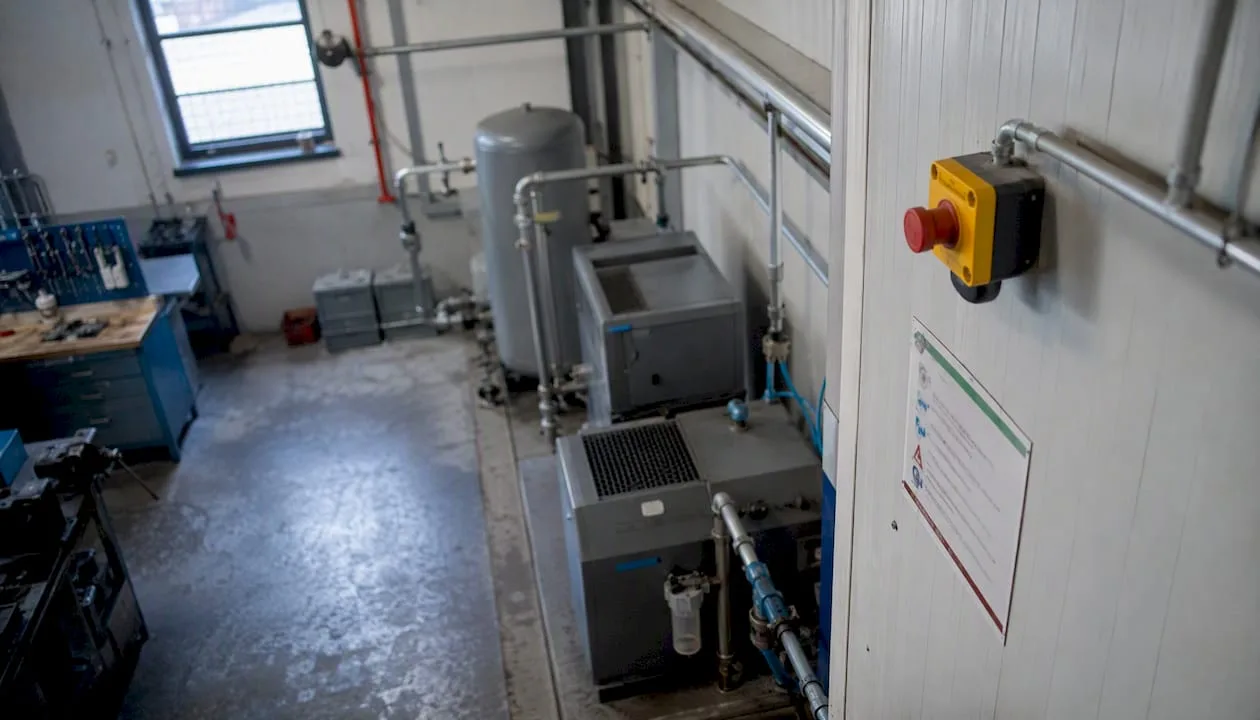
If you identify a risk during your own inspection, act immediately: stop operation in case of serious danger, isolate flammable liquids from the machine room, check the function of ventilation and safety valves, and order an updated fire safety design (PBŘ). Fire safety of the compressor room is not based on a single measure, but on a set of structural, technical, and organizational steps that must work together, and as soon as one part is missing, a fire brigade (HZS) inspection usually detects it first.
Before calling a PBŘ designer, check these six points yourself:
- Are flammable liquids (oils, cleaning agents) stored outside the compressor room?
- Does the emergency ventilation shutdown, operable both from inside the room and from outside, work?
- Are functional safety valves installed between the compressor and the first shut-off device?
- Does the classification and fire resistance of fire barriers (doors, dampers) correspond to the current operating condition?
- Is the condensate disposal system functional, with no oil leaking onto the floor?
- Do you have valid inspection reports for the electrical installation, pressure vessels, and fire extinguishers?
Professional tip: If you are not sure whether your existing PBŘ corresponds to the actual state of the technology, do not rely on guesswork. Changing the compressor output, adding a dryer, or modifying the piping can push the fire load beyond the scope of the original assessment, and this is exactly the type of discrepancy that the fire brigade (HZS) will detect first during an inspection.
Contents
- Requirements for building structures and division into fire compartments
- Technical measures in the compressor room: ventilation, fittings, electrics, condensate, and measurement
- Organisational measures and operating regime in the compressor room
- Fire safety design (PBŘ) and risk assessment: what it must contain
- Key standards and legal regulations you need to know
- Inspections, revisions and requirements for professional competence
- Practical checklist for operators: what to check today
- Recommendations from an operating supplier: a practical view of common mistakes
- How Kompresory-vzduchotechnika can help you
- Key conclusions for decision-making
- Useful resources and standards to check
- Frequently asked questions
Requirements for building structures and division into fire compartments
From a fire safety perspective, the compressor room is assessed as a separate or associated fire compartment, and this affects the required fire resistance of the surrounding walls, ceiling and doors. The methodological guideline for the design and assessment of fire safety design classifies the compressor room among the operations where the division into fire compartments (PÚ) is assessed individually, depending on the quantity of flammable substances, the output of the installed equipment, and its location within the building.
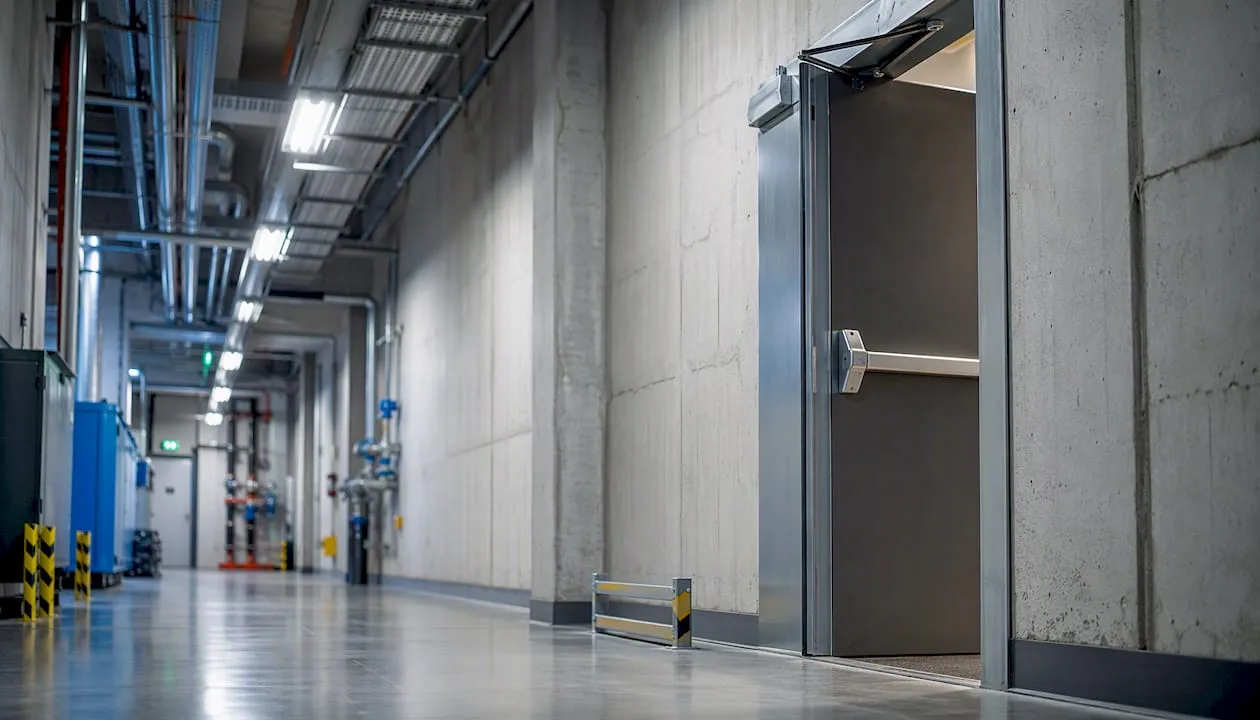
A typical value you will encounter in practice is structural resistance at the F30 level, i.e. medium-term resistance of walls and ceilings. However, this is really only an indicative value. The specific requirement is always determined by the risk assessment in the Fire Safety Design Documentation (PBŘ), and for more powerful machines with oil injection, separate fire protection rooms with stricter separation and a more resistant floor structure are often recommended in practice, because the risk of fire spreading through oil residues is higher.
Fire closures, i.e. doors, dampers and shaft closures, must have resistance corresponding to the class of the given fire compartment, and their function (self-closing, tightness, possibly status signalling) is documented separately.
| Structural element | What is assessed |
|---|---|
| Walls and ceilings of the fire compartment | Fire resistance class according to risk (often indicatively F30) |
| Doors and dampers | Resistance, self-closing mechanism, tightness |
| Shafts and penetrations | Sealing, fire protection collars, inspection of installation penetrations |
| Floor | Non-combustible, oil-resistant surface for machines with higher power |
The documentation that the Fire Safety Report must include for this part comprises:
- Calculation of fire load and classification into a fire hazard category.
- Justification of the size and boundaries of the fire compartment.
- Specification of the type and resistance rating of the fire closures used.
- Description of the connection to adjacent fire compartments and escape routes.
Technical measures in the compressor room: ventilation, valves, electrical equipment, condensate and measurement
Compressor stations are among the facilities with a risk of high pressure, medium leakage, and in some cases the formation of an explosive atmosphere, and therefore must have a separate space with effective ventilation and equipment for detecting abnormal conditions. Ventilation is addressed through a combination of natural and forced ventilation, with the emergency mode controllable both from the operator's room and from outside, in case it is not possible to safely enter the interior.
If there is a risk of an explosive atmosphere forming in the space, for example with gas compressors or where flammable gases are handled, Government Regulation No. 406/2004 Coll. requires a formal risk assessment and classification of the space into zones. This classification then determines which electrical devices and installations may be used in the given space, since standard switches and motors do not meet the required level of protection in a zone with an explosive atmosphere.
Key technical measures include:
- A safety valve between the compressor and the first shut-off device, which prevents overpressure in the system.
- Pressure gauges at individual compression stages for monitoring the actual operating condition.
- A prohibition on installing shut-off elements between individual pressure stages, as this would risk uncontrolled overload.
- Signaling of the status of shut-off valves and key fittings, ideally connected to a supervisory station.
- Remote control of electric motors on gas compressors, so that the equipment can be shut down without entering the hazardous area.
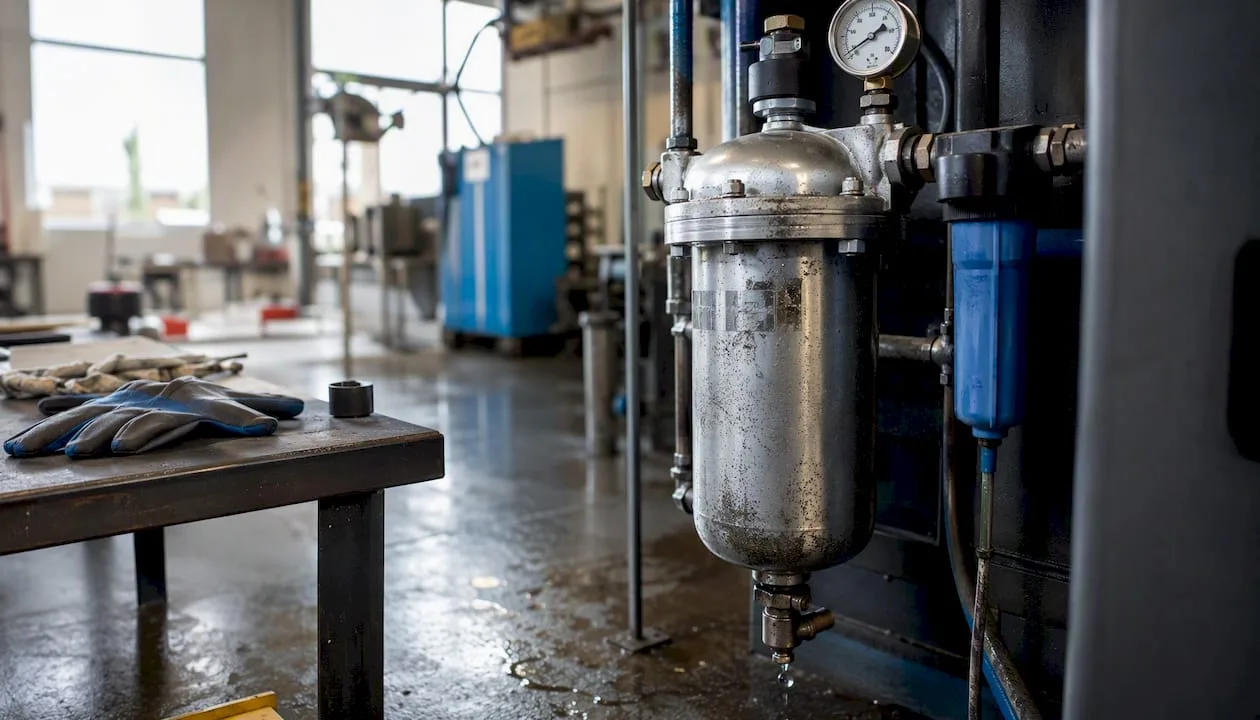
Condensate is an underestimated but real source of risk. Oil leaking with condensate easily spreads across the floor and increases the fire load of the space. The solution is oil/water separation directly at the source and discharge via certified piping that can withstand operating pressures and does not allow oil residues to escape into the surroundings. The material design of the piping and its testing should comply with ČSN EN 13480-5, which also applies to compressed air piping connecting directly to the compressor room.
Professional tip: Check the condensate separator visually at least once a week, not only during a scheduled inspection. A clogged or overflowing separator is one of the most common findings during operational checks, and it only takes a few minutes to catch the problem before the oil reaches the floor.
Organizational measures and operating regime in the compressor room
Technical measures only work when supplemented by a clearly defined operating regime with specific responsibility. Act No. 133/1985 Coll. on Fire Protection stipulates that responsibility for fire prevention, preventing its spread, and ensuring evacuation lies with the operator, in practice the company's statutory representative in cooperation with the fire protection technician and the compressor room operating technician. The Fire Rescue Service (HZS) acts as the relevant authority, which reviews the documentation and checks during inspections whether it corresponds to actual operating conditions.
- The statutory representative bears overall responsibility for the operation's compliance with the Fire Protection Act.
- The fire protection technician (a professionally qualified person in fire protection) prepares or coordinates the fire safety plan and proposes measures.
- The compressor room operating technician is responsible for daily compliance with operating rules and reporting deviations.
- HZS, as the relevant authority, reviews the documentation and carries out compliance inspections.
Operating rules, which every operator should have fixed in writing, include a ban on storing flammable liquids in the compressor room area, set intervals for inspections by operating staff, marking of escape routes and access paths, and clearly defined procedures for staff in case of deviations from standard operation.
- Compressor room operating regulations describing both routine and emergency procedures.
- Records of inspections and checks of technical equipment.
- Operating documentation from the compressor manufacturer, including recommended maintenance intervals.
- Procedure for emergency shutdown and evacuation of persons from the endangered area.
- Obligation to immediately report a fire or explosion to the fire and rescue service, even if it was extinguished using own resources.
A detailed overview of operating rules for compressor operators can be found in the list of safety rules for working with a compressor, which complements internal employee training.
Fire safety solution (PBŘ) and risk assessment: what it must include
PBŘ is a document that combines structural, technical, and organizational measures into a single whole assessed by the fire and rescue service, and it is indispensable for an industrial compressor room. The methodological guideline for designing and assessing the fire safety solution stipulates that the document must assess the stability of structures during a fire, the division of the building into fire compartments, the possibilities for evacuating persons, and the method of ensuring firefighting water supply.
Specifically, the PBŘ for a compressor room should include:
- Calculation of fire load and determination of the degree of fire hazard of the area.
- Description of the division into fire compartments and justification of the chosen structural fire resistances.
- Design of technical firefighting measures, including the type and placement of fire extinguishers.
- Description of internal and external access routes and staging areas for firefighting units.
- Ensuring fire water supply, i.e. the location of hydrants and their capacity.
- Clearance distances from surrounding buildings and equipment.
The fire safety documentation is prepared by a qualified designer, usually in cooperation with the operator's fire protection technician. The HZS (Fire Rescue Service), as the relevant authority, reviews the documentation as part of the building permit process or when the use changes, and during routine inspections verifies that the actual operating condition matches the documentation.
A fundamental rule that is most often violated in practice: any structural change or installation of new equipment must not reduce the level of fire safety of the building below that approved in the original fire safety documentation. Adding a more powerful compressor or dryer, or changing the piping, therefore always requires verification that the original assessment is still valid.
If you are planning to expand the compressor room, communicate with the fire safety documentation preparer already at the design stage, not after installation. Proving compliance retroactively is always more expensive and time-consuming than updating the documentation before implementation.
Key standards and legal regulations you need to know
The legal framework for fire safety in compressor rooms is based on Act No. 133/1985 Coll. on Fire Protection, the implementing decrees on technical conditions for fire protection of buildings, and Government Regulation No. 406/2004 Coll. on further requirements for safety and health protection at work in environments with explosion hazards. These regulations are legally binding, and the HZS requires compliance with them without exception during inspections.
In addition to the laws, a number of ČSN standards are used, which serve as technical background for preparing the fire safety documentation and for assessing both structural and operational parameters. The standards themselves are not always directly legally enforceable, but compliance with them is, in practice, considered the standard from which deviation is only acceptable with very good technical justification.
| Regulation / standard | What it regulates |
|---|---|
| Act No. 133/1985 Coll. | Basic obligations in fire protection, prevention, evacuation, firefighting intervention |
| Government Regulation No. 406/2004 Coll. | Classification of areas with explosion hazard, zoning |
| ČSN standards series 73 08xx | Fire safety of buildings, fire compartments, separation distances |
| ČSN EN 1012-1 | Safety requirements for compressors and vacuum pumps |
| ČSN 10 5004 | Design, installation, operation and maintenance of air compressors |
| Act No. 250/2021 Coll. and regulations No. 191/2022 Coll., 192/2022 Coll. | Designated pressure and gas equipment, inspections and checks |
The recommended study procedure is to go from the general to the specific: first Act No. 133/1985 Coll. for the framework of obligations, then Government Regulation No. 406/2004 Coll. for the assessment of explosive zones, next the ČSN standards series 73 08xx for the construction part, and finally ČSN EN 1012-1 together with ČSN 10 5004 for the technical equipment itself. The ČSN EN 1012-1 standard addresses not only machine safety but also serves as a basis for inspection reports and for demonstrating compliance during inspections.
Inspections, checks and professional competence requirements
Reserved pressure and gas equipment in the compressor room is subject to mandatory inspections under Act No. 250/2021 Coll. and its implementing regulations No. 191/2022 Coll. and No. 192/2022 Coll., which set out both the deadlines and the scope of inspections. This equipment may only be inspected by a person holding the appropriate authorization, not by an internal employee lacking the relevant qualification, and this also applies to inspections of electrical installations and fire extinguishers, where a professionally competent person with a valid certificate is required.
- Pressure vessels and gas equipment: inspections at intervals set by the implementing regulations, carried out by an authorized person.
- Electrical installations in areas with a classified zone: inspection by an electrical inspection technician specializing in environments with explosion hazards.
- Fire extinguishers: operability check at least once a year, carried out by a person authorized by the manufacturer or a service organization.
- Safety valves: functional test at the interval recommended by the manufacturer, usually annually, see the detailed guide on safety valves.
Industry practice: safety valves, condensate separation, and improper ventilation control are among the technical measures most frequently found to be deficient during operational inspections. These are not exotic faults, but things that can be detected already during a routine visual inspection, provided the operator has dedicated time for it and clear responsibility assigned.
Records of all revisions and inspections must be kept and available for inspection by the Fire Rescue Service. A proven approach is to maintain a single central record-keeping system for the entire compressor room, rather than scattered paper protocols for individual pieces of equipment, because a missing or untraceable record is assessed during an inspection the same way as an inspection not having been carried out.
Practical checklist for the operator: what to check today
Before ordering an external audit, go through your own internal inspection following this procedure, ordered by risk priority.
- Check the structural integrity and functionality of the compressor room's fire closures.
- Verify the function of both natural and forced ventilation and the emergency control from outside.
- Verify the presence and functionality of the safety valves between the compressor and the shut-off device.
- Check condensate separation and drainage, including the condition of the floor under the machine.
- Verify the electrical installation against the zone classification, if an explosive atmosphere may occur in the area.
- Check the marking of escape and intervention routes and their passability.
Priority should always go first to measures that directly prevent the occurrence and spread of fire, i.e. safety valves, ventilation and condensate, and only then to the formal aspects of documentation.
- Inspect safety valves and pressure gauges monthly by visual check, and functionally according to the manufacturer's recommendations.
- Check the condensate separator weekly.
- Check escape routes and marking at every operator shift.
- Review overall compliance with the Fire Safety Solution (PBŘ) once a year or whenever a technological change occurs.
If an inspection reveals a discrepancy between the actual condition and the approved PBŘ, do not address it as a temporary fix. Order a technical audit and, if necessary, an update of the documentation, because temporary repairs without updating the PBŘ are exactly what raises the most questions during a fire brigade (HZS) inspection. An overview of the basic requirements for a compressor room can also be found in the separate guide.
Recommendation from an operational supplier: a practical view of common mistakes
The most common mistake we encounter among compressor room operators is not missing documentation, but a discrepancy between what the PBŘ describes and what is actually installed. A company adds a second compressor, changes the piping route, or replaces an old machine with a more powerful one, and no one verifies whether the original fire load assessment is still valid. Yet this kind of minor operational change is exactly the moment when the PBŘ should be reopened, not only at the next scheduled inspection.
The second thing that surprisingly many facilities underestimate is the order of investments. When an operator has a limited budget, they often go first for visible structural modifications, while a cheaper and riskier gap remains in ventilation or condensate drainage. In terms of actual fire risk, however, functional emergency ventilation and reliable separation of oil from condensate often prevent more damage than a new fire-rated door, provided the existing construction meets at least the minimum requirements.
A preventive maintenance plan that actually works is not the most complex one, but the one that is followed. A short weekly visual check of the safety valves, separator, and floor condition will reveal most problems before they become serious. Annual inspections under Act No. 250/2021 Coll. are then a safeguard, not the main line of defence.
How Kompresory-vzduchotechnika can help you
Kompresory-vzduchotechnika is an alternative to searching for individual components from various suppliers on your own: we offer safety valves with the correct capacity, certified compressed air distribution piping, and technical consultancy all in one place, so you don't have to assemble a solution from several sources and verify component compatibility yourself.
For a compressor room where an inspection has revealed a discrepancy between the fire safety plan (PBŘ) and the actual state of the equipment, it makes sense to start with specific technical elements. We offer safety valves with parameters matching your compressor's output, consultancy in selecting the appropriate capacity, and certified piping for compressed air distribution that meets the design requirements under ČSN EN 13480-5. If you need equipment that genuinely matches your pressure rating and operating regime, browse the pneumatics and hydraulics range and choose a solution tailored to your compressor room. Our technical consultants will help you select the right valve capacity and related distribution piping, whether you are dealing with a new installation or correcting identified deficiencies.
Key takeaways for decision-making
Fire safety in a compressor room depends on the alignment between the design solution, functional technical elements (safety valves, ventilation, condensate separation), and the current fire safety plan (PBŘ), with any technological change requiring its review.
| Point | Details |
|---|---|
| Update the fire safety plan (PBŘ) with every change | Installing a new compressor or modifying the distribution system always requires verification of compliance with the fire safety plan (PBŘ). |
| Check safety valves and condensate most frequently | These elements are among the most common technical deficiencies identified during operational inspections. |
| Comply with inspection deadlines according to Act No. 250/2021 Coll. | Designated pressure and gas equipment may only be inspected by an authorized person at prescribed intervals. |
| Respect the classification of explosive zones | Government Regulation No. 406/2004 Coll. determines which electrical equipment may be used in a hazardous area. |
| Discuss technical measures with a specialized supplier | Kompresory-vzduchotechnika supplies safety valves and certified piping systems corresponding to your operating pressure. |
Useful resources and standards for inspection
When preparing or updating the Fire Safety Document, it pays off to proceed systematically from the general legal framework to the technical standards for specific equipment.
| Source | What to look for in it |
|---|---|
| Act No. 133/1985 Coll. | Basic obligations of the operator in fire protection |
| HZS methodological guide for the Fire Safety Document | The structure and content requirements of the fire safety design documentation |
| Government Regulation No. 406/2004 Coll. | The classification procedure for areas with explosion hazard |
| ČSN standards series 73 08xx | Specific parameters of fire resistance of structures and sections |
| ČSN EN 1012-1 and ČSN 10 5004 | Safety requirements for the design and operation of compressors |
| Act No. 250/2021 Coll. and Regulations No. 191/2022, 192/2022 Coll. | Deadlines and scope of inspections of designated pressure and gas equipment |
Recommended reading order: first the Fire Protection Act for the general framework of obligations, then the methodological guidance of the Fire Rescue Service for the structure of the fire safety design documentation, followed by Government Regulation No. 406/2004 Coll. for zoning, and finally the specific ČSN standards according to the type of your equipment. This procedure corresponds to the logic by which the documentation is assessed by the Fire Rescue Service itself during an inspection.
Frequently Asked Questions
What does fire safety of a compressor room mean in practice?
It refers to the compliance of structural, technical, and organizational measures, documented in the fire safety design documentation, which prevents the occurrence and spread of fire and ensures evacuation and firefighting intervention.
What is the typical fire resistance of compressor room walls?
In practice, an indicative value of F30 is often cited, but the specific requirement is always determined by a risk assessment in the fire safety design (PBŘ) based on the power and type of equipment.
Who prepares the fire safety design documentation for a compressor room?
The fire safety design (PBŘ) is prepared by a designer with professional qualification, usually in cooperation with the operator's fire protection technician, and is assessed by the Fire Rescue Service (HZS) as the relevant authority.
How often must pressure equipment in the compressor room be inspected?
The deadlines are set by implementing regulations No. 191/2022 Coll. and No. 192/2022 Coll. to Act No. 250/2021 Coll.; the inspection must be carried out by a person with appropriate authorization.
Where can I buy safety valves that comply with the standards for compressors?
Safety valves with the correct capacity for a given type of compressor are offered by Kompresory-vzduchotechnika, including advice on selecting a suitable model.
Recommended
- A list of safety rules for working with a compressor in automotive 2026 - Kompresory-Vzduchotechnika.cz
- Compressor bleeding procedure: a guide for technicians - Kompresory-Vzduchotechnika.cz
- Basic requirements for a compressor room: guide 2026 - Kompresory-Vzduchotechnika.cz
- Avoid the most common mistakes when using compressors - Kompresory-Vzduchotechnika.cz