
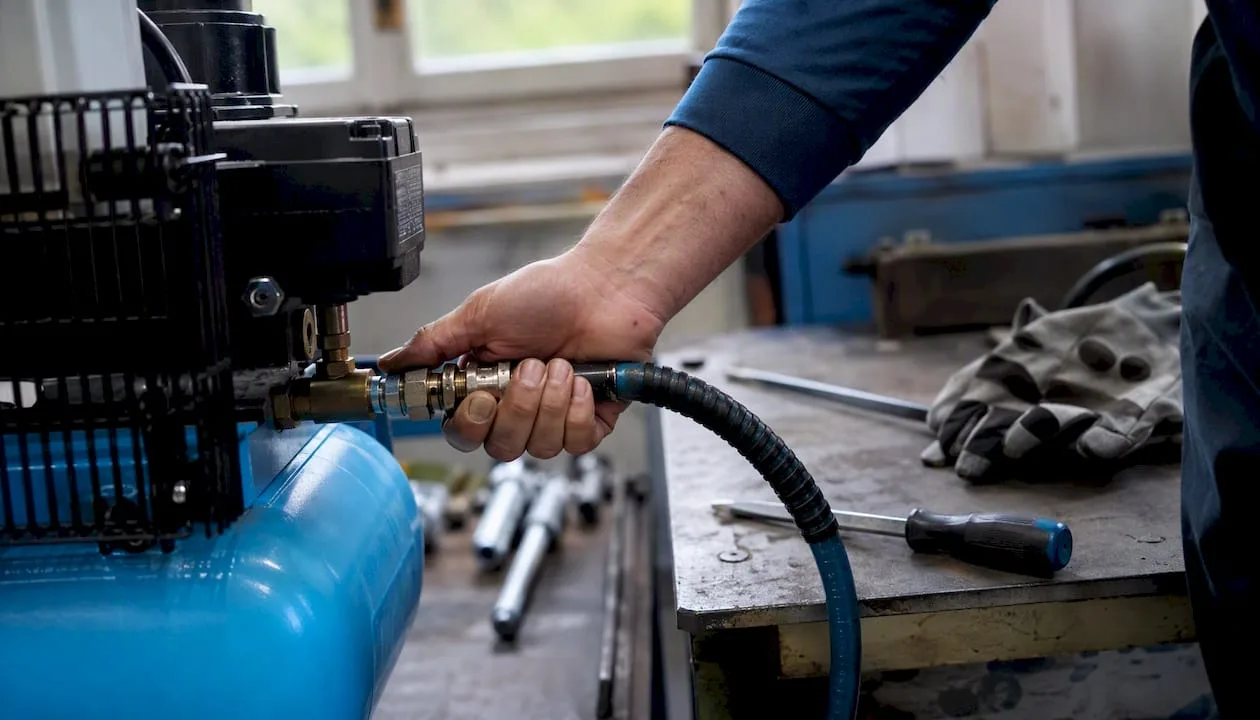
Quick couplings shorten connection time to seconds, eliminate the need for tools, and automatically seal the line when disconnected, reducing media leakage to a minimum. The same applies to both pneumatic and hydraulic systems: wherever hoses or modules are connected and disconnected repeatedly, quick couplings directly reduce downtime and operator errors. Standards ISO 7241-1 (profiles A and B) and ISO 16028 (flat-face) define the dimensions of nipples and operating pressures, so compatibility between manufacturers can be verified before purchase. Kompresory-vzduchotechnika provides technical datasheets and advice for selecting the correct series.
When to use quick couplings:
- Pneumatics: tool changes on compressor distribution lines, automated production lines, service workshops.
- Hydraulics: interchangeable modules on mobile machinery, agricultural equipment, high-pressure systems with sensitive media.
- Working with gases: special versions with flashback protection.
Professional tip: Start the selection by considering the operating pressure and the nipple profile according to ISO. Only then address the sealing material and flow rate. This significantly narrows down the number of compatible series and helps you avoid an incorrect order.
Key findings
A quick coupling correctly selected according to the ISO profile, operating pressure, and sealing material reduces service interventions, decreases media leakage, and extends the service life of the entire hydraulic or pneumatic system.
| Point | Details |
|---|---|
| Start with pressure and profile | Verify the maximum operating pressure and the ISO profile of the nipple before selecting the sealing material. |
| Drip-free design for sensitive media | Flat-face couplings according to ISO 16028 minimize air inclusion and system contamination. |
| Regular seal inspection | Worn O-rings are the most common cause of leakage; keep spare parts in stock. |
| Safety before coupling | Always reduce residual pressure and clean the face surfaces before each coupling. |
| Kompresory-vzduchotechnika | Offers technical data sheets, advice and products for complete compressed air piping systems. |
Contents
- What types of quick couplings exist for pneumatics and hydraulics?
- How do quick couplings save time, money and reduce risks?
- How to safely install and operate quick couplings?
- How to choose the right quick coupling step by step?
- How to maintain quick couplings and recognize wear?
- What are the main differences between pneumatic and hydraulic quick couplings?
- Where are quick couplings used in industry and service workshops?
- Where to find technical data sheets and product examples for quick couplings?
- Frequently asked questions
What types of quick couplings exist for pneumatics and hydraulics?
Quick couplings are divided into two main categories according to medium and working pressure. Each category has several design variants with different properties.
Pneumatic quick couplings
The most common type are push-in couplings for polyurethane or nylon tubing, where the tubing is simply pushed into the body and a locking ring secures it. For hoses with a larger diameter, bayonet or ball-type quick couplings are used, where locking is ensured by steel balls in the groove of the plug. The standard version has one shut-off valve (on the socket), while the non-drip version shuts off both sides simultaneously and prevents medium leakage upon disconnection.
Hydraulic quick couplings
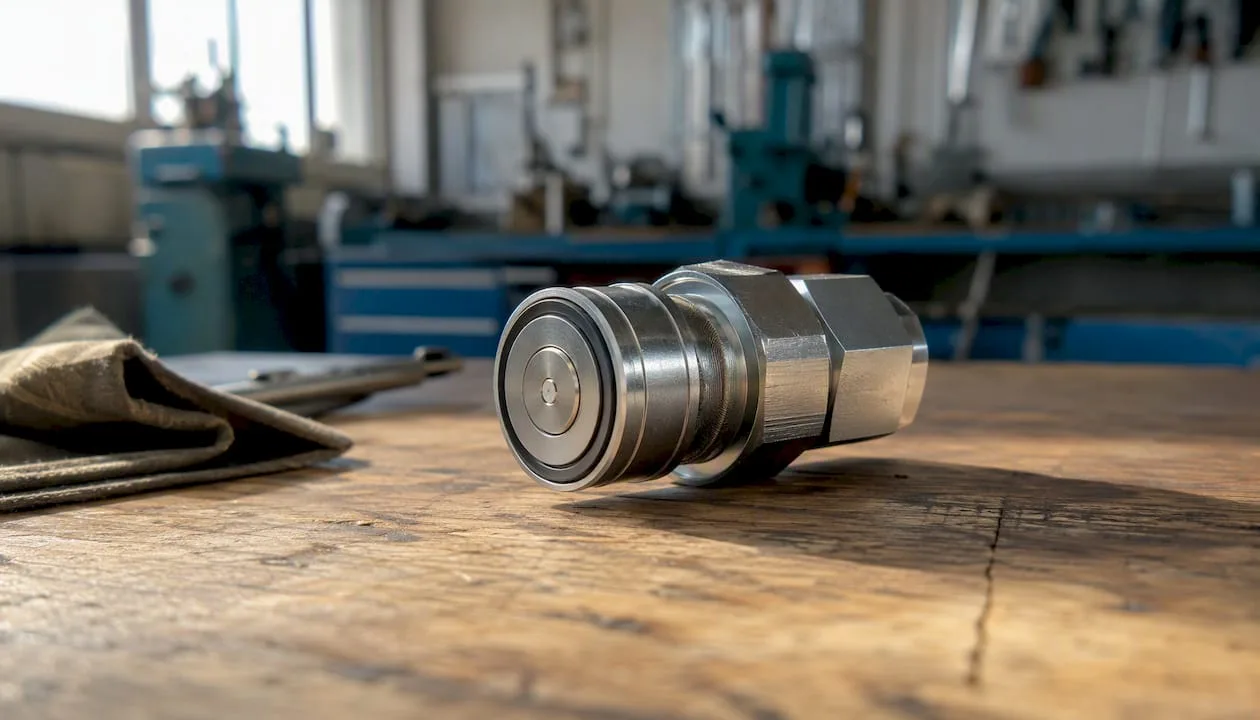
Hydraulics are dominated by ball-type couplings according to ISO 7241-1 (profiles A and B) for pressures typically up to 350 bar. Flat-face couplings according to ISO 16028 have flat front faces without an internal valve, which minimizes air inclusion and system contamination. They are recommended for high-pressure and sensitive applications, where cavitation or contamination cause premature wear of components. Screw-type couplings are used where joint strength under vibration is a priority, and the high-pressure version handles pressures above 400 bar for special hydraulic applications.
| Category | Typical working pressure | Main advantage | Risk / limitation |
|---|---|---|---|
| Pneumatic push-in | low pressure | Fast assembly without tools | Sensitivity to hose pull |
| Pneumatic ball-lock | low to medium pressure | Reliable locking | Single shut-off valve |
| Pneumatic drip-free | low to medium pressure | Zero leakage on disconnection | Higher purchase price |
| Hydraulic ISO 7241-1 | medium pressure | Wide compatibility | Air inclusion on connection |
| Hydraulic flat-face ISO 16028 | higher pressure | Minimal contamination | Requires clean face surfaces |
| Hydraulic high-pressure | high pressure | Extreme pressure loads | Limited availability of seals |
Professional tip: Flat-face couplings according to ISO 16028 require absolutely clean face surfaces. A single impurity on the surface will cause leakage or damage to the seal. Wipe the surfaces before every connection and use protective caps during transport.
How do quick couplings save time, money and reduce risks?
The main advantages of quick couplings are measurable in operating costs and equipment availability. Tool-free connection shortens the time needed to change tools or modules from minutes to seconds, which is particularly noticeable during repeated service interventions on a production line or in a service workshop.
Automatic shut-off valves prevent medium leakage with every disconnection. In hydraulics, this means less oil loss, lower risk of environmental contamination and longer service life of hydraulic components. Non-drip designs go even further: they close both sides of the connection simultaneously, so no air or impurities enter the system. Reducing air inclusion directly extends the service life of pumps and valves and reduces the risk of cavitation.
Self-locking mechanisms and visual position indicators reduce human error. The operator does not need to check whether the connection is secured, because the mechanism does it automatically. The consistency of the connection is then the same regardless of who performs the assembly.
In terms of materials: stainless steel resists corrosion in wet environments, brass is the standard for pneumatics, and thermoplastic bodies reduce weight in mobile applications. Longer material life means fewer replacements of the entire coupling and lower overall maintenance costs.
Professional tip: Always choose non-drip or flat-face designs when the system contains a sensitive hydraulic medium (biodegradable oils, food-grade lubricant) or when system contamination is unacceptable. For standard pneumatics in a workshop, a standard ball coupling is sufficient.
How to safely install and operate quick couplings?
Safety when working with quick couplings depends on following several specific steps. Underestimating preparation before connection is the most common cause of injuries and equipment damage.
Before connection:
- Check the compatibility of the working pressures on both sides of the connection. Never connect components with different maximum pressures without knowing the weaker link.
- Verify that the plug profile matches the socket profile (ISO 7241-1 A/B, ISO 16028 or another standard).
- Clean the front faces of dirt, oil and moisture.
- Reduce residual pressure in the system before connecting. Use a static pressure eliminator or slowly open the bleed valve.
- Fit protective caps on unused connections.
When disconnecting:
- First release the pressure in the system to operating minimum or zero.
- Disconnect the coupling with a smooth movement according to the design principle (push-pull, ring rotation).
- Immediately fit protective caps on both sides.
- Check that the shut-off valves have properly stopped the flow.
Personal protection:
- Safety glasses are mandatory when working with pressure systems.
- When working with flammable gases, use quick couplings with flashback protection and comply with regulations for working in explosion-hazard environments.
- Gloves protect when handling hot or chemically aggressive media.
The most common mistake is connecting under pressure without prior depressurization. The result is often an uncontrolled hose whip or seal damage at the first connection.
How to select the correct quick coupling step by step?
Selecting the correct quick coupling comes down to six criteria in this order:
- Working pressure and safety factor. The maximum operating pressure of the system must be lower than the rated pressure of the coupling. Account for pressure spikes during the compressor duty cycle.
- Nipple profile and compatibility. ISO 7241-1 A or B, ISO 16028, or a manufacturer-specific profile. Different profiles are not interchangeable.
- Flow and pressure drop (Cv). Too small a nominal bore causes pressure drop and reduces the performance of the tool or actuator.
- Medium and chemical resistance of the seal. NBR for mineral oils and air, Viton for aggressive liquids and higher temperatures, EPDM for water and steam.
- Operating temperature. Standard NBR seals work approximately from -20 °C to +100 °C. Extreme temperatures require special materials.
- Cyclic loading and corrosion resistance. A high number of cycles per shift requires a more durable body material and a higher-quality surface treatment.
Checklist questions for quick selection:
- Can it be connected with one hand? (Necessary for mobile machines and work in gloves.)
- Is drip-free design needed? (Sensitive medium, food industry operation, hydraulics with biological oils.)
- What nipple profile does the existing system have?
- What sealing does the medium require?
- Are there vibrations or dynamic loads in the system? (Consider a screw-type or locking design.)
Expanding existing pneumatic equipment is simpler if you choose couplings from standardized series with available replacement seals from the start.
How to maintain quick couplings and recognize wear?
Regular inspection of quick couplings prevents unplanned downtime. Recommended inspection points:
- Visual inspection of seals: cracks, deformation, or hardening of O-rings indicate the need for replacement. Rubber that has lost its elasticity does not seal reliably even at low pressure.
- Leak test: after connecting, apply soap solution or use a leak detector. Bubbles or pressure drop indicate a leak.
- Inspection of locking rings and balls: worn balls or a deformed locking ring cause unintentional disconnection under pressure.
- Cleanliness of face surfaces: dirt on the surfaces of flat-face couplings causes scratches on the seal and permanent leakage.
- Body corrosion: surface corrosion is cosmetic, corrosion in the threaded section or on the face surface is a functional problem.
The most common failure is worn O-rings. Replacement is simple: depressurize the system, remove the coupling, replace the O-ring with an identical part (same material, same wire diameter and inner diameter) and lightly lubricate the O-ring with compatible grease before assembly.
Professional tip: Keep a stock of spare O-rings for each type of coupling in operation. Downtime caused by waiting for a seal worth a few crowns is unnecessary. When ordering a new coupling, always order a set of spare seals as well.
When servicing, use dust caps on both sides of the disconnected coupling. They prevent dirt from entering the system and shorten the cleaning time before reconnection.
What are the main differences between pneumatic and hydraulic quick couplings?
The choice between a pneumatic and hydraulic quick coupling is not just a matter of medium. They differ in working pressures, flow rates, sealing requirements and the risk of contamination.
Pneumatic couplings tolerate a certain amount of moisture and dirt in the medium better than hydraulic ones. Hydraulic flat-face couplings according to ISO 16028 are the most demanding in terms of design: a flat face without an internal valve minimizes air inclusion and extends the service life of hydraulic components, but requires absolute cleanliness at every connection.
When to choose which type:
- Flat-face ISO 16028: high-pressure hydraulics, sensitive media, mobile machines with interchangeable working tools.
- ISO 7241-1 A/B: standard hydraulic applications where compatibility and availability of spare parts are a priority.
- Push-pull pneumatic: service workshops, production lines, compressed air distribution up to 16 bar.
Where are quick couplings used in industry and service workshops?
Quick couplings in industry cover a very wide range of applications. Each has specific design requirements.
Production lines and automation: Quick replacement of pneumatic tools or actuators during line changeover. The key property is connection consistency and the ability to replace with one hand without interrupting production. Integration into pneumatic automation requires standardized profiles and reliable locking.
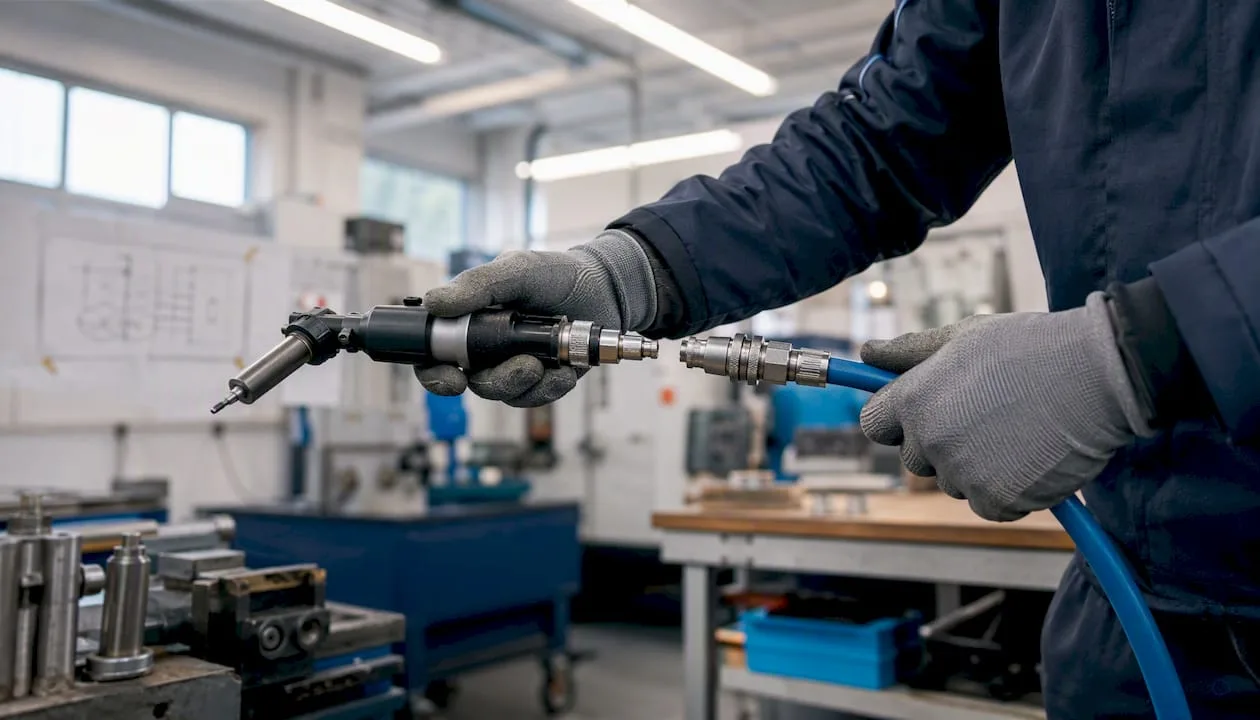
Service workshops: Connecting pneumatic tools (impact wrenches, grinders, guns) to the compressor distribution system. Standard ball-type couplings with NBR seals are sufficient. Emphasis on ergonomics and the ability to change tools with one hand.
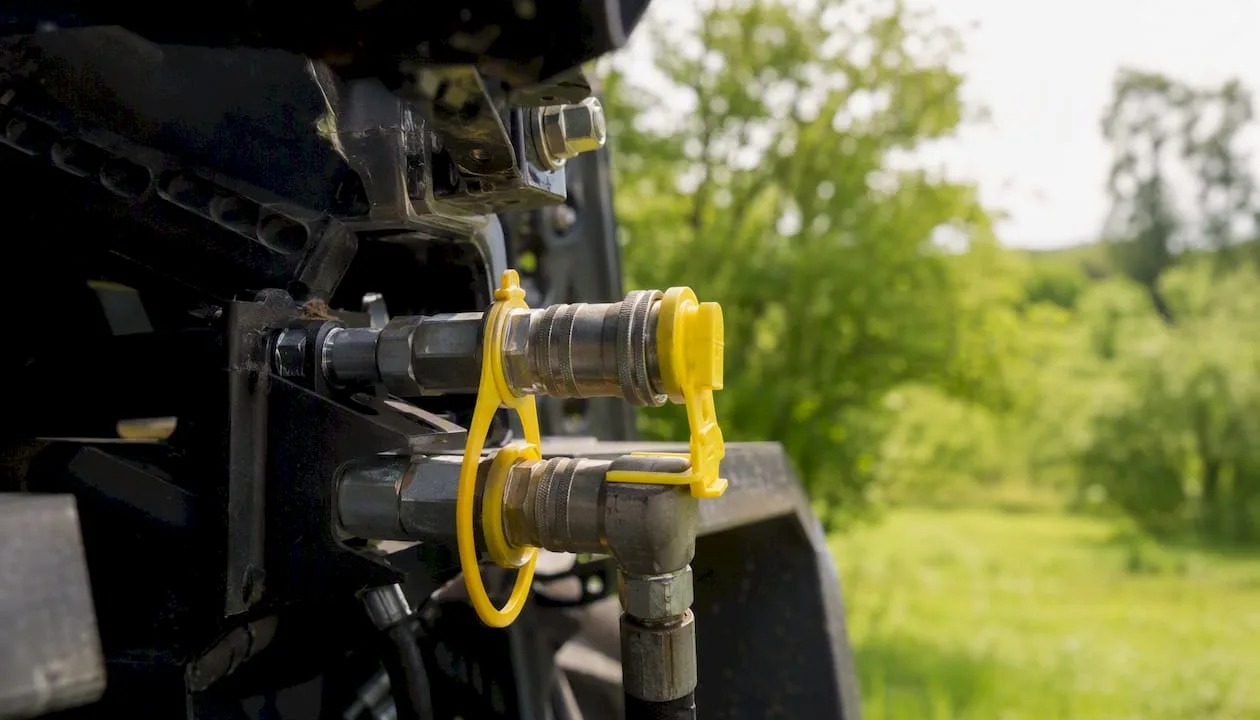
Mobile machinery and agricultural equipment: Replacing hydraulic working attachments (shovels, cutters, buckets) directly on the machine. Priorities are safeguards against accidental disconnection and emergency release mechanisms when the hose is stretched. Push-pull or automatic disconnection under overload protects both the operator and the machine.
Work with flammable gases: Special designs with flashback protection and antistatic materials. These couplings must comply with relevant safety standards for environments with explosion hazards. Standard pneumatic or hydraulic couplings are not suitable for this application.
Laboratory and food industry applications: Non-drip stainless steel design with EPDM seals for media where contamination by oil or impurities is unacceptable.
Professional tip: For mobile machinery and agricultural equipment, always consider a push-pull mechanism or automatic emergency disconnection when the hose is stretched. This feature protects the hydraulic circuit from damage in case of accidental hose overextension.
Where to find technical data sheets and product examples for quick couplings?
Technical data sheets are an essential tool for verifying parameters before purchase. The Kompresory-vzduchotechnika website provides datasheets for specific product lines, for example ES DN7.2 Lüdecke quick couplings, where you can check the nominal bore (DN7.2), maximum working pressure, flow coefficient Cv, body material, and seal type.
What to read first in the datasheet:
- Maximum working pressure (bar): must exceed the system's operating pressure, including peaks.
- Nominal bore / flow rate (Cv or Qn): determines whether the coupling will restrict the flow of the medium.
- Seal material: NBR, Viton, or EPDM depending on the medium and temperature.
- Nipple profile: ISO designation or manufacturer-specific profile for compatibility verification.
- Operating temperature range: critical for outdoor or high-temperature applications.
Standards ISO 7241-1 and ISO 16028 are publicly available through national standardization bodies. Manufacturers such as Lüdecke publish dimensional drawings and CAD files on their websites, which are useful when designing air distribution systems.
When selecting a quick coupling, always verify three parameters directly in the datasheet: maximum working pressure, nipple profile according to ISO, and seal material. These three values determine the compatibility and safety of the connection. Everything else is secondary.
For technical inquiries, catalog requests, or dimensional drawings, contact Kompresory-vzduchotechnika technical support directly through the website.
A view from an expert salesperson and service technician
In practice, quick coupling selection most often goes wrong at one point: a technician selects a coupling based on hose diameter but forgets to verify the nipple profile and maximum pressure. The result is either an incompatible pair or a coupling that only lasts until the first pressure spike. Prioritize pressure and profile, address the seal afterward.
A non-drip design costs more, but in sensitive applications, this investment pays off at the first service intervention, when the system remains clean. For standard pneumatics in a workshop, a standard ball coupling is fully sufficient and does not unnecessarily increase operating costs.
Quick couplings and accessories for pneumatics in one place
Kompresory-vzduchotechnika offers direct access to technical products for compressed air distribution: from pipes for compressed air distribution through air treatment units to pneumatic tools. Technical support will help with selecting the correct quick coupling according to operating parameters, provide the datasheet for the specific series, and advise on seal compatibility.
To place an order or make a technical inquiry, visit the Kompresory-vzduchotechnika website or contact technical support directly. Catalogs, dimensional drawings, and consulting for custom distribution system design are available.
Frequently Asked Questions
What are the main advantages of quick couplings over fixed connections?
Quick couplings allow tool-free connection and disconnection within seconds, automatically shut off the line when disconnected, and reduce media leaks. Fixed connections are suitable for permanent installations, while quick couplings are suited for situations where hoses or modules are exchanged repeatedly.
What is the difference between ISO 7241-1 and ISO 16028?
ISO 7241-1 defines ball-type hydraulic quick couplings with an internal valve (profiles A and B), while ISO 16028 describes flat-face designs without an internal valve, featuring flat front surfaces. Flat-face minimizes air inclusion and contamination, making it suitable for sensitive and high-pressure hydraulic applications.
How can I tell that a quick coupling seal is worn out?
Visible cracks, deformation, or hardening of the O-ring are clear signs. A functional test involves applying soapy solution to the connection under pressure: bubbles or a pressure drop indicate a leak and the need to replace the seal.
Can pneumatic and hydraulic quick couplings be interchanged?
No. They differ in working pressures, plug profiles, seal materials, and design construction. Interchanging them can cause leaks, system damage, or injury. Always verify the ISO profile and maximum pressure in the datasheet.
Where can I find technical datasheets for quick couplings in Czech?
Technical datasheets for specific product lines are available on the Kompresory-vzduchotechnika website, directly from the manufacturer (e.g. Lüdecke), or through technical support. ISO standards are available through the Czech Office for Standards, Metrology and Testing (ÚNMZ).
Recommended
- Quick couplings and plugs for fast and reliable connection
- What is pneumatic lubrication: a guide for technicians - Kompresory-Vzduchotechnika.cz
- I.e. pneumatic connection: types, functions and practice - Kompresory-Vzduchotechnika.cz
- Advantages of pneumatic systems: Why use them in production - Kompresory-Vzduchotechnika.cz