

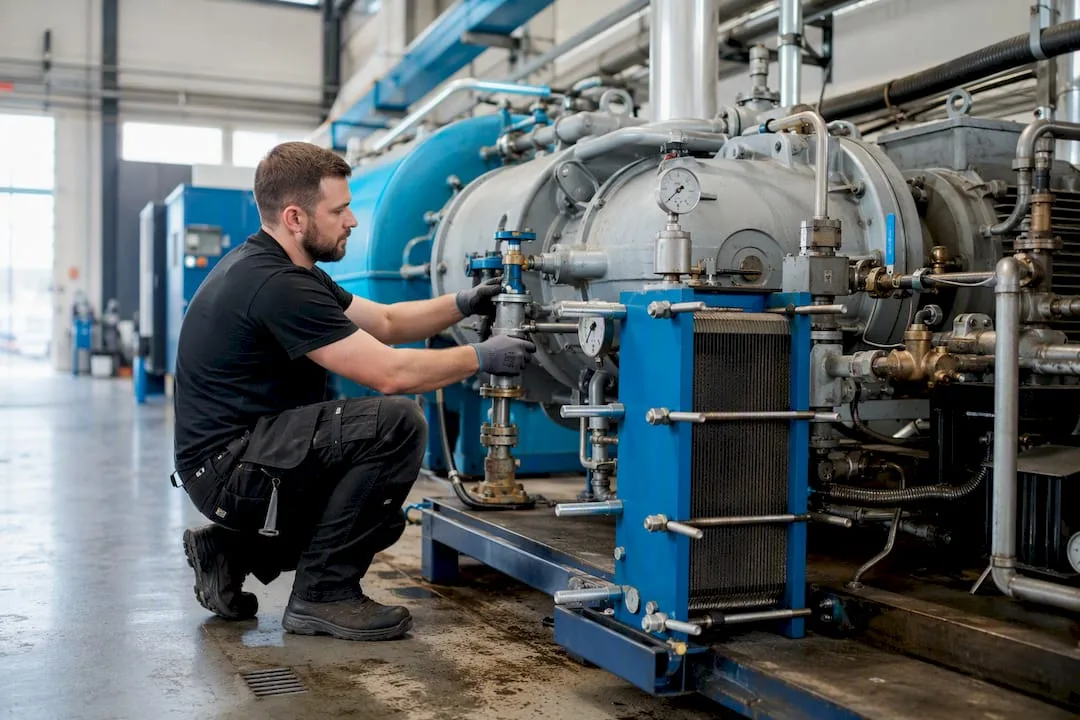
The waste heat from a compressor is an immediately available energy source that, with proper design, can be used for domestic hot water heating, hall temperature control, or as an input for a heat pump. With screw compressors, most of the electrical input is converted into heat, with only a fraction remaining as compressed air energy.
Statistics: with screw compressors, the vast majority of this energy is commonly discharged unused, even though it is technically easy to capture.
Three applications deliver the fastest payback: domestic hot water preparation, temperature control of production halls and warehouses, and preheating of process media or air for ventilation systems. The following sections show where the heat's potential comes from, how to calculate it, and which technical variants actually prove themselves in operation.
Key takeaways
Heat recovery from a compressor can return the investment within three months in two-shift operation, turning the machine from a pure cost into a source of heat for the facility.
| Point | Details |
|---|---|
| High heat share | With screw compressors, most of the electrical input is converted into heat. |
| Three main uses | Domestic hot water heating, hall temperature control, and preheating of process media or ventilation systems deliver the fastest benefit. |
| Quick payback | For two-shift operations with sufficient hours, the payback period is under three months compared to electric heating. |
| Accumulation for irregular consumption | Where heat consumption is intermittent, a storage tank or heat pump is required, otherwise the potential is lost. |
| Support from an expert | Kompresory-vzduchotechnika offers technical assessment of the compressor station and supply of components for heat recovery design. |
Recommended sources and further reading
- Action plan for the development of the use of low-potential renewable and waste heat by the Ministry of the Environment
- Final report on the potential of low-temperature heat sources in district heating systems
Start collecting your own data by measuring the temperature and flow rate on your compressor's cooling circuit for at least one week.
Contents
- Where does the waste heat from the compressor come from
- How much heat can realistically be recovered?
- What technical variants of heat recovery exist?
- Where can recovered heat be best utilized in operation?
- How to calculate the return on investment in heat recovery
- Installation and operation: what to prepare for
- When heat recovery is not worthwhile
- How a professional heat recovery audit is conducted
- Standards and legislative requirements for heat recovery
- Frequently asked questions
Where compressor waste heat comes from
Electrical energy supplied to the compressor is converted into mechanical work and heat. In oil-lubricated screw compressors, most of the heat ends up in the lubricating oil, which removes heat from the compression block. The remainder escapes into the cooling air around the motor and block, or into water if the machine is water-cooled.
Heat sources and their typical parameters:
- Oil circuit – oil temperature typically 70–90 °C, high heat quality, easily removed via a plate heat exchanger.
- Cooling air – temperature 30–50 °C above ambient, lower quality, suitable for space heating.
- Water cooling circuit – in water-cooled machines the temperature is similar to the oil, a clean source without the risk of oil contamination.
- Dryers and condensate – lower temperature level, supplementary source, often overlooked.
The key measuring points are the inlet and outlet of the cooling medium, the flow rate and the temperature difference between them. Without this data, the potential cannot be reliably assessed nor can a heat exchanger be designed.
How much heat can realistically be recovered?
An accurate calculation requires design software, but a rough estimate can be made within a few minutes. Procedure:
- Find the compressor power input in kW from the nameplate or from consumption measurement.
- Multiply by the heat share – for screw compressors, expect most of the power input to be converted into heat.
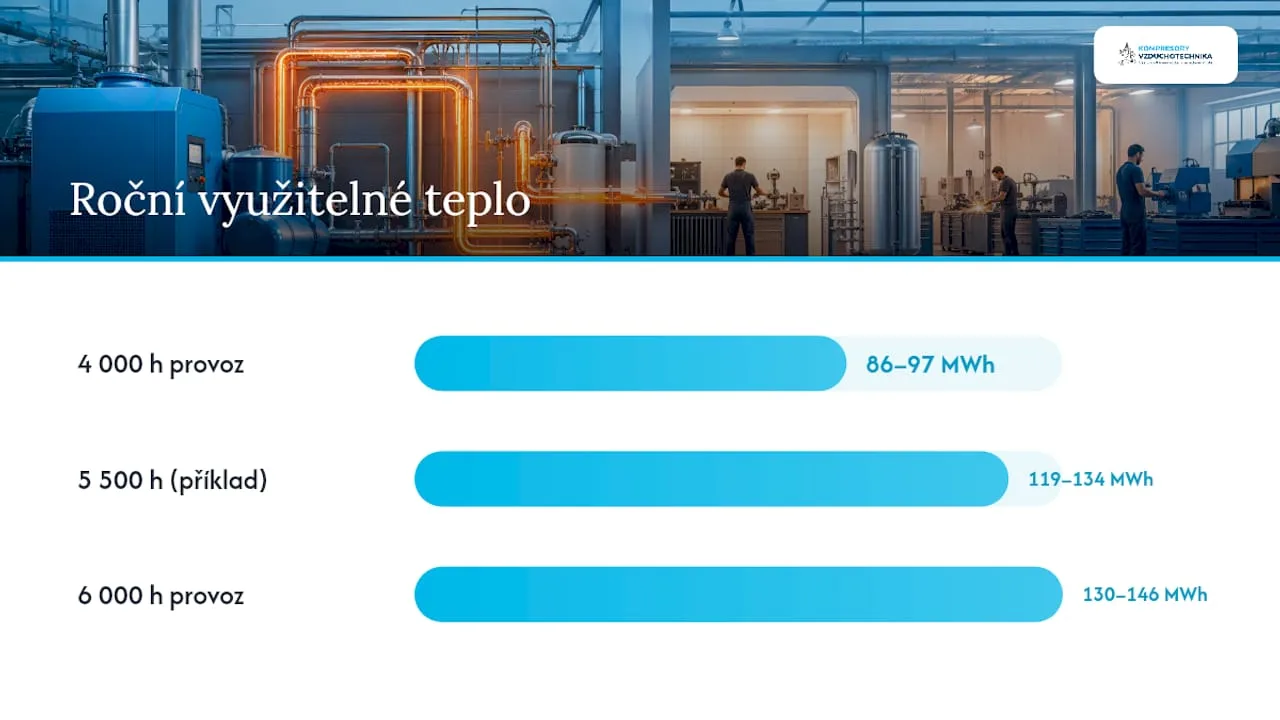
- Multiply by annual operating hours – for two-shift operation, typically around 4,000 to 6,000 hours.
- Subtract losses and reserve – not all heat is practically recoverable, allow for a safety factor of 10 to 20 %.
Example: a compressor with a power input of 30 kW, operating 5,500 hours per year, with 90 % conversion into heat. The gross heat potential comes out at around 148 MWh per year, and after deducting the reserve, a realistic figure is closer to 120 MWh.
The result varies significantly depending on the machine's load, seasonality and the difference between rated and actual output. For this reason, the estimate is always given as a range, not as a single fixed number.
What technical variants of heat recovery exist?
The choice of technology depends on the type of compressor, the available temperature level, and the heat consumption profile in the facility.
- Integrated plate heat exchanger in the oil circuit – the most common solution for oil-lubricated screw compressors, compact, relatively inexpensive, suitable for heating domestic hot water or heating water.
- Water-cooled heat exchangers – cleaner medium, lower risk of contamination, but require their own water circuit and maintenance against corrosion.
- Connecting the exhaust to the ventilation system – simple integration for air-cooled machines, ideal for tempering halls in winter.
- Connection to a heat pump – increases the usable temperature of low-potential heat, recommended mainly where direct heat is not sufficient to cover the required temperature level.
- Accumulation tank – compensates for the mismatch between heat generation by the compressor and sudden consumption in the facility.
Oil-free compressors offer cleaner heat without the risk of oil contamination, but usually with a lower available temperature. With oil-lubricated machines, on the other hand, it is necessary to account for filtration and regular inspection of the oil condition in the heat exchanger.
Each variant requires a circulation pump, temperature and flow control, and safety fuses against overheating. Without properly dimensioned control, there is a risk of outlet temperature fluctuations, which complicates connection to domestic hot water or ventilation systems.
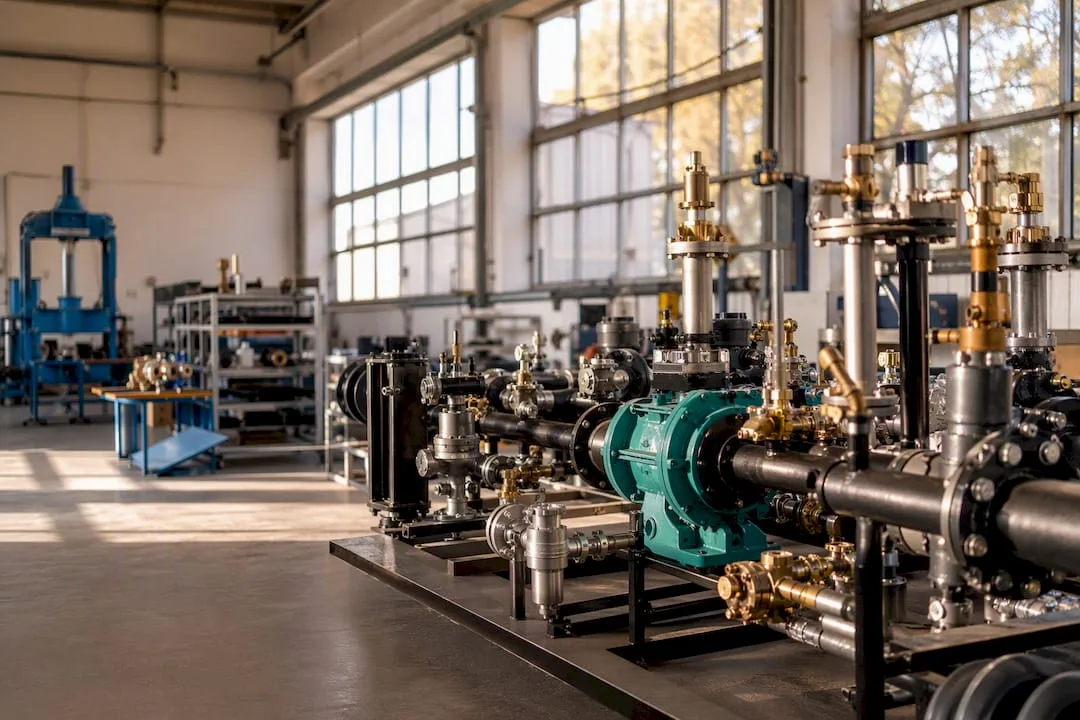
Professional tip: Before ordering a heat exchanger, have the actual temperature profile of the compressor measured over a week of normal operation – the nominal values from the catalog often do not correspond to reality after years of operation and wear.
For more details on cooling and its effect on compressor service life, see the article on compressor cooling.
Where is recovered heat best utilized in a facility?
The most common application is where heat extraction is regular and predictable:
- Heating domestic hot water for sanitary facilities, washrooms, or washing in production.
- Tempering halls and warehouses in winter months, especially for air-cooled compressors connected to HVAC systems.
- Preheating air in HVAC systems before further heating, which reduces the consumption of the main heating source.
- Regeneration of adsorption dryers for compressed air, where the heat is used directly in the process.
- Process preheating of water or media in downstream production.
Direct connection without storage works well where the compressor runs continuously and heat extraction mirrors its operation, for example in three-shift production lines or data centers. Where extraction is intermittent, storage or a heat pump is almost always necessary, otherwise a large part of the potential is lost.
How to calculate the return on investment in heat recovery
The basic formula is simple:
- Calculate the annual savings – the amount of heat recovered in MWh multiplied by the price of the alternative source (electricity, gas).
- Add up the investment costs – heat exchanger, piping, pumps, controls, and installation.
- Divide the investment by the annual savings – the result is the payback period in years.
For standard two-shift operations with sufficient operating hours, a well-designed heat recovery system typically shows a payback period of under three months when compared to direct electric heating. This is an extremely short period even compared to other energy-saving measures in industry.
Include secondary benefits in the calculation as well – lower CO2 emissions and reduced load on the main heat source. The remaining risk is operational variability: if compressor utilization decreases, the available heat also decreases, reducing the actual savings compared to the calculation.
Installation and operation: what to prepare for
Before the supplier installs the system, the project should include several fixed points:
- Heat extraction point – a precisely determined location on the oil, water, or air circuit.
- Plate heat exchanger sized for actual output, not just the nominal rated value.
- Circulation pumps and expansion tank to maintain pressure in the heating circuit.
- Storage tank, if heat extraction is irregular.
- Control system with flow and temperature measurement at both inlet and outlet.
- Oil or water filtration, to prevent impurities from fouling the heat exchanger.
Operational risks include oil overheating due to control malfunction, corrosion on the water side of the heat exchanger, and freezing of outdoor piping in air systems during winter. Access to the compressor's service points must remain unobstructed even after the heat exchanger is installed, otherwise routine maintenance time increases.
Professional tip: Set up a heat exchanger efficiency check at least once a quarter – comparing the temperature difference at the inlet and outlet will quickly reveal fouling or performance decline before it shows up on the energy bill.
Detailed requirements for compressor room layout and access to service points are described in the article on compressor room requirements.
When heat recovery does not pay off
The project usually does not make economic sense if the compressor runs only a few hours a day, operation is highly irregular with no possibility of heat accumulation, or the available temperature is so low that it would require an expensive heat pump without a corresponding heat demand. External heat sales to neighbours or a heating plant also carry the risk of dependence on the operation of one's own compressor. Interruption of production means interruption of heat supply, which requires careful contractual arrangements and almost always complicates the project's economics more than it might appear at first glance.
How a professional heat recovery audit is carried out
A quality supplier follows a clear methodology, not an estimate:
- Data collection – measurement of power input, temperatures and flows in the cooling circuits over a representative operating cycle.
- Mapping of heat demand in the facility – where and when heat is actually needed.
- Design of solution variants – direct connection, accumulation, or combination with a heat pump.
- Economic analysis with payback prediction and sensitivity to energy price.
The technical report should include a wiring diagram, heat exchanger sizing, a control plan, a maintenance schedule and a cost estimate. The standard process then runs from the offer through pilot verification, installation and commissioning to long-term efficiency monitoring.
Standards and legislative requirements for heat recovery
Heat recovery from compressors in the Czech Republic is assessed primarily in the context of energy management and the national policy on low-potential heat. The Action Plan for the Development of Low-Potential Renewable and Waste Heat Utilisation, prepared by the Ministry of the Environment, recommends using waste heat preferentially directly at the point of generation and identifies heat pumps as a key technology for sources with a low temperature level.
For companies subject to regular energy audits under the energy management act, heat recovery from compressors is a standard item that the auditor must assess as a measure with a defined payback period. The installation of heat exchangers and pressure vessels is also subject to standard technical norms for pressure equipment and heating water distribution, so the project must also address inspections according to valid ČSN standards for heating systems and pressure vessels.
If a company plans to sell heat externally, for example to a neighboring facility or into a district heating system, contractual and energy legislation governing the supply of heat to third parties comes into play. This usually means more complex administration as well as technical requirements for measuring and invoicing the supplied heat, so in practice it is recommended to prioritize internal use over external sale wherever economically feasible.
Author's recommendations for practice
Prioritize internal use of heat, start with a pilot on the most stable line, and measure real data, not catalog values. Where draw-off is irregular, plan for accumulation from the very beginning. The most common mistake tends to be underestimating the control system, not the choice of heat exchanger.
How Kompresory-vzduchotechnika.cz can help you
Kompresory-vzduchotechnika is an alternative to hiring a separate design studio for heat recovery: you get technical consultation on your compressor station and recommendations for suitable components directly from a supplier that actually supplies and services compressors and accessories.
We offer an energy assessment of the compressor station, design of the heat exchanger connection, supply of components for distribution and air treatment, and 24/7 service. If you are addressing the quality of the medium for the heat exchanger, it's worth starting with compressed air treatment units, which protect the system from contamination and extend its service life. Contact us with the parameters of your compressor station and we will arrange a non-binding technical consultation on the heat recovery design.
Frequently asked questions
How much heat can realistically be recovered from a compressor?
In screw compressors, most of the electrical input power is converted into heat; the actually usable share depends on the type of medium, the temperature level, and the operating hours.
What is the typical return on investment for heat recovery?
For standard two-shift operations with sufficient utilization, a payback period of under three months compared to electric heating is cited; for less utilized operations, this period is longer.
Is heat recovery also suitable for oil-free compressors?
Yes, oil-free compressors provide cleaner heat without the risk of oil contamination, but usually with a lower available temperature than oil-lubricated machines.
When is a heat pump needed instead of direct connection?
A heat pump is suitable where the temperature of the waste heat is too low for direct use, typically with cooling air at a lower temperature level.
Where can I get a technical assessment for designing heat recovery?
Kompresory-vzduchotechnika offers technical consultation and assessment of the compressor station, including recommendations for heat exchanger components and heat distribution.
Recommended
- Compressor bleeding procedure: a guide for technicians - Kompresory-Vzduchotechnika.cz
- How to properly ventilate a compressor room: a guide for technicians - Kompresory-Vzduchotechnika.cz
- Basic requirements for a compressor room: guide 2026 - Kompresory-Vzduchotechnika.cz
- Saving energy with a compressor: an expert guide 2026 - Kompresory-Vzduchotechnika.cz