

TL;DR:
- Insufficient cooling of compressors leads to overheating, degradation of the oil and a shortening of their service life. The right choice and regular maintenance of the cooling system are the key to their reliability and efficiency. Failing to observe these principles causes serious faults, high operating costs and premature failure of the equipment.
Up to 30% of compressors returned under warranty failed because of a lack of oil caused by poor cooling. Even so, cooling is among the most underestimated aspects of the operation and maintenance of compressor systems. Why does cooling a compressor matter? Because without proper temperature control there is overheating, carbonisation of the oil, accelerated degradation of the seals and, in the extreme case, the wreck of the whole machine. This article examines the physical principles behind the generation of heat, the available options for cooling compressors, the effects of insufficient cooling and specific recommendations for optimising operation.
Contents
- Key findings
- Why cooling a compressor matters: the physical basis
- Options for cooling compressors
- The effects of poor compressor cooling
- How to cool a compressor correctly and optimise its operation
- A view from service practice
- Kompresory-vzduchotechnika: solutions for reliable cooling
- FAQ
Key findings
| Point | Details |
|---|---|
| Heat arises with every compression | Without the heat being carried away, the discharge temperature quickly exceeds the safe limits and damages both the lubrication and the seals. |
| The right choice of cooling method | Air, water and liquid cooling have different areas of use; the choice depends on the type of compressor and the operating conditions. |
| Poor cooling destroys the oil and the motor | Carbonisation of the oil and a false diagnosis of overheating lead to mechanical failure and needlessly high repair costs. |
| Temperature monitoring protects the investment | Watching the operating temperatures and regular servicing extend the service life of the compressor and reduce downtime. |
| Integrating cooling with the other systems | Coordinating cooling with the power supply and the control system increases overall efficiency and the return on the investment. |
Why cooling a compressor matters: the physical basis
Every compressor works on the principle of adiabatic or polytropic compression of a gas. When air or refrigerant is compressed, mechanical work is converted into heat. The temperature of the compressed medium at the discharge depends on the compression ratio and on the physical properties of the medium.
Specifically: on piston compressors with a compression ratio of 8:1, the temperature of the hot air at the discharge can reach 150 to 200 °C. On screw compressors the discharge temperature tends to be lower thanks to the oil injection, but it still lies in the range of 70 to 100 °C. The maximum permitted temperature of the hot gas at the discharge for the refrigerant R410A is roughly 50 K above the condensation temperature. Exceeding this limit leads to irreversible degradation of the oil.
High temperatures have three direct effects on operation:
- Degradation of the lubricating properties of the oil. Both synthetic and mineral oils lose viscosity at temperatures above 90 °C and form carbon deposits.
- Thermal expansion of the components. Pistons, cylinders and rotors expand, the clearances shrink and there is a risk of seizure.
- Shortening of the service life of seals and valves. Rubber and polymer seals degrade exponentially as the temperature rises.
Professional tip: Measure the discharge temperature regularly under steady operation and compare it with the design values. A deviation of more than 10 °C from normal is the first signal of a problem with the cooling, not necessarily of a fault on the compressor itself.
Options for cooling compressors
Industry uses three basic methods of cooling compressors. Each has its typical area of use, its advantages and its operating limits.
Air cooling
Air cooling is the most widespread on piston compressors of smaller and medium output. The cooling medium is the ambient air, which flows over the finned cooling surfaces of the compressor either by natural convection or forced by a fan. The advantages are minimal demands on infrastructure and low purchase costs. The limitation lies in the dependence on the ambient temperature: at ambient temperatures above 35 °C the effectiveness of air cooling drops markedly and the compressor may overheat.
Water cooling
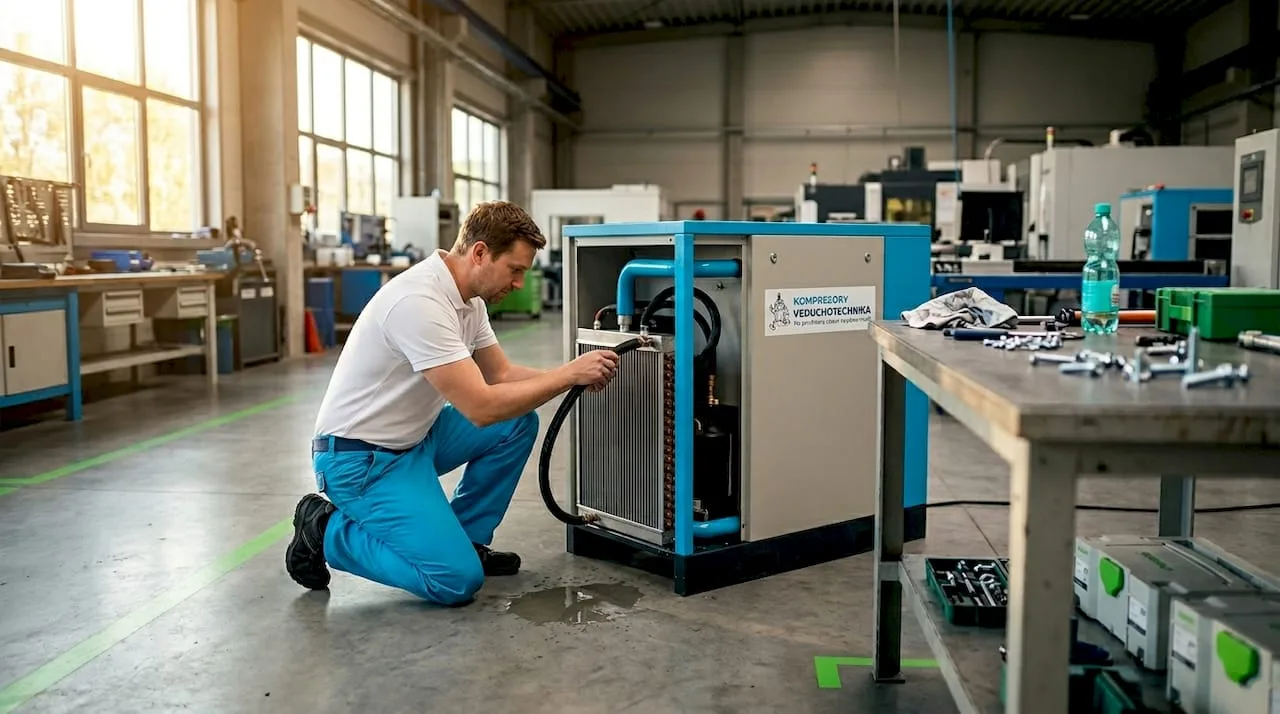
Water cooling is used on compressors of higher output, particularly on multi-cylinder piston and screw machines in industrial operation. The cooling water circulates through the cooler inserts in the compressor and carries the heat away to a cooling tower or to a heat exchanger. The key parameter is the temperature and flow of the cooling water. Water that is too warm or contaminated will not give the cooling sufficient performance.
Liquid (indirect) cooling
Liquid cooling using industrial chillers brings the highest accuracy of control. Precise control of the cooling water temperature in the range of 20 to 30 °C with a tolerance of ±0.3 to ±1 °C is essential, for example, for helium compressors in cryogenic applications. Modern industrial chillers achieve an accuracy of ±0.3 °C, which markedly extends the service life of sensitive compressor systems.
A comparison of cooling methods:
| Cooling method | Typical use | Accuracy of control | Operating costs |
|---|---|---|---|
| Air | Piston compressors up to 22 kW | Low (dependent on the surroundings) | Low |
| Water | Industrial compressors 22 to 200 kW | Medium | Medium |
| Liquid (chiller) | Large industrial systems, cryogenics | High (±0.3 °C) | Higher |
Professional tip: With air cooling in enclosed plant rooms, check the temperature of the ambient air at the fan intake, not the temperature on the room thermostat. An overheated plant room with a temperature of 40 °C can cause overheating even of a compressor that is otherwise in perfect condition.

The modern approach to cooling goes beyond the compressor itself. Integrating cooling with the power supply and the control of the system is the key to maximum efficiency and return on the investment. On screw compressors with a frequency inverter this means coordinating the speed of the cooler fan with the current heat output, which reduces the energy consumed for cooling by up to 20%.
The effects of poor compressor cooling
Insufficient cooling does not cause overheating alone. It sets off a cascade of problems that show up gradually and in various parts of the system. Technicians unfamiliar with this causal chain often repair the symptoms instead of the cause.
The most common consequences of insufficient cooling:
-
Carbonisation of the oil. At temperatures above 100 °C the molecules of the oil break down and form solid carbon deposits. These block the oil ways, the valves and the filters. The compressor gradually loses lubrication without the oil level in the tank dropping.
-
A false diagnosis of refrigerant overheating. Overheating of the refrigerant may be false when there is a refrigerant leak and the compressor is compressing liquid instead of vapour. The result is rapid mechanical wear even though the temperature sensors show no alarm. This error in diagnosis is, according to experience from the operation of heat pumps, one of the most common causes of compressor wreckage.
-
Loss of lubrication owing to a refrigerant leak. A refrigerant leak leads to the loss of the oil that circulates together with the refrigerant in the circuit. If the pipework is not correctly sized, the oil does not return to the compressor and dry compression occurs.
-
Mechanical failure of the compressor. The combination of carbonisation of the oil, dry running and extreme heat leads to seizure of the pistons or rotors. A damaged compressor motor requires a thorough cleaning of the whole circuit before a new unit is installed, including the removal of acidity and corrosion using a burn-out filter. Without this step, even a new compressor will fail within a shortened time.
-
Increased operating costs. An overheated compressor works with lower efficiency, consumes more electrical energy and produces less compressed air. More information on how the output of a compressor affects the overall cost of operation can be found in a separate article.
Professional tip: If a technician diagnoses overheating of the compressor, first verify the condition and the quantity of refrigerant or oil in the system. A lack of lubrication is often the consequence of a refrigerant leak, not of a direct fault in the lubrication system. Confusing these causes makes the repair more expensive and does not solve the problem.
How to cool a compressor correctly and optimise its operation
Optimising the cooling of a compressor is not a one-off action. It is a continuous process that includes the right setup at installation, regular monitoring and planned preventive maintenance.
Key principles for correct cooling:
-
Keep to the operating temperature ranges. Most industrial compressors are designed for an ambient temperature of 5 to 40 °C. The temperature of the discharge air at the outlet of the cooler should not exceed 40 °C on screw compressors. Watching these values is the basis of correct cooling.
-
Clean the cooling surfaces regularly. A dusty environment blocks the fins of air coolers and reduces their performance by tens of percent. Monthly cleaning with compressed air or a brush is the minimum standard for air cooling.
-
Check the flow and quality of the cooling water. With water cooling, monitor the flow, the temperature at the inlet and outlet of the cooler and check the hardness of the water regularly. Limescale deposits reduce heat transfer and can drive the system into overheating.
-
Track the temperatures using a data logger or the control system. Modern screw compressors are fitted as standard with temperature sensors at the discharge, in the oil circuit and at the outlet of the cooler. Connecting the data to an industrial control system makes it possible to detect trends before a failure occurs.
-
Integrate the cooling with the frequency inverter. On compressors with variable speed, match the output of the cooler fan to the current load. This achieves energy savings while maintaining optimal temperature conditions.
-
Plan the replacement of oil filters and oil according to the thermal load, not just according to the hourly cycle. A compressor run in a hot environment or at a high load needs its oil changed sooner than the interval recommended by the manufacturer says.
Cooling and the service life of a compressor are directly linked. A correctly set up and maintained cooling system extends the service life of the compressor by years and dramatically reduces the likelihood of unplanned shutdowns. See also the overview of the most common mistakes in operation that shorten the service life of compressors.
A view from service practice
In my experience the greatest problem is that technicians approach cooling as a passive part of the system. They check whether the fan turns, whether the water flows, and if so they close the problem. That is a mistaken approach.
I have seen dozens of compressors that failed even though the cooling system formally worked. The fan turned, the water flowed. But the water flow was 30% below the design value because of a blocked filter on the inlet. Or the air cooler was clogged with dust deposits from the production hall, which reduced the heat transfer by half. You only come across these insidious problems when you measure the real operating parameters and compare them with the design values.
The second thing that is often forgotten in practice: cooling and the service life of a compressor are a linked system. Badly set up cooling need not cause a failure immediately. It shortens the service life of the compressor by 30 to 50% and increases the energy consumption without your noticing. A regular energy audit and thermal imaging of the cooling surfaces once a year are investments with a demonstrable return.
For experienced technicians: do not forget the influence of the installation conditions on the cooling. A compressor placed in the corner of a plant room without free air circulation, or with the warmed air from the cooler recirculating back into the fan intake, will never reach its design output regardless of how good the machine itself is.
— Zdeněk
Kompresory-vzduchotechnika: solutions for reliable cooling
Correct cooling starts with choosing a compressor designed for your operating conditions. Kompresory-vzduchotechnika offers a complete range for industrial and workshop use with an emphasis on thermal reliability and low operating costs.
For continuous industrial operation, screw compressors for continuous operation with an integrated cooling system and thermal management are suitable. For applications where the cleanliness of the air matters as much as reliable cooling without the risk of contamination by oil, oil-free ABAC Super Silent OS compressors are available. Kompresory-vzduchotechnika also provides expert technical advice on choosing the cooling configuration, sizing the accessories and setting the service intervals with regard to the customer’s specific operating conditions. The product team is available for B2B consultations and for individual technical requirements.
FAQ
What causes a compressor to overheat?
Overheating of a compressor is most often caused by clogged or undersized cooling, a high ambient temperature, a lack of oil or refrigerant and carbon deposits in the cooling circuit. Overheating may also be false when there is a refrigerant leak.
How does cooling affect the energy consumption of a compressor?
Poor cooling raises the temperature of the compressed medium, which increases the power input needed to reach the required pressure. Properly functioning cooling keeps the operating point of the compressor in the region of highest efficiency and so reduces operating costs.
How often is the cooling system of a compressor cleaned?
Air coolers should be cleaned at least once a month in a dusty environment, and once a quarter under standard conditions. Water circuits require a check of the flow and the water quality at least twice a year, with the charge replaced according to a chemical analysis.
What is the correct temperature range for running a compressor?
The temperature of the ambient air with air cooling should not exceed 40 °C. The discharge temperature of the oil on screw compressors ideally lies between 70 and 95 °C. For precise cryogenic applications, control of the cooling water in the range of 20 to 30 °C with a tolerance of ±1 °C is recommended.
Does the whole circuit have to be cleaned after a compressor wreck?
Yes. After damage to a compressor it is necessary to clean the whole circuit of acidity, corrosion and carbon residues using a burn-out filter. Without this step, the new compressor risks failing quickly from the same cause.
Recommended
- Why quiet compressor running is key to efficient work - Kompresory-Vzduchotechnika.cz
- Avoid the most common mistakes when using compressors - Kompresory-Vzduchotechnika.cz
- The working principle of the piston compressor for efficient operation - Kompresory-Vzduchotechnika.cz
- Examples of compressor use: a guide for the workshop and production - Kompresory-Vzduchotechnika.cz