

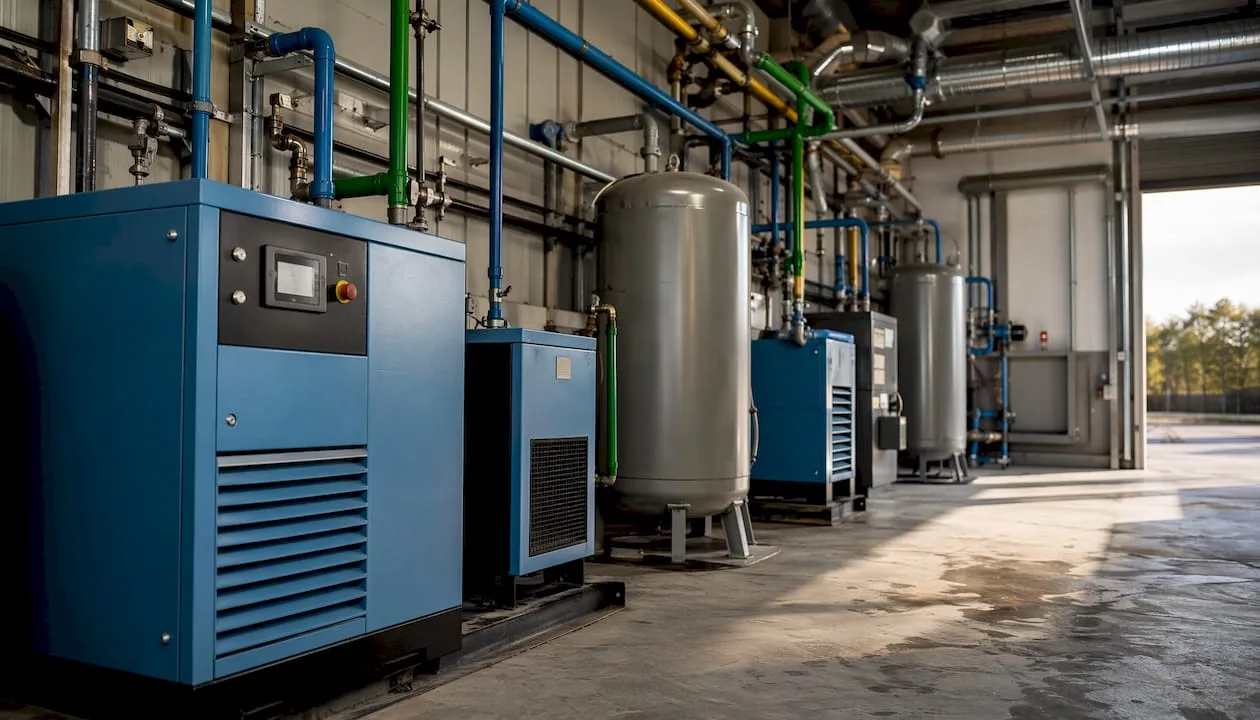
In brief:
- Proper ventilation of the compressor room maintains a temperature of 18–27 °C and humidity of 40–60%, which is key for the long service life of the equipment. Inadequate climate control leads to overheating, corrosion and higher energy consumption. Correct placement of openings, fan selection and regular maintenance are essential for efficient operation.
Proper ventilation of the compressor room is defined as the controlled supply of fresh air and removal of heat so that the room temperature stays within the range of 18–27 °C and the relative humidity at a level of 40–60%. These parameters directly determine how efficiently the compressor works and how long it lasts without a serious failure. Overheated or humid air shortens the service life of filters, oils and mechanical components. Technicians who underestimate ventilation end up dealing with costly repairs where it would have been enough to properly design the air paths from the start. This guide describes specific technical measures that ensure stable and reliable operation of the compressor room.
How to properly ventilate a compressor room: optimal climatic conditions
The temperature in the compressor room must stay within the range of 18–27 °C and the humidity at 40–60%. These values are not indicative recommendations; they are operating limits whose exceeding has a direct impact on the performance and wear of the equipment.
Exceeding the upper temperature limit increases the compressor's power consumption, because the machine has to compress warmer and less dense air. The result is higher energy consumption at lower output. Conversely, too low a temperature, especially during the winter months, causes moisture condensation inside the air tank and piping, which accelerates corrosion.
Humidity above 60% accelerates the degradation of compressor oil and shortens the service life of air filters. Cleanliness and climate stability significantly affect the service life of filters and components. A filter clogged with moisture and impurities increases the pressure drop, which directly translates into higher energy consumption.
A stable environment in the compressor room is not a luxury. It is a basic condition for the equipment to work according to the manufacturer's specifications and for service intervals to correspond to the planned schedule.
Impacts of an unstable environment on operation
- Temperature above 27 °C: higher power consumption, risk of compressor thermal protection, shortened oil service life
- Temperature below 18 °C: moisture condensation, corrosion of the air tank and piping, starting problems in frost
- Humidity above 60%: faster filter clogging, oil degradation, corrosion of internal components
- Humidity below 40%: increased risk of electrostatic discharge for sensitive control units
How to ensure proper air flow in the compressor room?
Proper air flow in the compressor room depends on the placement of the intake and exhaust openings. Intake openings positioned low draw in cooler air near the floor, while exhaust openings positioned high remove heated air outside. This arrangement takes advantage of the natural physical properties of air and minimizes the energy demands of ventilation.
A key problem is flow short-circuiting. This occurs when the intake and exhaust openings are located close to each other or on the same side of the building. The compressor then draws in air that has just been heated and expelled. Underestimating flow short-circuiting leads to the intake of heated air and reduces the efficiency of the entire system.
The exhaust ductwork must be as short as possible, with a minimum number of bends. Each 90° bend increases the pressure drop that the fan must overcome. If the length of the exhaust ductwork exceeds several meters, the fan's output must be recalculated to cover the resulting resistance.
Professional tip: When renovating an existing compressor room, first visualize the air flow using a smoke test or thermal imaging. This will reveal locations where warm air accumulates, allowing you to design modifications with minimal structural intervention.
Principles for proper placement of openings
- Intake openings: place at the lowest possible height, ideally 0.3–0.5 m above the floor, on the side facing away from the exhaust
- Exhaust openings: place as high as possible, preferably under the roof or at roof level
- Distance between the intake and exhaust openings: as large as possible, ideally on opposite sides of the room
- Protective grilles: fit with filter inserts to prevent dust and insects from entering
- Check valves on the exhaust: prevent the backflow of cold air in winter when the fan is shut down
What type of fan should you choose for ventilating a compressor room?
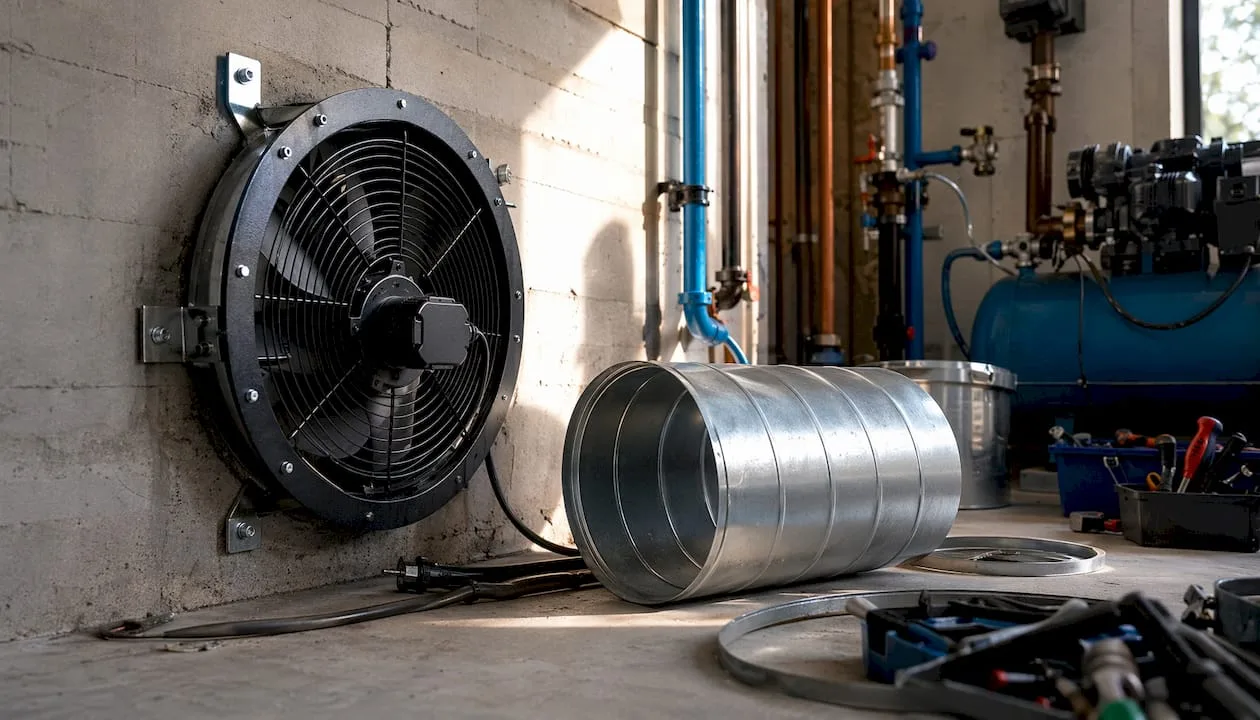
The choice of fan depends on the nature of the air ducting. Axial fans are suitable for open spaces with low pressure resistance, while radial fans are suitable for ducting systems where air has to travel longer distances and pass through more fittings. Mixing up these two types leads to under-sizing or over-sizing the ventilation.
An axial fan installed directly in a wall opening is the simplest and cheapest solution. It works reliably where the exhaust opening leads directly outside without ducting. As soon as the air needs to be routed through ducting longer than 1–2 m or through several bends, an axial fan is not sufficient and a radial design must be used instead.
Fans with an alarm output are essential in continuous 24/7 operation. The alarm output signals motor failure or bearing overheating before ventilation failure occurs and the compressor subsequently overheats. This function is standard in industrial installations and should not be missing even in smaller operations with continuous running.

Professional tip: Always size the ventilation for the maximum expected summer temperature, not the annual average. Under-sizing the ventilation leads to inefficient cooling precisely when the thermal load is highest.
Comparison of axial and radial fans
| Parameter | Axial fan | Radial fan |
|---|---|---|
| Pressure resistance | Low | High |
| Suitable use | Wall opening, short run | Ducting system, longer run |
| Noise level | Lower | Higher |
| Acquisition costs | Lower | Higher |
| Alarm output | Optional | Standard on industrial types |
Implementation and maintenance of the ventilation system in the compressor room
A properly designed ventilation system requires regular maintenance, otherwise its performance gradually declines. Overpressure in the room and poor ventilation maintenance increase operating costs and the risk of equipment damage. The maintenance plan must be part of the compressor room's operational documentation from the first day of operation.
Procedure for installing or modifying ventilation:
- Heat load calculation: Add up the power input of all compressors and other heat sources in the room. The result determines the minimum required air flow capacity of the ventilation in m³/h.
- Opening placement design: Mark the position of the intake and exhaust openings on the floor plan. Verify that the distance between them is maximum and that there is no risk of flow short-circuiting.
- Fan selection: Based on the length and shaping of the exhaust ducting, choose an axial or radial type. Add a capacity reserve of at least 20% for summer operation.
- Sensor installation: Place temperature and humidity sensors in the center of the room, outside the direct reach of the compressor's intake opening. A sensor placed in a stream of cold air gives distorted readings.
- Control setup: Connect the sensors to the fan controller. Set the fan's activation temperature so that it starts before the temperature exceeds 25 °C.
- Regular filter cleaning: Clean or replace the filters on the intake openings according to the manufacturer's instructions, but at least every three months. A clogged filter reduces air flow and increases pressure resistance.
- Flow inspection: Once a year, check the actual air flow with an anemometer. A drop in flow below the designed value indicates clogged filters or a fan malfunction.
- Value logging: Keep an operating log with monthly records of temperature, humidity, and filter condition. A rising temperature trend at the same ventilation setting will warn of a problem before it manifests as a failure.
Regular diagnostics of the compressor room, including checking the ventilation system, is the most reliable way to prevent unplanned downtime.
Typical ventilation mistakes in compressor rooms and how to avoid them
Improper placement of intake and exhaust openings is the most common cause of compressor room overheating. Technicians make this mistake during renovations, when they rely on existing structural openings instead of designing a new layout based on the physical principles of air flow.
Lack of regular inspections and monitoring continuously reduces system reliability. Neglected ventilation does not show up immediately. The room temperature rises gradually, the compressor switches into thermal protection more and more often, and only then does the technician find out that the filters have not been cleaned for a year and a half.
Overview of the most common mistakes:
- Flow short-circuit: intake and exhaust openings on the same wall or too close to each other; solution: relocate one of the openings or install directional deflectors
- Undersized fan: the fan output corresponds to the average temperature, not the summer maximum; solution: recalculate and replace with a stronger type or add a second fan
- Missing filters on intake openings: dust and dirt settle on the compressor's cooling fins; solution: fit filter inserts of class G3 or G4
- Absence of an alarm system: a fan failure goes unnoticed until the compressor overheats; solution: install a fan with an alarm output or add a temperature alarm
- Incorrect sensor placement: a sensor in the cold air stream shows a lower temperature than the actual room temperature; solution: relocate the sensor to the center of the space
An overview of the most common mistakes in compressor operation shows that ventilation is one of the three most frequently underestimated areas.
Key findings
Proper ventilation of the compressor room requires a combination of correctly placed openings, a correctly sized fan, and regular maintenance, and neglecting any one of these three elements leads to overheating and a shortened service life of the equipment.
| Point | Details |
|---|---|
| Temperature and humidity range | Maintain a temperature of 18–27 °C and humidity of 40–60% for optimal compressor operation. |
| Opening placement | Place intake openings low, exhaust openings high, and on the opposite side of the room. |
| Fan selection | Axial type for direct wall openings, radial for duct systems with higher resistance. |
| Sizing for maximum conditions | Design ventilation for the summer temperature peak, not for the average annual temperature. |
| Regular maintenance | Clean filters at least every three months and keep an operating log with measured values. |
Practical experience: what really determines ventilation quality
Over years of working with compressor rooms of various sizes, I have found that the biggest problems do not arise from a lack of knowledge of principles, but from compromises made during implementation. The technician knows that the intake opening should be low, but the builder says there is a load-bearing wall there. The result is an opening at the wrong height and a compressor that overheats in July.
The second thing that repeatedly surprises me is the absence of monitoring. A compressor room without a temperature alarm is like a car without an oil warning light. You keep driving until it breaks down. Installing a simple temperature sensor with an alarm costs a fraction of the price of a single compressor repair after overheating.
Personally, I recommend taking a thermal image of the compressor room after the first summer of operation with every new installation or reconstruction. A thermal camera shows exactly where warm air accumulates and where airflow is insufficient. This information is more valuable than any desk-based calculation. The correct basic requirements for a compressor room are a foundation, but operational reality always brings details that no manual covers.
— Zdeněk
Compressors and expert support from Kompresory-vzduchotechnika
A well-designed compressor room ventilation system only makes sense if it is backed by a reliable compressor. Kompresory-vzduchotechnika offers SCR screw compressors for industrial operations, where the demands for stable temperature and continuous operation are highest.
The Kompresory-vzduchotechnika team provides technical consultations on equipment selection as well as on the design of the compressor room ventilation system. If you are dealing with the reconstruction of an existing compressor room or planning a new installation, our expert support includes an assessment of the spatial conditions, fan recommendations, and a review of the project documentation. Contact us directly through the website and describe your operation. We will respond with specific technical recommendations, not a generic offer.
Frequently Asked Questions
What is the optimal temperature for a compressor room?
The optimal temperature in a compressor room is 18–27 °C. Exceeding the upper limit increases the compressor's power input and shortens the oil's service life.
How to prevent air short-circuiting?
Place the intake and exhaust openings on opposite sides of the room and as far apart as possible. Airflow short-circuiting occurs when the compressor draws in air that has just been blown out.
When should a radial fan be chosen instead of an axial one?
Choose a radial fan whenever the exhaust ducting exceeds a length of 1–2 m or includes multiple bends. An axial fan will not achieve the required airflow in such a system.
How often should the filters on the compressor room intake openings be cleaned?
Clean or replace the filters at least every three months. In dusty environments, shorten the interval to six weeks and monitor the pressure drop across the filter as an indicator of clogging.
Why is temperature monitoring in the compressor room necessary?
A temperature alarm detects a fan failure or filter clogging before the compressor goes into thermal protection. Without monitoring, you will only discover the problem during an unplanned shutdown.
Recommended
- Basic requirements for a compressor room: guide 2026 - Kompresory-Vzduchotechnika.cz
- Checklist of accessories for compressors: a guide for technicians - Kompresory-Vzduchotechnika.cz
- The significance of the compression stage: a guide for technicians - Kompresory-Vzduchotechnika.cz
- Compressor bleeding procedure: a guide for technicians - Kompresory-Vzduchotechnika.cz